-
-
Curio
-
Market Research Survey Results
Project Demo Youtube Link: (https://youtu.be/QALnLcPjHkQ )
Describe your project (max 150 words) Curio is a low-pressure social app designed to help younger and older generations connect through short, shared daily prompts. Users answer one prompt daily, such as, “What song are you into right now?”, and post it as a short note visible to others. Over time, these answers build a personal story on user’s profiles, allowing all generations to learn about one another in a quick, easy way.
Curio focuses on removing the awkwardness and pressure from cross-generational communication. Instead of forcing long conversations, it provides small, meaningful moments of connection through shared questions. Privacy is built into the experience as well, with accounts being private by default and users to send and accept friend requests before messaging.
By turning everyday curiosity into an easy habit, Curio creates a space where differences become opportunities for connection and understanding across all generations.
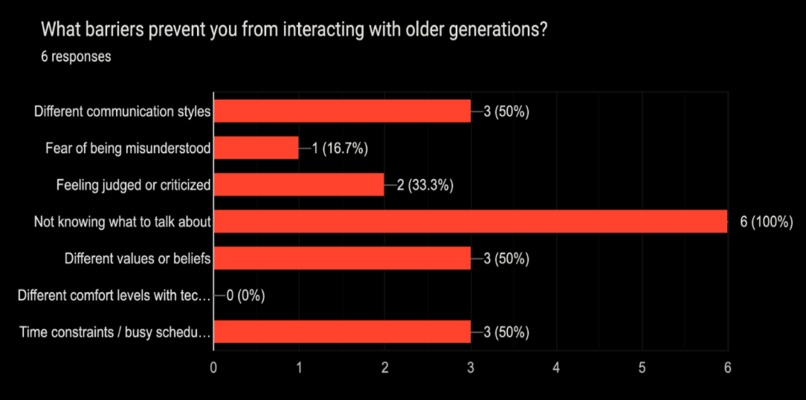
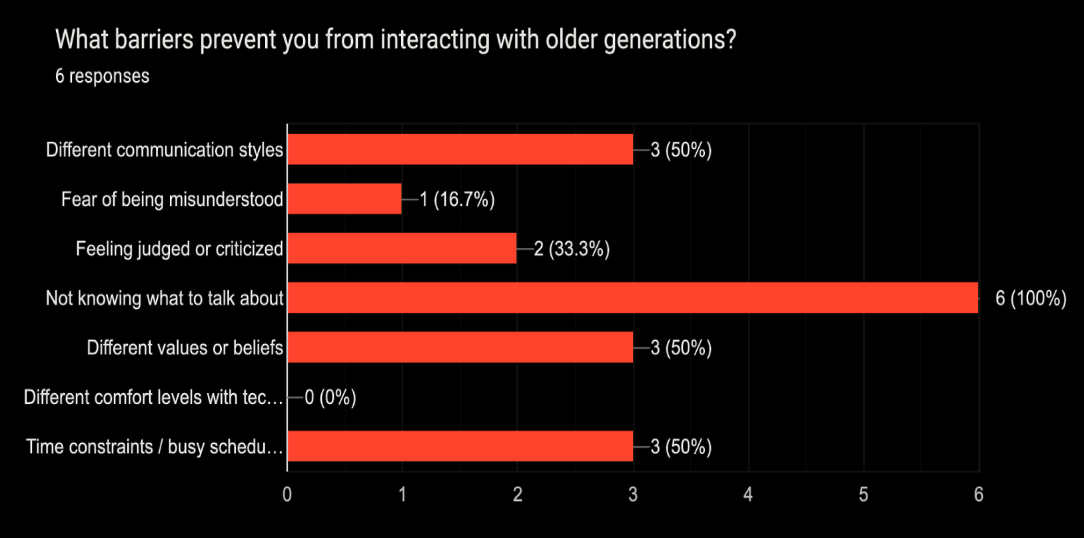
Describe your research process and findings. (Max 500 words) We started our project by conducting both primary and secondary research to understand why cross-generational communication can be hard. Our primary research included a survey of 6 people and interviews with 2 participants from different age groups (ranging from Gen Z to Baby Boomers). The survey asked about how people share their daily lives, how often they interact with other generations, what makes those interactions uncomfortable, and what would make communication feel more meaningful. (Survey) Our interviews explored similar topics in more depth, focusing on what makes conversations feel meaningful versus awkward.
From this research, we identified three major types of barriers:
Emotional Barriers
Younger participants described interactions as awkward or not relatable, while older participants shared experiences of feeling misunderstood. Both groups expressed having a hard time understanding values, slang, and humor as it doesn’t translate well. Trust between generations was normal, showing openness to connect but also caution. These findings aligned with intergenerational communication research showing that misunderstandings and stereotypes increase anxiety between age groups (Pettigrew & Tropp, 2006; intergenerational contact theory).
Practical Barriers
Participants reported not knowing what to talk about and having different communication styles. Language gaps were common, like younger people using slang that older generations can’t understand, and older generations expressing experiences younger users can’t relate to. This reflects broader platform usage differences identified by Pew Research Center, showing social media use varies by age group, causing generations to occupy different digital spaces (Pew Research Center, “Social Media Use by Age”).
Cultural Barriers
Different values, beliefs, and expectations about what is appropriate to share made conversations uncomfortable. Each generation follows different social norms, which can cause misunderstandings. This matches findings from workplace and communication studies that show generational differences in expectations and values shape how people interpret conversations.
We also conducted secondary research using sources such as Pew Research Center, AARP, and Nielsen Norman Group. Pew Research Center reports that while older adults increasingly use social platforms, their usage patterns differ from younger users, proving the lack of a shared communication space across generations (Pew Research Center, 2025). AARP research shows that older adults value technology but are more cautious about privacy and confidence when using new platforms (AARP Technology Trends). Nielsen Norman Group identifies usability challenges for older adults, including the need for simple navigation, readable text, and low cognitive load (Nielsen Norman Group, “Usability for Senior Citizens”).
This research validated and informed our design in Curio. The daily question feature solves the problem of not knowing what to talk about. Short notes keep sharing personal but not overly intimate and uncomfortable. Profile histories build trust over time. Private accounts and friend-only messaging address safety and comfort concerns identified in both our primary research and AARP’s findings on privacy and confidence. All in all, these features reflect our research insight that people want connection but need a structured, low-pressure way to achieve it.
- Describe your most important design decisions. What research findings and/or user testing results led you to make these decisions? (Max 500 words)
Curio’s most important design decisions center on reducing conversational anxiety and creating a low-pressure, human way for different generations to connect through everyday storytelling. Our primary research showed that people across generations already interact regularly—mainly through family and work—but struggle to find comfortable, relatable topics to talk about. Younger participants described conversations with older generations as awkward due to lack of shared context, while older participants expressed uncertainty around what to talk about, unfamiliar slang, and fear of saying the “wrong thing.” Notably, 100% of users surveyed said they did not know what to talk about with older generations, and 50% cited time constraints and communication differences as barriers to interaction. These findings led to our core design decision: one daily, bite-sized prompt. By offering a single prompt per day, Curio removes topic anxiety and lowers the cognitive load of initiating conversation. Short responses and notes allow users to share meaningfully without oversharing, aligning with research showing that trust builds through personal—but not overly intimate—disclosure over time.
Curio Stand-out Designs: We intentionally designed Curio to be private by default, allowing users to control who they interact with and requiring mutual connection before direct messaging. This decision was informed by both user testing and secondary research highlighting older adults’ heightened privacy concerns and fear of making mistakes online (AARP Technology Trends). Structured, consent-based interaction also aligns with research showing that guided intergenerational contact reduces anxiety and negative stereotypes.
Another key decision was removing likes, follower counts, and public metrics. Desk research on social media engagement suggests that visible feedback mechanisms increase performativity and social pressure, often discouraging authentic expression. By eliminating public evaluation, Curio prioritizes reflection and genuine conversation over attention-seeking behavior.
Features like age-range selection, a calendar view of past entries, and a streak-based habit system were shaped by testing with six users. Participants consistently expressed admiration for older generations’ lived experiences and younger generations’ energy and openness. Curio’s design enables users to explore these perspectives gradually, fostering understanding through small, consistent moments of shared curiosity.
Overall,the minimal, warm visual design—including the envelope logo with a sun opening from the center—reinforces Curio’s purpose: “Open a little, learn a lot.” The envelope signals a personal message, while the sun represents a new day and a new perspective. This metaphor supports an opening animation that feels intentional, human, and inviting.
- If applicable, describe how you utilized AI in your design process in detail. Please explain where AI fit into your workflow, which tools you used, and the specific purpose AI served at that stage. Include a concrete example of how AI influenced a design decision. (Max 500 words)
AI played a supportive role throughout our design process, particularly in helping us move efficiently from idea to execution as beginner designers. After attending Kelly Truong’s workshop, we explored Figma’s AI capabilities—including Figma Make, smart animation, and AI-assisted component generation—to overcome the initial learning curve and prototype Curio effectively.
Early in the process, we used AI to help structure our workflow. By prompting AI with our design-a-thon brief, we generated a clear project roadmap outlining each phase: problem definition, primary and secondary research, ideation, prototyping, and testing. This ensured we stayed focused on the core problem—intergenerational communication—rather than feature creep. AI also supported our research synthesis. After conducting user interviews and surveys, we used AI to help identify recurring themes such as topic anxiety, privacy concerns, and discomfort with performative social media. These insights directly influenced decisions like limiting interaction to one prompt per day and removing likes and follower metrics. Within Figma, AI tools helped us rapidly generate initial layout variations and animations, allowing us to test multiple visual directions before refining our final design. For example, AI-assisted prototyping enabled us to experiment with the ‘Smart Animation’ feature to reveal the envelope-opening on launch. Seeing how users emotionally responded to the prompt reveal in a positive and surprised interaction helped us confirm the envelope as a strong metaphor for personal storytelling and discovery.
Importantly, AI did not replace our creativity, but expanded it. We treated AI as a collaborator for speed and iteration, while using our unique creative storytelling and final decisions. By balancing AI efficiency with intentional team discussion, we were able to address the generation gap problem at its core and deliver Curio as a thoughtful, research-driven storytelling experience.
CITATIONS:
Bridging Interactions Across Generation Gaps (Responses. “Bridging Interactions across Generation Gaps (Responses).” Google Docs, 2019, docs.google.com/spreadsheets/d/1BUleclFB3dMYjA9ZofFlefhz7cKUPfByiZVB36DOyjI/edit?usp=sharing. Accessed 1 Feb. 2026. Brittne Kakulla. 2026 Tech Trends and Adults 50-Plus. 5 Dec. 2025, www.aarp.org/pri/topics/technology/internet-media-devices/2026-technology-trends-older-adults/?msockid=0cc99eba6145649a14d18cb060dc6522, https://doi.org/10.26419/res.01020.001. Gottfried, Jeffrey, et al. Americans’ Social Media Use 2025 Growing Shares of U.S. Adults Say They Are Using Instagram, TikTok, WhatsApp and Reddit, but YouTube Still Rises to the Top for MEDIA or OTHER INQUIRIES. Kane, Lexie. “Usability for Older Adults: Challenges and Changes.” Nielsen Norman Group, 8 Sept. 2019, www.nngroup.com/articles/usability-for-senior-citizens/?utm_source. Accessed 1 Feb. 2026. Pettigrew, Thomas F., and Linda R. Tropp. “A Meta-Analytic Test of Intergroup Contact Theory.” Journal of Personality and Social Psychology, vol. 90, no. 5, 2006, pp. 751–783, https://doi.org/10.1037/0022-3514.90.5.751. Sandstrom, Gillian M., et al. “Talking to Strangers: A Week-Long Intervention Reduces Psychological Barriers to Social Connection.” Journal of Experimental Social Psychology, vol. 102, no. 104356, Sept. 2022, p. 104356, www.sciencedirect.com/science/article/pii/S0022103122000750, https://doi.org/10.1016/j.jesp.2022.104356. Smith, Aaron, and Monica Anderson. “Social Media Use in 2018.” Pew Research Center: Internet, Science & Tech, 2018, www.pewresearch.org/internet/2018/03/01/social-media-use-in-2018/.
Built With
- figma

Log in or sign up for Devpost to join the conversation.