
Inspiration
When we first heard about this project, we were inspired to help those in need, especially individuals who receive hospice care and face great difficulty navigating technology finding doctors in a timely manner. With grandparents and older relatives of our own, many in a completely different country, we were well-aware of their struggles with access to reliable medical services, as well as their lack of experience or familiarity with technology. They were a generation who preferred simple conversation to complex digital tools and frustrating setbacks - a generation at their most vulnerable in terms of age and health, in need of direct guidance now more than ever. Thus blossomed the idea of implementing an AI chatbot and voicebot as the main features of our app, offering both a typical digital tool for younger generations who preferred text and an audible conversation tool that’s much more accessible to older generations who may struggle with screens for various reasons.
What it does
Our project focuses on utilizing a chatbot and an AI voicebot patients can converse with for medical help in times of need - especially in moments of peak worry, when a medical expert can’t be reached or simply isn’t worth reaching. With Curio, patients can type their health concerns in the chat and ask questions, or speak to an AI voice assistant for guidance. They can describe specific symptoms, receive in-depth information about particular conditions and diagnoses, and request details about medical providers, stores, and resources nearby or online.
How we built it
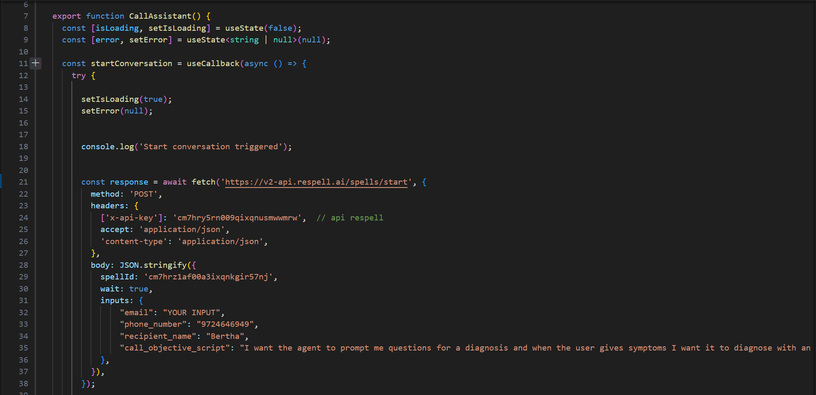
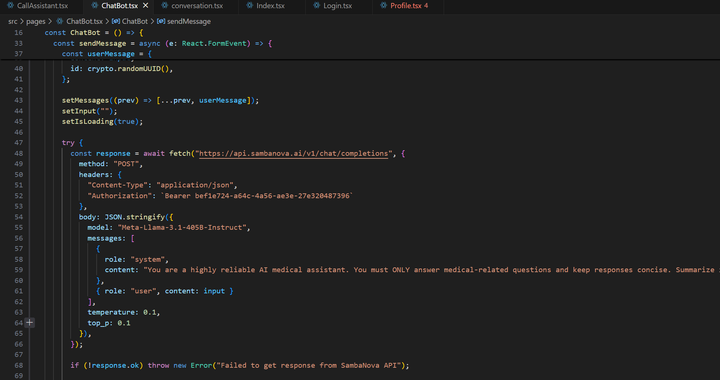
We began by brainstorming the core features of our app while simultaneously ensuring we stuck to the given challenge of incorporating AI/ML into predictive healthcare for an easy-to-use software accessible from home. Once ideas were jotted and a general consensus was reached, we divvied up the work and delegated tasks according to our strong suits; the front-end developers took on the role of creating a rough framework for the apps components while assisting with research for AI APIs and medical databases those AIs could be trained on, while the back-end developers trained the models and focused on testing implementation of the chosen voicebot AI and chatbot AI APIs into various platforms. After lengthy testing, errors, and successes, we chose to proceed with a React.js-based web app that implemented the AIs and stuck with JavaScript/TypeScript, which were languages we were fairly familiar with. Things began to properly progress slowly but steadily - an AI voicebot was acquired, the database was selected, the AI was trained, a cohesive design scheme was chosen, the APIs were implemented, UI elements were coded and customized, and our idea began to truly come to life.
Challenges we ran into
We ran into several challenges related to the development of code as well as finding a way to incorporate an AI voicebot into the system. For instance, finding an effective way to create the back-end and frontend took several hours of brainstorming. Additionally, finding a reliable AI voice chat was a hindrance as finding such a tool took a lot of time and integrating this tool with programming took several attempts. There was also the matter of selecting platforms that worked best with the APIs as each language and type of app resulted in different interactions. However, we were able to accomplish all of the following with learning more about certain tools and collaborating as a team.
Accomplishments that we're proud of
We are glad that we were able to develop a project that allows individuals to receive the general help with the use of AI where their questions are answered immediately. It was very vindicating seeing rough concepts of pages and elements appear on the screen with concrete designs, cohesive themes, and actual functionality. This feeling was further magnified with the success of our chatbot and voicebot when we managed to carry a conversation with it for the first time, receiving real-time input on listed symptoms and concerns to emulate a realistic doctor-patient conversation. It was an incredibly stressful and tense time, so simply having a product we can present and call ours is our greatest pride at the end of the day.
What we learned
Throughout this hackathon, we have many valuable lessons such as how back-end and front-end code work together, the power of AI voice chat, and the importance of time management. We learned of the importance of reading through documentation and API guides for AIs, languages, UI elements, and any software tool in general, alongside the best methods of seeking guidance for complicated installation processes or illegible code. The importance of debugging after every change was another point we came to realize as well, facing difficulties with coding entire environments only for them to take ages to come to light with a sea of errors. But most of all, we learned the necessity of experimenting with various programming and design tools on our own time purely for educational purposes to widen our knowledge of resources and better understand what best works in different scenarios. The lack of early preparation, research, and planning in regards to the tools we’d use is what resulted in our biggest frustrations throughout this event, and it’s something we’ll be sure to prioritize next time.
What's next for Curio
We hope to keep developing the app to make it much stronger than what has already been created. We would like to add other features that would incorporate AI into the design and allow it to be useful to the common people. A lot of training and humanization of the AI is to be done as well to greatly elevate the patient’s experience with the chatbot/voicebot, especially when it comes to catering to their needs, and we’d certainly want to better flesh out ideas of updating physicians, keeping track of symptoms, and analyzing possible future risks.
Built With
- chatgpt
- figma
- gemini
- javascript
- react.js
- sambanova
- supabass
- twilio
- typescript


Log in or sign up for Devpost to join the conversation.