-
-

Curio start page
-
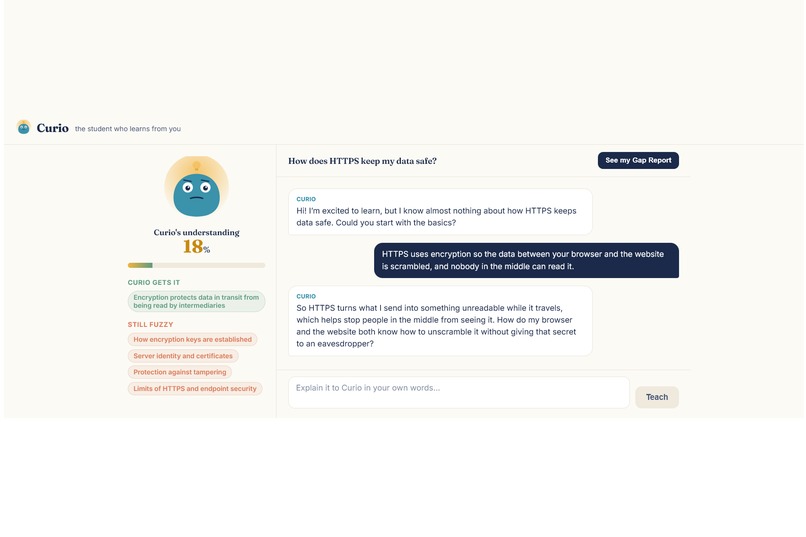
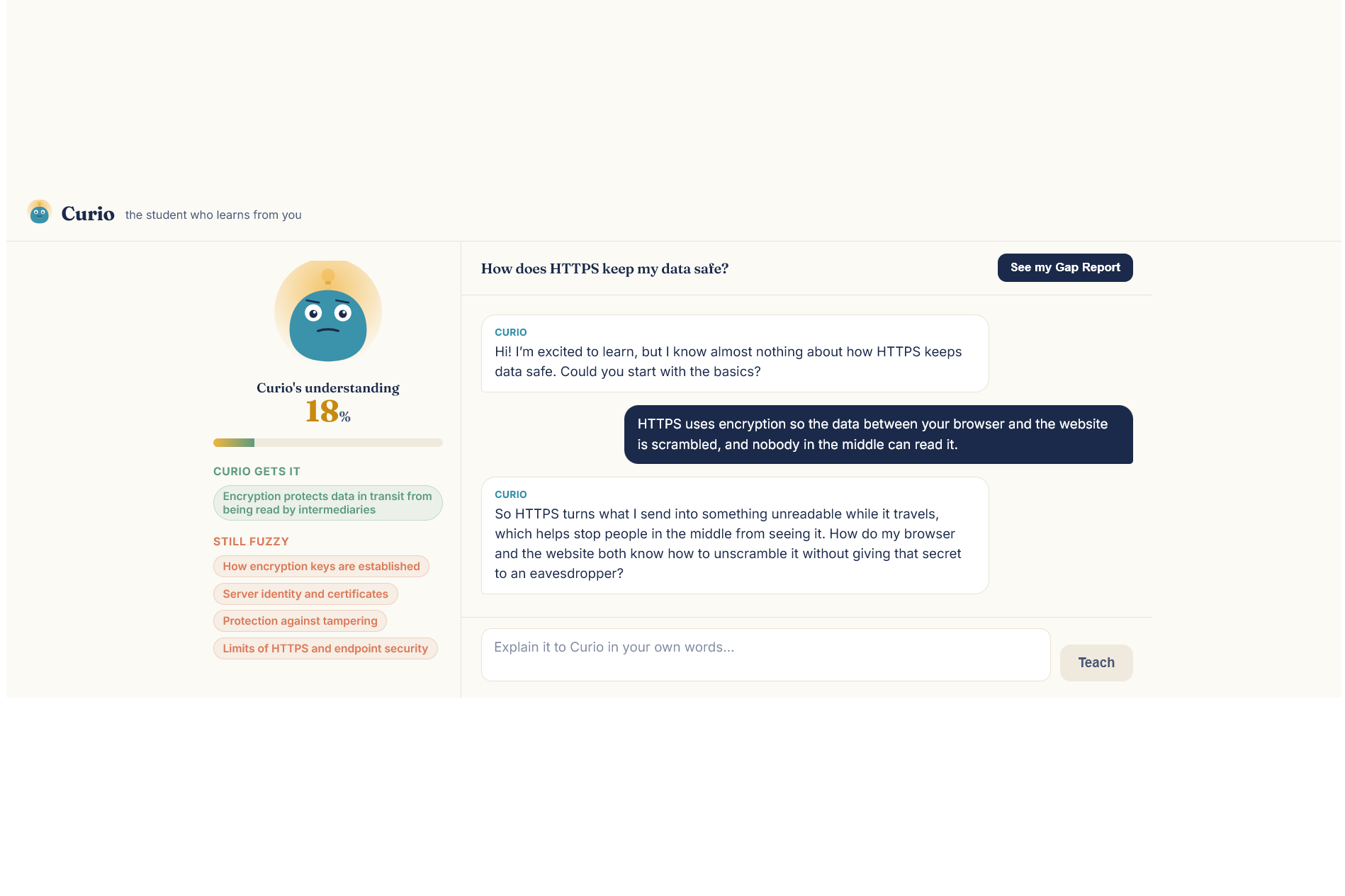
Curio teaching screenshot
-
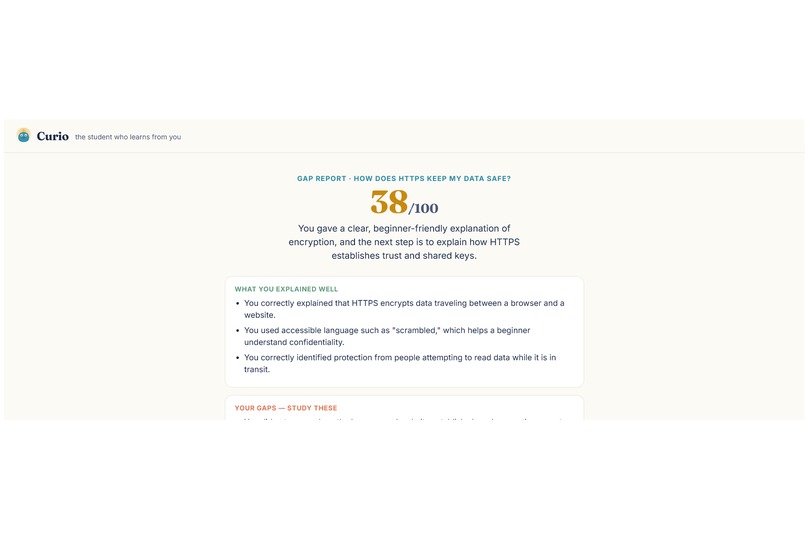
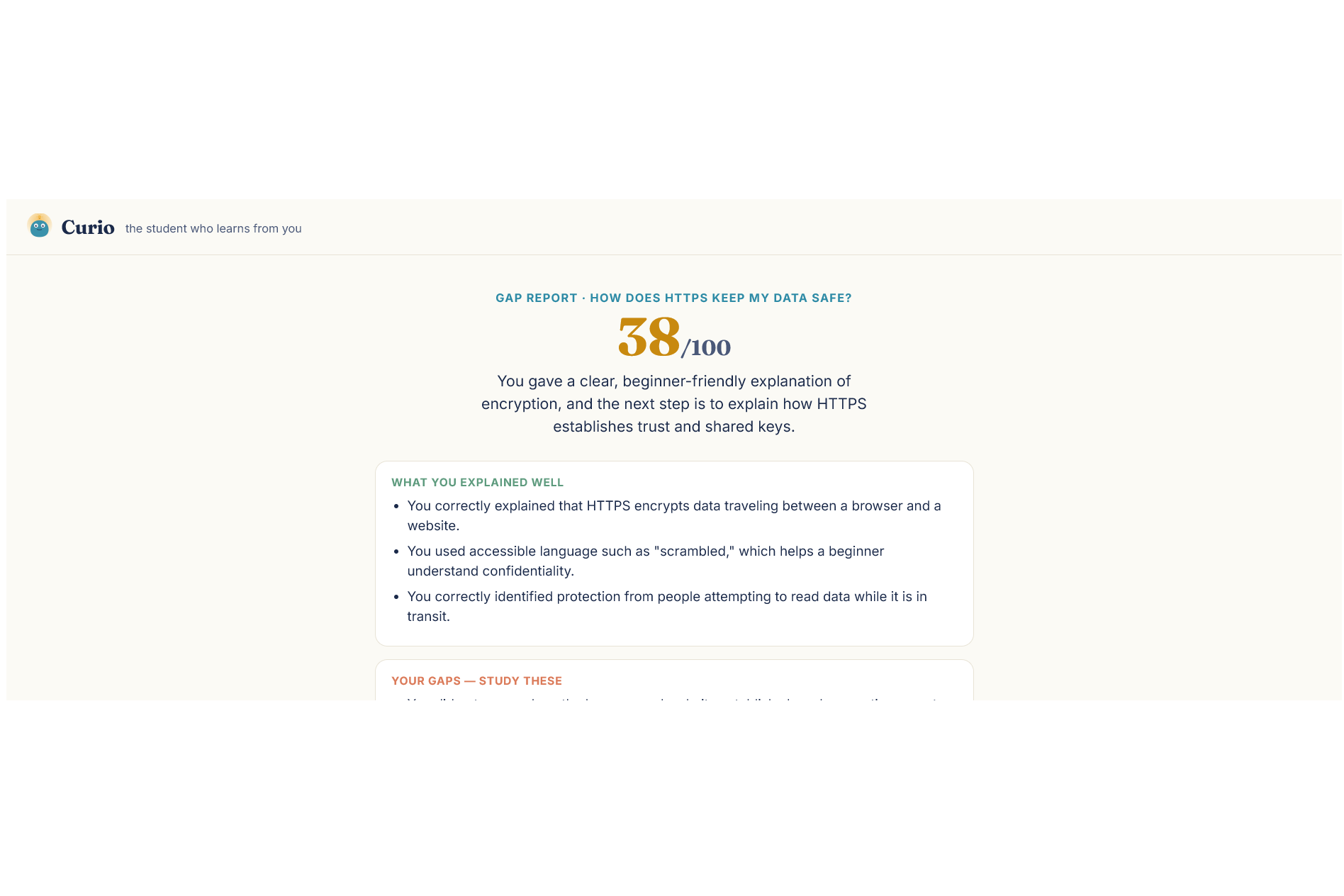
Curio gap report

Inspiration
The best way to learn something is to teach it. But you can’t teach an empty room and you can’t see your own blindspots. This project was inspired by the desire to arm any learner with a patient student that exposes their own blindspots for them to learn from.
What it does
Curio is an AI student that you teach. Pick a topic and explain it to Curio in your own words. Curio will respond as a real beginner would and you will have to clarify many things for him or her. Curio will even reveal many of the misconceptions that a real beginner would have for that topic. The live meter on the right will show you how well you are doing in getting the idea across to the student. At the end of the session, Curio will produce a Gap Report that lists your strengths, the specific gaps in your knowledge for the topic that you have been studying, flashcards for vocabulary that you don’t know yet, and a quiz on the gaps that you are uncertain about.
How we built it
We built the application using a thin Express.js backend API (single route /api/curio) that calls GPT-5.6 Sol, and a front-end React app built using Vite. The “brains” behind the student and assessment are a few prompt-engineered models that we call the “brains”. The first is the persona prompt for Curio the student, the second is the live-assessment prompt that returns structured JSON of the learner’s understanding score, covered concepts, fuzzy areas where they are uncertain, and whether any of the typical misconceptions were even surface in their explanation. The third is the report prompt that takes the entire transcript and turns it into a report by the coach of the learner. The entire application was built using Codex as the agent, and GPT-5.6 Sol as the model.
How we used Codex and GPT-5.6
- Codex (the agent) built the app: a thin Express.js backend (/api/curio) plus a Vite powered React frontend. All error handling, component construction and prompt pipeline are also handled by the agent. The session ID is on the form for curious users to try out Curio.
- GPT-5.6 Sol (the model): this is the core intelligence of Curio. Here, it is used to generate the Gap Report, and score the student’s understanding turn by turn during the session. It also decides when to surface a student’s misconception, and writes out the session, all of the time staying in character as a curious student of age 14, learning the topic for the first time. We chose Sol for this task as it was by far the warmest and most believable persona in the GPT-5.6 model set, and it also returned a large amount of reliable structured JSON for each turn of assessment.
Challenges we ran into
One of the harder things to get right with Curio was making it so that the student remained a believable beginner, even as it produced an accurate understanding score for the assesment it was driving. We were able to come up with a solution to this problem by splitting out the model’s work into two functions: a hidden, structured assessment of the learner’s work, and an in-character reply to the work that the learner had produced. The JSON returned by the model includes both of these functions, and it is the latter that the learner sees when they are interacting with the system.
What we learned
This is the pedagogy interface, which means the interface is also the assessment. When we drive Curio’s expression and the meter for understanding from the same score then the model’s reasoning becomes visible and thus also becomes trustworthy. That this worked so well for us can likely be attributed to the fact that we were able to implement the whole thing in one evening with the help of Codex. The really great moment was when, unprompted, Curio asked how a browser and server would exchange keys without leaking the secret to third parties. It was clear that the concept actually worked.
What's next
Misconceptions by subject: a pack of curated blind spots for each topic. Spaced repetition on the flashcards generated for each Gap. A teacher dashboard that plots out where the explanations of their students break down.
Built With
- codex
- education
- express.js
- gpt-5.6
- javascript
- node.js
- openai
- react
- vite


Log in or sign up for Devpost to join the conversation.