
Inspiration
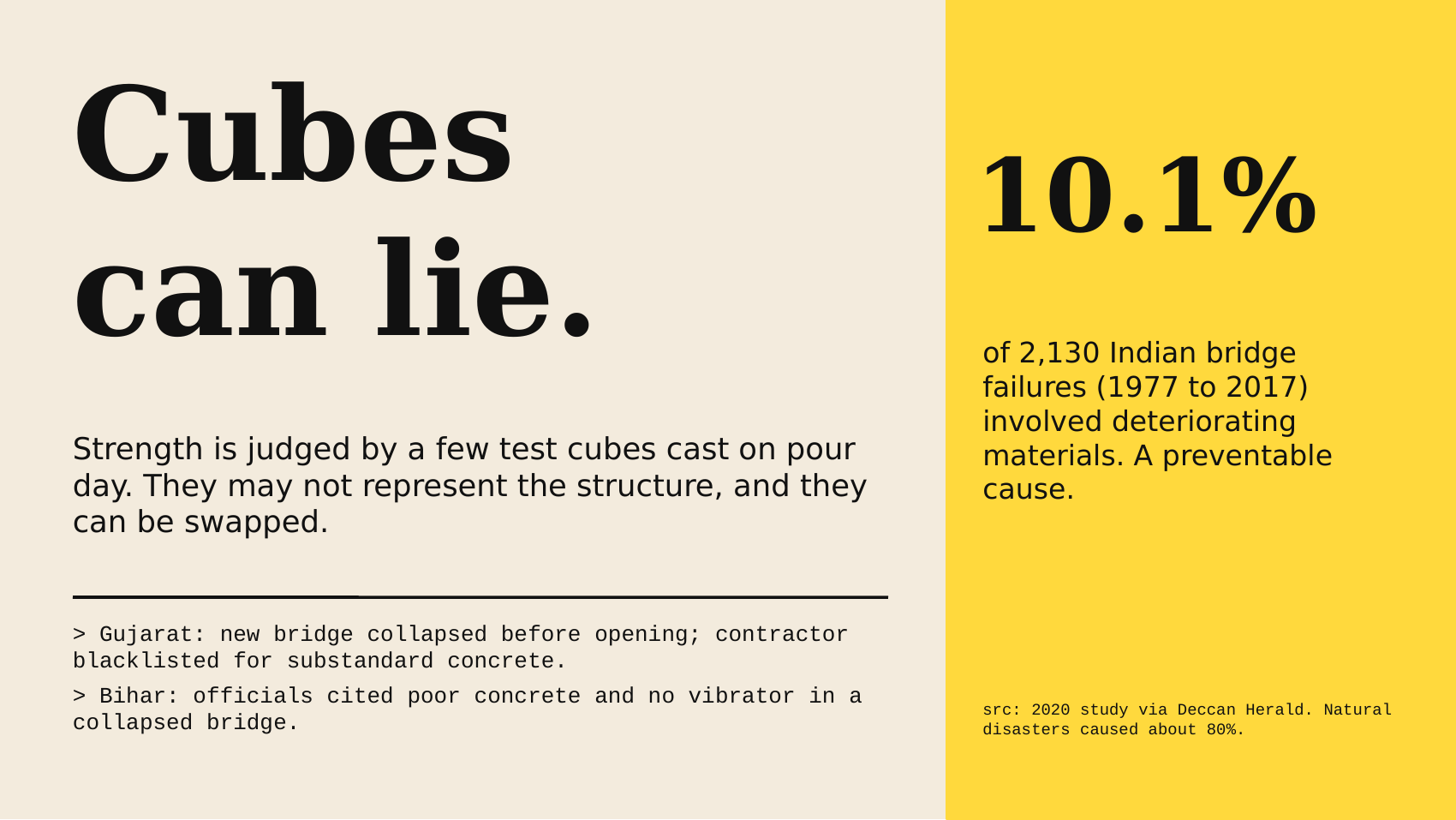
Concrete strength is usually judged by a few small cubes cast on pour day. Those cubes may not represent the structure, and they can be swapped or faked. A 2020 study of Indian bridge failures from 1977 to 2017 found that 2,130 bridges failed, and about 10.1% of cases involved deterioration of materials. Natural disasters caused about 80%, so bad concrete is not the biggest cause, but it is a preventable one. Cases like a new Gujarat bridge that collapsed before opening (the contractor was blacklisted for substandard concrete) made us ask: why can't an ordinary builder cheaply check what is really inside the concrete?
What it does
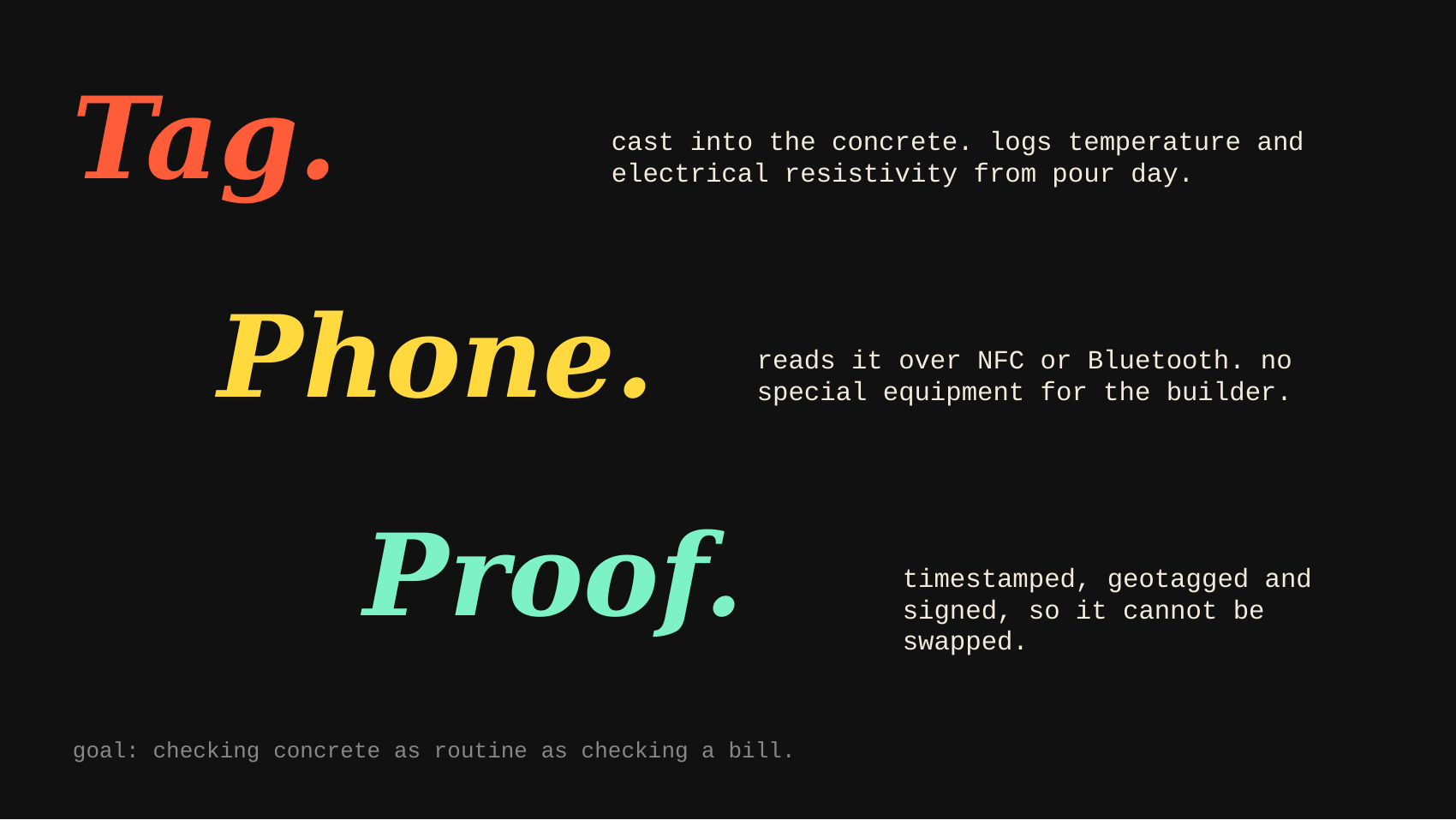
CureCheck is a low-cost tag cast into concrete. It logs two signals from the moment of pouring:
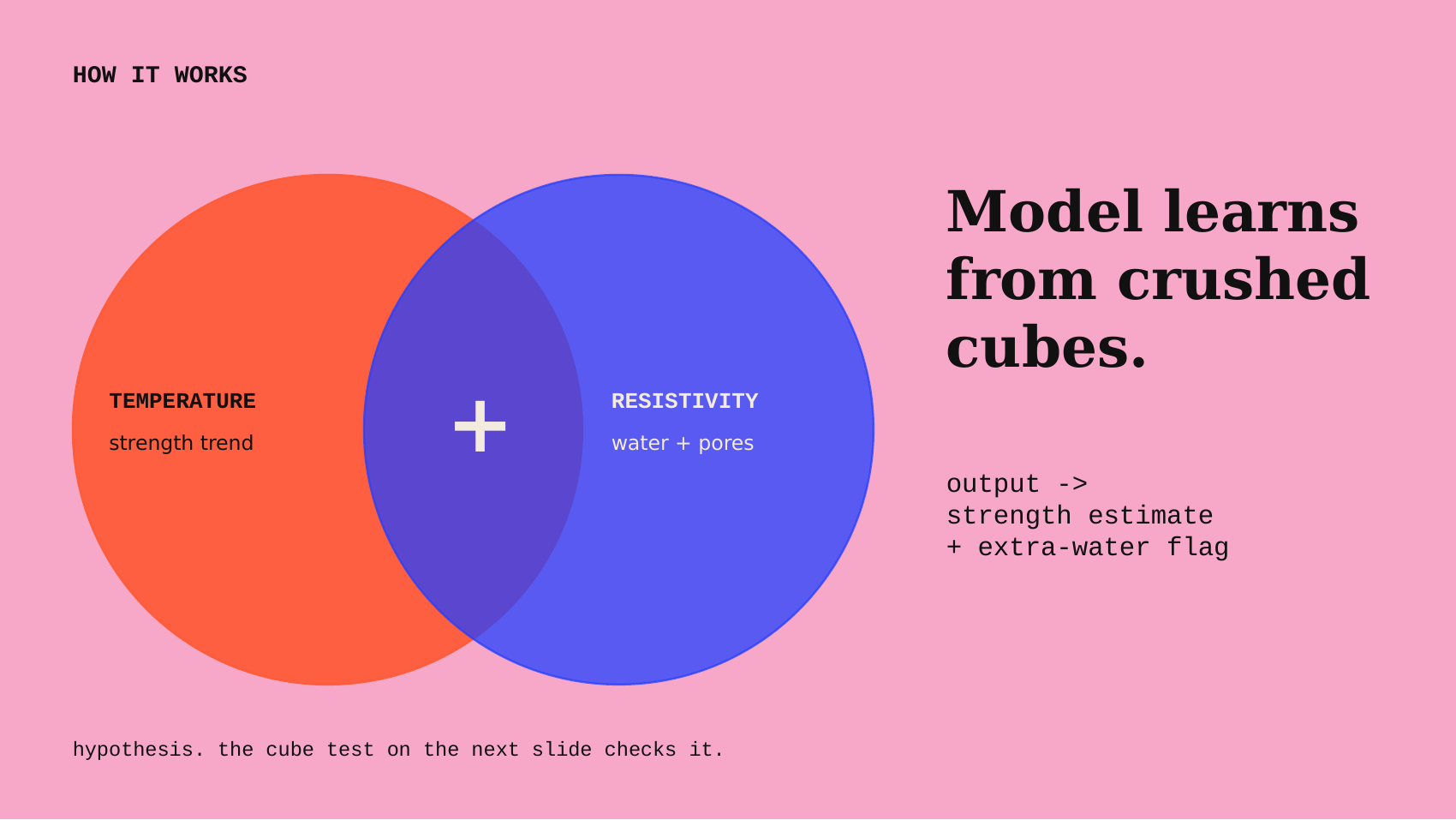
- Temperature, which shows how fast the concrete is gaining strength (the standard maturity method).
- Electrical resistivity, which reflects water content and pore structure, so it can flag extra water added on site.
A phone reads the tag over NFC or Bluetooth. Each reading is timestamped, geotagged and signed, so records can't be swapped like test cubes. A model learns how sensor curves relate to crushed-cube results, and shows a strength estimate and an extra-water flag.
The maturity method estimates strength from the temperature history:
$$M = \sum (T_a - T_0)\,\Delta t$$
where ( T_a ) is the average concrete temperature in each interval, ( T_0 ) is a datum temperature, and ( \Delta t ) is the interval length.
How we built it
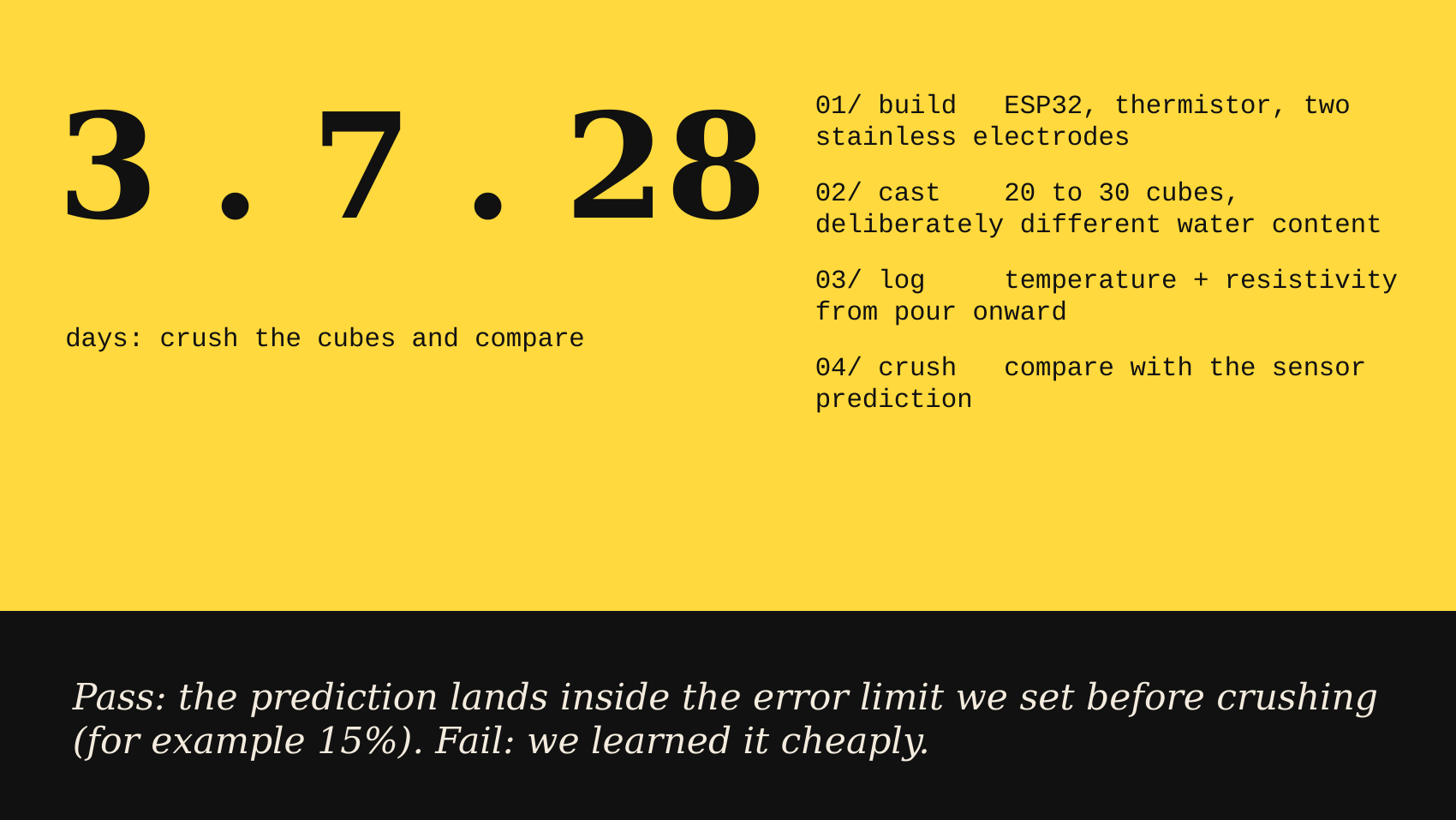
For this ideathon we designed the concept and the test plan. We did not build a working prototype. The plan:
- Build a tag from an ESP32, a thermistor and two stainless electrodes.
- Cast 20 to 30 cubes with deliberately different water content.
- Log temperature and resistivity from pour onward.
- Crush cubes at 3, 7 and 28 days and compare with the sensor's prediction.
We set the pass/fail rule before testing: the prediction must land inside an error limit we choose in advance (for example, 15%).
What we learned
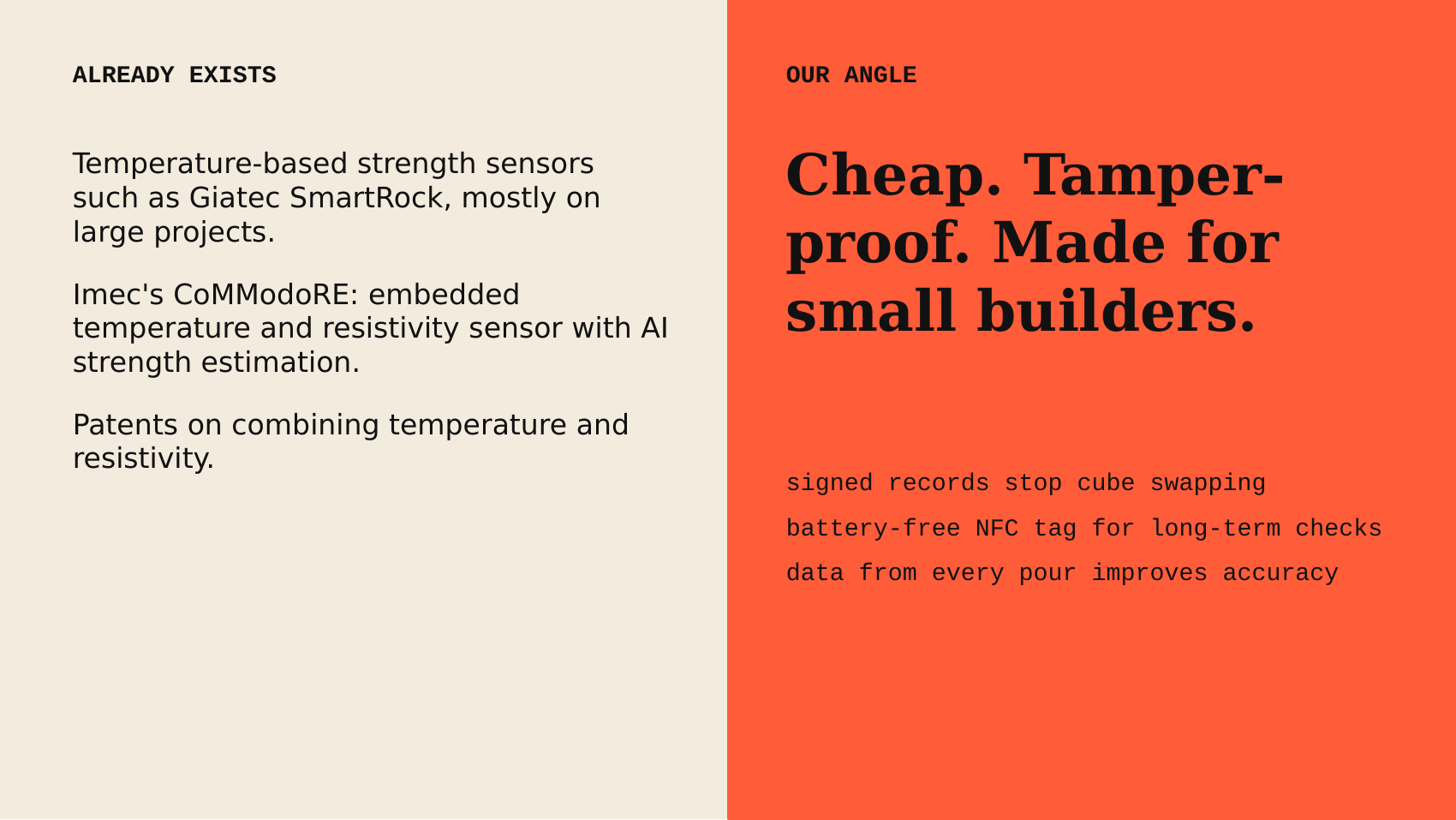
- Temperature-based strength sensors already exist (for example Giatec SmartRock), mostly on large projects.
- Research and patents already combine temperature and resistivity. Imec's CoMModoRE project built an embedded sensor with AI strength estimation.
- So the opportunity is not the sensing idea. It is making something cheap, tamper-proof and usable by small builders.
Challenges
- Resistivity is a proxy for strength, not a direct measurement, so accuracy has to be proven by testing.
- Calibration changes with each concrete mix, so a model needs data from many pours.
- Getting engineers and inspectors to accept a new check takes time and validation.
- Tamper-proofing means the signed record has to be trustworthy end to end.
What's next
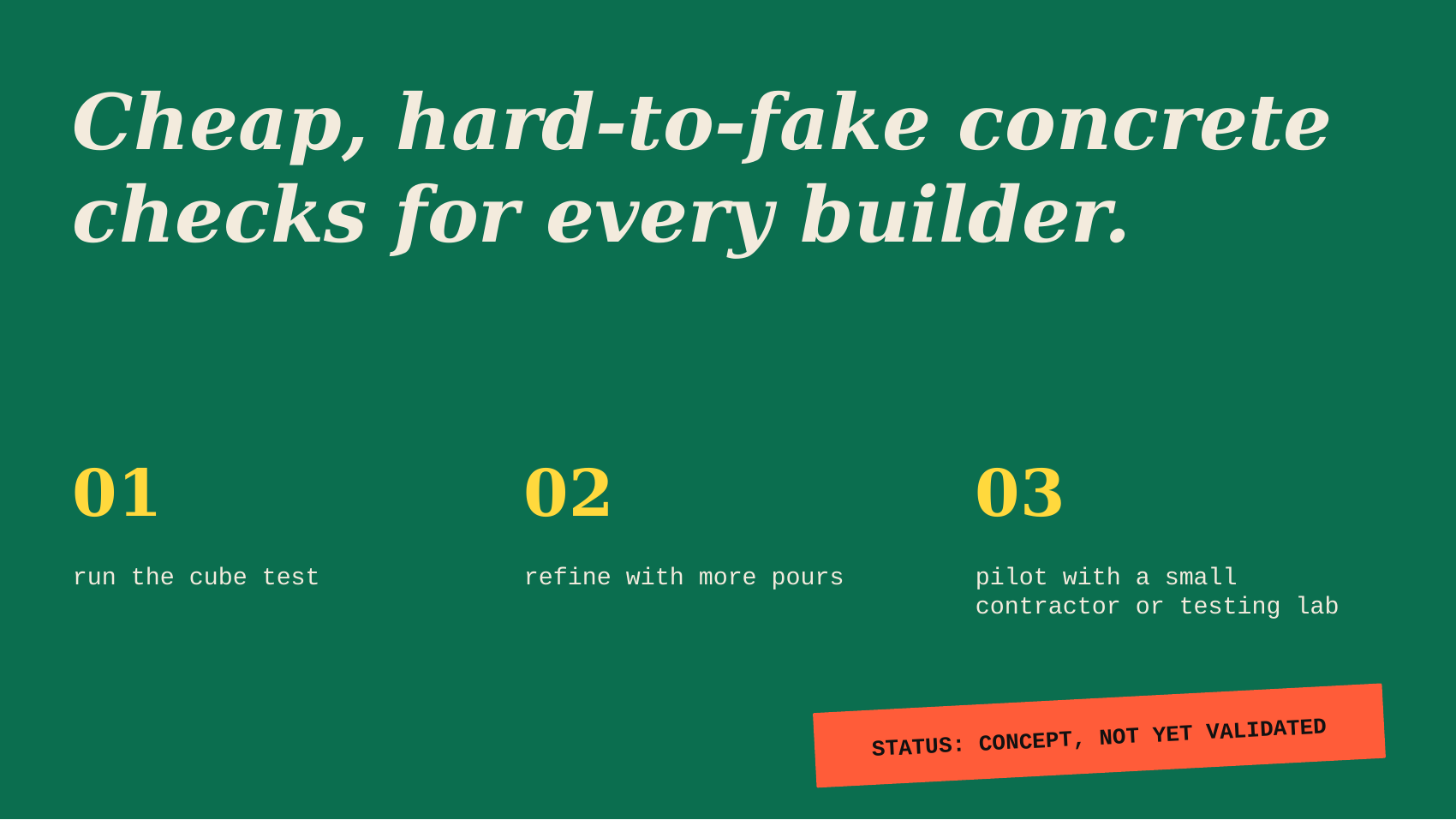
Run the cube experiment, refine the model with more pours, and pilot with a small contractor or testing lab.
Built With
- bluetooth
- esp32
- figma
- nfc
- powerpoint
- python

Log in or sign up for Devpost to join the conversation.