-
-
Anki Study
-
Practice
-
Schedule
-
Study Plan
-
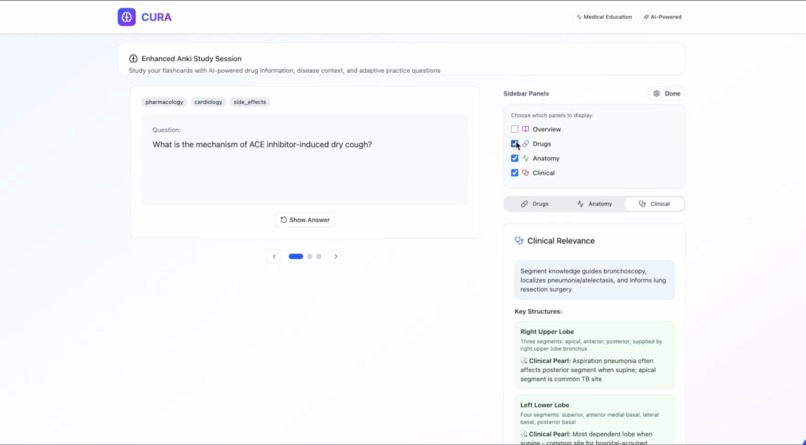
Customizable Sidebar
-
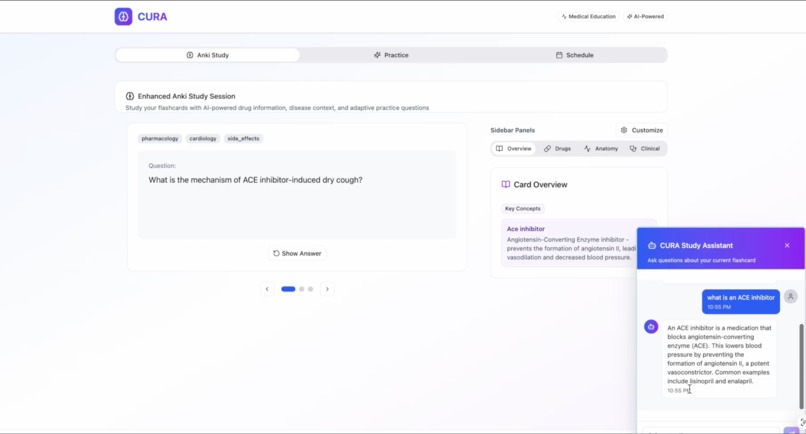
CURA Study Assistant
Inspiration
Medical school is one of the most demanding academic journeys a person can undertake, and the tools students rely on often fall short of what they actually need. We wanted to build something different: an interactive education application that meets students where they are and engages them on a deeply personal level.
To do that, we went straight to the source. We consulted medical professionals who had recently gone through med school and asked them to walk us through their specific pain points while studying. One theme came up again and again: Anki. While Anki's spaced repetition system is powerful, students felt isolated while using it - staring at a question with no context, no clinical connection, and no way to quickly look up the drug or anatomical structure being referenced. They were constantly switching between tabs, textbooks, and YouTube just to understand a single flashcard. CURA was built to fix that.
What it does
CURA is an AI-powered medical study platform with three core modules:
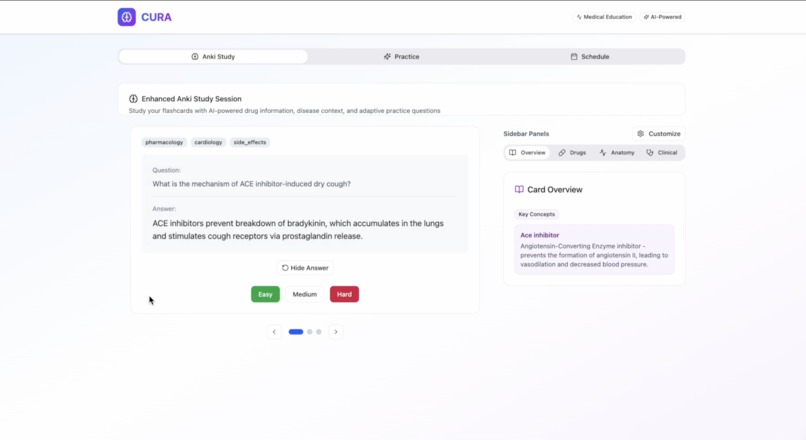
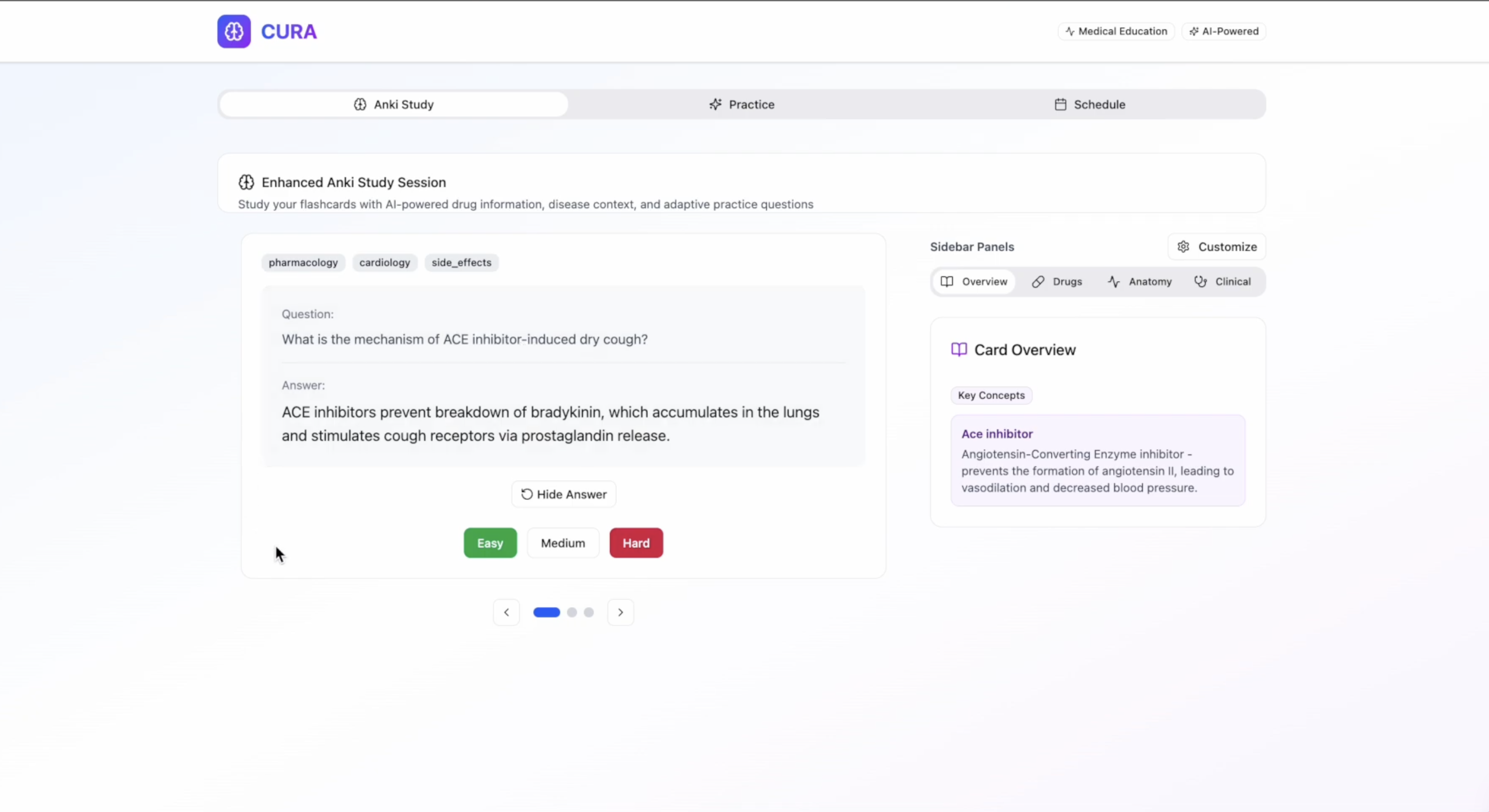
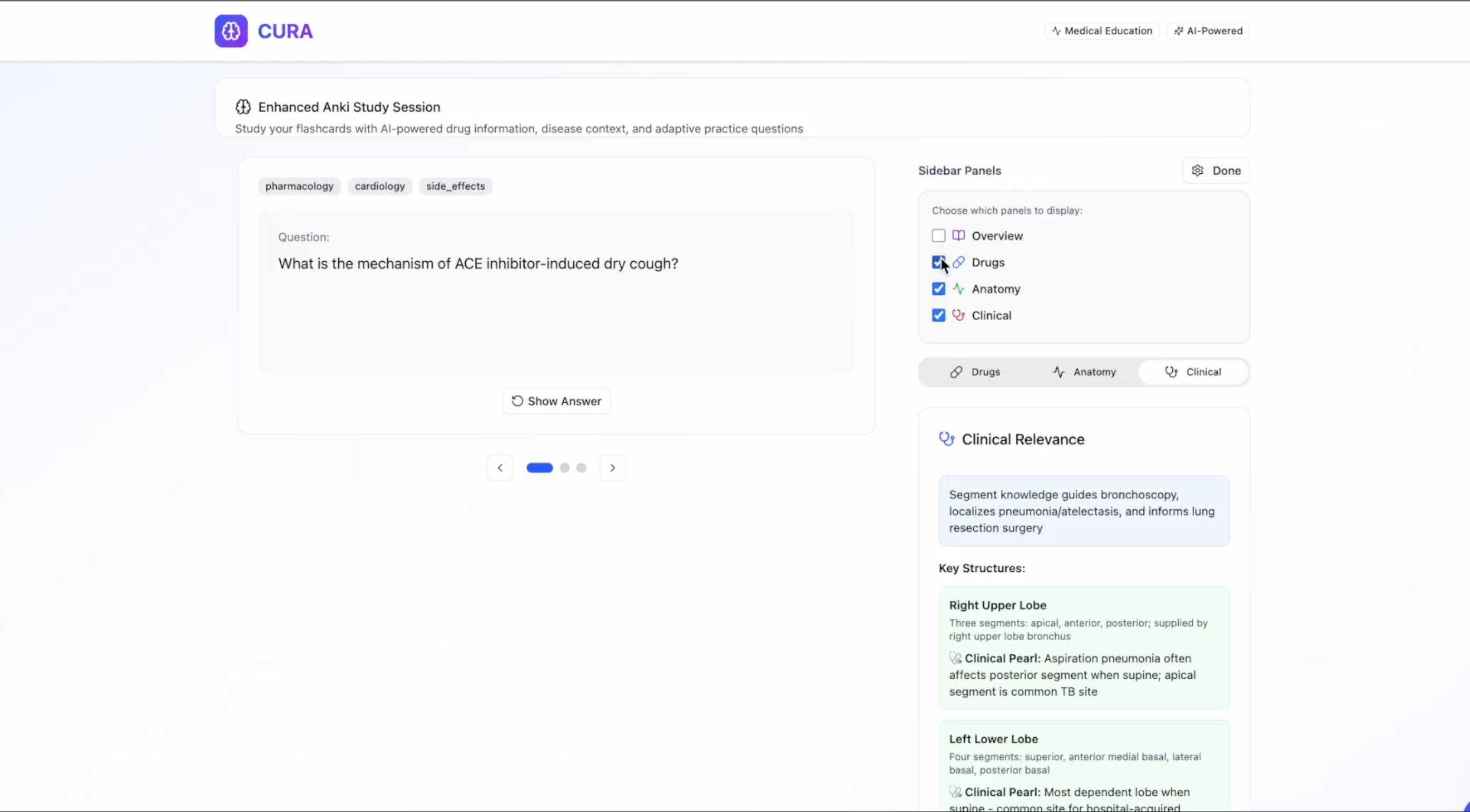
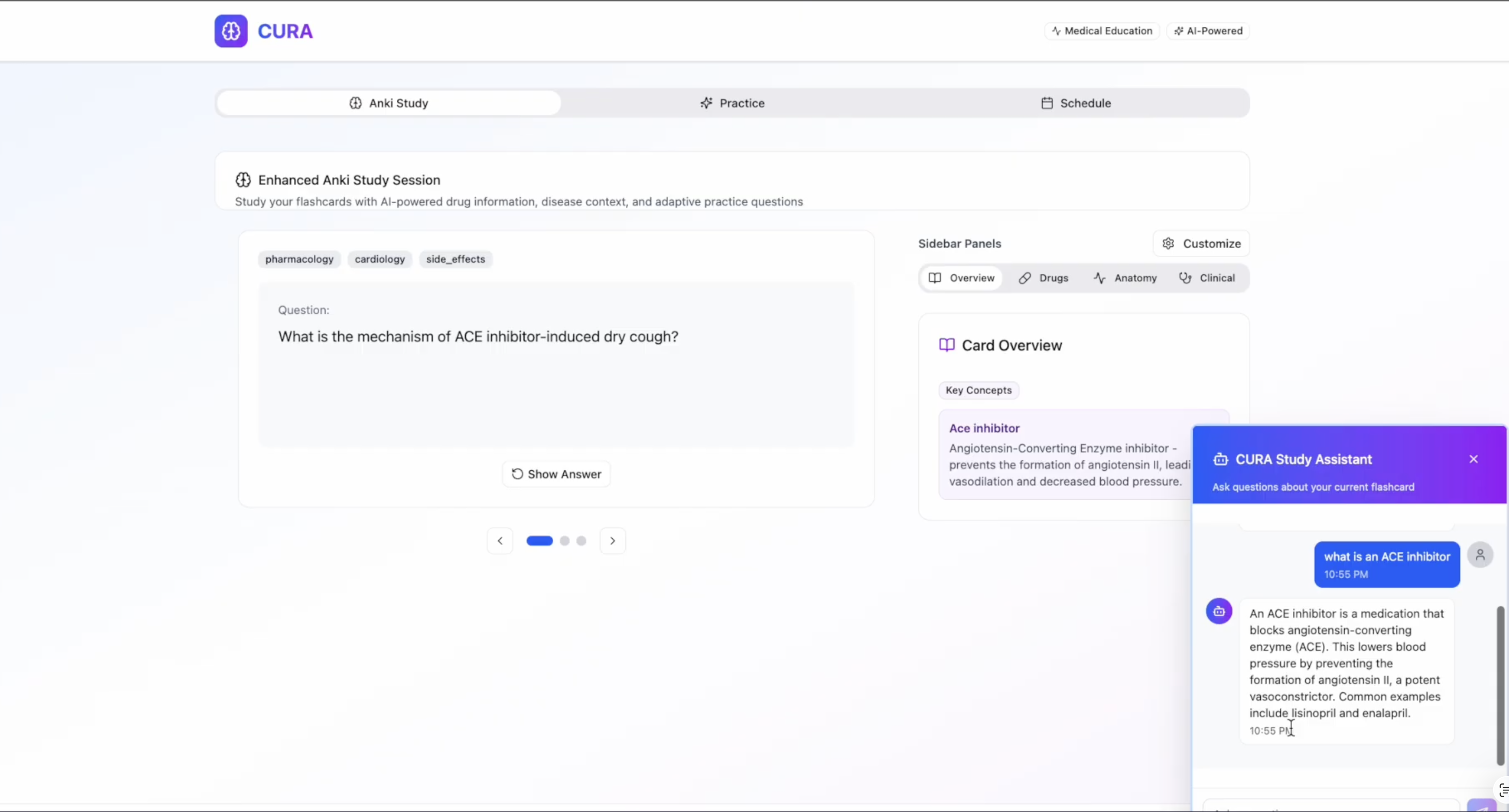
Anki Study Tab: Users bring their Anki flashcards into an enhanced study session. Each card displays the question and answer alongside keyword tags identifying the concepts being tested. After revealing the answer, students can rate their confidence as Easy, Medium, or Hard to guide spaced repetition. The real power, however, lives in the customizable sidebar:
- Card Overview: defines and explains key concepts related to the current flashcard
- Drugs: surfaces detailed pharmacological information for any drug mentioned, including Generic Name, Mechanism of Action, Indications, Contraindications, Adverse Effects, Dosage, and Drug Interactions
- Anatomy: renders interactive anatomical diagrams of relevant structures; users can hover over components to highlight and explore them
- Clinical Relevance: contextualizes key structures and concepts in real-world clinical scenarios, explaining why something matters in practice
Users can fully customize which sidebar panels are visible, so they see exactly as much, or as little supplemental information as they want.
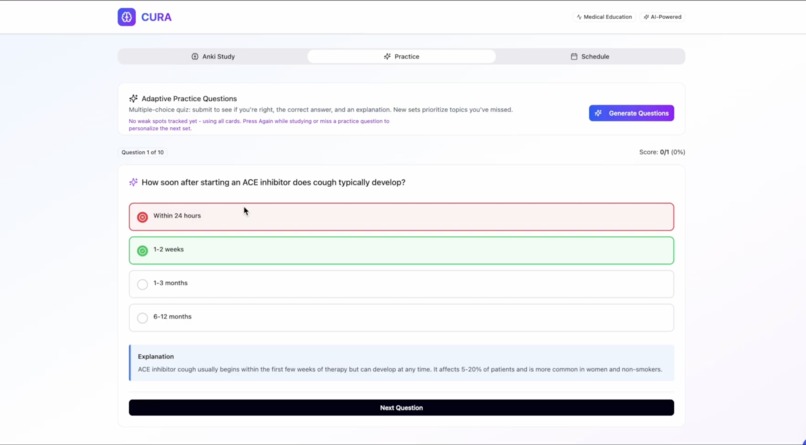
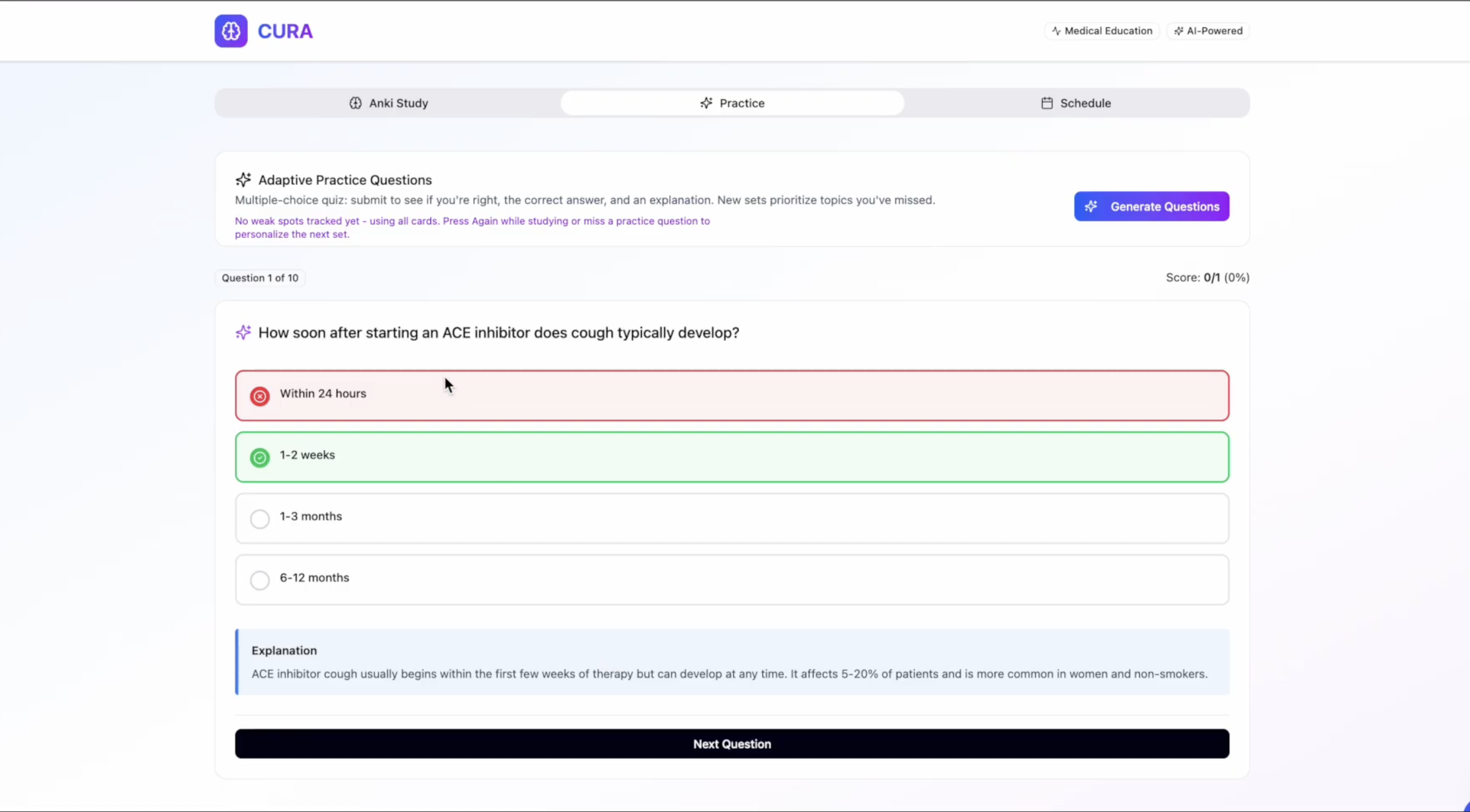
Practice Tab: Students can generate adaptive multiple-choice practice questions. Each new set intelligently prioritizes topics the user has previously missed or answered incorrectly. After submitting answers, a score is displayed and every correct answer is paired with a detailed explanation. Missed topics automatically trigger additional questions on that subject, creating a feedback loop that targets weak spots until they become strengths.
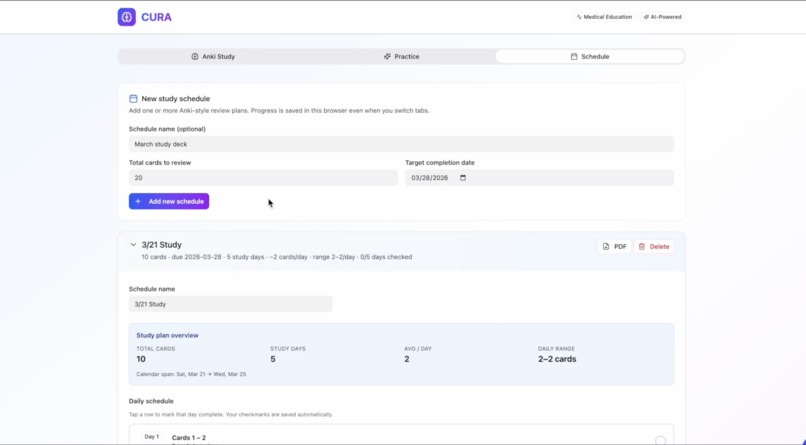
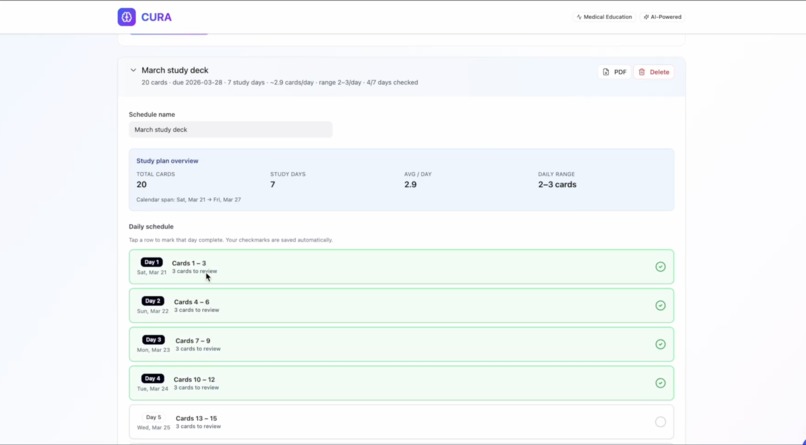
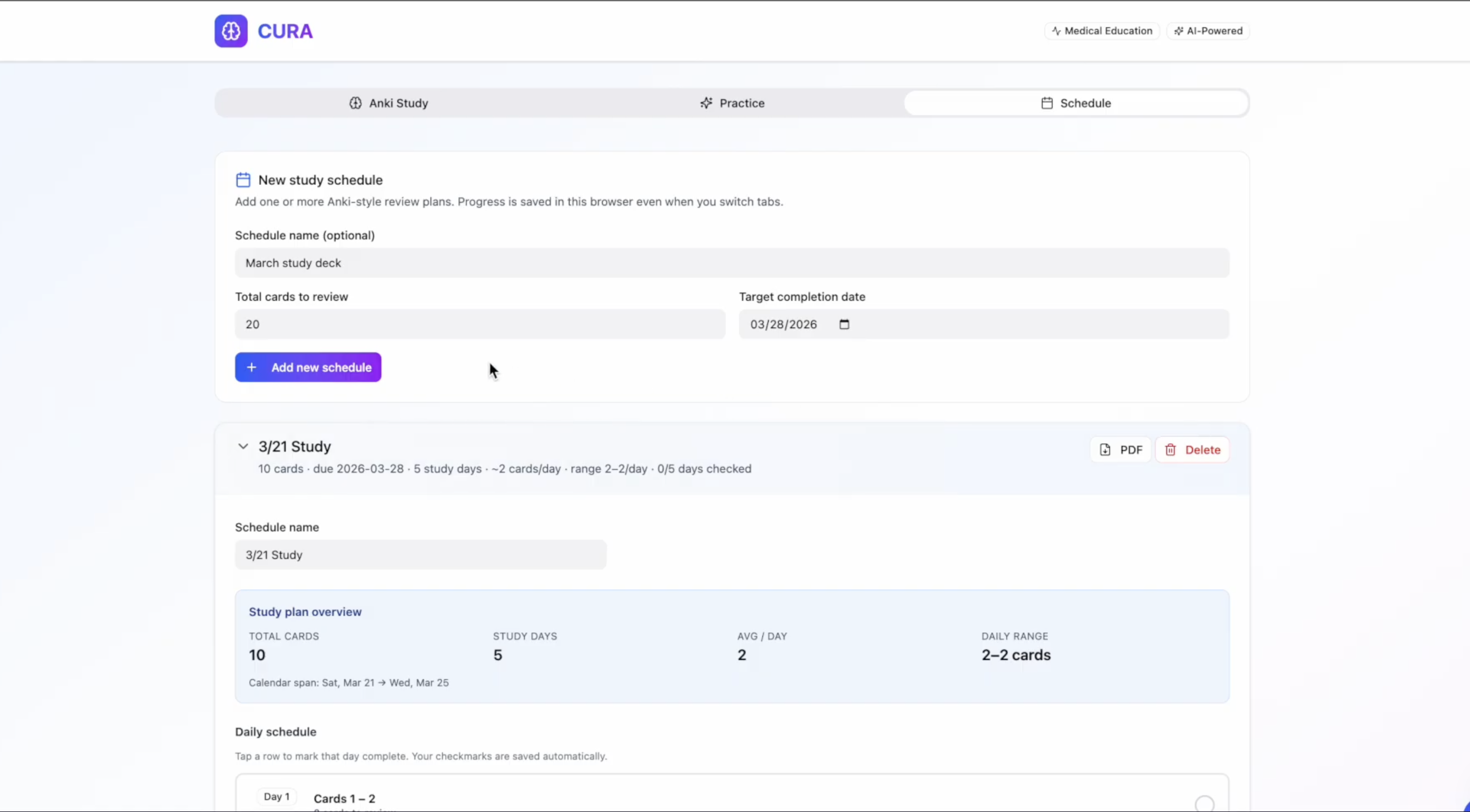
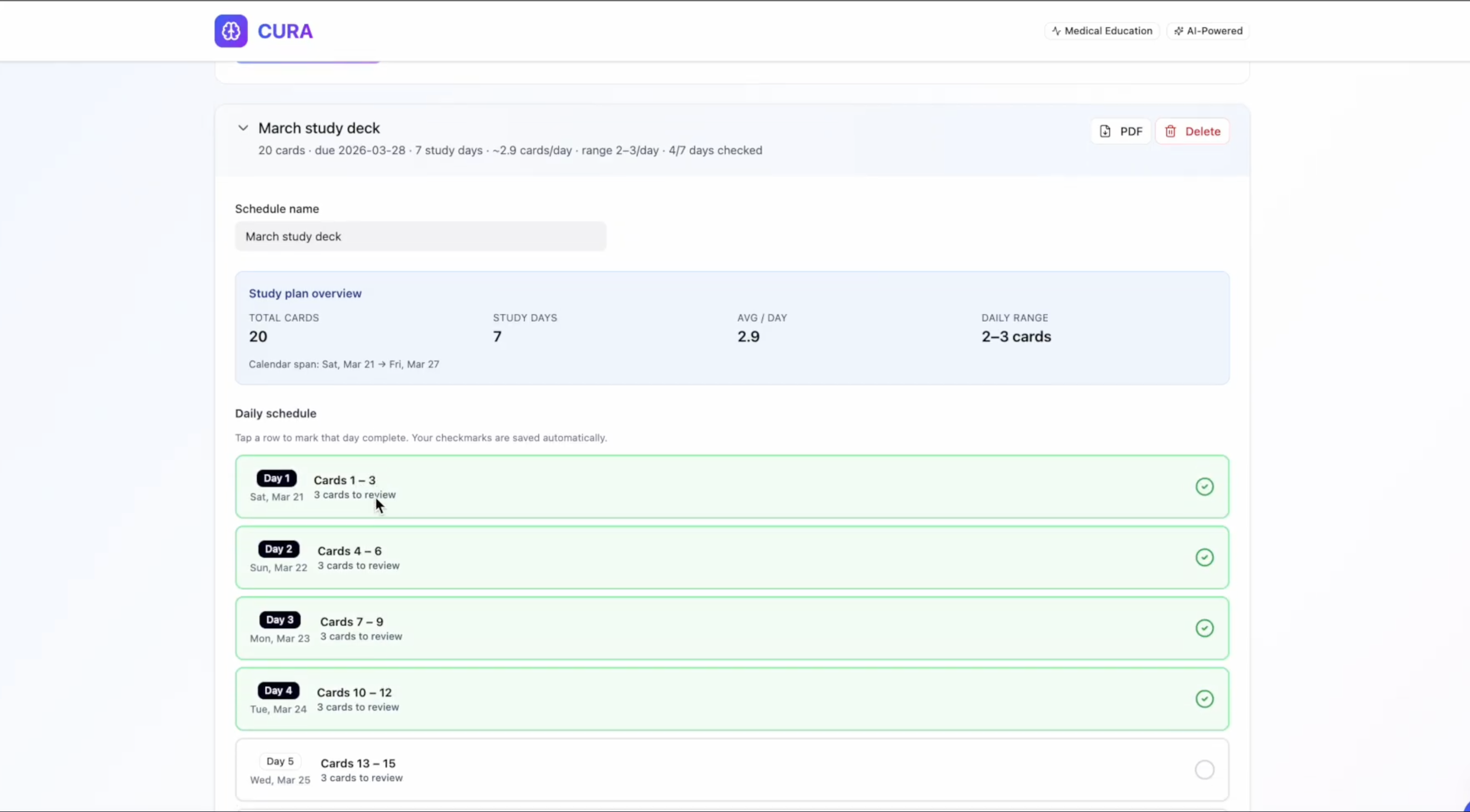
Schedule Tab: Users can create and manage multiple personalized study schedules. Each schedule takes a name, total card count, and target completion date, then generates a full study plan overview including total cards, study days, average cards per day, and a recommended daily range. A daily schedule view lets students mark individual days as complete, with progress saved automatically. Schedules can be exported as PDFs or deleted at any time.
CURA Study Assistant: A built-in AI chatbot is available throughout the app, allowing students to ask any question about the current flashcard in real time - getting immediate, contextual answers without ever leaving their study session.
How we built it
We started in Figma, designing the full UI and user experience before writing our code. Once our design system was solid, we built CURA using Next.js with TypeScript, JavaScript, CSS, and HTML for the frontend. We integrated the DeepSeek API to power the information sidebar, and leveraged the OpenAI API to drive the AI-powered features including the study assistant chatbot and adaptive question generation. Cursor and Claude were instrumental throughout development as AI coding assistants, helping us ship features faster and debug complex integrations.
Challenges we ran into
One of our biggest early challenges was API integration: managing multiple API keys, handling rate limits, and ensuring that responses from OpenAI and DeepSeek were consistent, accurate, and fast. Getting the chatbot to respond with genuine contextual awareness of the current flashcard (rather than generic answers) took significant prompt engineering and iteration. We overcame this by carefully structuring the context passed to the model and testing extensively.
We also had to deeply research how Anki works under the hood. We examined its scheduling algorithm, card states, and the way medical students actually use it day-to-day to ensure our enhanced study session felt intuitive rather than foreign to existing Anki users. Through persistence and a willingness to rebuild parts of the system from scratch when needed, we conquered each of these hurdles and came out with a more robust product.
Accomplishments that we're proud of
We're most proud of building something that actually helps. Getting real feedback from medical students and professionals who said CURA would have made their studies meaningfully easier is something that genuinely motivated us throughout the hackathon.
We're also proud of the depth of integration we achieved: seamlessly connecting multiple APIs, an interactive anatomy viewer, an adaptive quiz engine, a scheduling system, and an AI chatbot into one cohesive product. Several of these technologies and frameworks were new to us going in, and pushing through that learning curve under time pressure was a real accomplishment. The fact that the app feels polished, purposeful, and genuinely usable is something we're proud of as a team.
What we learned
Beyond discovering just how much medical students are expected to memorize, we gained a deep appreciation for how Anki works and the very real friction users experience with it. We learned that isolated memorization without context is one of the biggest gaps in medical education tools; students don't just need to know what something is, they need to understand why it matters and how it shows up clinically.
We also learned that accuracy and up-to-date information are non-negotiable in a medical context. This shaped every API and data source decision we made and gave us a much deeper respect for the stakes involved in medical education.
What's next for CURA
CURA is just getting started. We plan to introduce personalized performance analytics: visual dashboards showing mastery trends, weak subject areas, and study streak data over time, giving students a clearer picture of where to focus their energy.
On the AI side, we're exploring voice-mode study sessions where students can verbally answer flashcard questions and receive spoken feedback, ideal for commuting or hands-free review. We also want to expand the anatomy viewer into a full 3D interactive model using Three.js, giving students the ability to rotate, isolate, and annotate structures in depth.
We're also looking to add collaborative study features so that study groups can share schedules, compare performance, and quiz each other in real time. Longer term, we envision CURA supporting Step 1, Step 2, and USMLE-specific content packs, making it a comprehensive study platform for every stage of medical training.
Built With
- claude
- css
- cursor
- deepseekapi
- figma
- html
- javascript
- next.js
- openaiapi
- typescript

Log in or sign up for Devpost to join the conversation.