Cura: An AI-Powered Application for Chest X-Ray Analysis
Cura is an end-to-end medical imaging pipeline that performs automated analysis of chest X-rays across 14 pathologies. It combines image quality assessment, multi-label disease classification, anatomically grounded explainability, and a full-stack web interface.
Issue to Address
Late diagnoses of pneumonia, tuberculosis, lung diseases, among others, are likely to result in poor outcomes for patients and delayed medical interventions. The overload of radiology practices increases pressure within healthcare facilities, especially in areas where there is a shortage of skilled medical practitioners. This results in healthcare disparities and inefficiency within the medical sector. Furthermore, lack of transparency within AI-based diagnostics may decrease confidence in clinicians, hindering their adoption and resulting in poor efficiency within the medical sector.
Demo
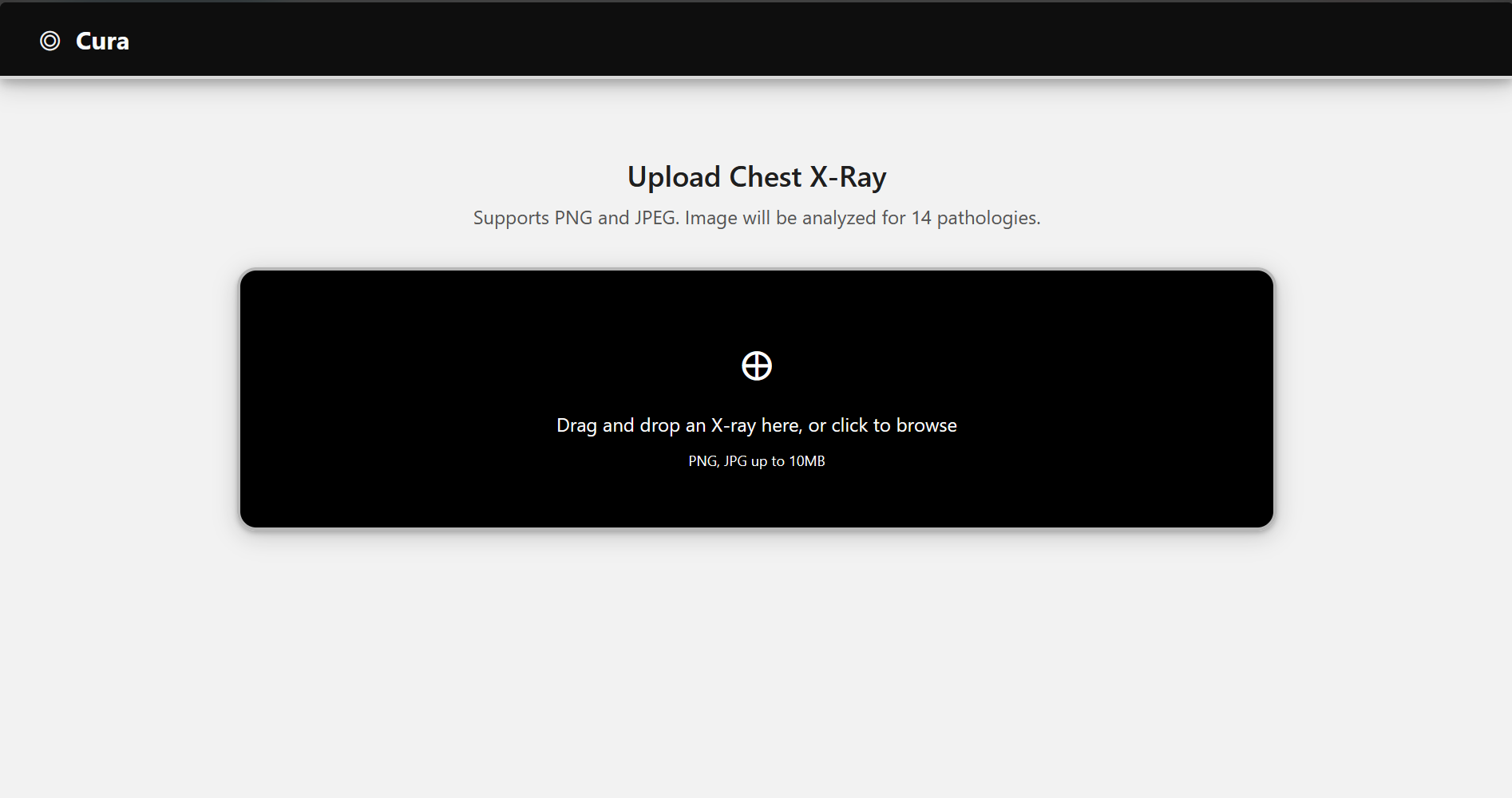
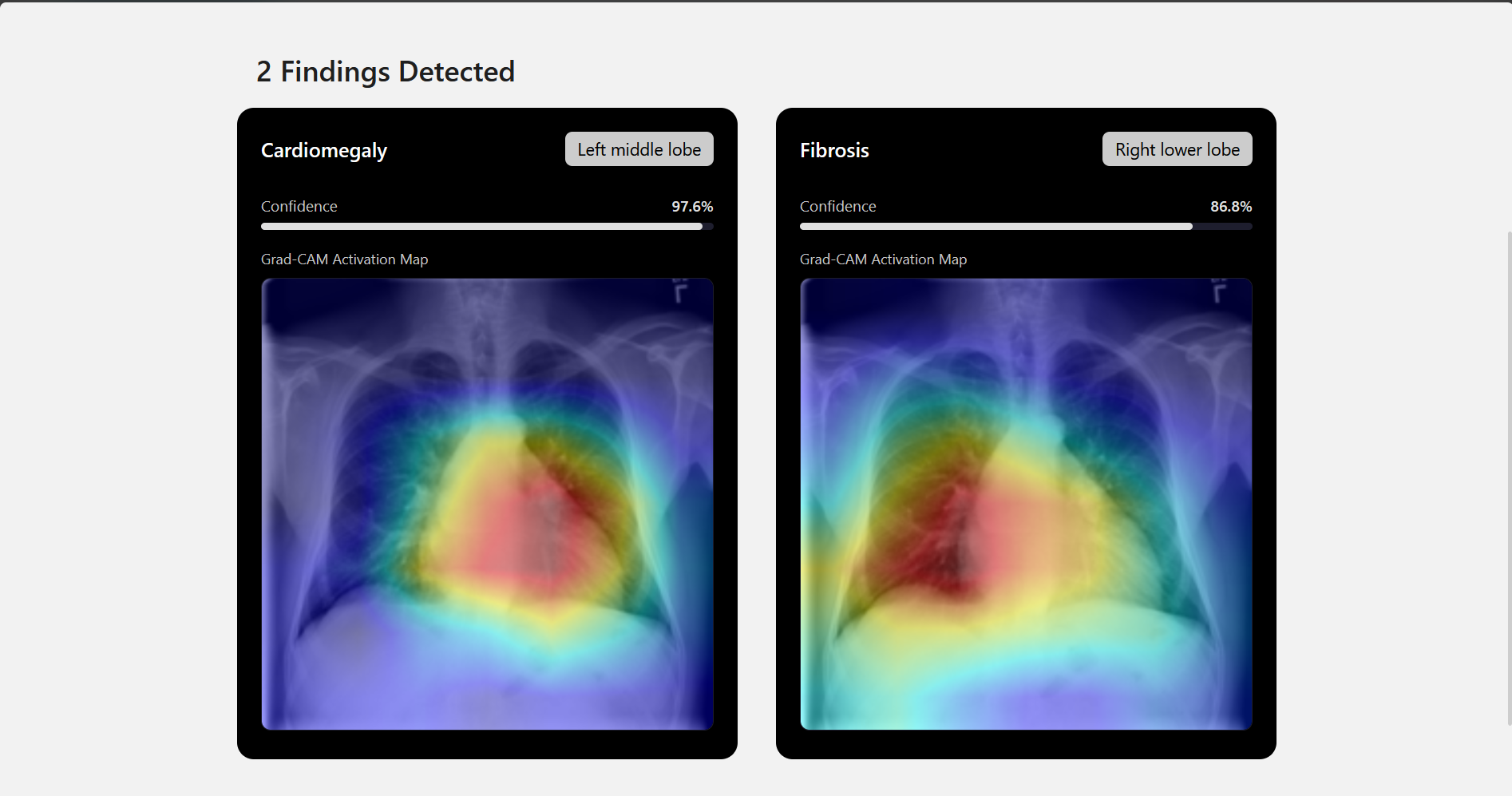
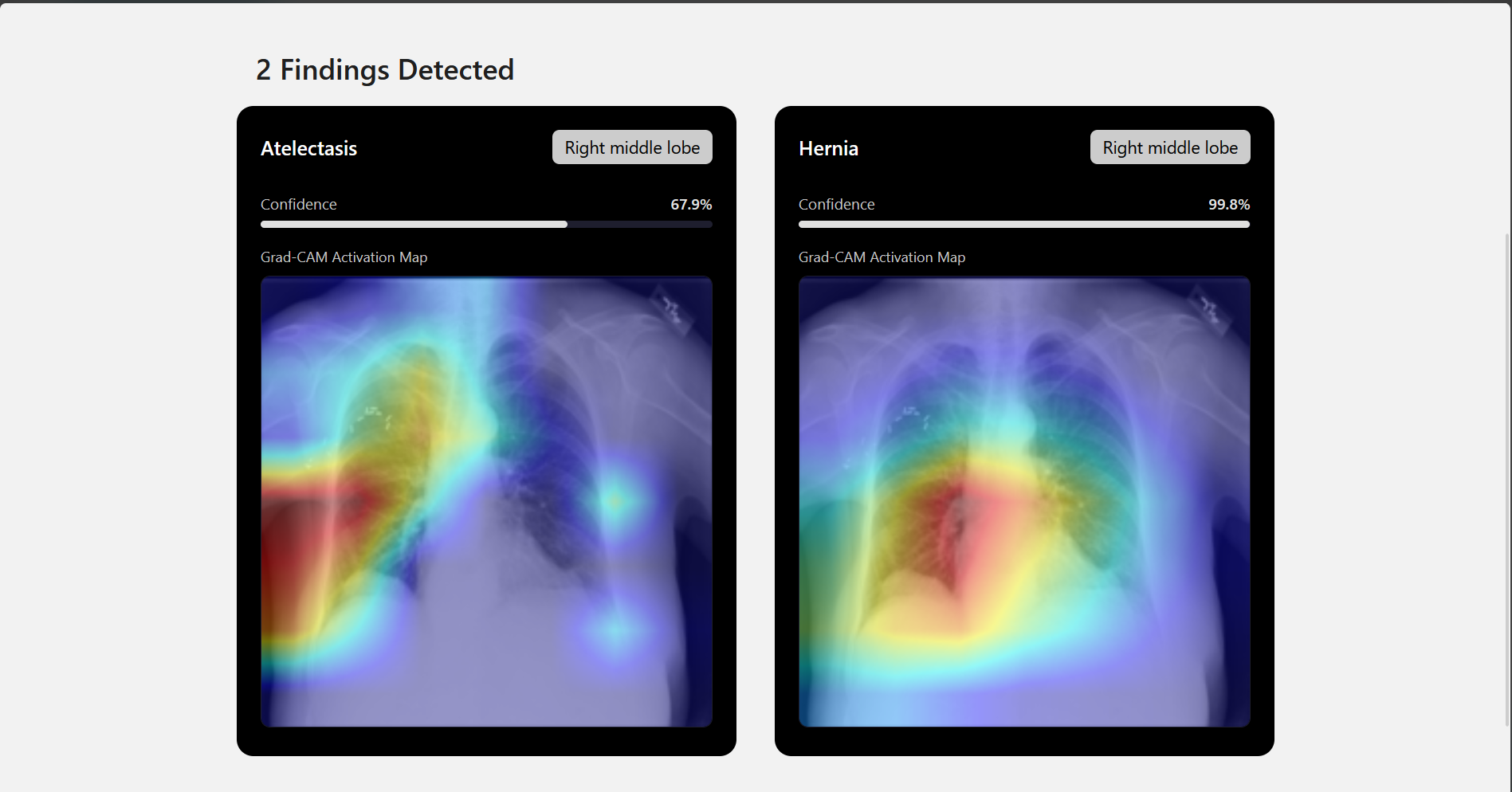
Upload a chest X-ray to receive a structured diagnostic report with disease classifications, confidence scores, affected anatomical regions, and Grad-CAM activation maps.
- Frontend: https://cura-xray.vercel.app
- API: https://mjrq-cura.hf.space/docs
Features
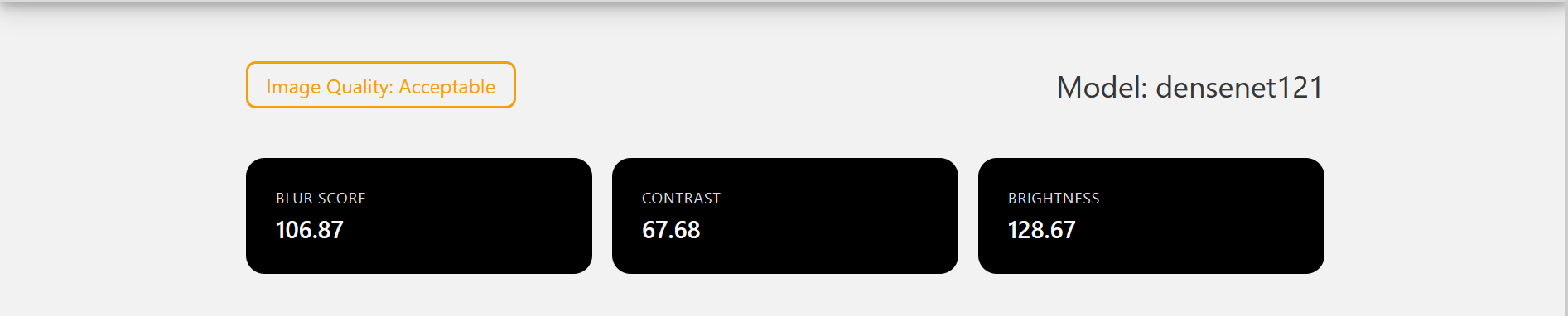
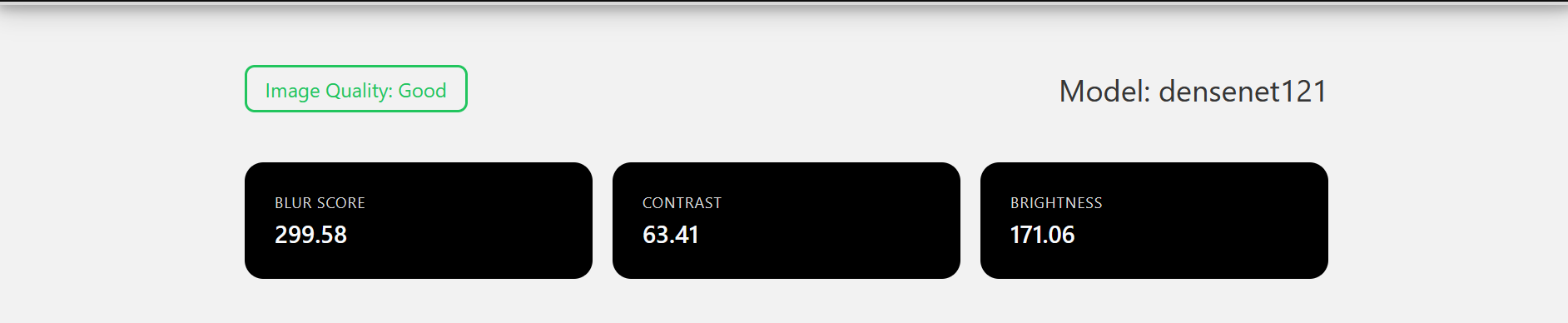
- Image Quality Assessment: Rejects low-quality images before inference using blur detection (Laplacian variance), contrast assessment, and exposure analysis. Thresholds calibrated from 500 NIH dataset samples.
- Multi-Label Classification: Classifies 14 chest pathologies simultaneously using fine-tuned CNNs. Each image can have multiple simultaneous findings.
- CNN Benchmark: Trains and evaluates DenseNet121, ResNet50, and EfficientNet-B0 on the NIH ChestX-ray14 dataset.
- Explainability: Grad-CAM heatmaps grounded in TorchXRayVision anatomical segmentation, producing region labels such as "Right lower lobe" rather than raw pixel coordinates.
- Calibrated Thresholds: Per-class confidence thresholds derived by maximizing F1 scores, replacing a naive fixed cutoff.
- REST API: FastAPI backend serving structured JSON diagnostic reports.
- React Frontend: Drag-and-drop interface with real-time results, confidence bars, and heatmap overlays.
Architecture
- Chest X-Ray Image
- Image Quality Assessment (Open CV)
- DenseNet121 Inference (PyTorch)
- Grad-CAM and TorchXRayVision Segmentation
- Structured JSON Report
- React Frontend
Results
CNN Benchmark — NIH ChestX-ray14 (Mean AUC)
| Architecture | Mean AUC |
|---|---|
| DenseNet121 | 0.8289 |
| ResNet50 | 0.8284 |
| EfficientNet-B0 | 0.8219 |
Per-Class AUC (DenseNet121)
| Disease | AUC |
|---|---|
| Atelectasis | 0.7978 |
| Cardiomegaly | 0.9140 |
| Effusion | 0.8796 |
| Infiltration | 0.7092 |
| Mass | 0.8357 |
| Nodule | 0.7355 |
| Pneumonia | 0.7665 |
| Pleural Thickening | 0.7926 |
| Pneumothorax | 0.8587 |
| Consolidation | 0.7987 |
| Edema | 0.8887 |
| Emphysema | 0.9263 |
| Fibrosis | 0.8200 |
| Hernia | 0.8808 |
Results comparable to the original CheXNet paper (Rajpurkar et al., 2017) which reported mean AUC of 0.841.
Dataset
NIH ChestX-ray14 — 83,691 frontal chest X-rays (224×224) across 14 disease labels.
- Source: Kaggle — NIH Chest X-ray 14 (224x224 resized)
- Split by patient ID to prevent data leakage (16,428 train / 2,054 val / 2,054 test patients)
- Class imbalance handled via BCEWithLogitsLoss pos_weight (up to 439x for Hernia)
- Dataset-specific normalization: mean [0.509, 0.509, 0.509], std [0.251, 0.251, 0.251]
Setup
Backend
# Create and activate environment
conda create -n cura python=3.11
conda activate cura

# Install dependencies
pip install -r backend/requirements.txt

# Place model checkpoint in backend/checkpoints/
# densenet121_best.pt

# Start API server
uvicorn backend.api.main:app --reload --port 8000
Frontend
cd frontend
npm install
npm run dev
Open http://localhost:5173
API
POST /analyze
Upload a chest X-ray image and receive a full diagnostic report.
Request: multipart/form-data with file field (PNG or JPEG)
Response Example:
{
  "passed_quality": true,
  "rejection_reason": null,
  "image_quality": "Good",
  "quality_metrics": {
    "blur_score": 299.58,
    "contrast_score": 63.41,
    "mean_brightness": 171.06
  },
  "model": "densenet121",
  "diagnoses": [
    {
      "disease": "Atelectasis",
      "confidence": 0.6794,
      "threshold_used": 0.65,
      "affected_region": "Right middle lobe",
      "heatmap_base64": "..."
    }
  ],
}
GET /health
Returns server and model status.
Technical Decisions
Why DenseNet121?
Achieves the highest AUC with 3x fewer parameters than ResNet50 with second highest AUC.
Why patient-level splits?
The NIH dataset contains multiple scans per patient. Image-level splits would allow patient anatomy to appear in both train and test sets, inflating metrics. All images from one patient are assigned to exactly one split.
Why per-class thresholds?
A single threshold treats all 14 diseases equally. Hernia (0.5% prevalence, 439x class weight) requires 90% confidence before being reported. Infiltration (most common disease) only requires 50%. Thresholds derived by maximizing F1 Score.
Why TorchXRayVision for region detection?
Raw Grad-CAM coordinates map poorly to anatomy. Multiplying the Grad-CAM heatmap by TorchXRayVision's anatomical segmentation masks constrains activation to clinically meaningful regions and produces human-readable labels.
Why dataset-specific normalization?
X-rays have a fundamentally different pixel distribution from natural images (mean 0.509 vs ImageNet 0.485). Computed from 5,000 random samples using the computational variance identity.
Known Limitations
- Rotation detection disabled: Hough line transform unreliable on chest X-rays due to absence of strong dominant lines
- Uncertainty estimation not yet implemented: requires MC Dropout layer injection into pretrained weights
- Trained on 30k image subset per architecture for 7 epochs and than around 90k images for the last 3 epochs. This was due to computation constraints.
- LLM clinical report generation from JSON output planned but not yet implemented.
Future Work
- Monte Carlo Dropout uncertainty estimation
- LLM-generated clinical narrative reports
- MLflow experiment tracking integration
References
- Rajpurkar et al. (2017). CheXNet: Radiologist-Level Pneumonia Detection on Chest X-Rays with Deep Learning
- Wang et al. (2017). ChestX-ray8: Hospital-scale Chest X-ray Database and Benchmarks
- Selvaraju et al. (2017). Grad-CAM: Visual Explanations from Deep Networks via Gradient-based Localization
- Gal & Ghahramani (2016). Dropout as a Bayesian Approximation
- Cohen et al. (2022). TorchXRayVision: A library of chest X-ray datasets and models
Built With
Languages
- Python — backend, ML pipeline, data processing
- JavaScript (JSX) — React frontend
- SQL — SQLite via MLflow (experiment tracking)
- Bash — deployment scripts, Kaggle CLI
ML & Data Science
- PyTorch — model training, inference, Grad-CAM
- Torchvision — pretrained CNN architectures (DenseNet121, ResNet50, EfficientNet-B0)
- TorchXRayVision — anatomical segmentation for region detection
- scikit-learn — AUC, F1, ROC curves, confusion matrices
- NumPy — numerical operations
- Pandas — dataset management, CSV processing
- Matplotlib / Seaborn — evaluation visualizations
- OpenCV (cv2) — image quality assessment (Laplacian, Canny, Hough)
- Pillow (PIL) — image loading and preprocessing
Backend & API
- FastAPI — REST API framework
- Uvicorn — ASGI server
- Pydantic — request validation
- Python-multipart — file upload handling
Frontend
- React — UI component framework
- Vite — build tool and dev server
- Axios — HTTP client for API calls
- React Dropzone — drag-and-drop file upload
MLOps & Experiment Tracking
- MLflow — experiment tracking, model registry (planned)
- DVC — data version control (planned)
- GitHub Actions — CI/CD pipeline (planned)
Platforms & Cloud
- Google Colab — initial GPU experimentation
- Kaggle Notebooks — primary training platform (2× T4 GPU)
- Google Drive — dataset and checkpoint storage
- GitHub — version control, code hosting
- Docker — containerization
- Render — planned deployment platform
Datasets & APIs
- NIH ChestX-ray14 — 112,120 chest X-ray images, 14 disease labels
- Kaggle API — programmatic dataset download
- TorchXRayVision PSPNet — pretrained chest X-ray segmentation model
Development Tools
- Anaconda — Python environment management
- Jupyter Notebooks — data exploration and prototyping
- Git — version control
- VS Code — primary IDE
License
MIT
Built With
- check-project-details

Log in or sign up for Devpost to join the conversation.