-
-
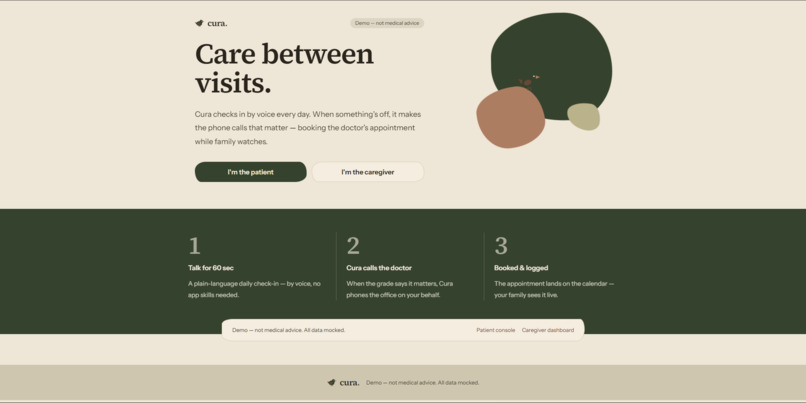
Landing Page
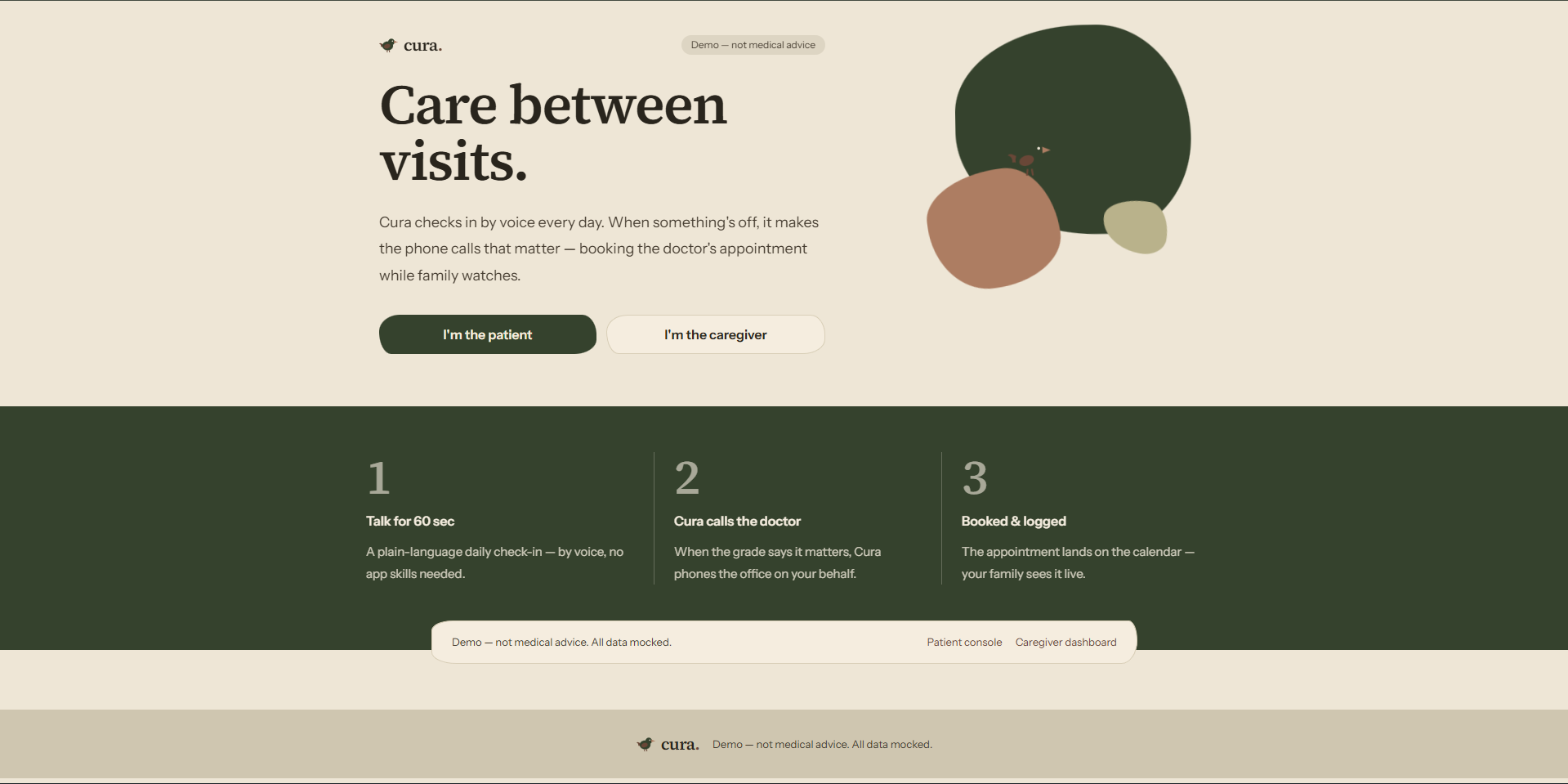
Cura: Care Between Visits
Inspiration
Healthcare does not stop mattering when a doctor's appointment ends. For older adults living alone, the days between appointments can be just as important. A missed routine, an unanswered call, or a small change in how someone feels can go unnoticed until it becomes a bigger problem.
I wanted to explore how AI could help bridge that gap without making healthcare feel more complicated or less personal. Many older adults may not be comfortable navigating another app, remembering passwords, or learning a new interface. I wanted to build something that felt more natural: a simple conversation.
That idea became Cura, a voice-first AI care companion designed to help older adults check in on their well-being and keep trusted family members informed.
What It Does
Cura is designed to make everyday check-ins easier for older adults while giving caregivers a clearer picture of how things are going between appointments.
The experience centers on three things:
- Voice-first check-ins: A familiar, conversational way for users to share how they are feeling and describe anything that is bothering them.
- Caregiver visibility: A dashboard where family members can review check-in summaries, see follow-up items, and identify situations that may need attention.
- Human follow-up: When a conversation raises a concern, Cura is designed to help organize the information and guide it toward an appropriate human follow-up rather than treating the AI as a replacement for care.
The goal is not to have AI make medical decisions. It is to make communication easier, reduce the chance that important information gets overlooked, and help people stay connected between visits.
How I Built It
I approached Cura as a combination of a conversational interface, an AI reasoning layer, and a system for organizing and sharing information.
My planned technology stack includes:
- Next.js for the web interface and caregiver dashboard.
- Gemini function calling to let the AI interact with specific application tools instead of only generating text.
- Twilio for phone-based communication.
- Supabase for storing check-in records and related application data.
- Vercel for deployment.
One of my main design decisions was to avoid letting the AI directly control everything. Instead, the model can identify a possible action, while application-side logic validates what is allowed and handles execution. This matters when a system deals with potentially sensitive health-related information.
I also designed the experience around distinct outcomes. A routine check-in should remain routine. A concern may need follow-up from a caregiver. A potentially serious situation should not be handled as if an AI conversation alone were enough.
I focused the interface on making these outcomes understandable, with a patient-facing experience, a caregiver view, and a summary of relevant information.
Challenges I Faced
One of the biggest challenges was figuring out how to make an AI care companion useful without giving it more responsibility than it should have.
A conversational model can sound confident even when it misunderstands something. In a healthcare-related setting, that is a serious design problem. I had to think about what happens when a user gives an unclear answer, when the system identifies a concern, or when a follow-up action has been requested but has not actually happened.
This made me pay closer attention to the difference between identifying a concern, requesting human follow-up, and confirming that the follow-up occurred. Those are different events, and the interface should never imply that one automatically guarantees the next.
Another challenge was balancing accessibility with useful functionality. Adding more buttons and settings might make a product seem more powerful, but it can also make it harder for someone to use. I wanted the core experience to feel straightforward, especially for people who may not be comfortable with complicated technology.
Working on the project independently also meant thinking through the product from multiple perspectives: the older adult using it, the family member checking in, and the developer responsible for making the system behave reliably. I had to consider not only the AI response, but also the surrounding application logic, data handling, and user experience.
What I Learned
Building Cura reinforced that using AI effectively is not just about making a model smarter. It is about designing the system around the model.
Function calling is useful because it connects a conversational interface to concrete application actions, but those actions still need validation and clear results. A model-generated response is not proof that a database was updated, a message was delivered, or an appointment was booked.
I also learned to treat safety and accessibility as core product requirements rather than features to add at the end. In a product intended for older adults, clarity matters as much as capability. People should know what the system can do, what it cannot do, and when a real person needs to get involved.
Most importantly, this project pushed me to think about AI in terms of the problem it solves for people, not just the technology it uses. Building a useful product means making deliberate choices about what to automate, what to leave to humans, and how to earn the user's trust.
What's Next
My next steps are to strengthen the core check-in workflow, improve the reliability of follow-up tracking, and test the experience with appropriate user feedback. I would also like to explore multilingual conversations, configurable reminders, and integrations with health information systems where users have explicitly authorized access.
Before expanding its capabilities, I want to make sure the fundamentals are dependable: conversations are understandable, information is handled carefully, and follow-up statuses accurately reflect what has actually happened.
Closing
Cura started with a simple question: What if getting support between doctor's visits felt as natural as having a conversation?
I built this project to explore that possibility. My vision is a future where technology helps older adults feel less isolated, gives caregivers better visibility, and makes it easier for people to stay connected to the care they need.
Cura. Care between visits.


Log in or sign up for Devpost to join the conversation.