-
-
Culturize
-
Dish Locator
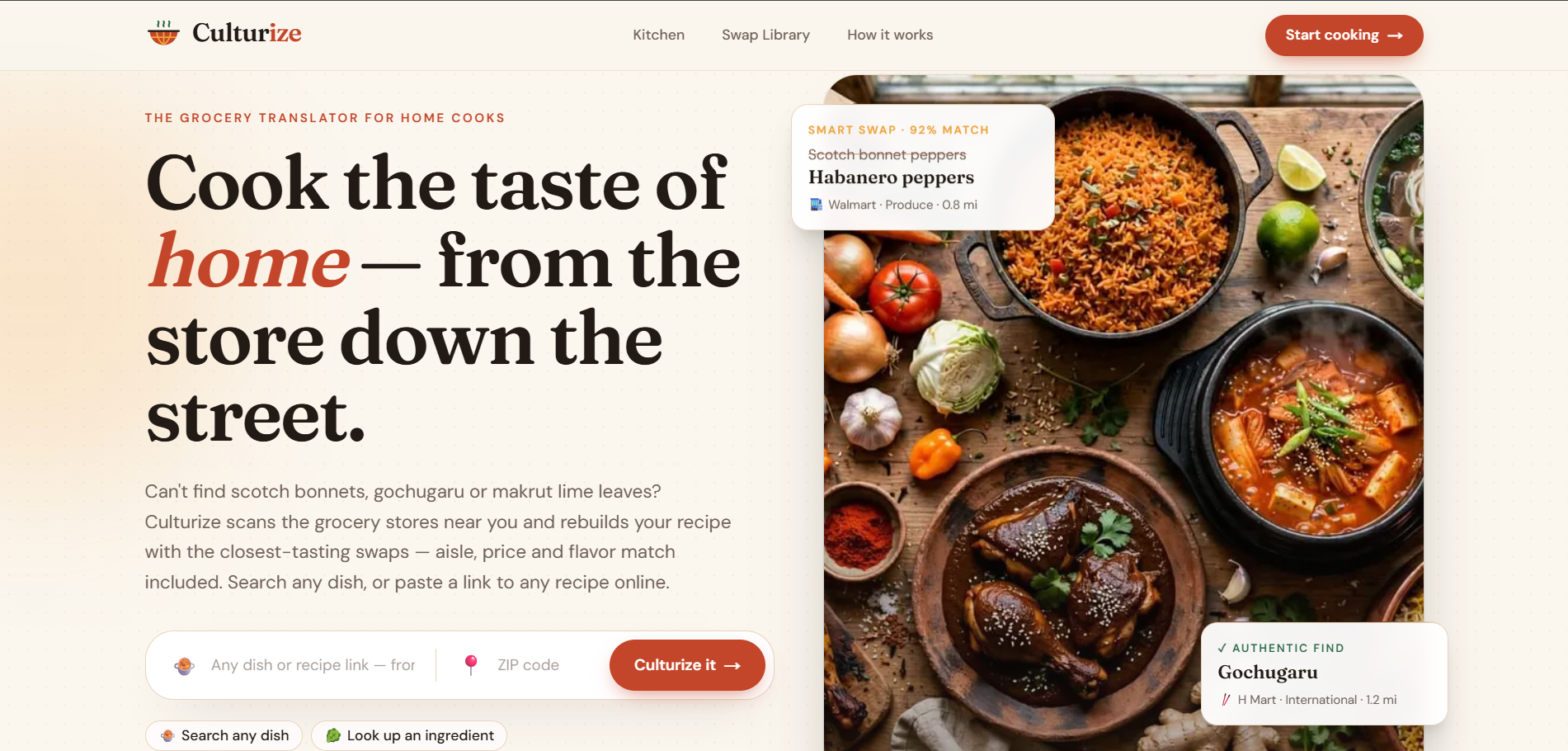
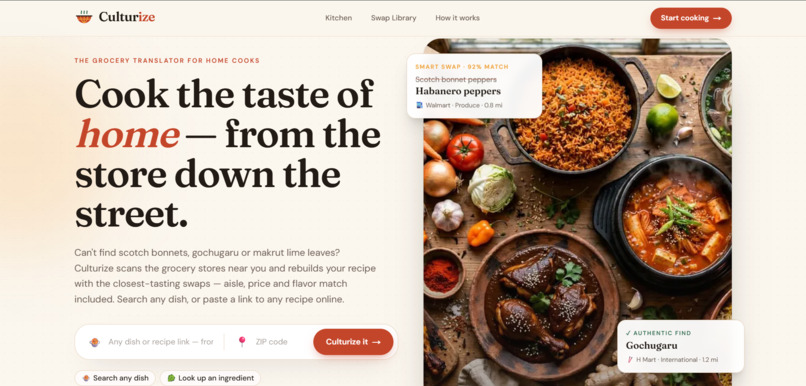
Many of us grew up eating dishes that are hard to recreate far from home. A recipe calls for scotch bonnets, gochugaru, paneer, or makrut lime leaves, and the nearest international market is an hour away. Existing recipe sites assume you can buy every ingredient, and searching for a regional staple like moong dal often returns nothing helpful. We wanted a tool that works with the grocery store down the street instead of against it, so people can cook the food they grew up with wherever they live.
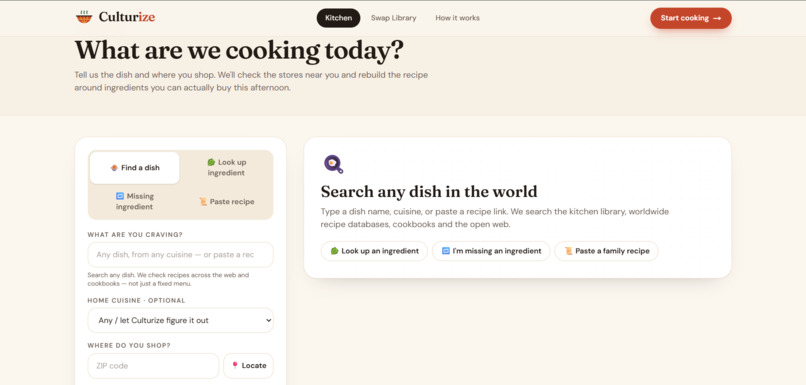
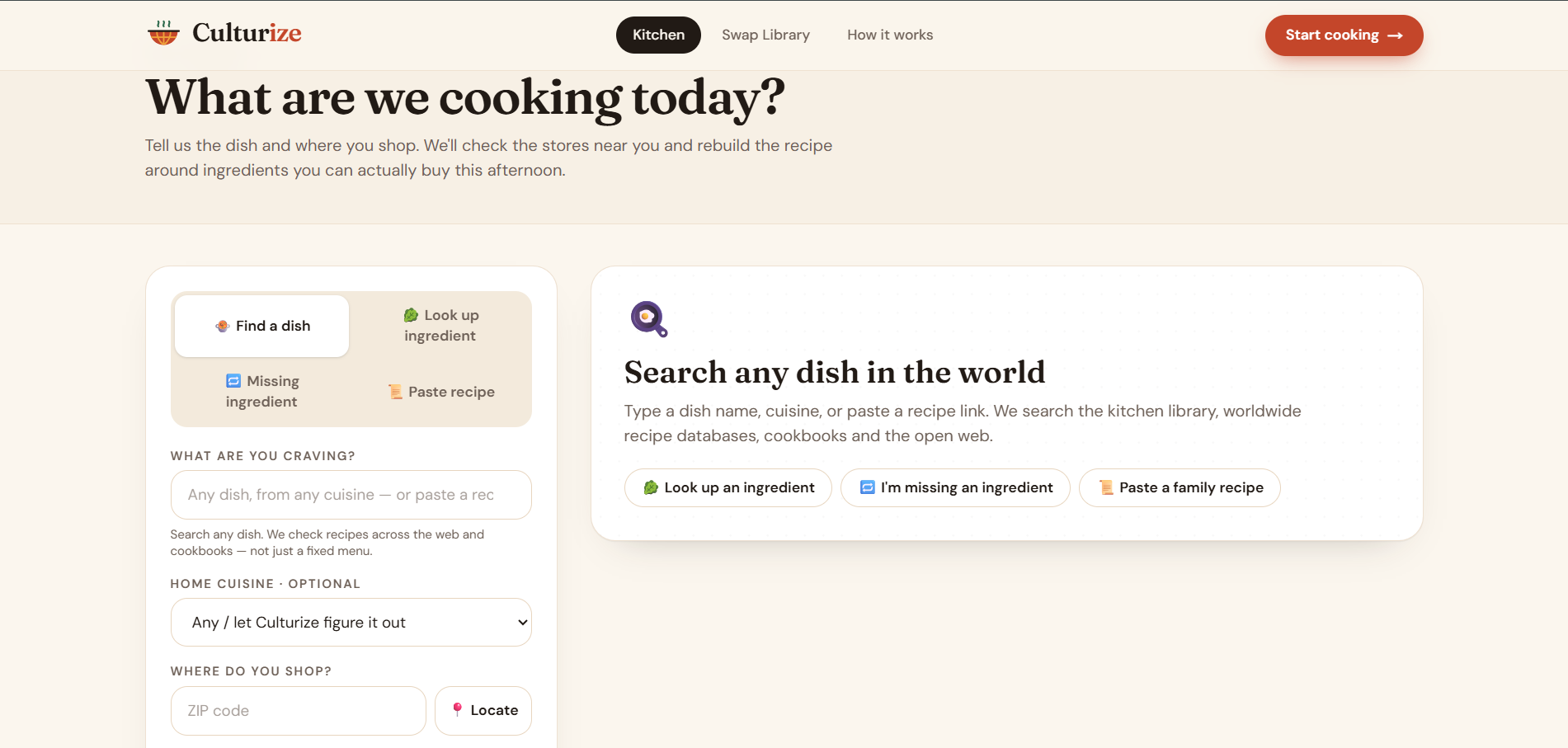
Culturize is a universal kitchen companion. You can search any dish or ingredient from any cuisine, with no fixed menu, and see what it is, what else it's called, and how it's used. If you're missing an ingredient, tell us the dish and what you lack, and Culturize suggests a swap with a flavor match score and notes on taste, texture, and quantity. Enter your ZIP code and it matches swaps to nearby supermarkets and international markets to build a shopping list. You can also paste a family recipe or a link to any recipe online, and Culturize rewrites it around ingredients you can actually buy. Recipes can be saved to a community cookbook.
We built Culturize with Next.js, TypeScript, and Tailwind CSS, with Supabase (PostgreSQL) and Drizzle ORM storing saved recipes and search logs. AI generates recipes and substitutions for dishes outside our built-in library and translates pasted family recipes. For broad coverage we combined a hand-built knowledge base of 200+ cultural ingredients and 240+ flavor-matched substitutes with open sources: TheMealDB, the Wikibooks Cookbook, Wikipedia food pages, and OpenStreetMap for store locations. The code lives on GitHub and is deployed on Vercel, and we used Arena's AI coding tools to generate and iterate on the site.
The biggest challenge was making search feel unlimited. Early versions only knew a handful of dishes, so we layered several sources and an AI fallback so nearly any query returns something useful. AI-generated photos also didn't always match the dish, so we replaced them with images that fit. Getting the project deployed took work too: moving it from an AI sandbox to GitHub and Vercel meant fixing the folder structure and setting up environment variables and a hosted database. We also had to judge substitutes honestly, since a swap that works in soup may not work in a fried dish, so we focused on explaining trade-offs instead of promising a perfect match.
We're proud that a user can look up almost any ingredient or dish, not just a preset list, and that the substitution feature explains why a swap works and what changes. We're also proud of shipping a full-stack, database-backed app that feels welcoming to many cuisines at once.
Along the way we learned how to connect a Next.js app to a hosted Postgres database and manage environment variables securely, how to combine curated knowledge with open data and AI, and how much regional spellings and synonyms affect whether people find what they're looking for.
Next, we want to add user accounts and personal pantries so swaps account for what you already own, dietary filters (vegan, halal, gluten-free, allergies), real-time store inventory and prices, community-submitted family recipes with swap ratings, and support for more languages and regions outside the U.S.
Built With
- arena.ai


Log in or sign up for Devpost to join the conversation.