-
-
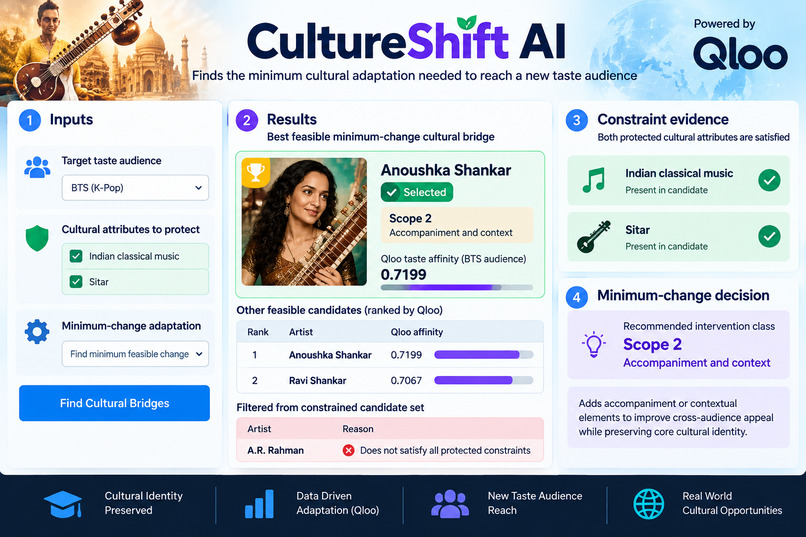
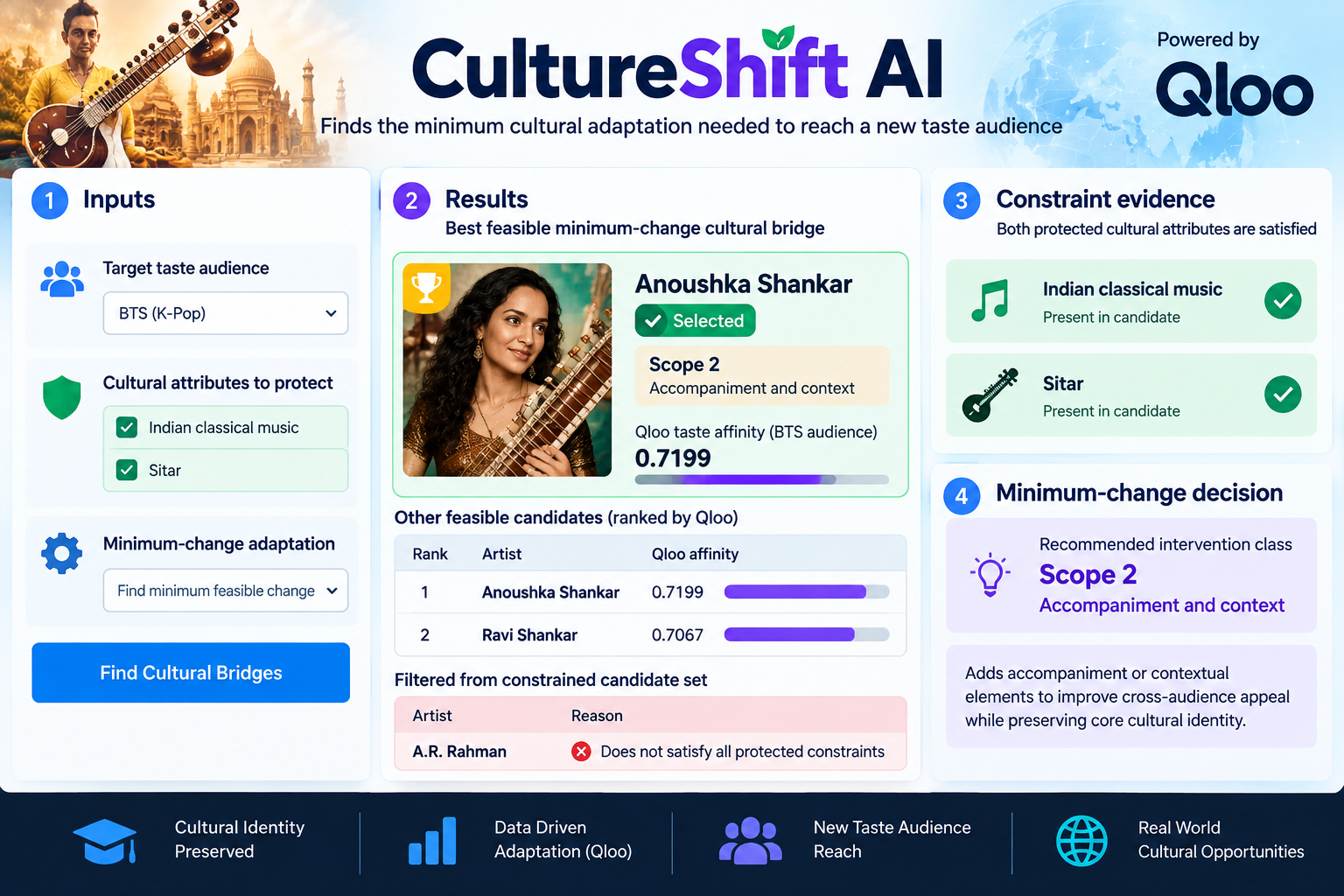
CultureShift AI decision flow: protected constraints are enforced before Qloo ranks the feasible minimum-change cultural bridges.
-
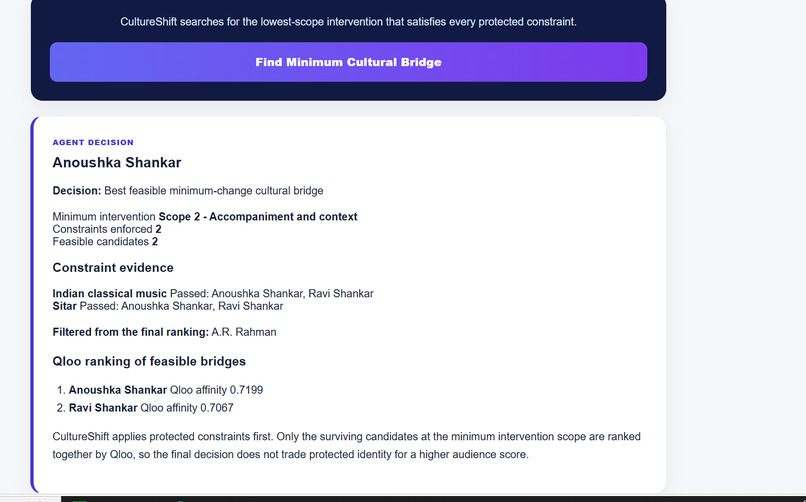
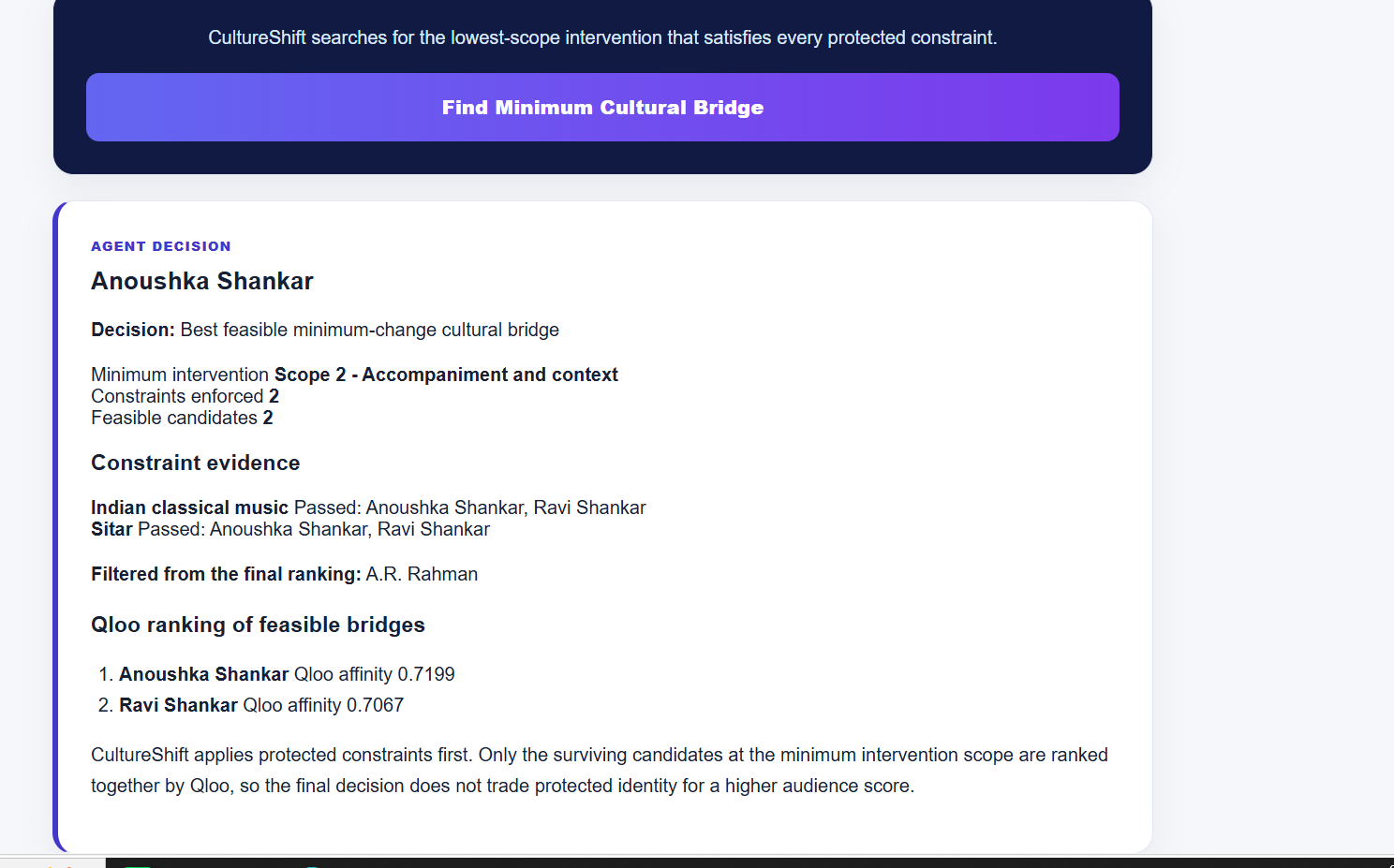
Live deployed CultureShift result: two protected constraints leave two feasible bridges, ranked together by Qloo.
Inspiration
Most recommendation systems ask one question: what will this audience like?
For cultural adaptation, that is not enough. Maximizing audience appeal can unintentionally remove the very elements that give a cultural experience its identity.
CultureShift AI explores a different question:
What is the minimum change needed to reach a new taste audience while preserving what must not change?
What it does
CultureShift AI is a constraint-aware cultural decision agent powered by Qloo.
A user selects a target taste audience and identifies cultural attributes that must be protected. CultureShift then:
- checks candidate cultural bridges against each protected constraint using Qloo;
- intersects the results so every surviving candidate satisfies all protected constraints;
- selects candidates at the minimum feasible intervention scope; and
- asks Qloo to rank only those surviving candidates for the target audience.
This creates a constraints-first, ranking-second decision process.
If no candidate satisfies the protected constraints, the decision engine can return DO NOT CHANGE instead of sacrificing cultural identity merely to obtain a recommendation.
How we built it
CultureShift uses a lightweight web architecture with a static HTML, CSS and JavaScript frontend and a Cloudflare Worker backend.
The Qloo API key is stored only as a server-side Worker secret.
The decision engine models intervention scope as:
- Scope 0: No change
- Scope 1: Discovery and framing
- Scope 2: Accompaniment and context
- Scope 3: Core modification
Protected constraints are treated as hard feasibility conditions. Qloo is then used to rank the feasible candidates within the minimum intervention scope.
Multiple protected constraints are checked independently and intersected by CultureShift, giving them hard-AND behavior.
Qloo integration
Qloo is not used as a decorative recommendation API at the end of the workflow. It is part of the agent's decision process.
CultureShift uses Qloo first to determine which candidate bridges survive the protected cultural constraints and then uses Qloo again to rank the surviving minimum-change candidates against the target taste audience.
This makes Qloo central to both feasibility and final selection.
Working demonstration
Our deployed demonstration targets a BTS taste audience while protecting:
- Indian classical music
- Sitar
The production run left two feasible candidates:
- Anoushka Shankar
- Ravi Shankar
A.R. Rahman was filtered from the final constrained candidate set.
The surviving candidates were ranked together by Qloo:
- Anoushka Shankar - affinity 0.7199
- Ravi Shankar - affinity 0.7067
CultureShift therefore selected Anoushka Shankar, with the demonstrated intervention class Scope 2: Accompaniment and context.
The repository includes the validated production response used as evidence for this run.
What makes it different
CultureShift reverses the usual recommendation pattern.
Instead of:
Audience -> recommendation
we use:
Cultural experience + protected identity + target audience -> feasible bridges -> minimum intervention -> Qloo ranking
The goal is not simply to maximize taste affinity. The goal is to find the best audience bridge subject to identity-preservation constraints.
Challenges
A major technical challenge was that multiple Qloo tag filters use union semantics. CultureShift therefore evaluates protected constraints independently and intersects the surviving entity IDs itself to implement hard-AND preservation.
We also avoided comparing affinity scores from separate Qloo calls. Final candidate comparison is performed within the same ranking call.
Another challenge was keeping the Qloo credential completely outside the browser while still providing a public live demo. We solved this with a Cloudflare Worker and server-side secret.
Accomplishments
We built and deployed a working end-to-end prototype with:
- live Qloo integration;
- hard cultural preservation constraints;
- multi-constraint intersection;
- minimum-intervention decision logic;
- same-call Qloo ranking;
- explainable constraint evidence;
- a DO NOT CHANGE decision path;
- a public web interface; and
- committed production validation evidence.
What we learned
Taste intelligence becomes more useful when it participates in a decision process rather than simply producing recommendations.
For culturally sensitive applications, knowing what not to change can be as important as knowing what an audience may prefer.
What's next
CultureShift can be extended to richer candidate sets and additional cultural domains while retaining the same constraints-first decision architecture.
A future evaluation can also test genuinely different intervention scopes across a larger candidate set. The current live artist demonstration uses Scope 2 candidates, so we do not claim that this particular production example empirically compares Scope 1, Scope 2 and Scope 3.
Built With
- cloudflare-workers
- css
- html
- javascript
- qloo-api

Log in or sign up for Devpost to join the conversation.