-

Home Page
-

The bookshelf
-
Book Shorlistings
Inspiration
Your next favourite book can be on a friends bookshelf. It's one thing to locate the book, and another to get an exchange that everyone agrees to. Even a three-person loop may not be able to be performed in a direct swap.
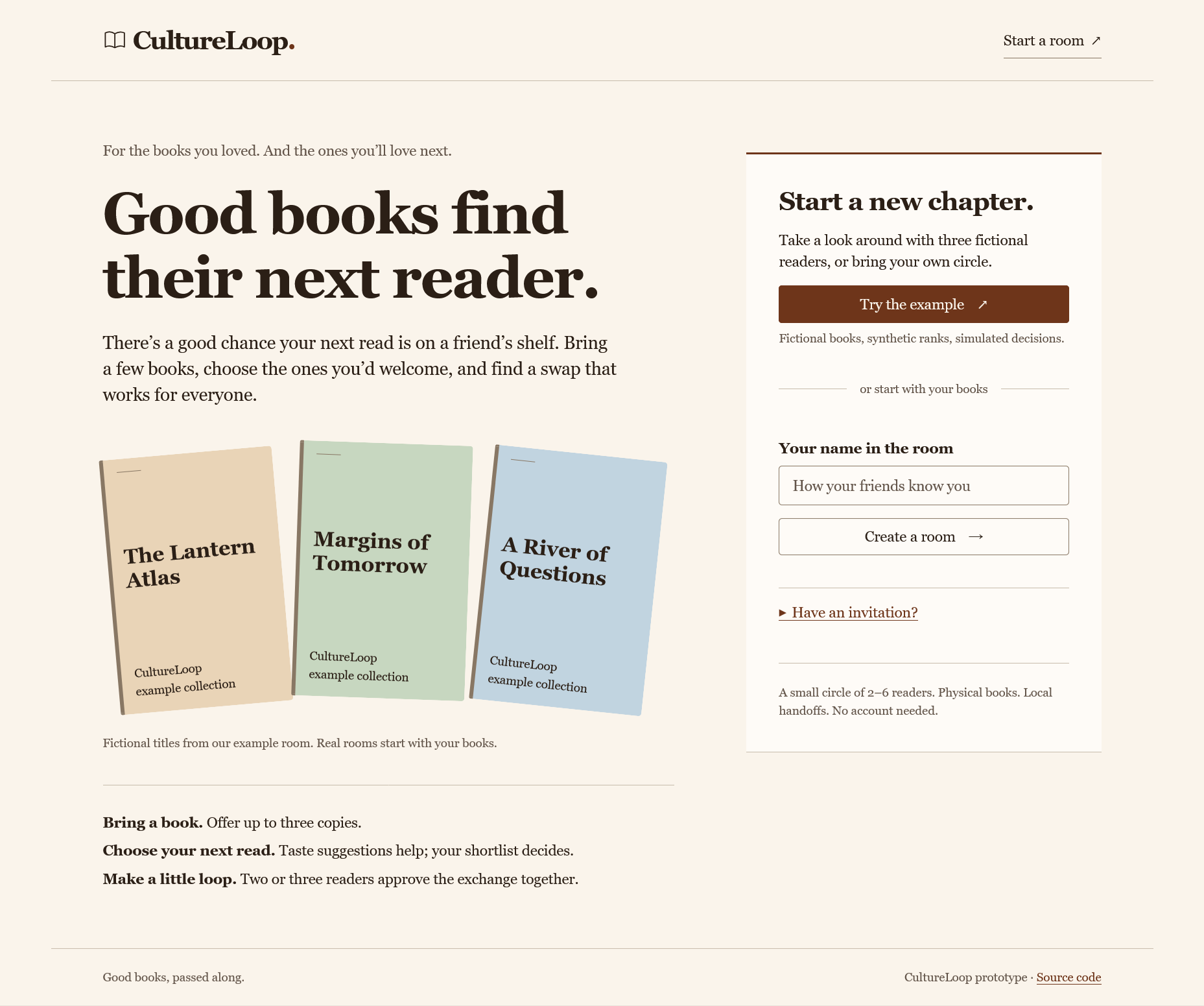
CultureLoop brings the culture with the books. It provides friends and students with the information they need to find interesting books to read, to decide what they would want to read, and to arrange a reasonable local exchange.
What it does
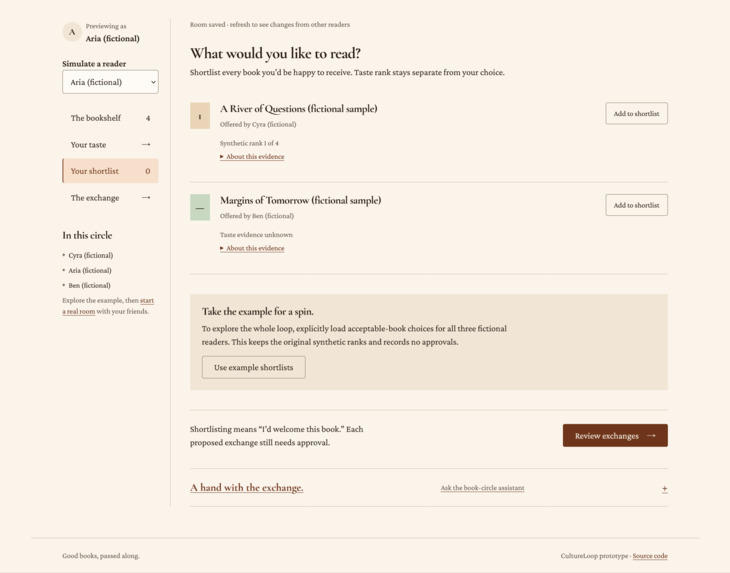
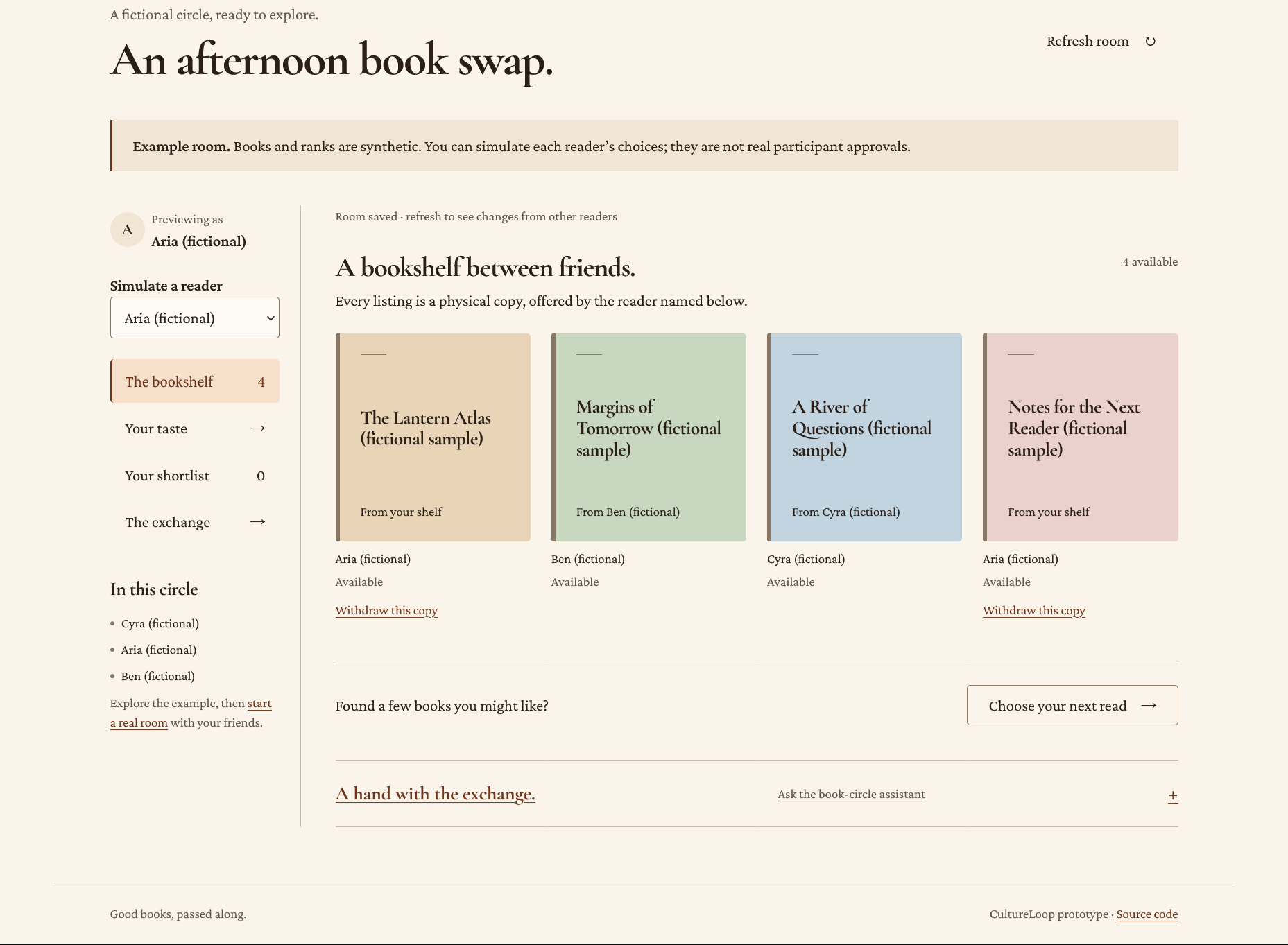
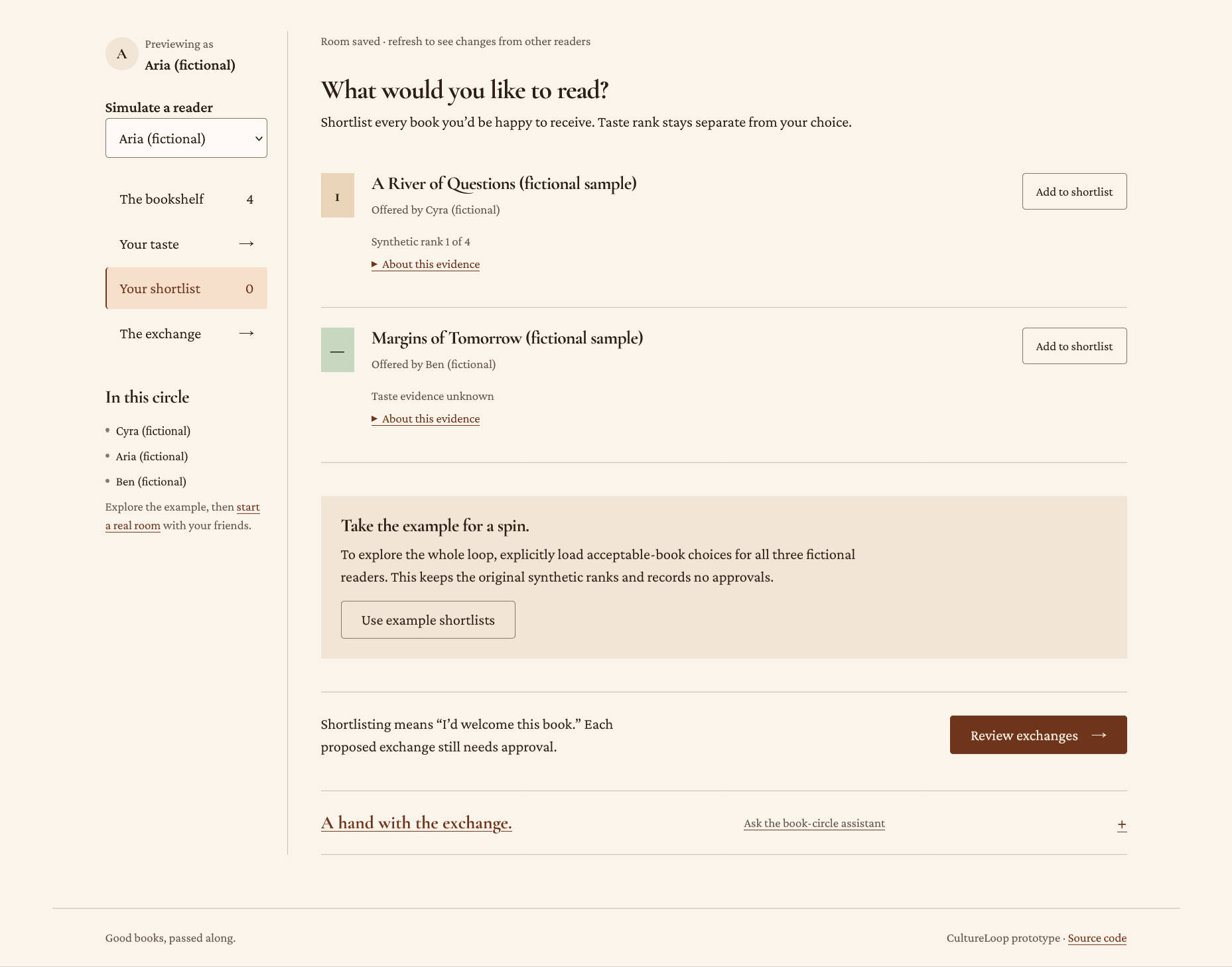
Readers form a private book circle of 2-6 readers. Every individual can contribute up to 3 physical copies and can certify up to 3 cultural favourites. Based on those confirmed interests, the books that are offered in that room are ranked by Qloo. The readers are then asked to explicitly list the titles that they would like.
CultureLoop looks for two and 3-person loops. The participants see exactly what they receive and give, and approve their own transfers. Unanimous approval reserves copies and will allow an Agreement that can be downloaded. When someone withdraws a book, or declines, the workflow can fix the proposal without altering any exchanges. New approval to be issued for changed transfers.
A supporting assistant will read the stored room, refresh the taste suggestions, find exchanges and explain proposals. The shortlist, approval and reporting of a completed handoff are still participant decisions.
What makes it Qloo-powered?What makes it Qloo-powered?
Qloo provides fixed book catalog with canonical cultural identities and ranking evidence for the room. They can find an offered title that they might not have thought of if they had not heard of it through a reader's favourite film, artist, game or book.
The workflow separates three things: Qloo evidence, reader's willingness and approval of an exact exchange. If a rank is missing it remains unknown. The assistant does not create taste scores or consider a generated explanation to be consent.The assistant does not create taste scores or consider a generated explanation as consent.
The deterministic solver makes the logistics possible, Qloo provides cultural and background support for discovery and ordering. No taste quality gains have been compared with others.
How it was built
This application is built with Next.js and comprises the following components: React / TypeScript and is deployed on Vercel. The AI SDK was used to connect domain tools directly to an evengiant with Google's Gemini inferences. Supabase PostgreSQL houses rooms, unique copies, shortlist, evidence, cycle revisions, approvals and inventory holds.
Each action and conversation is associated with the current guest, with a server-side membership check. Retries maintain the same decision, while transactional holds block duplicate allocation. Qloo responses are normalised and cached in private, displayed evidence find live, cached and unknown answers. The credentials remain on the server.
Challenges
The central problem was to connect the fuzzy recommendations to concrete transfers.The main issue was how to combine the uncertain recommendation evidence and perform the actual transfers. Two copies of the same title are separate items. A shortlist is not a Green Light. If one loop is repaired it would preserve the useful decisions from the other loop.
Other problems that had to be addressed were limited coverage of Qloo, agent identity confirmation, private guest sessions, web app + agent deployment in free tiers, and streamed agent reply.
Accomplishments
The deployed application is able to handle the entire exchange workflow consisting of revision-bound approvals, export of repair and agreement. Hosted checks: real SQL, Qloo responses, model / tool execution. The labeled fictional example was reviewed in the browsers, as were the separate simulated approvals, agreement download, reload persistence and an assistant reply. The six screen widths were checked for responsive DOM.
These are implementation tests. We have not conducted participant research, verified physical handoffs or established recommendation superiority.
What we learned
Cultural intelligence is more effective when it leads to a specific decision. A real inventory can be ranked, the choice of humans makes the exchange acceptable. Honest unknowns and preserved approvals are as important as an appealing suggestion.
What's next
Review the current workflow with the consenting book circles, and compare with and without Qloo evidence to enhance the coverage in the catalog and the presentation by the assistants based on the feedback received. It remains to be seen if there will be free tier capacity, and how long it will last.
Built With
- ai-sdk
- eve
- google-gemini
- next.js
- qloo-api
- react
- supabase-postgresql
- typescript
- vercel
- zod


Log in or sign up for Devpost to join the conversation.