-
-
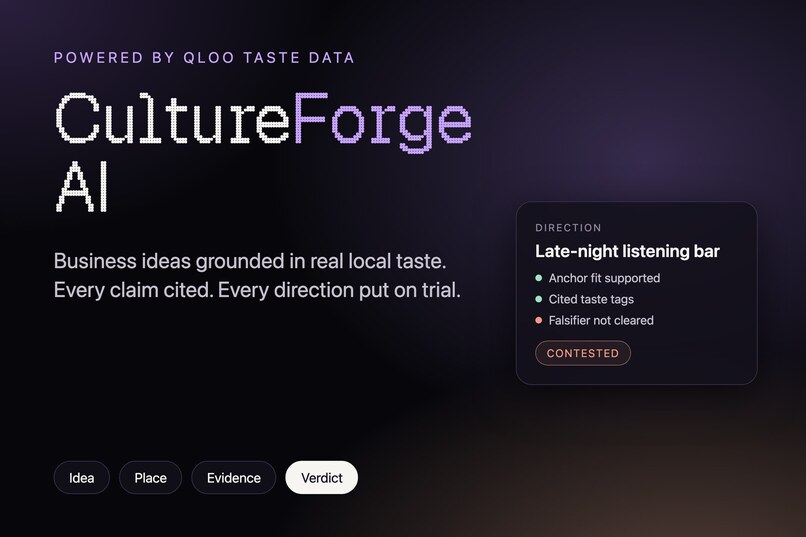
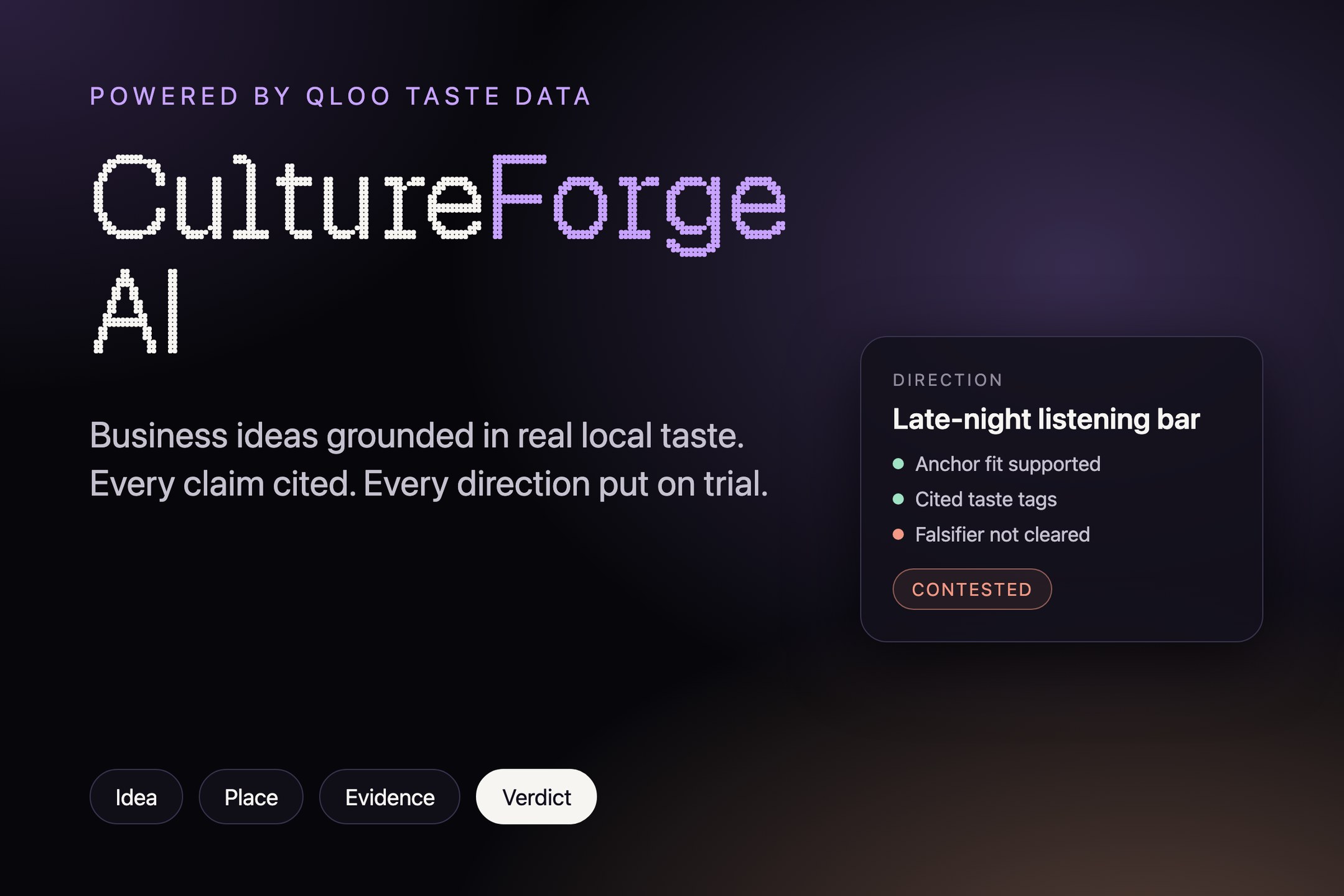
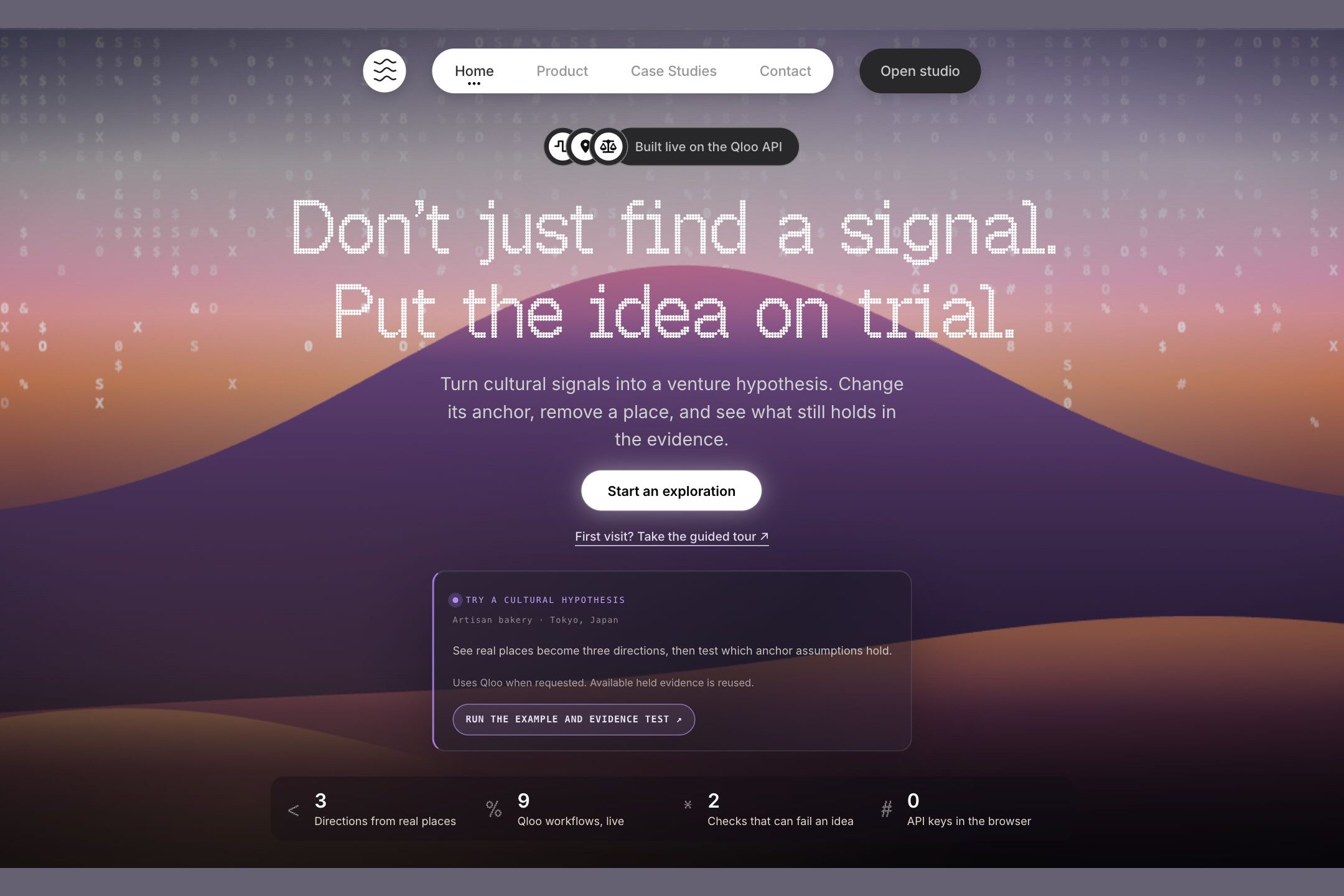
CultureForge AI: put your business idea on trial against real Qloo taste data. Every claim cited, every direction testable.
-
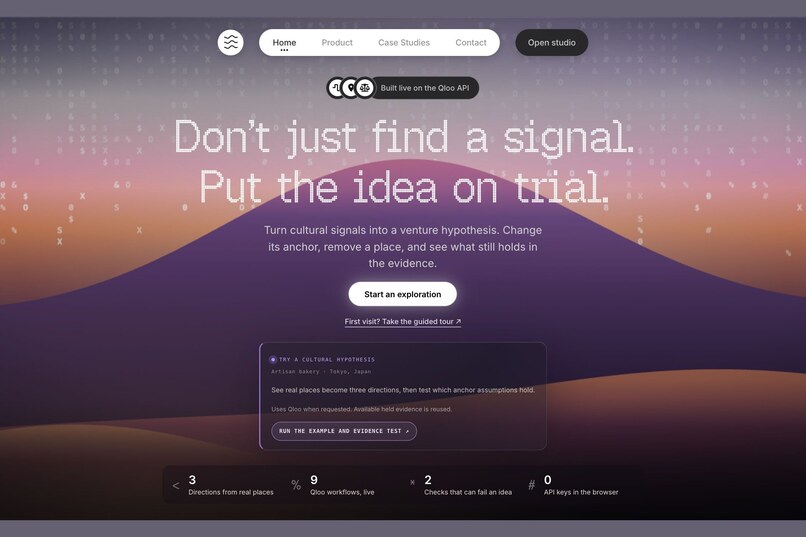
Don’t just find a signal. Put the idea on trial. Our front page runs a live example on the Qloo API.
-
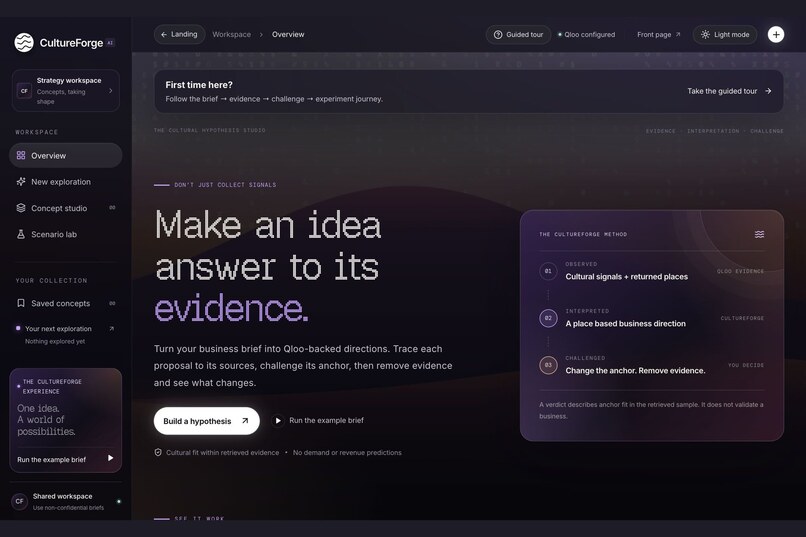
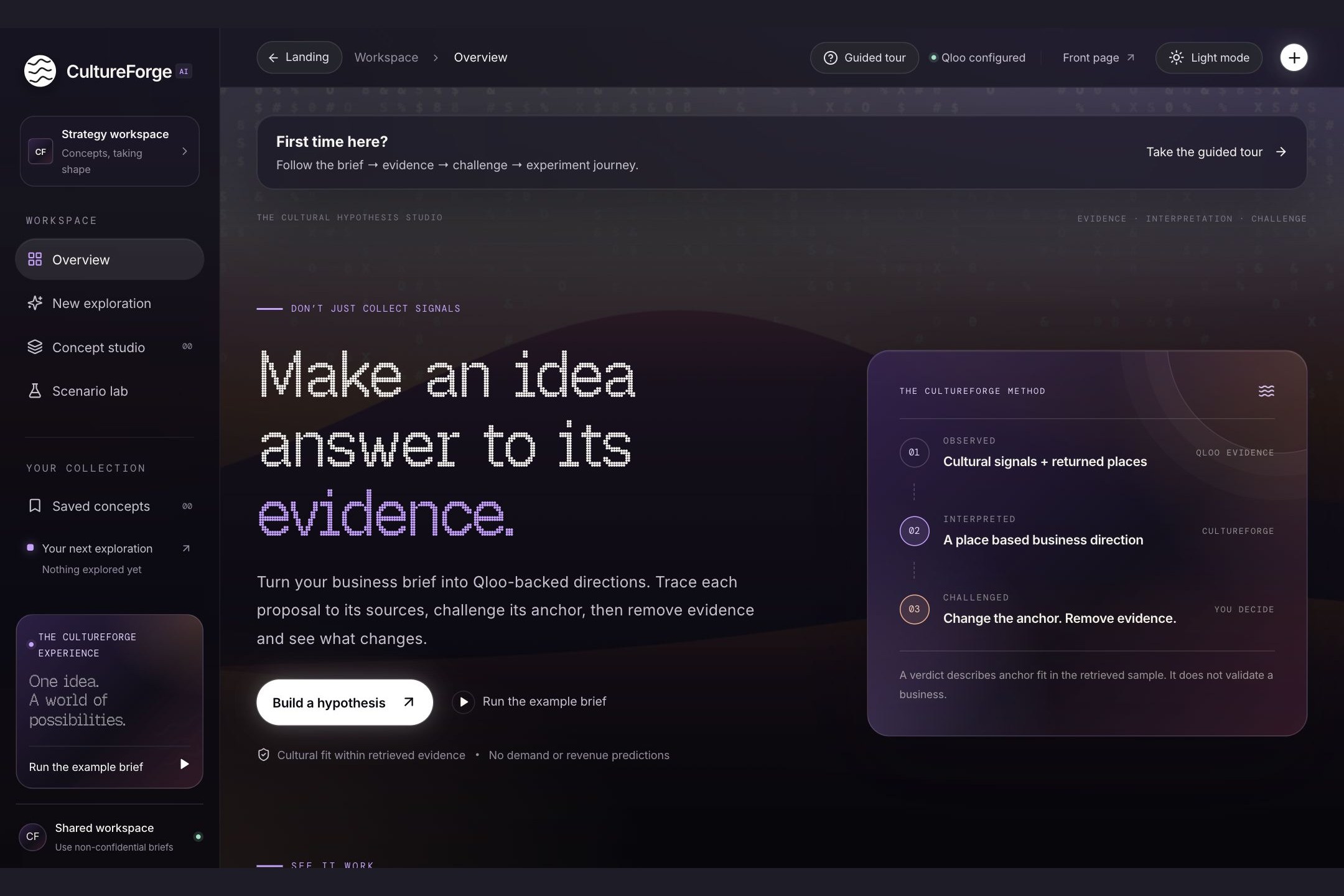
The studio: one idea in, a guided journey of evidence, challenge and experiment out.
-
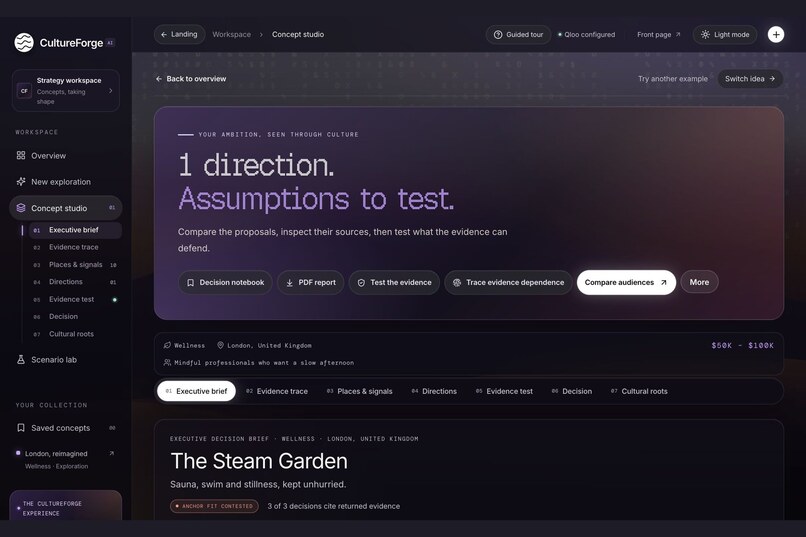
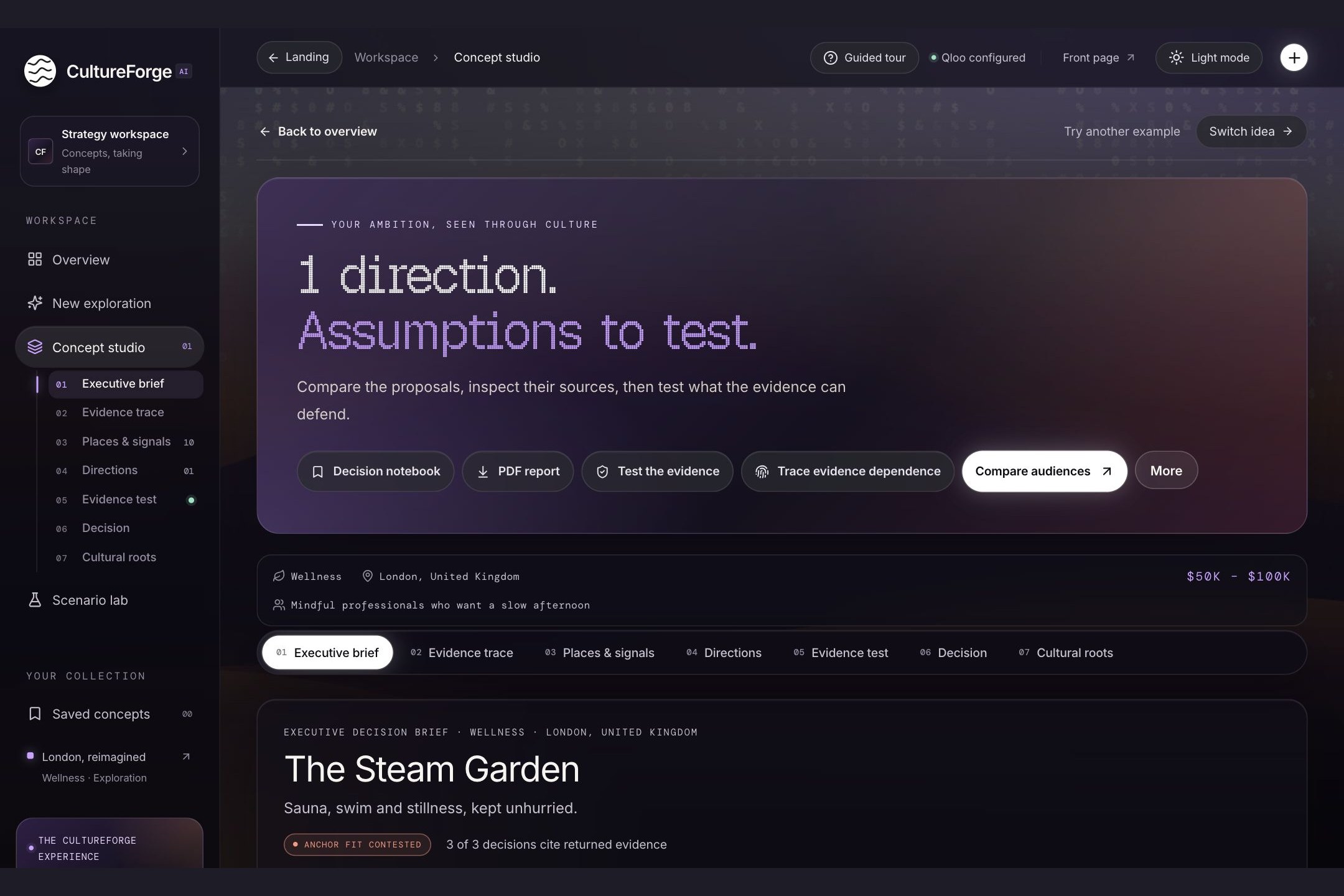
Executive brief: directions to test and assumptions to defend, with every source one click away.
-
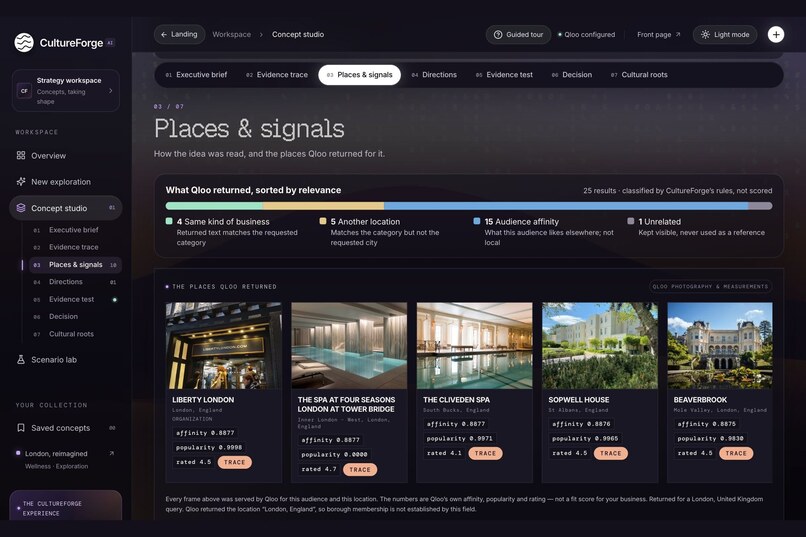
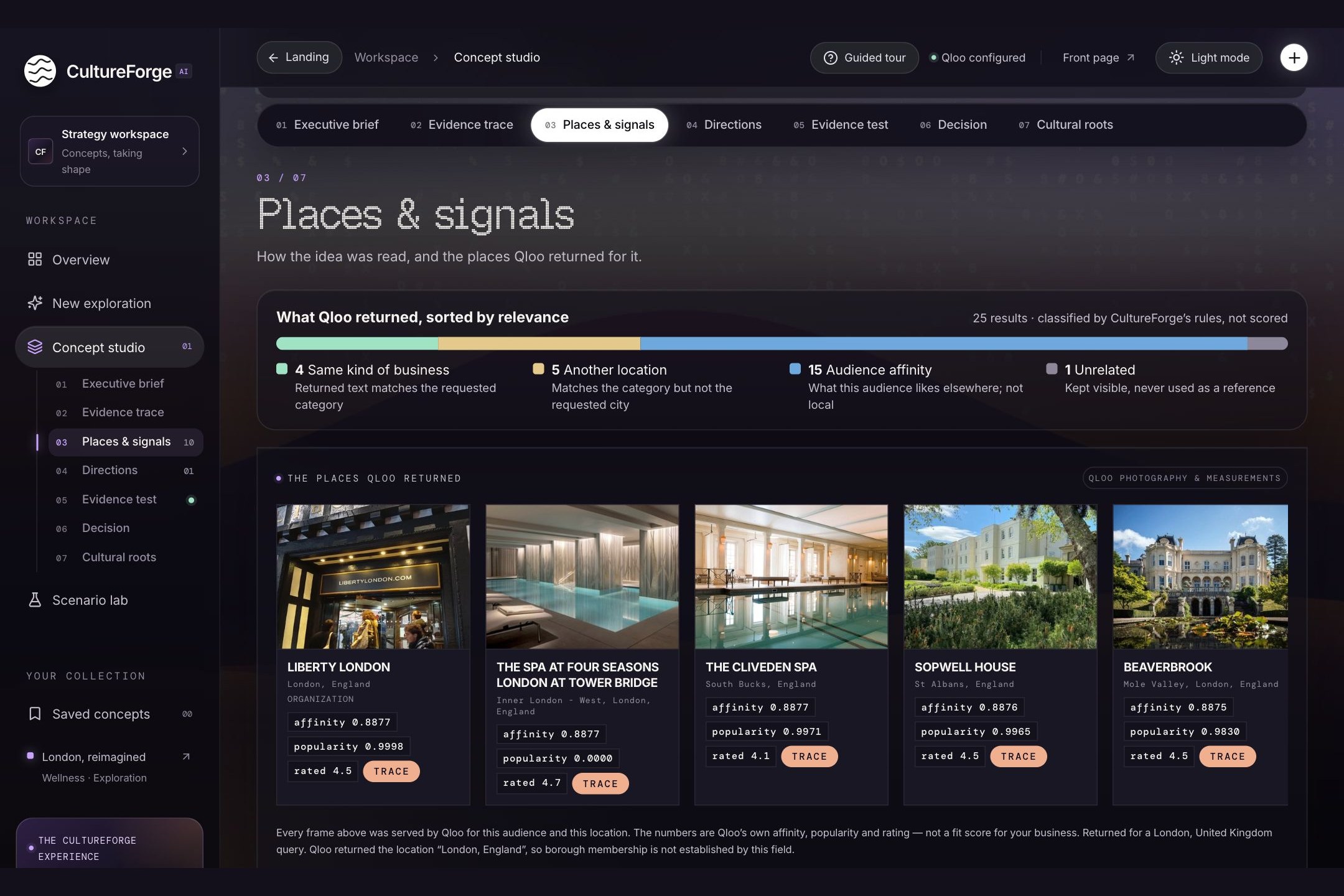
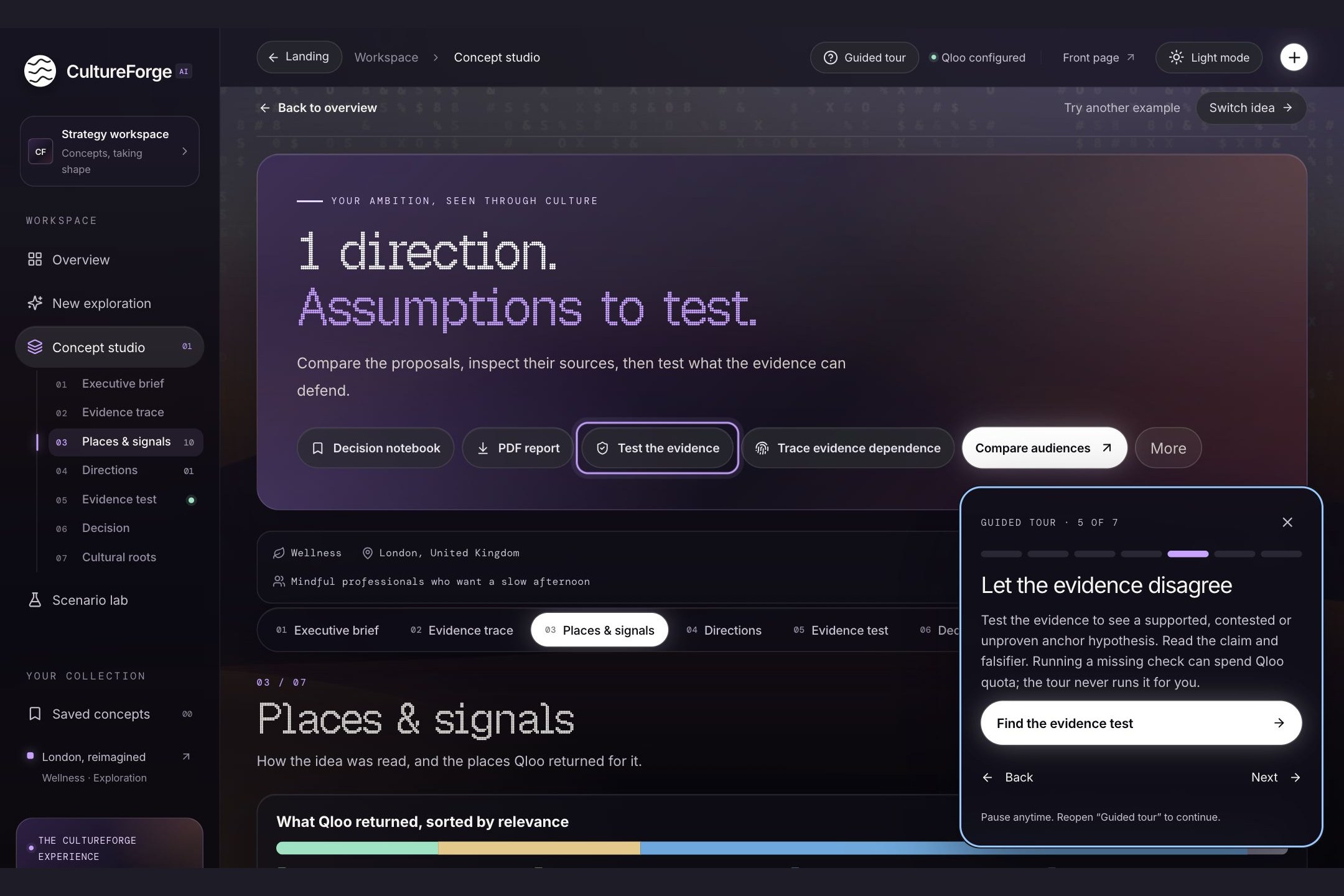
Places & signals: the real places Qloo returned, ranked by relevance, with the exact values Qloo gave.
-
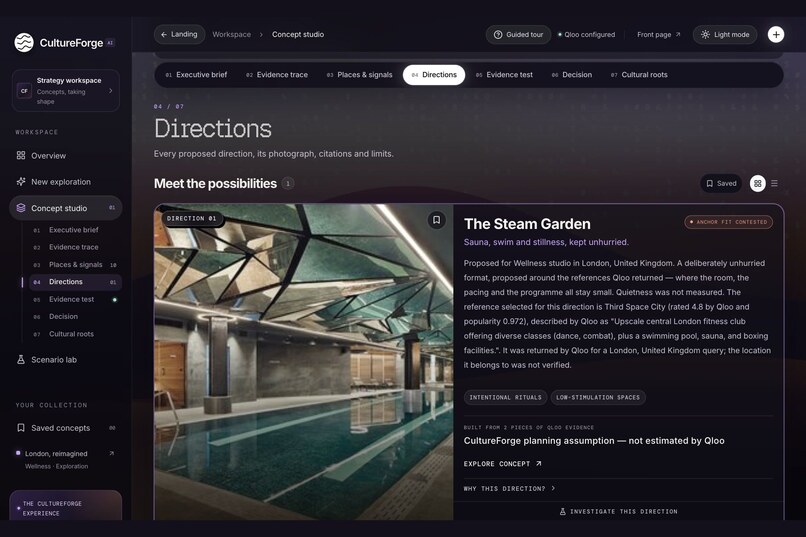
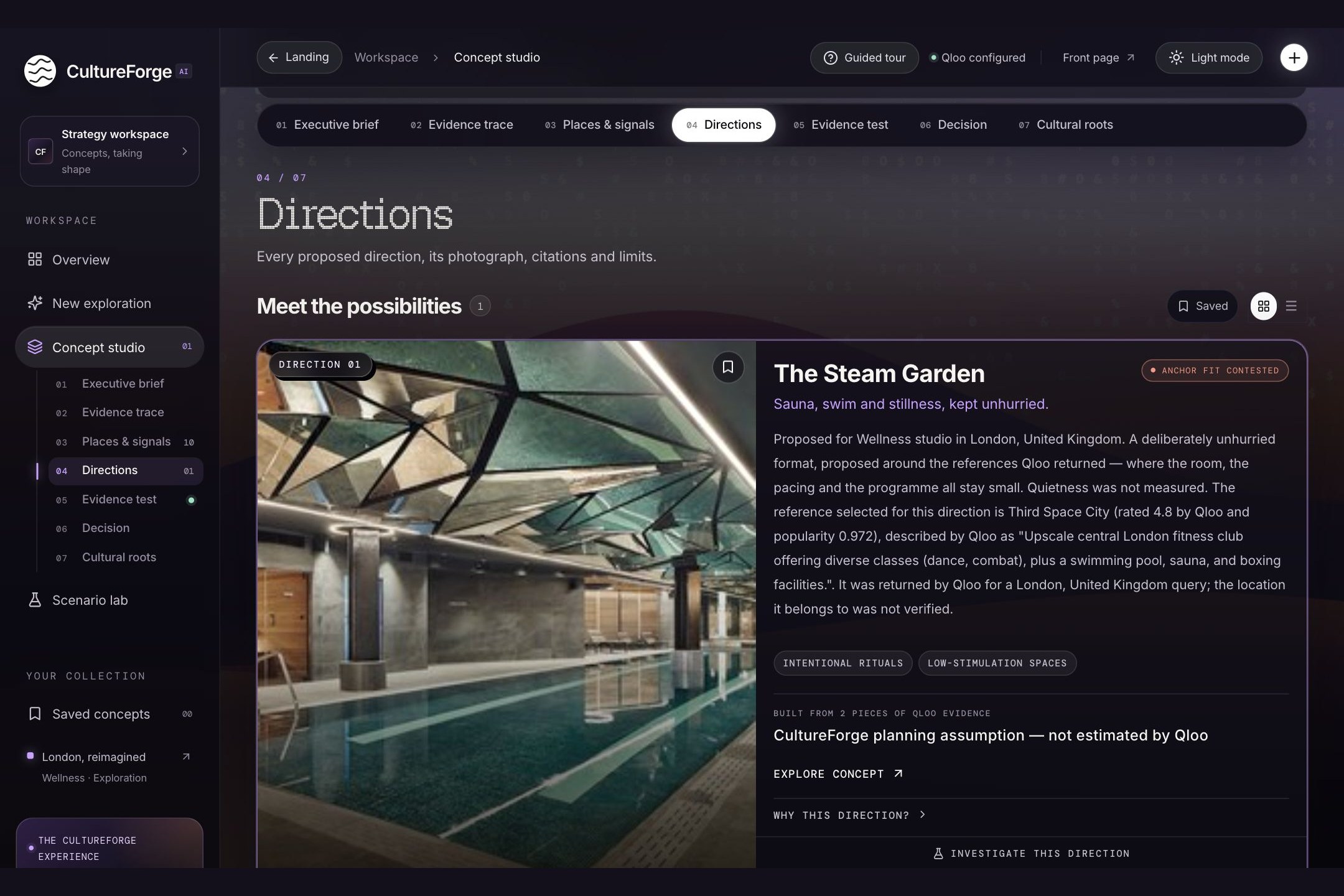
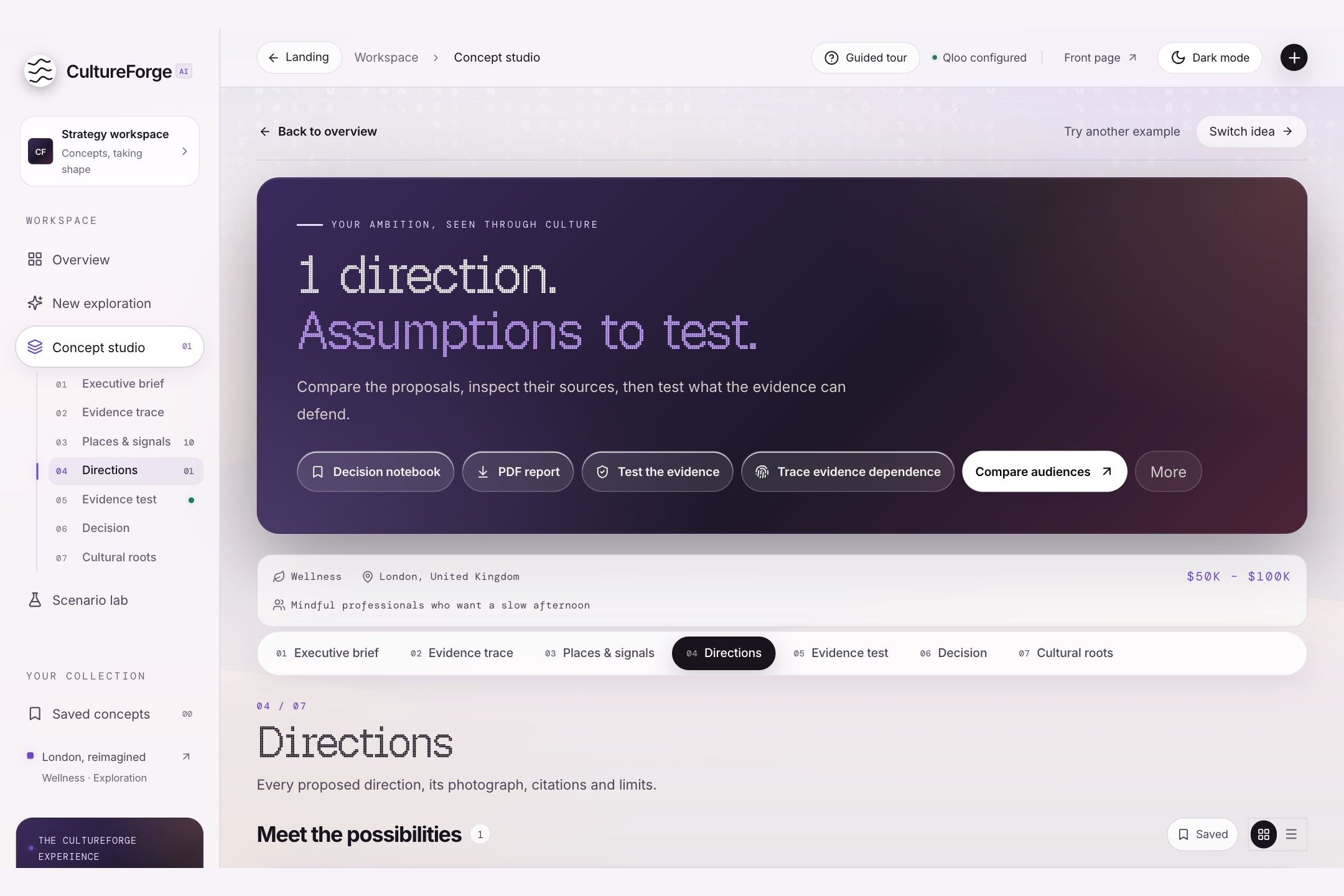
Directions: each proposal names its evidence, claim, falsifier and unproven condition. Nothing invented.
-
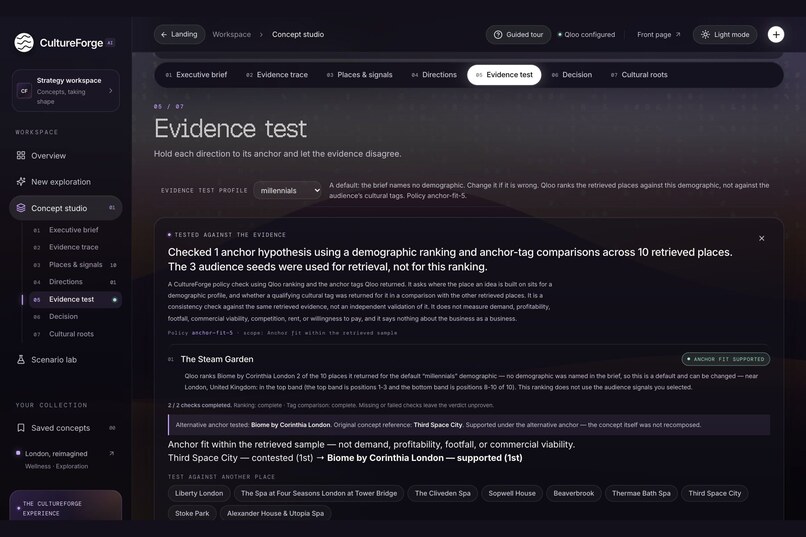
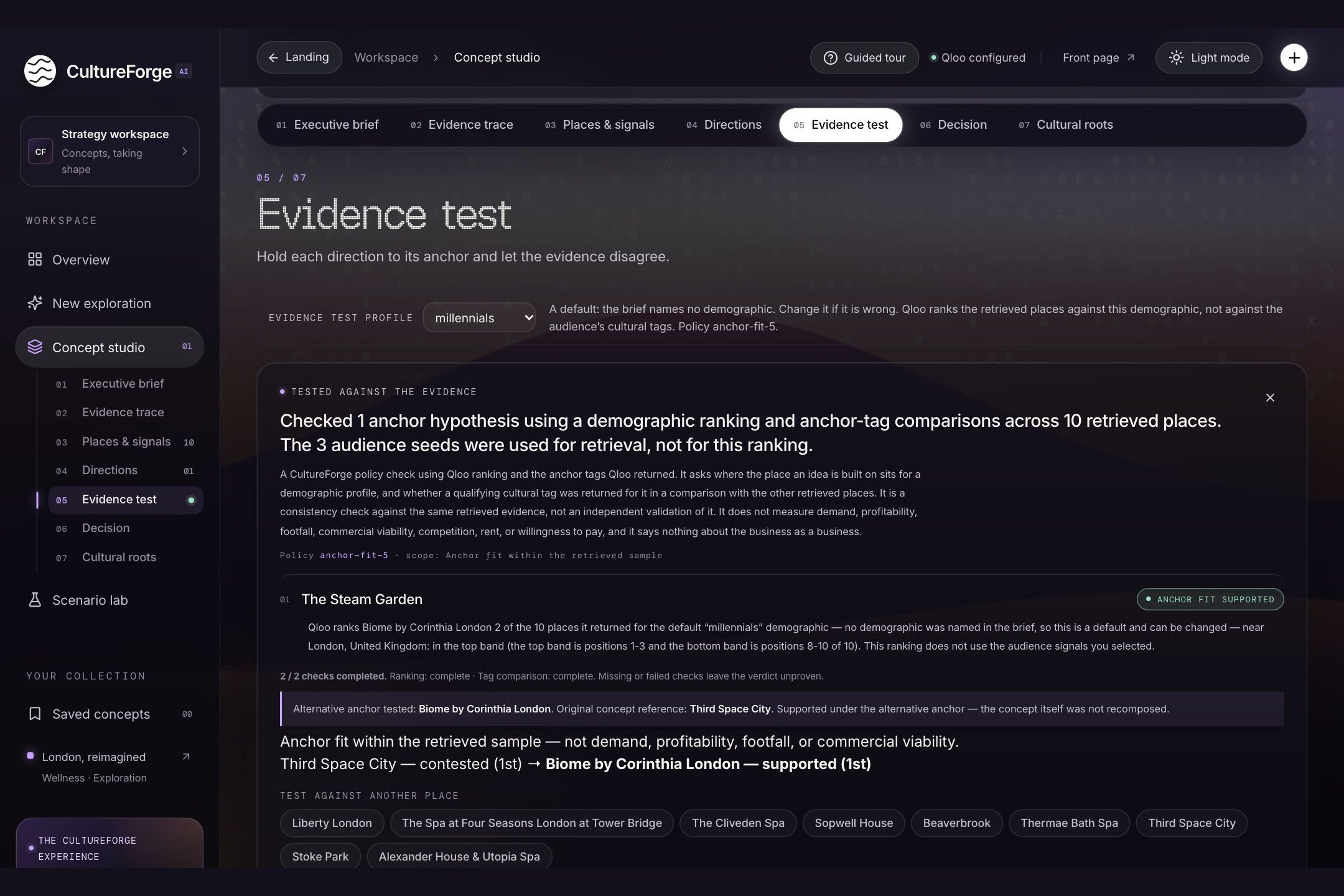
The evidence test checks anchor fit with Qloo rank and audience comparison. It can say “contested”.
-
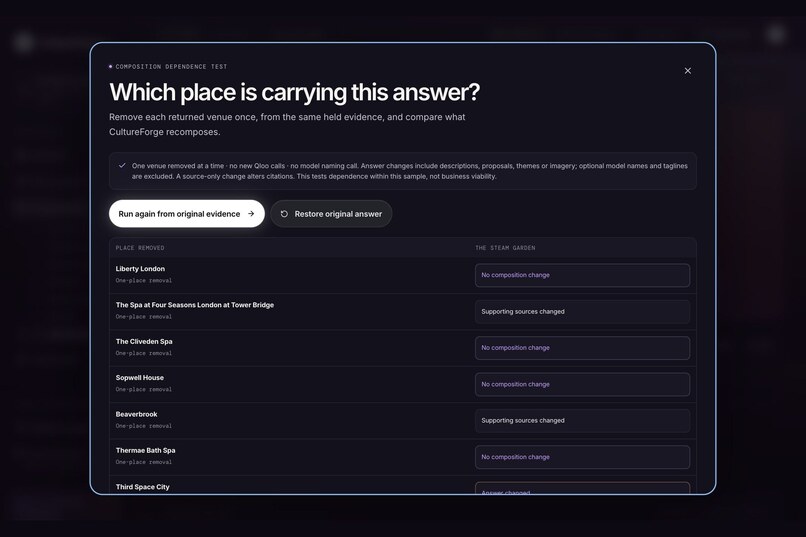
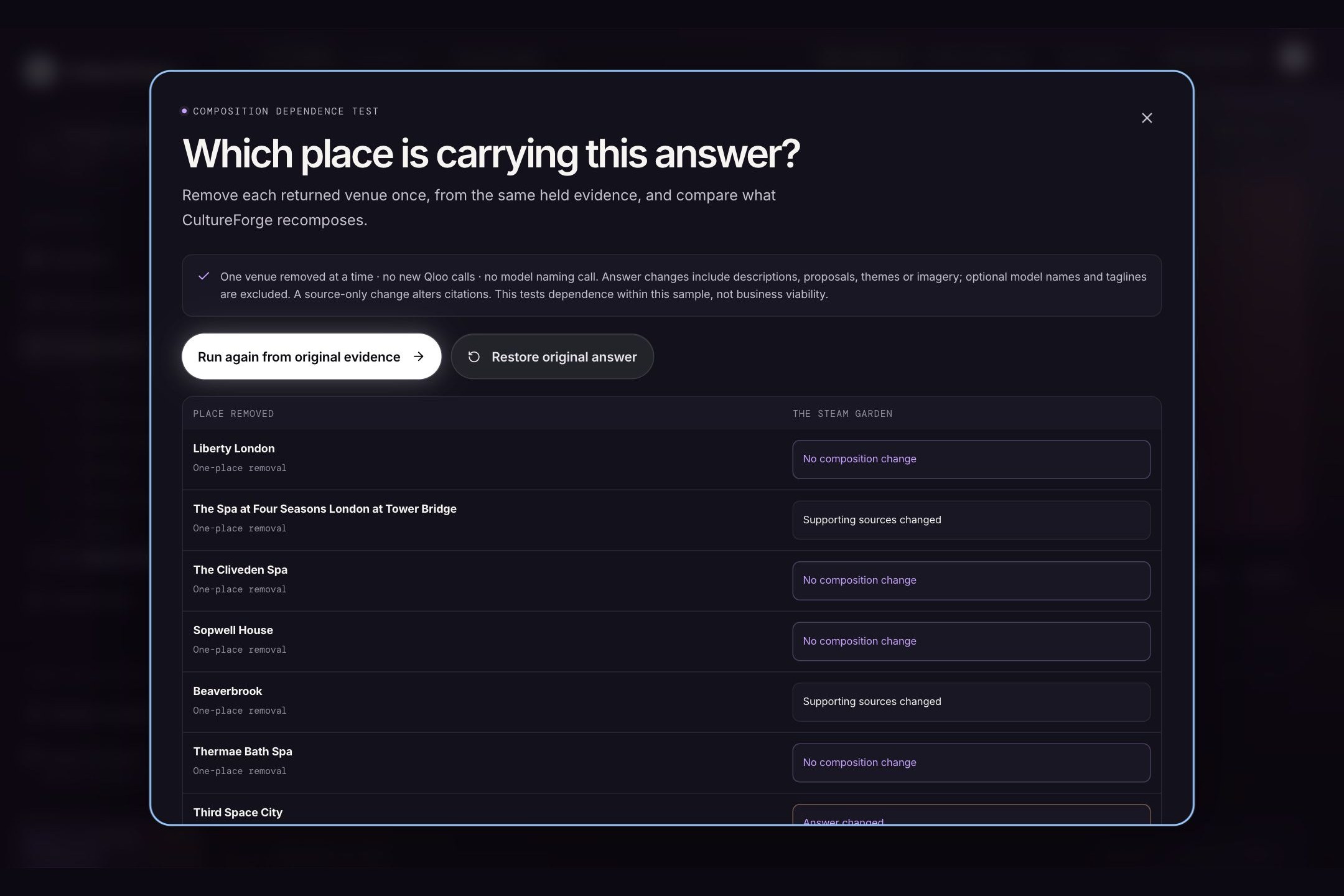
Remove a place and the whole answer is rebuilt from what’s left: description, photo, citations and anchor.
-
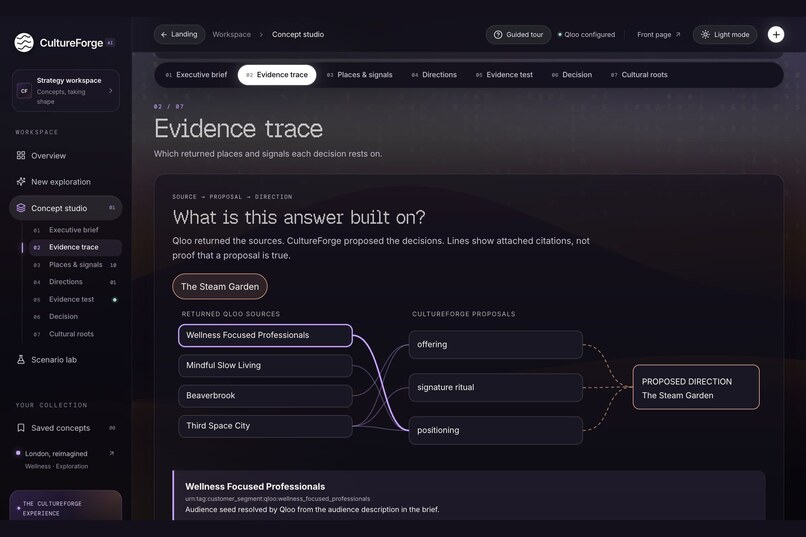
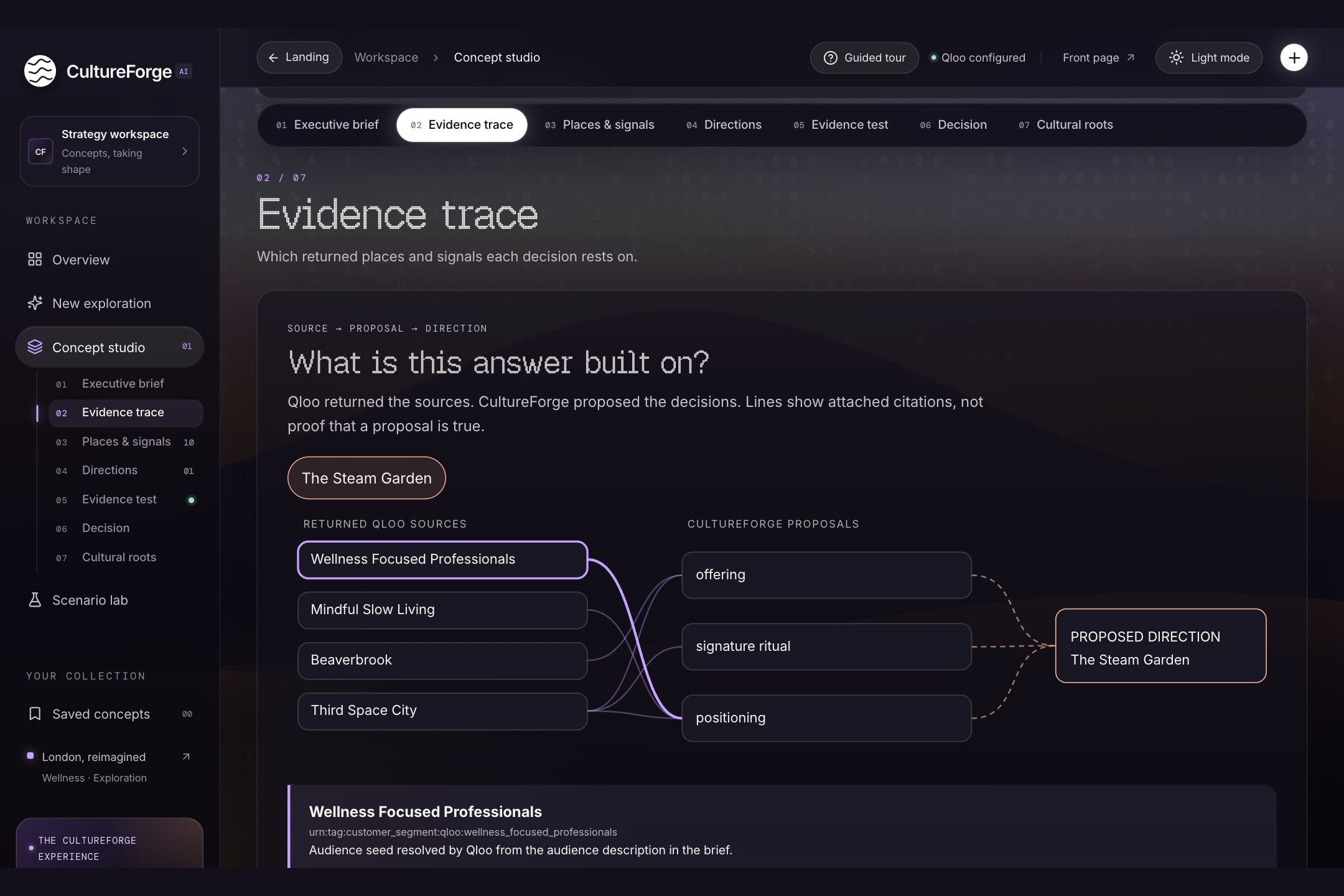
Evidence trace: follow any proposal back to the Qloo results it rests on. If it can’t be traced, it isn’t claimed.
-
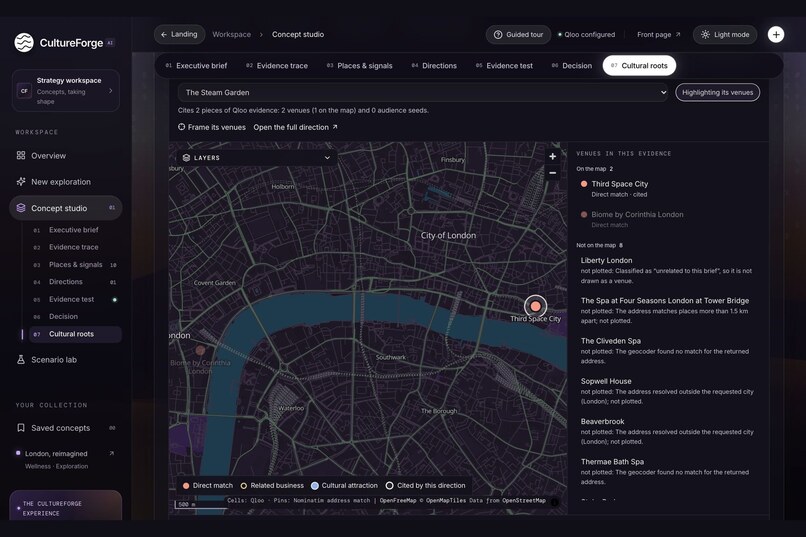
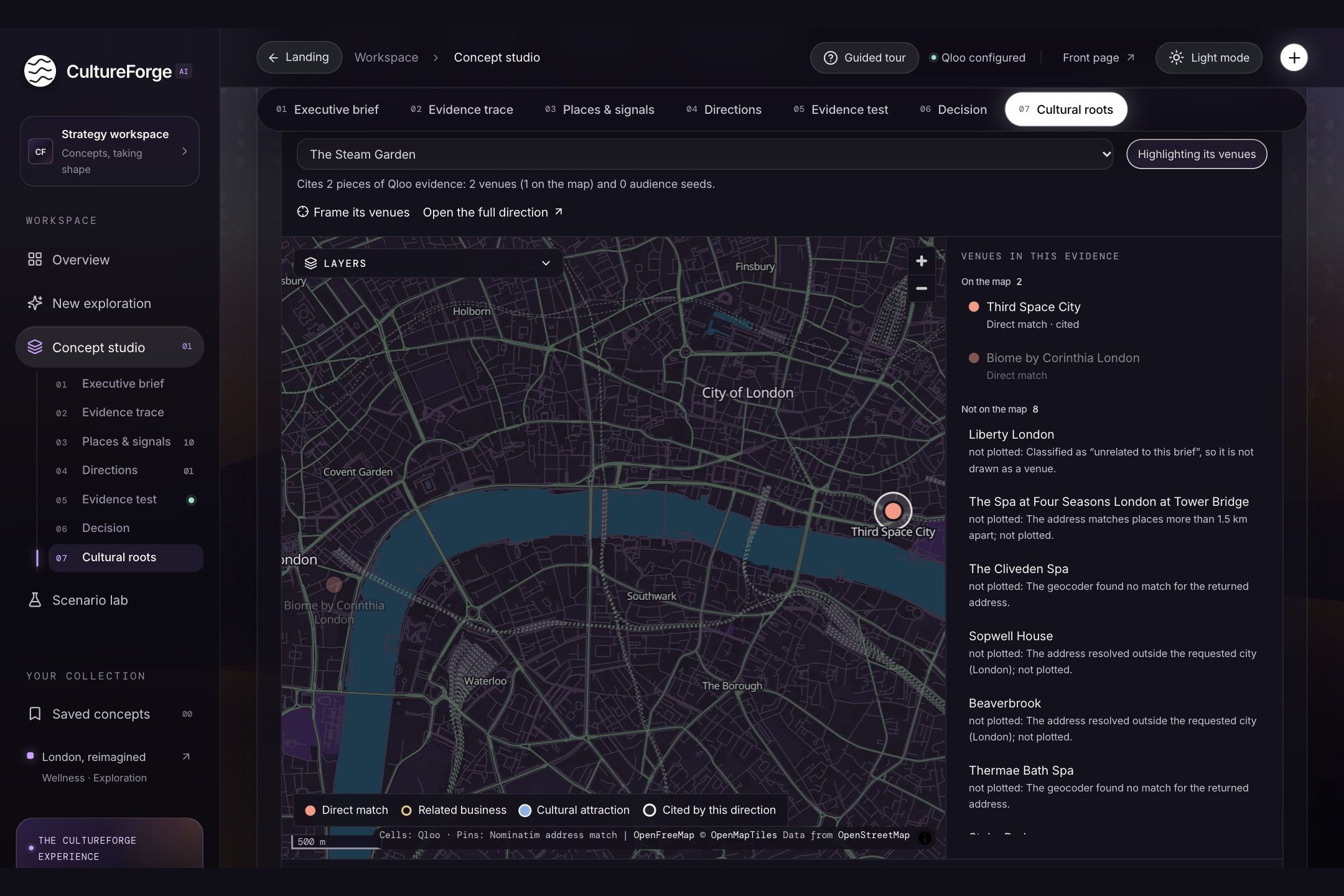
Cultural roots map: see where the cited venues sit and which ones the evidence actually points to.
-
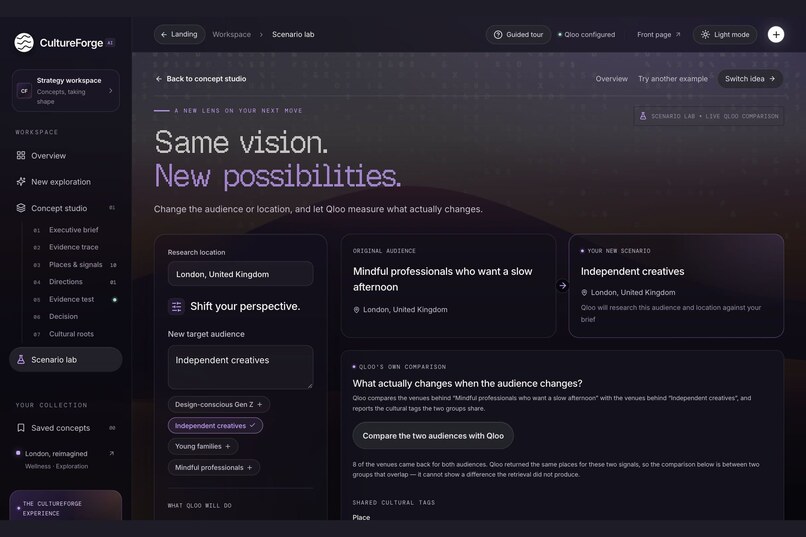
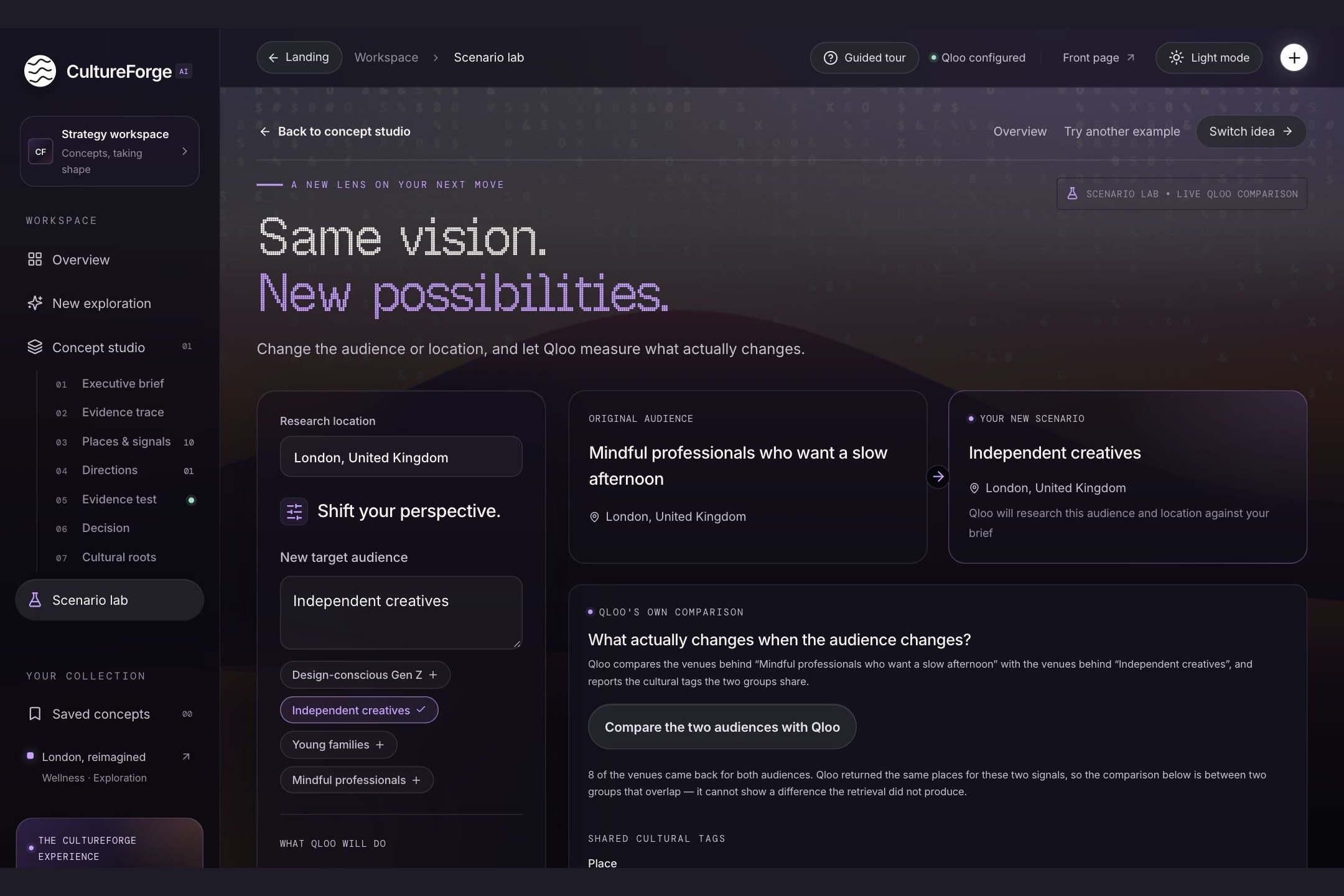
Scenario lab: change the audience or city and see exactly what Qloo says changes. Same vision, new possibilities.
-
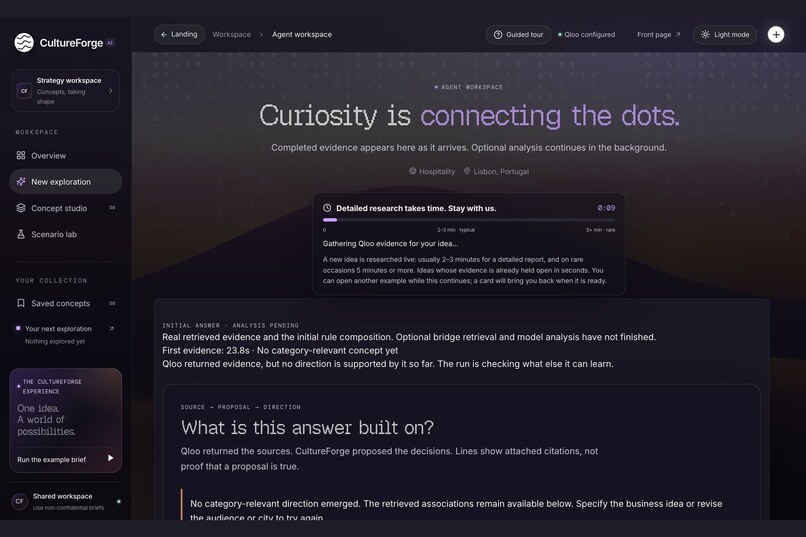
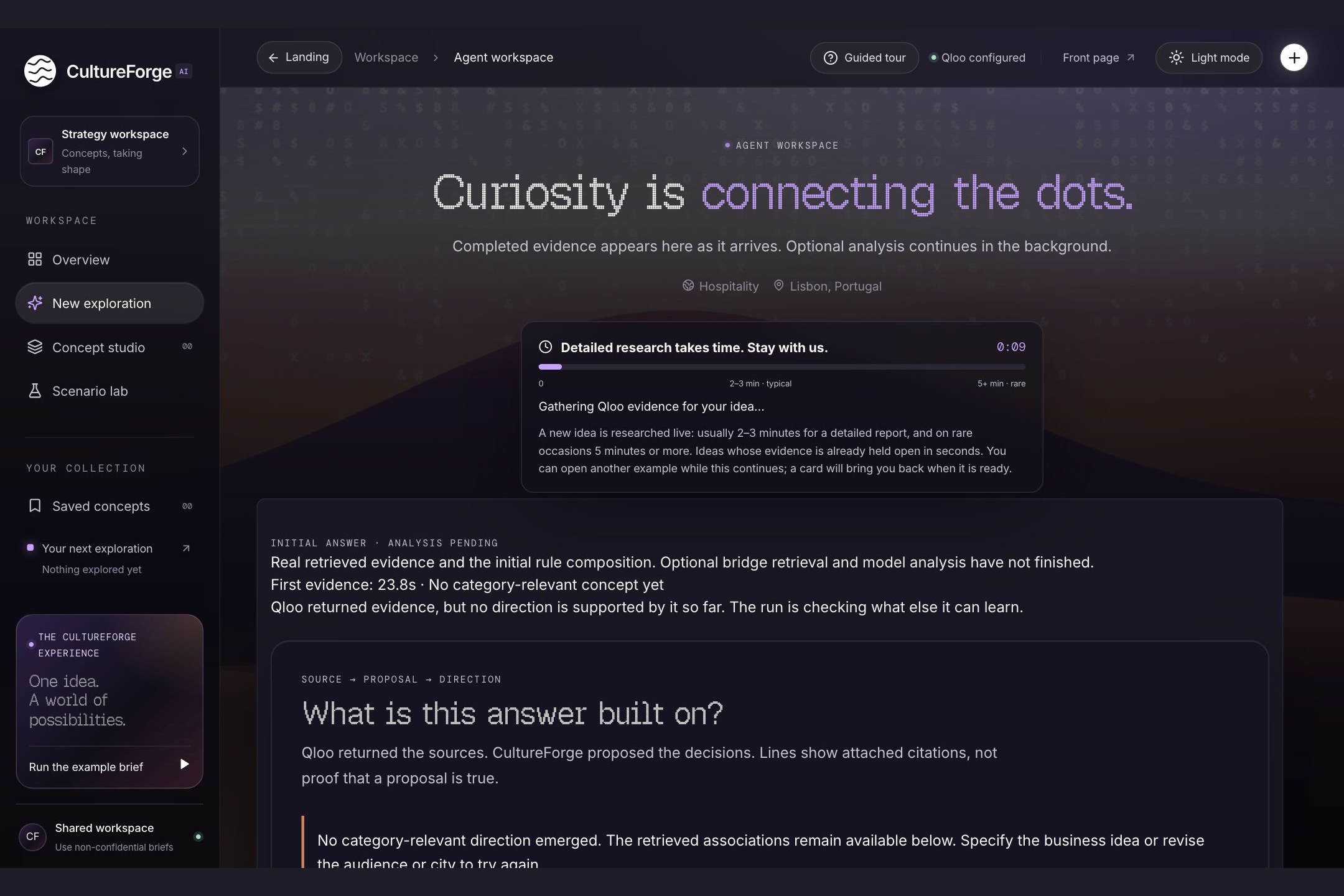
Agent workspace: a bounded AI loop calls only allowlisted Qloo workflows and cites every claim by ID.
-
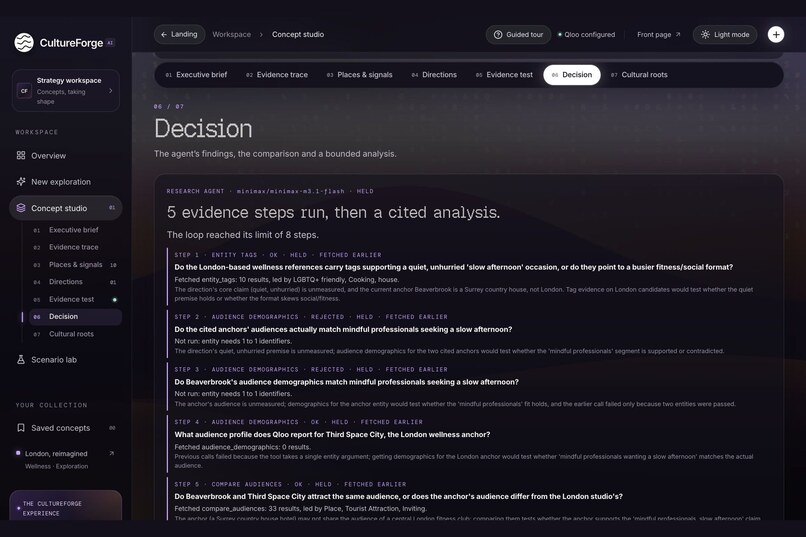
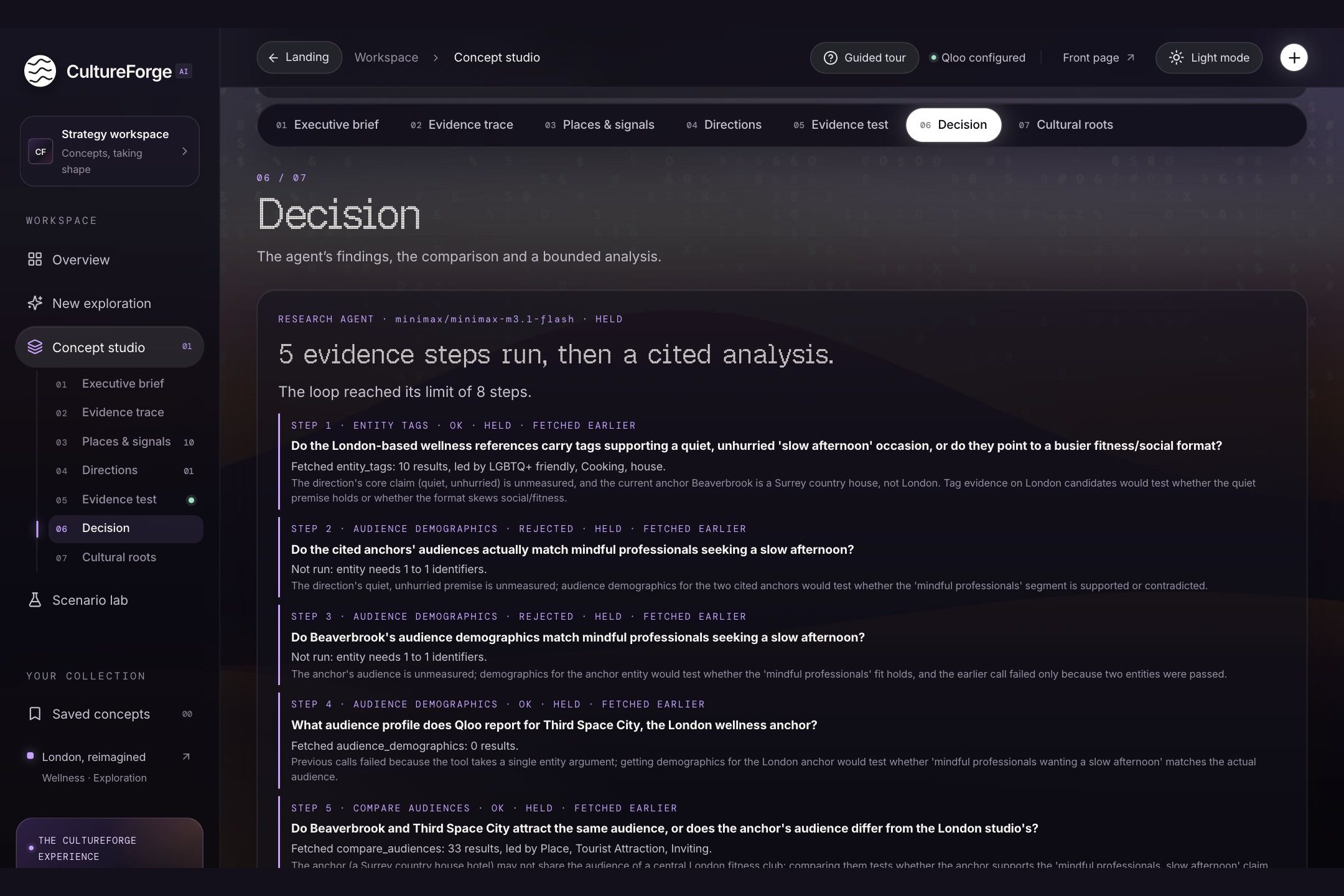
Decision: a cited analysis of the agent’s steps, naming the most defensible direction to investigate first.
-
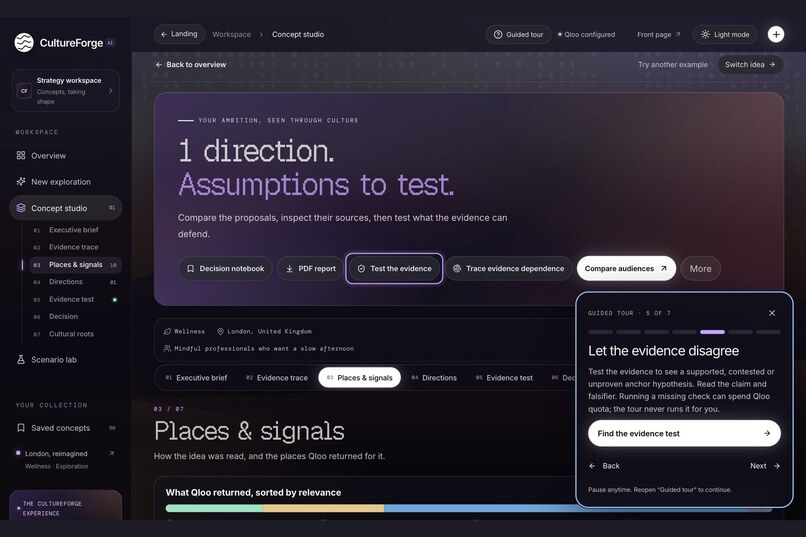
Guided tour: built-in prompts walk a first-time judge from brief to verdict, step by step.
-
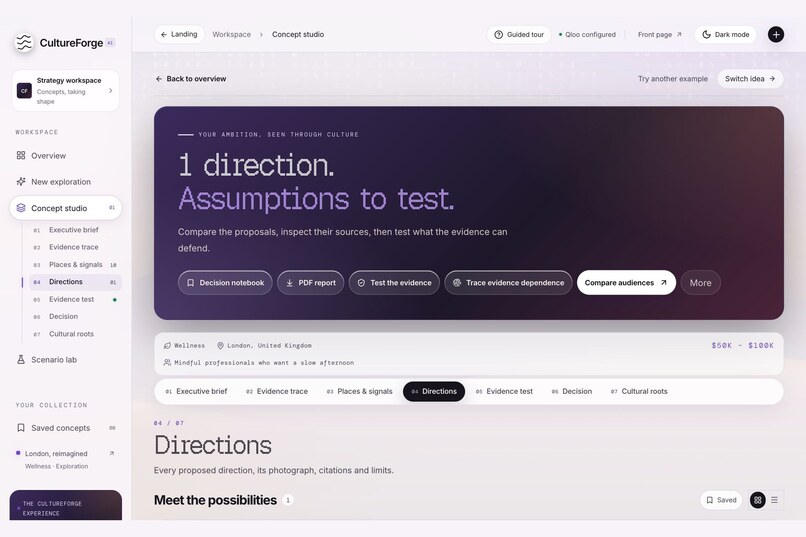
Light mode: the same evidence-first studio, readable in daylight, with the same rules and citations.
Inspiration
🌍 Most AI idea generators tell you what you want to hear. CultureForge is built to disagree with itself.
Everyone has watched an AI confidently invent a "market insight" that nobody can trace. A strategist at a hospitality group has to defend a site choice to a committee, and a paragraph of fluent guesses will not survive that room. They need to know what the data actually returned, and what would prove the idea wrong.
Agents are culturally blind. Qloo's taste graph (250M+ entities) fixes that, so we asked one question:
What if the AI could only say what Qloo returned, and then had to defend its idea against that evidence?
Our rule: the model may write the words, but it may never invent the facts. 🔒
🎬 Watch the demo video above · 🌐 Try the live studio · 💻 Read the code, all linked under "Try it out".
What it does
You give CultureForge a business idea, a city and an audience. It reads real Qloo taste data, proposes culture-backed directions, cites the evidence behind every claim, and then puts each direction on trial. A direction can come out contested, and that is the point. ⚖️
🧭 Reads the idea. A brief like "plant-based restaurant" or "bookshop café" becomes typed parts: hybrids, specialisations, and simplifications it tells you about.
🔎 Gets real evidence. Qloo returns the audience's tags and up to 10 real local places.
🧱 Builds directions. Plain rules turn that evidence into proposals. Every proposal names the places and tags it came from.
🤖 Investigates like an agent. Up to 8 plan, act, observe steps over an allowlist of Qloo workflows. Every claim must cite an entity ID or tag it actually saw in that run, or it is thrown out.
⚖️ Tests itself. Qloo rank and compare_audiences check whether a direction's anchor place really fits. A direction can come out supported, unproven or contested, and it can be held to a different place and re-tested.
✂️ Lets the evidence go. Remove any place and the answer is rebuilt from what is left: description, photo, citations and anchor.
🧪 Scenario lab. Change the audience and see what Qloo says changes, including when two audiences overlap too much to tell apart.
💬 Ask the evidence. Follow-up questions are answered from the evidence on screen, or refused.
📄 Take it away as a PDF report and a decision notebook.
Every screen also says what it cannot claim: the verdict is about anchor fit within the retrieved sample, not demand, rent, competition or willingness to pay. 🎯
🔌 What makes it Qloo-powered: all nine workflows of the Qloo Hackathon Kit
1️⃣ find_tags: turns the audience and category into real Qloo tags.
2️⃣ recommend: up to 10 local places per brief (the core evidence), plus artists, films and brands for the same audience, so the answer reaches beyond places.
3️⃣ rank: ranks the anchor place for a demographic profile. Half of the verdict.
4️⃣ compare_audiences: compares the anchor's tags against every other returned place. The other half.
5️⃣ where_popular: the cultural-interest map.
6️⃣ entity_tags: the tags behind a place the agent is investigating.
7️⃣ describe: metadata for an entity, available to the agent and to chat.
8️⃣ audience_demographics: a demographic index for an audience, available to the agent and to chat.
9️⃣ trends: time series, available to the agent and to chat.
Each one has its own request builder, goes through the same cache, and appears in a provenance drawer with the request that was actually sent.
Would it work without Qloo? No. There is no mock path anywhere in the studio. Without a Qloo key it refuses to answer, and a contract test fails the build if a mock reference ever comes back. Without Qloo's returned IDs, nothing can be cited, and an uncited claim is rejected.
🧭 Where to look, by judging criterion
🛠️ Technological Implementation: nine Qloo workflows, a bounded agent with a citation validator, a durable evidence cache, and 493 backend tests that all pass.
🎨 Design: a seven-section studio with a guided tour, light and dark themes and a phone layout. Every state that can fail has a stated reason and a way forward.
📈 Potential Impact: the buyer is a location or concept strategist at a hospitality group or brand agency, who has to defend a site or concept to a committee. The business case and its open assumptions are in docs/BUSINESS.md.
💡 Quality of the Idea: a verdict that can disagree with the composer, and a model that is not allowed to cite anything Qloo did not return.
🔍 Check it yourself in two minutes
The live studio is public, and every claim here can be checked without taking our word for it:
🩺 /api/health shows the profile, the budgets and that the provider is live.
📚 /api/examples lists the 14 prepared briefs and whether each one is held.
🧾 /docs is the full, interactive API reference.
🗂️ /api/qloo/workflows lists the nine workflows.
🔁 scripts/judge_replay.py in the repo replays all 14 prepared briefs from a clean install, with an empty cache and Qloo and the model switched off. In our run it returned 17 directions: 2 supported, 2 contested and 13 unproven, with zero upstream requests. A test that always says yes would be decoration. This one often says "not proven", and sometimes says no.
How we built it
🐍 Backend. Python, FastAPI and Pydantic, with SQLite for workspaces, metering and the call ledger. Every route that takes a body takes a typed one, so a malformed request is a 422, never a silent pass.
🔌 Qloo layer. One request builder per workflow, because Qloo rejects fields it does not know. A durable evidence store holds every answer (24 hours in dev, 30 days in judging), and a failure is never cached.
🤖 Agent loop. Server-built requests, observed IDs only. Its analysis is validated so every claim cites an entity ID or tag URN from the run. If validation fails, the rule composer's answer stands, and the screen says so.
🧠 Model layer. Vercel AI Gateway, server-side only. The model writes bounded direction names, taglines and analysis. The rules keep every fact, verdict and citation, and unsupported numbers are rejected.
🎨 Frontend. React 18, TypeScript, Vite and Tailwind, with MapLibre for the map.
🧮 The verdict maths
We refused to invent a fit score. The test uses only ranks, counts and values Qloo returned.
Let n be the number of places Qloo ranked, and p the anchor's position, where 1 is best. The band size is:
k = max(1, ⌊n / 3⌋)
The rank check is:
- pass if p ≤ k
- fail if p > n − k
- mixed otherwise
With ten places, k = 3: positions 1 to 3 pass and positions 8 to 10 fail.
The verdict combines the rank check with the tag check:
- contested if the rank check fails
- supported only if the rank check and the tag check both pass
- unproven otherwise
Half an answer is not a verdict, so one passing check and one missing check is unproven.
Leave-one-out. We remove each other place in turn and re-apply the rule among n − 1 places, with k′ = max(1, ⌊(n − 1) / 3⌋). If any single removal flips the rank check, confidence drops to low. The policy is versioned (anchor-fit-5), and the version changes whenever its logic or wording does.
🚢 Shipping. Docker on our own Ubuntu server, publicly reachable over HTTPS through Tailscale Funnel. A judging profile lifts call-count budgets but keeps timeouts, the 429 cool-down, request de-duplication and the cache. The 493 backend tests, plus contract, walkthrough and endpoint checks, never touch Qloo or a model.
🗓️ Built during the hackathon. CultureForge was started from scratch on October 17, 2026, inside the submission period.
Challenges we ran into
⏱️ Qloo is slow and finite. /v2/insights needs about 25 seconds, while the stock client gives up at 20, so every live request turned into three failed attempts. We wrapped the harness with our own timeouts and a 429 cool-down. Held briefs now replay in about a second, and a first answer on a brand-new brief appeared in about eleven seconds in one measured London run (an example, not a latency guarantee) while the full report finishes in the background.
🗺️ A wrongly used location role. Berlin timed out until we isolated it: the same tags, category and count, with a result-location filter instead, returned ten places in under nine seconds.
🤥 Keeping the AI honest. Letting a model analyse is easy. Making it unable to cite anything Qloo did not return is the hard part, so every identifier is checked against the run's own responses and the rest are rejected.
🧾 Removing a place must really remove it. A rebuild that claims to have happened while the removed venue is still the anchor is the worst lie this product could tell. Removal now rebuilds the description, photo, citations and anchor, and tests pin it.
🪞 Wording the verdict. We rewrote the copy repeatedly so it never says Qloo inferred a profile (CultureForge proposed it) or calls a tag exclusive.
Accomplishments that we're proud of
⚖️ A verdict that can say no. The test can disagree with our own composer, and across the 14 prepared briefs it returns contested, supported and unproven, not just one.
🚫 Zero mock data. No mock path, anywhere.
🔗 Every claim traceable. Each direction links to the Qloo places and tags it rests on, with its claim, its falsifier and its unproven condition stated.
🧪 14 prepared trials you can open straight away, across food, wellness, entertainment, retail and hospitality, in cities from Brooklyn to Tokyo to Mexico City. They ship with the code and reopen with zero new Qloo requests.
🧰 Honest about its limits. Every screen states what it cannot claim, and the project ships docs on limitations, evidence policy and a business case labelled as assumptions.
🌐 Live and public. Anyone can open the studio and run it today.
What we learned
🧠 A verdict has to be able to fail. If every direction passes, the feature is decoration.
🏷️ Say what the check did, not what it sounds like it did. Our ranking request sends a demographic profile and a location, not the audience's cultural tags, so the screen says exactly that.
🕳️ Absence is not proof. A comparison response is a bounded list, so a tag that was not returned never proves other places lack it.
💸 Quota is a design constraint. On-disk caching, single-flight requests and a call ledger keep the demo honest and cheap: a repeated brief costs zero upstream requests.
🛟 Never strand the reader. Every state that can fail has a stated reason and a way forward.
What's next for CultureForge AI
🤝 A design-partner pilot with one hospitality or brand-strategy team, to see whether cited, challengeable evidence gets used in a real concept review. The business case is in docs/BUSINESS.md, labelled as assumptions to test, not traction.
🧩 More category coverage and a wider library of held, citable trials.
🌍 More cities.
🏢 A licensable layer (workspaces, issued keys, saved explorations and metering), already built on SQLite.
CultureForge AI turns cultural signals into a venture hypothesis you can challenge, and it can tell you when the evidence says no. ⚖️✨
Built With
- ai-agents
- css3
- docker
- eslint
- fastapi
- fpdf2
- html5
- javascript
- maplibre-gl
- node.js
- pydantic
- pytest
- python
- qloo-api
- qloo-hackathon-kit
- react
- sqlite
- tailscale
- tailwindcss
- typescript
- ubuntu
- uvicorn
- vercel-ai-gateway
- vite
