-
-
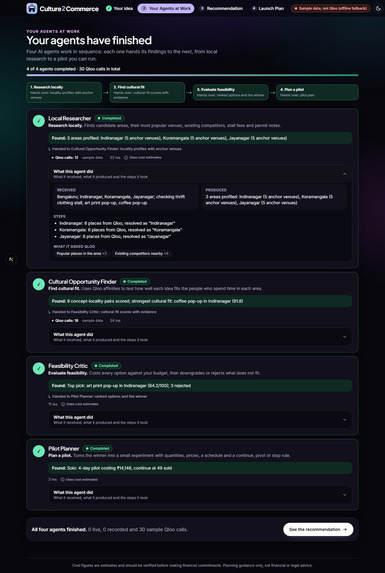
Agents at Work
-
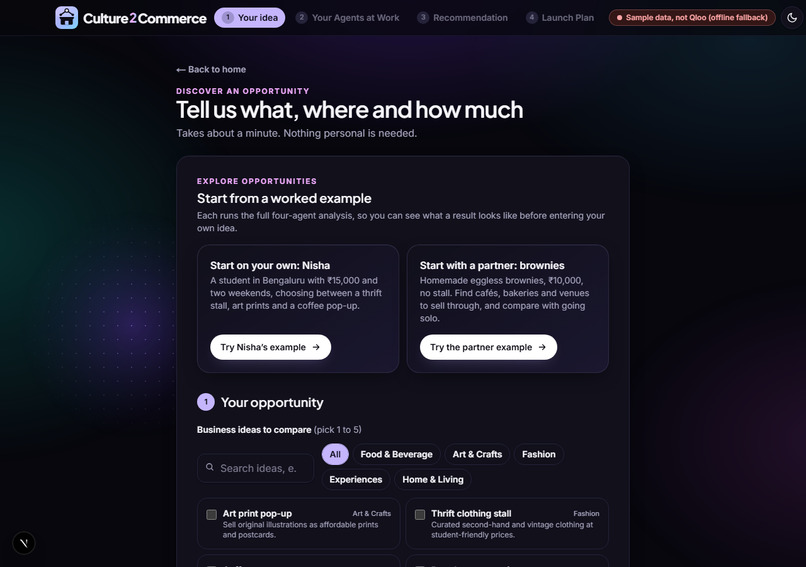
Your Idea
-
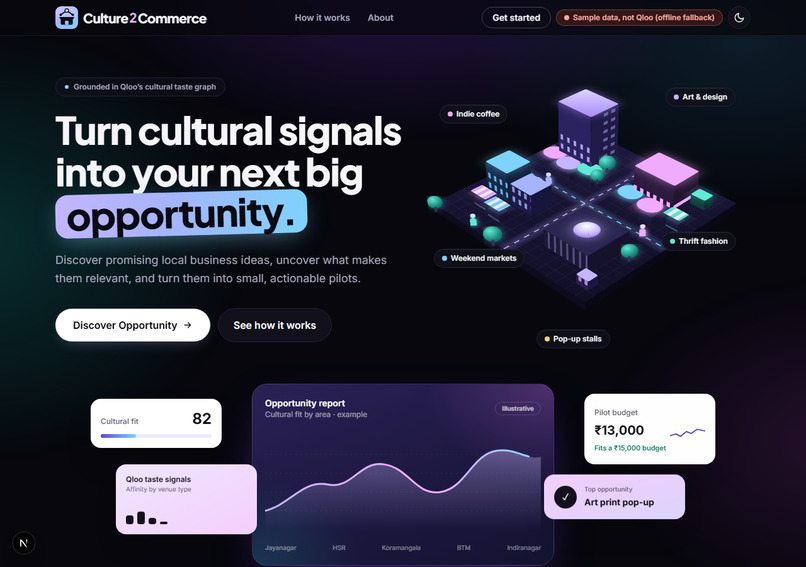
Landing
-
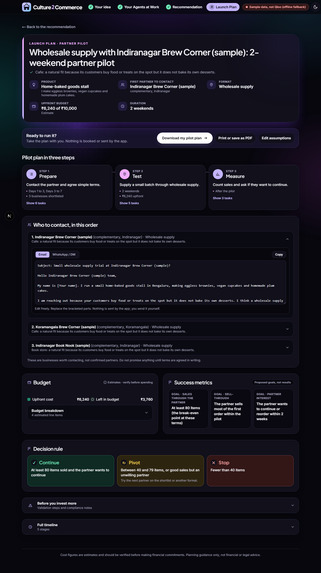
Launch Plan
-
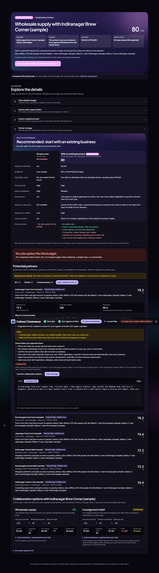
Partners
-

Recommendation

Inspiration
It started with something small.
We were visiting a hotel when we noticed a stall selling sarees. They were genuinely beautiful, but hardly anyone stopped. People walked past.
And then we started noticing the same thing everywhere.
At roadside markets, talented artisans displayed handmade crafts that barely caught anyone's attention. At malls, small businesses set up stalls, hoping to find their next customer. At exhibitions and weekend pop-ups, passionate home bakers, jewellery makers, and independent creators brought their creations to life, hoping the right people would discover them.
Some stalls were buzzing with excitement, while others, just a few steps away, struggled to attract a single customer.
And we kept wondering — why?
Was it the product? Was it the price? Or was it simply that the right people weren't there?
What if the saree seller had set up in a neighbourhood where people loved traditional fashion? What if a home baker knew which community would welcome her weekend dessert pop-up? What if a local artist could discover the perfect spot to showcase their handmade creations?
These weren't just business problems. Behind every stall was someone's talent, hard work, savings, and a dream they were trying to turn into reality.
We began to imagine a world where people wouldn't have to rely entirely on guesswork, take a leap of faith, and hope for the best.
A world where cultural trends, local interests, and neighbourhood preferences could help them make more informed decisions — before investing their time, money, and effort.
What if finding the right place for your idea was no longer a gamble, but a smarter first step?
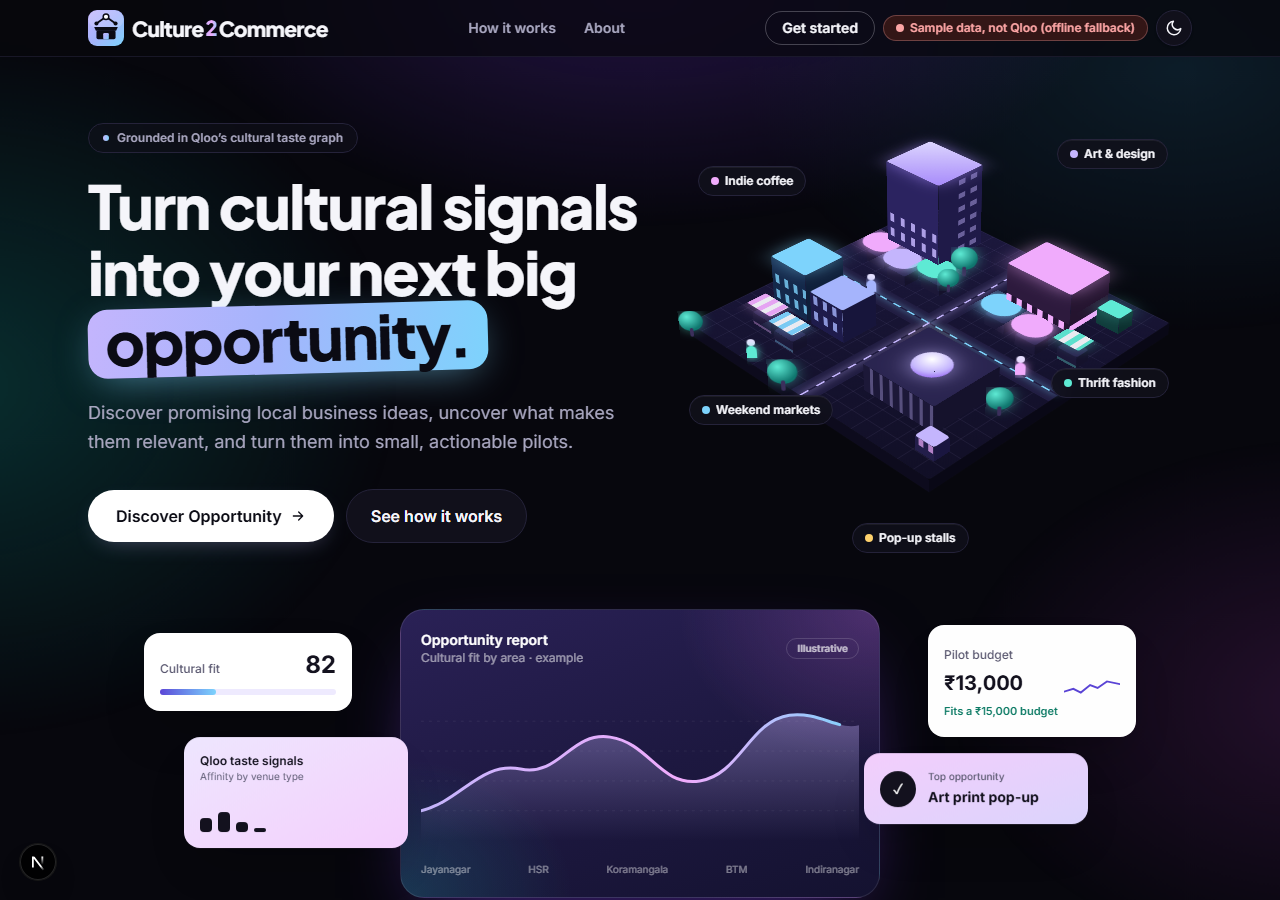
That question became the beginning of Culture2Commerce — turning cultural signals into real-world opportunities, helping small business dreams find the people and places where they have the potential to thrive.
What it does
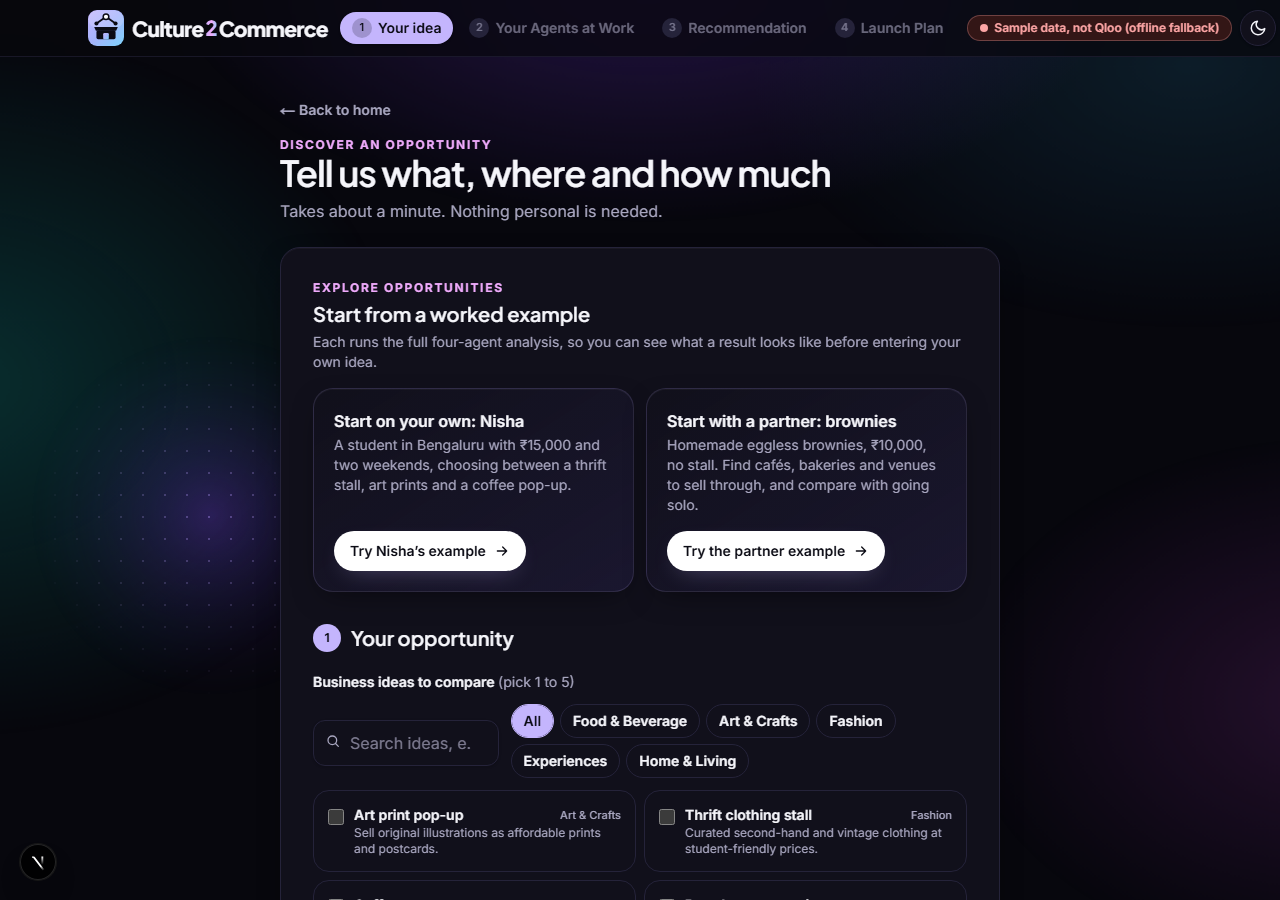
Culture2Commerce helps small sellers, artisans, home bakers, and first-time founders figure out where their idea is most likely to find the right crowd — before they spend their savings.
You tell it what you want to try (a saree workshop, a craft stall, a dessert pop-up), and it:
- Explores neighbourhoods and the popular places people already love there.
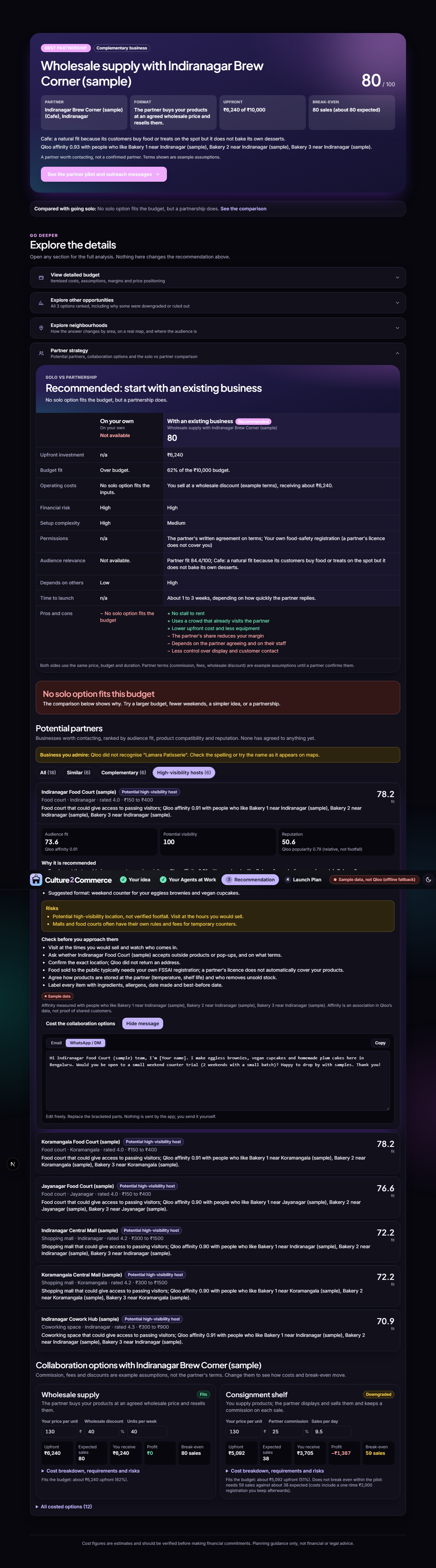
- Matches your idea to local taste, using Qloo's cultural taste data to see which areas fit.
- Checks the money side and asks, "Can you actually afford this?"
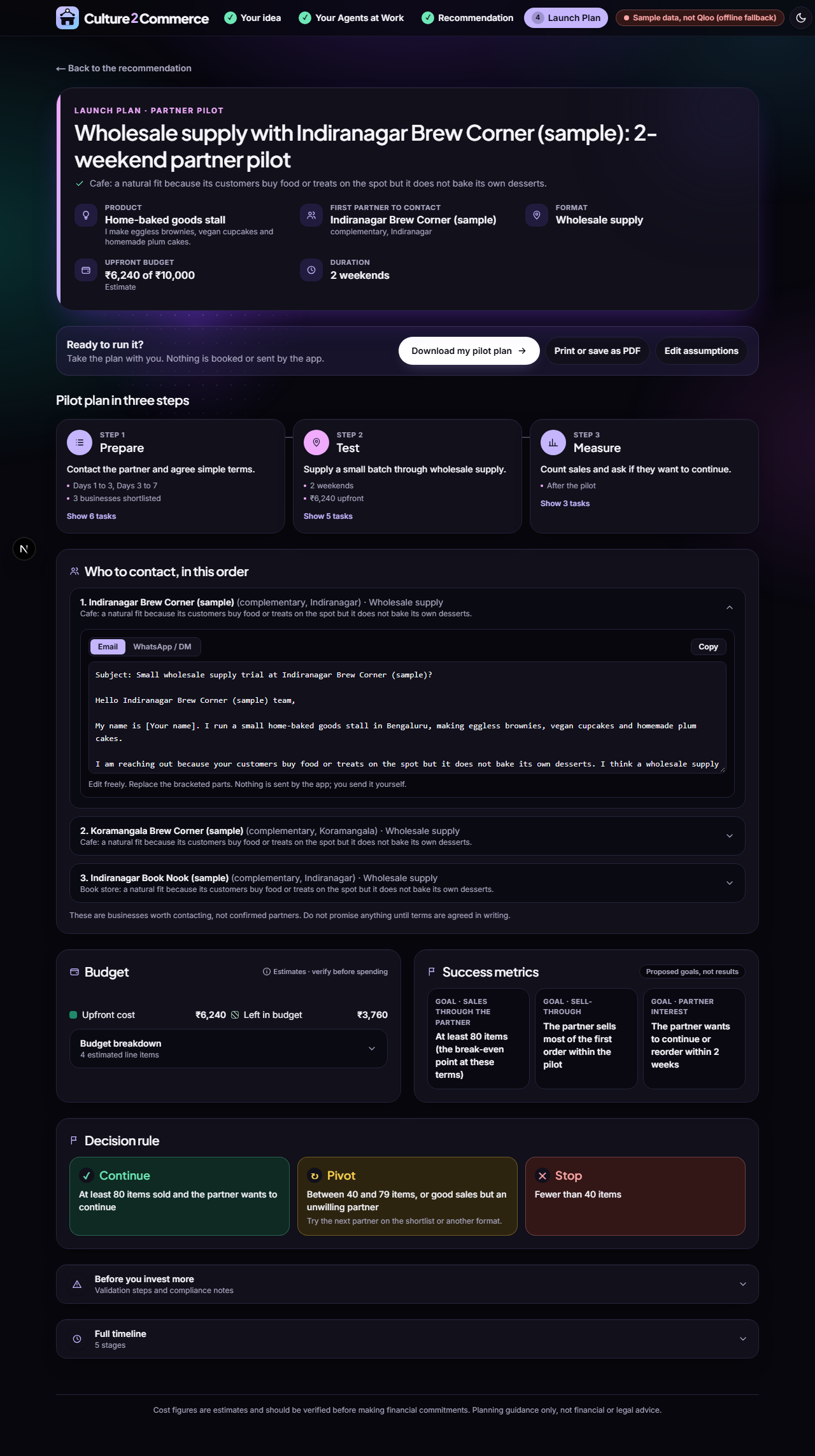
- Suggests a small, low-cost experiment you can run in real life to test the idea before committing.
Every recommendation comes with a plain-language explanation of why, not just a score, so you can see the reasoning and decide for yourself.
How we built it
We built the app with Next.js and TypeScript, and used Qloo's taste data to understand what people in different neighbourhoods enjoy.
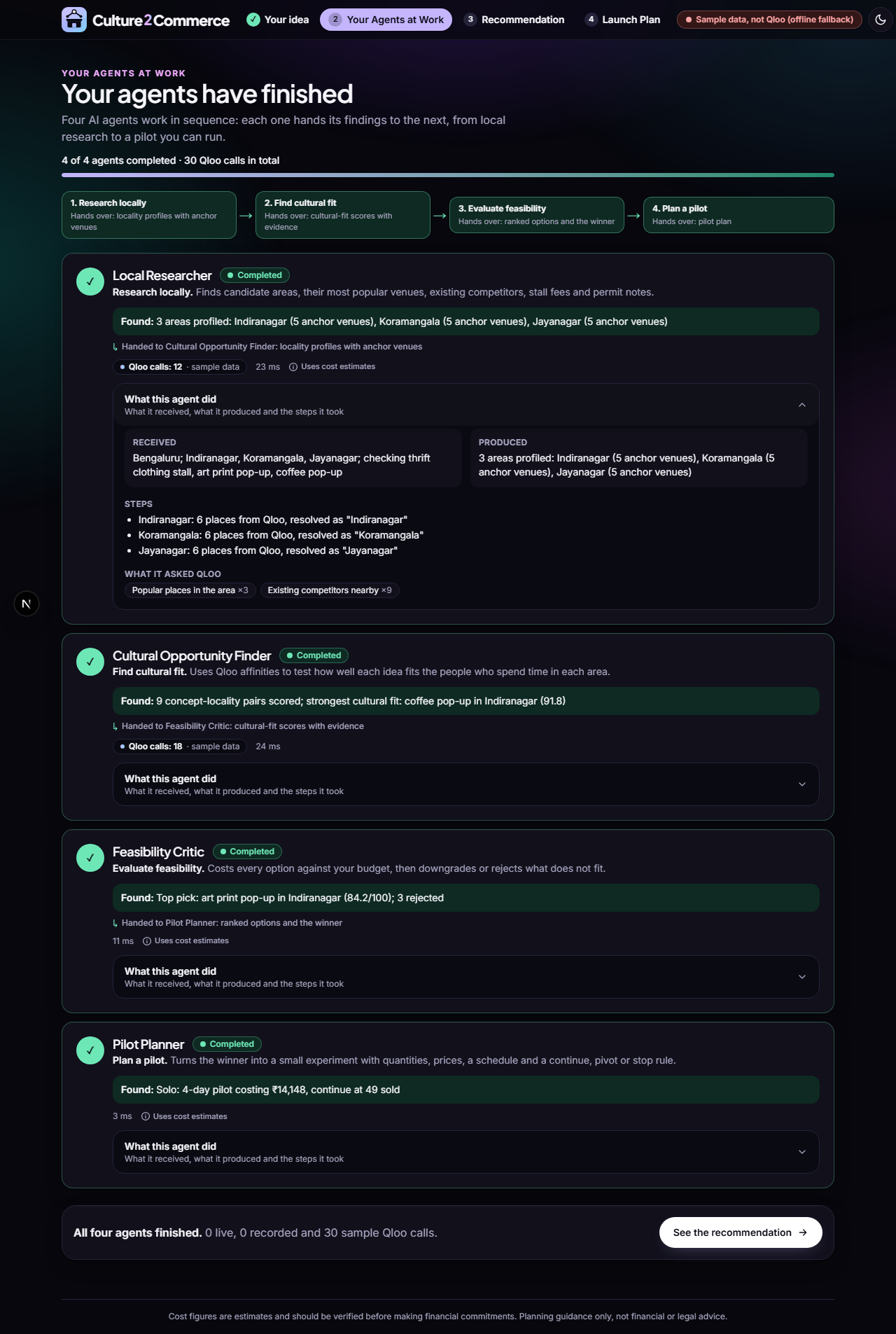
Instead of building one big AI that does everything, we split the work between four specialised agents, a bit like a small team:
- Explorer – looks at neighbourhoods and the businesses already there.
- Taste Matcher – checks which ideas fit the local crowd's taste.
- Budget Checker – looks at the money and asks, "Can you actually afford this?"
- Experiment Planner – turns the best idea into a small, low-cost experiment you can try in real life.
One idea we're really proud of: we treat the most popular places in an area as a stand-in for the people who hang out there, then ask Qloo what else those people tend to like. It turned out to be a simple but powerful way to understand a neighbourhood's personality.
We also wanted every result to be easy to trust, so the app explains why it chose an idea instead of just giving a score.
Challenges we ran into
Honestly, there were a lot.
- Real data didn't always behave as expected. We spent a lot of time testing, getting confused, and then rethinking our approach.
- Some information just wasn't available. We couldn't find reliable data on things like stall rents or how many people walk through an area, so we used estimates and are upfront about them in the app.
- Resisting the urge to oversell. It would have been easy to show a big "94% accurate" number, but it wouldn't have been true. We chose to be honest about what we know and what we're estimating.
- Too many words. Our first designs were full of long paragraphs. Nobody wants to read an essay before deciding whether to start a business, so we learned to say less and make the next step obvious.
- Learning as we went. We were fairly new to building with AI coding tools, so there was plenty of trial and error along the way.
Accomplishments that we're proud of
- Turning a moment at a saree stall into a working product that answers a real question: Where should I start?
- Developing the "popular places as a stand-in for people" approach, giving us a simple, explainable way to understand a neighbourhood's taste.
- Building a four-agent architecture, where each agent has one clear job, making the app easier to build, test, and explain.
- Keeping the app honest and transparent — showing estimates as estimates and explaining every recommendation.
- Ending every result with a real-world next step, instead of just a number.
What we learned
Building Culture2Commerce taught us that solving real-world problems takes more than a great idea or powerful technology. It takes constant observation, thoughtful research, choosing the right tools and APIs, teamwork, time management, and the determination to keep going when things don't work as expected.
We realised that our society has countless problems waiting to be solved. We just need to keep observing, questioning, and innovating.
With the Qloo API, we turned one such observation into a meaningful solution, connecting cultural intelligence with real-world business opportunities.
Because innovation isn't just about using technology — it's about using it to make a difference.
What's next for Culture2Commerce
Our dream is to make Culture2Commerce the first place anyone checks before starting a small business, so that fewer people lose their savings to a bad location and more local talent gets seen.
- Empowering first-time founders who can't afford to fail — especially women running home businesses, artisans, and students, who often have the most to lose from one wrong guess.
- Bringing traditional crafts to the people who value them — connecting handloom weavers, potters, and local artists with neighbourhoods that genuinely love their work, so these skills stay alive.
- Helping customers discover what they'll love nearby — making it easier for people to find bakers, makers, and creators who match their taste, right in their own area.
- Making it free and simple for those who need it most — with local-language support and a mobile-friendly experience, so a small seller in a smaller town can use it as easily as anyone else.
- Learning from every real experiment — letting sellers share how their test went, so every new user benefits from what the community has already learned.
- Partnering with malls, markets, exhibition organisers, and local governments — helping them fill stalls with the right sellers and support small businesses through local programmes.
- Growing into a sustainable startup — keeping the core tool free for small sellers, while offering deeper insights to event organisers, brands, and mall operators who want to bring the right businesses to the right crowds.
We believe every talented person deserves a fair chance to be discovered.
Culture2Commerce is our step towards making that happen.
Built With
- eslint
- gemini
- leaflet.js
- motion
- next.js
- node.js
- playwright
- qloo-api
- react
- recharts
- tailwind-css
- typescript
- vercel
- vitest
- zod


Log in or sign up for Devpost to join the conversation.