-
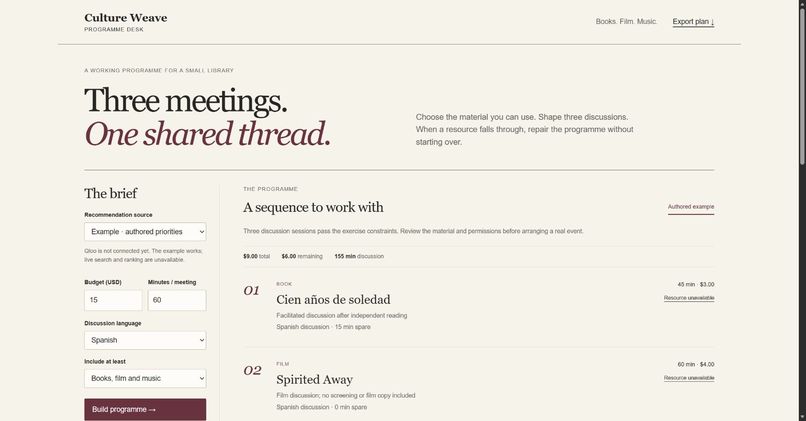
Authored example: invented planning facts, explicit budget and availability. This view is separate from the live Qloo runs.
-
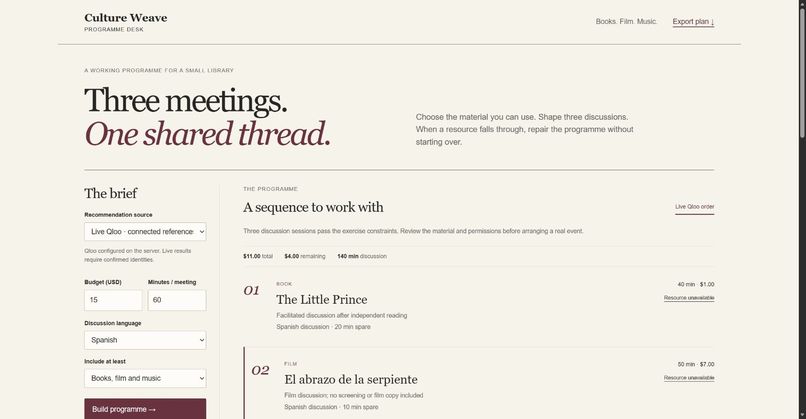
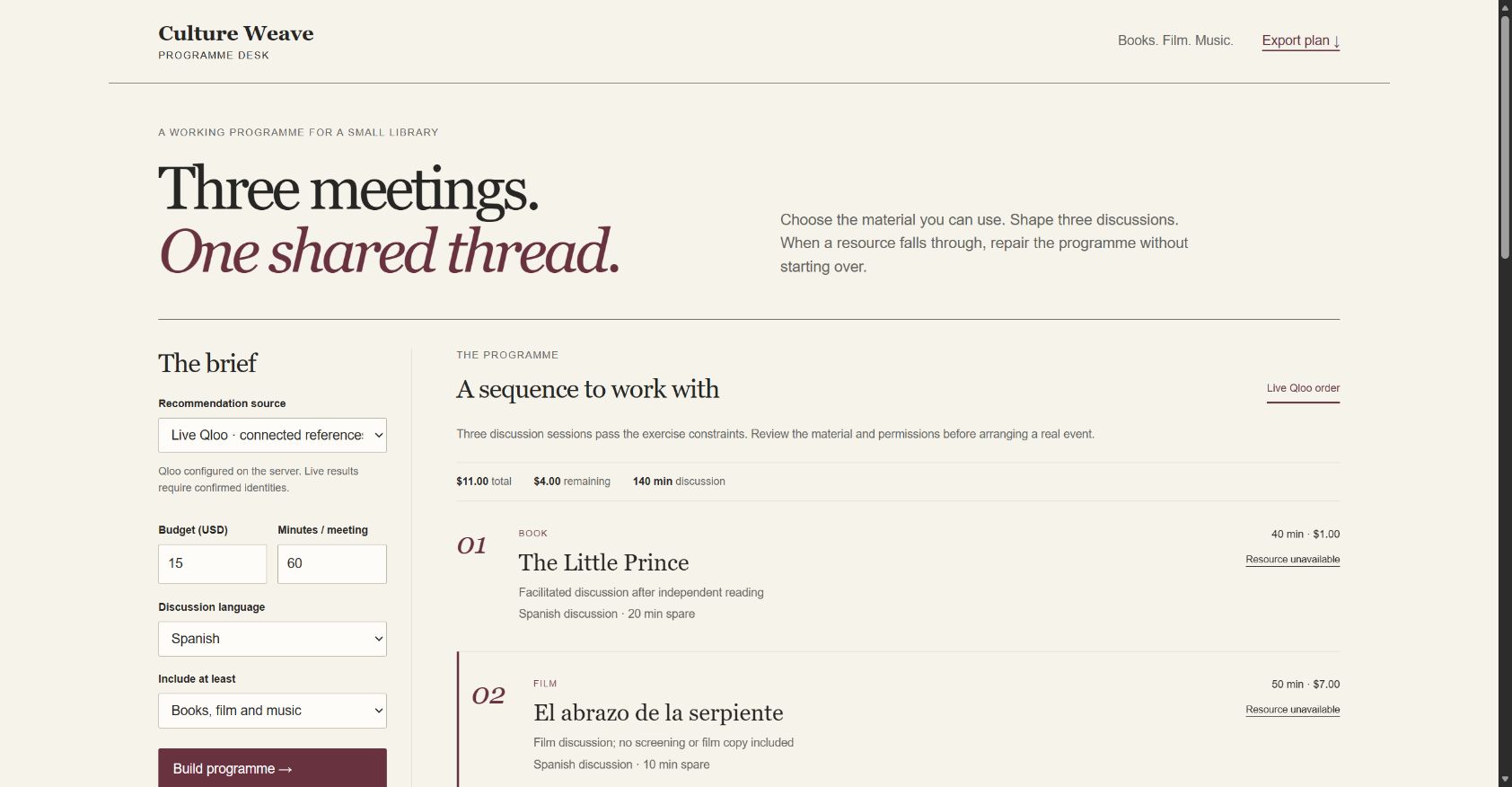
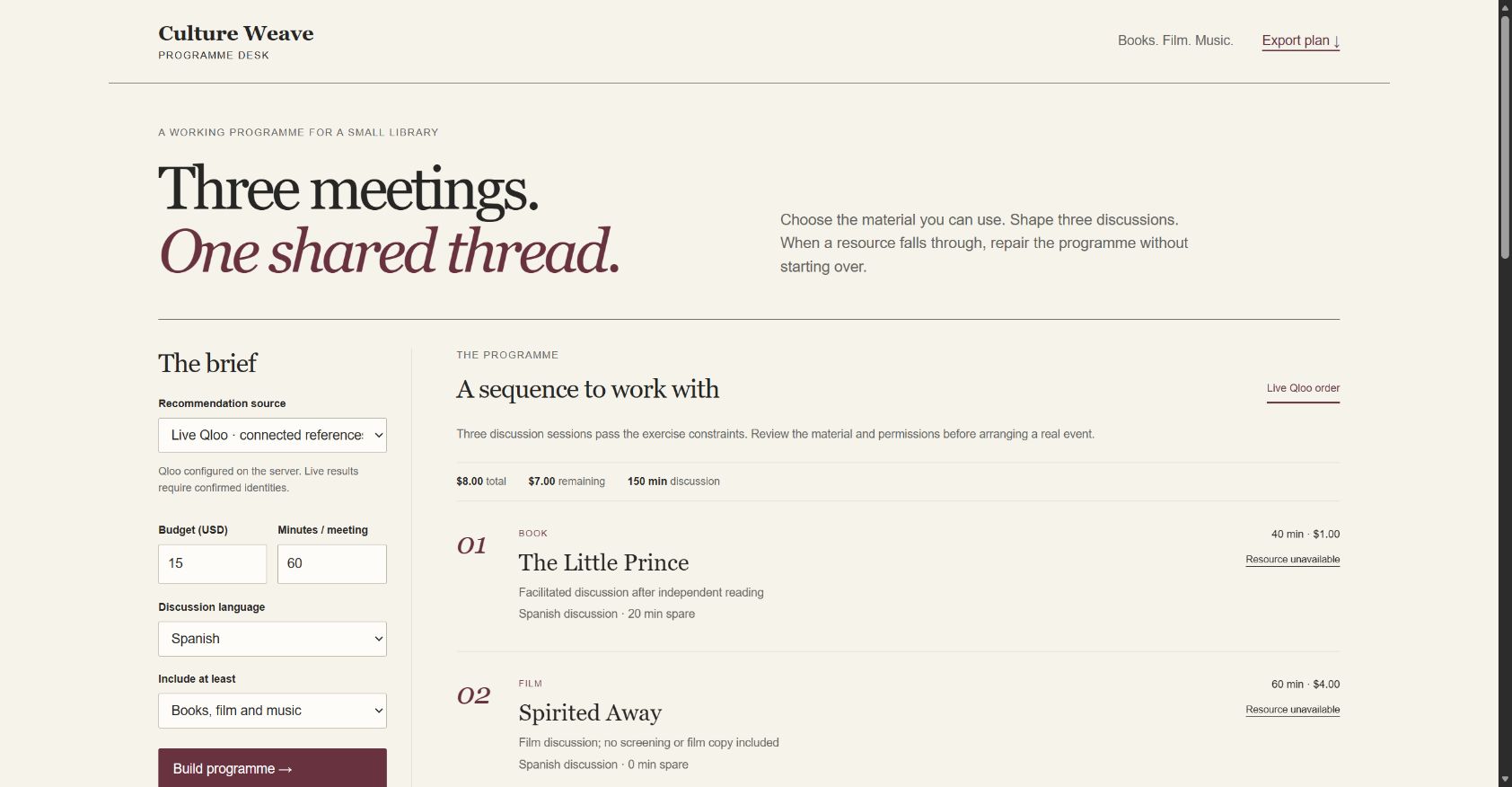
Verified Qloo flow with Princess Mononoke as the taste reference. The repair preserves two sessions and replaces the unavailable film.
-
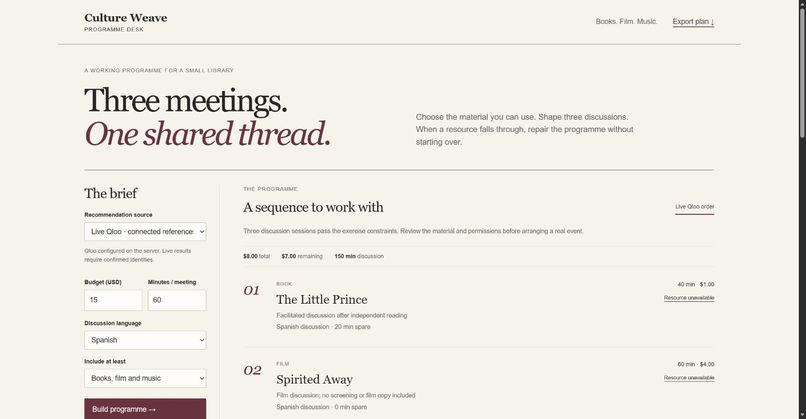
Verified Qloo flow: three sessions and repair after a film becomes unavailable. Costs and durations are authored scenario inputs.
What Culture Weave does
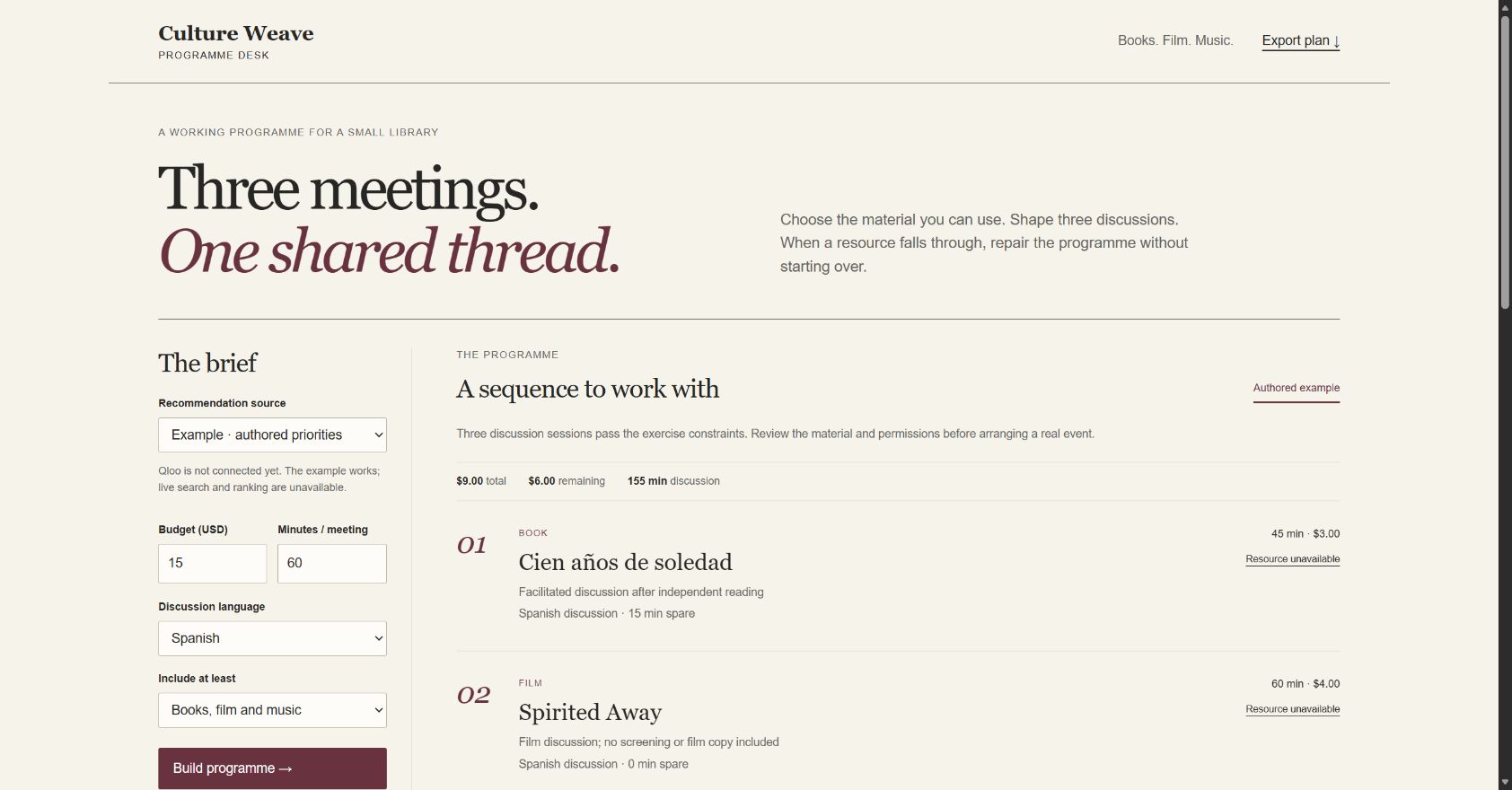
Culture Weave is a programme desk for a small library or reading space. It turns a finite catalogue into three discussion sessions, checks the practical constraints, and repairs the programme when a resource becomes unavailable.
The problem is a planning task rather than an endless recommendation list: a good suggestion is not usable if it exceeds the budget, takes too long, cannot be discussed in the chosen language, or has unconfirmed permission. The prototype keeps those constraints explicit.
Try the current prototype
The public demo opens with an authored example. It plans a book, film and music discussion within a $15 example budget. Mark the film as unavailable: the planner replaces it and retains the other two sessions when that remains feasible. Change the budget or permissions to inspect an honest failure when no complete programme is possible. Export saves the plan, catalogue assumptions and decision trace.
The six titles are real cultural references. Their availability, costs, activity durations and permission states are invented scenario inputs. The app supplies no copyrighted text, film or recording and makes no claim about actual library holdings or screening rights.
Qloo and the planning agent
The server implements Qloo entity search and fixed-shortlist Insights ranking against the hackathon API. Users review returned identities before using a reference or connecting a catalogue resource. The agent chooses ranking calls for the resolved media, checks that Qloo stays inside the requested shortlist, solves the session assignments, validates the constraints, and repairs the programme after a change.
This is a bounded deterministic planning agent. It does not use an LLM runtime. Within each medium it uses the returned Qloo ordering; it interleaves media without pretending that ordinal positions are comparable affinity probabilities. Missing entities, permission gaps and provider errors are not filled with invented facts or disguised example responses.
Live validation completed on 3 October 2026. The public app resolved all six catalogue identities through Qloo Search. With Princess Mononoke (1997) as an external reference, Insights returned one of two books, two films and two artists. The programme selected The Little Prince, Spirited Away and Miles Davis ($8 in invented scenario costs, 150 discussion minutes). Removing Spirited Away replaced it with El abrazo de la serpiente and preserved the other two sessions ($11, 140 minutes). The Spanish edition of Cien años de soledad was absent from the ranking and was left out. These results validate this tested flow and these entities, not universal catalogue coverage. The API key is kept only in a server-side secret.
How it is built and tested
JavaScript, Node.js, HTML and CSS, with a dependency-free Cloudflare Worker for the hosted application. The same planning and HTTP modules run locally. The source is public under the MIT license, with run and build instructions.
There are 42 passing automated tests covering exact monetary arithmetic, constraint failures, missing facts, immutable inputs, repair stability, provider schema failures, shortlist violations and requests without credentials. Nine additional checks of the built Worker passed using local requests and no network calls. These checks use explicit test fixtures and are not evidence of live Qloo compatibility.
What we learned and what comes next
Preserving a previous session is a preference, never permission to violate a new constraint. A missing price is not zero, and a missing permission is not approval. Keeping these rules outside generative text makes the plan inspectable.
Next: broaden catalogue coverage, test more taste references and add a durable shared quota before a larger rollout. No library partnership, user study, attendance improvement or measured time saving is claimed. AI assistance was used for implementation, design, tests and documentation.

Log in or sign up for Devpost to join the conversation.