Inspiration
Both of us are travel enthusiasts, we like to explore and see the wonders, cultures and beauties around the world. Since the beginning of the pandemic, we felt we have been missing out on many beautiful places we could have been visiting in the meantime. So we thought we’d create a platform that would help us see the many wonders of the world and connect enthusiasts alike , while being stuck at home. We also think that our platform can be used as an education to teach history and culture.
What it does
The platform is divided into two parts.
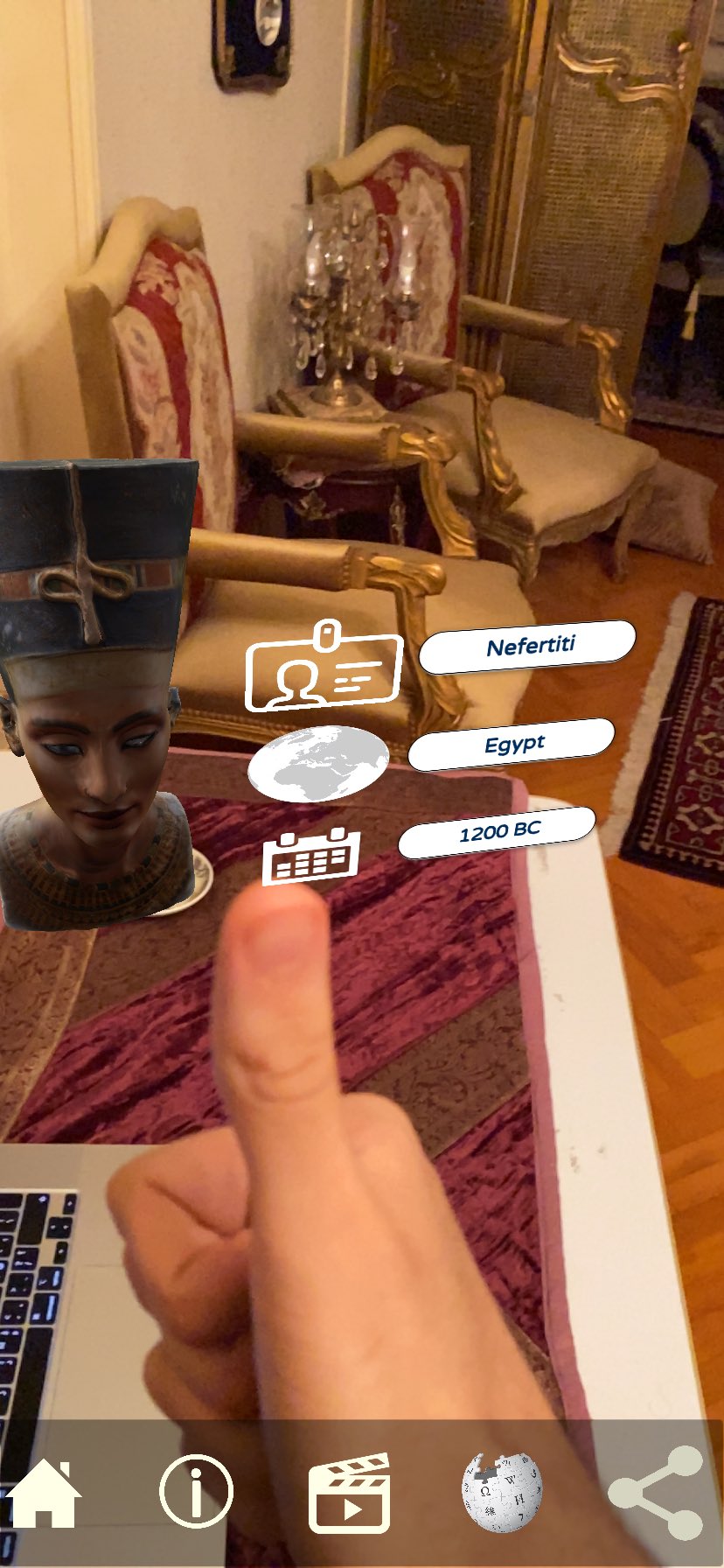
The first part is a mobile application where one can view a list of artifacts added by the community, Then selects one artifact that can be viewed in AR. In the AR view one can see basic information about the artifact. Using the tool bar at the bottom, 1- one can view a detailed description of the artifact and translate this description into various languages in real time 2- view a video in app explaining more about the artifact 3- visit wikipedia to show more information about the artifact 4- take a screenshot and share it to various platforms.
The second part is a content management system (CMS), that the users can visit to see all the artifacts available on our platform, with an image and some basic information about each artifact. The users can also fill a form to request certain artifacts be added, these requests are then confirmed by our admins and the artifacts are added to the application. Another side of the CMS is that it serves as a backend to the mobile application, providing http routes to fetch data about the artifacts from the database
How we built it
The mobile app is built using Unity. We use Unity’s AR foundation to display the artifacts in AR. Moreover we used AWS to translate languages in real time.
The CMS is built using python’s web development library Django. It is a standard django dashboard, with the backend in python and the frontend using django forms alongside bootstrap. The database is using sqllite3. The website is deployed using Microsoft Azure services on an Ubuntu 18.4 virtual machine.
Challenges we ran into
Our main challenge was uploading 3d objects through our cms which would then be read directly in our. We first tried using echo ar to accomplish this. Unfortunately the iOS build wasn’t able to sync with echoar’s database. We spent a lot of time trying to solve it but to no end. So, we decided to use Unity’s asset bundles. Where one would import a 3d object in Unity, build an asset bundle for it and then upload it using our cms
Accomplishments that we're proud of
Being able to complete this project in the allowed timeframe with a relatively small team was a really proud achievement for us. We are pleased with having a final product that is close to how we imagined in the first place, and that can also be improved in multiple directions. Also the experience of participating in an international hackathon with teams from many parts across the world is very satisfying
What we learned
This was our first attempt deploying using azure services. They provide a very seamless experience and the deployment went very smoothly. Also connecting the website to our app was very interesting and fun.
What's next for Culturally
Support more languages
Allow people to register to our website in order to add and view their artifacts
Market for the app on facebook and youtube
Add more Artifacts
Allow users to add hotspots to Artifacts to make them more interactive

Log in or sign up for Devpost to join the conversation.