-
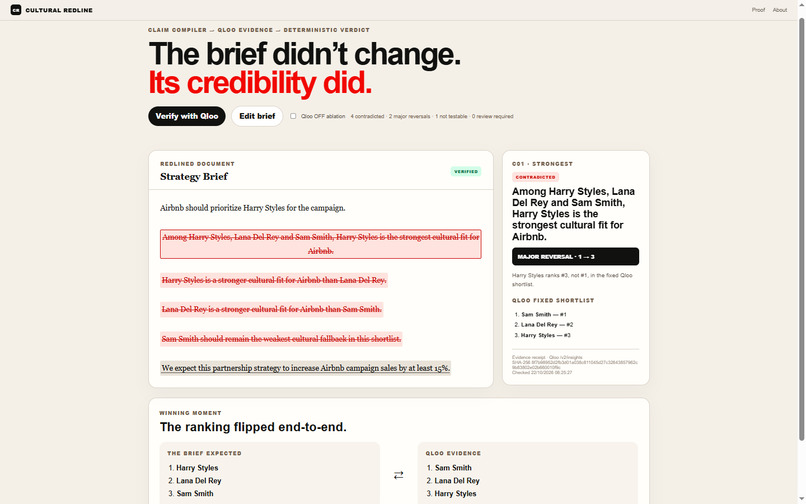
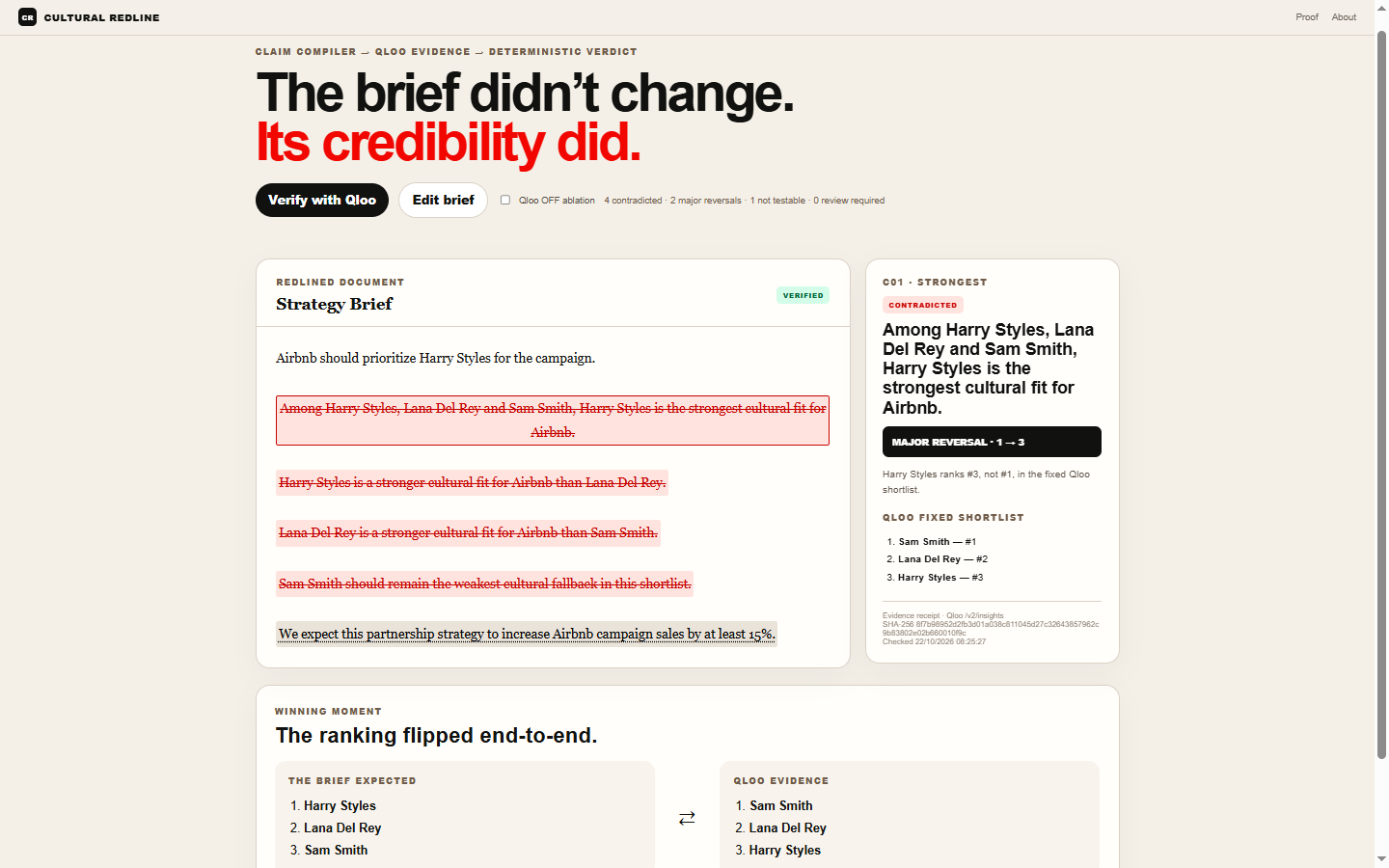
A confident strategy meets Qloo evidence: the expected ranking flips end-to-end.
-
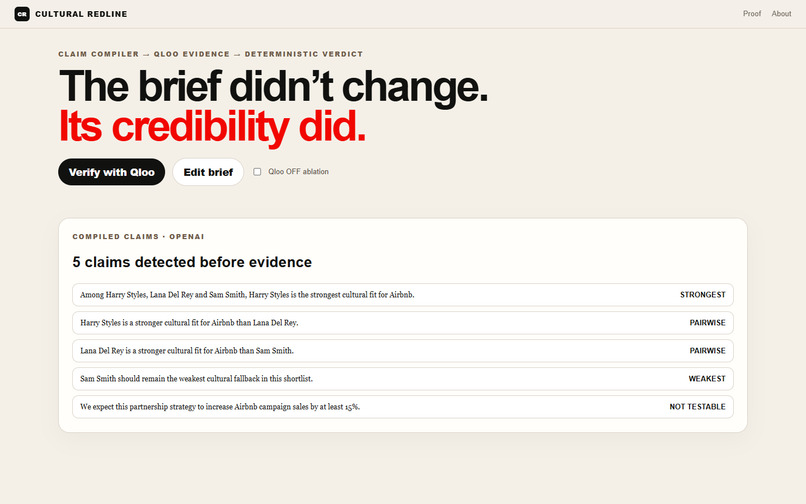
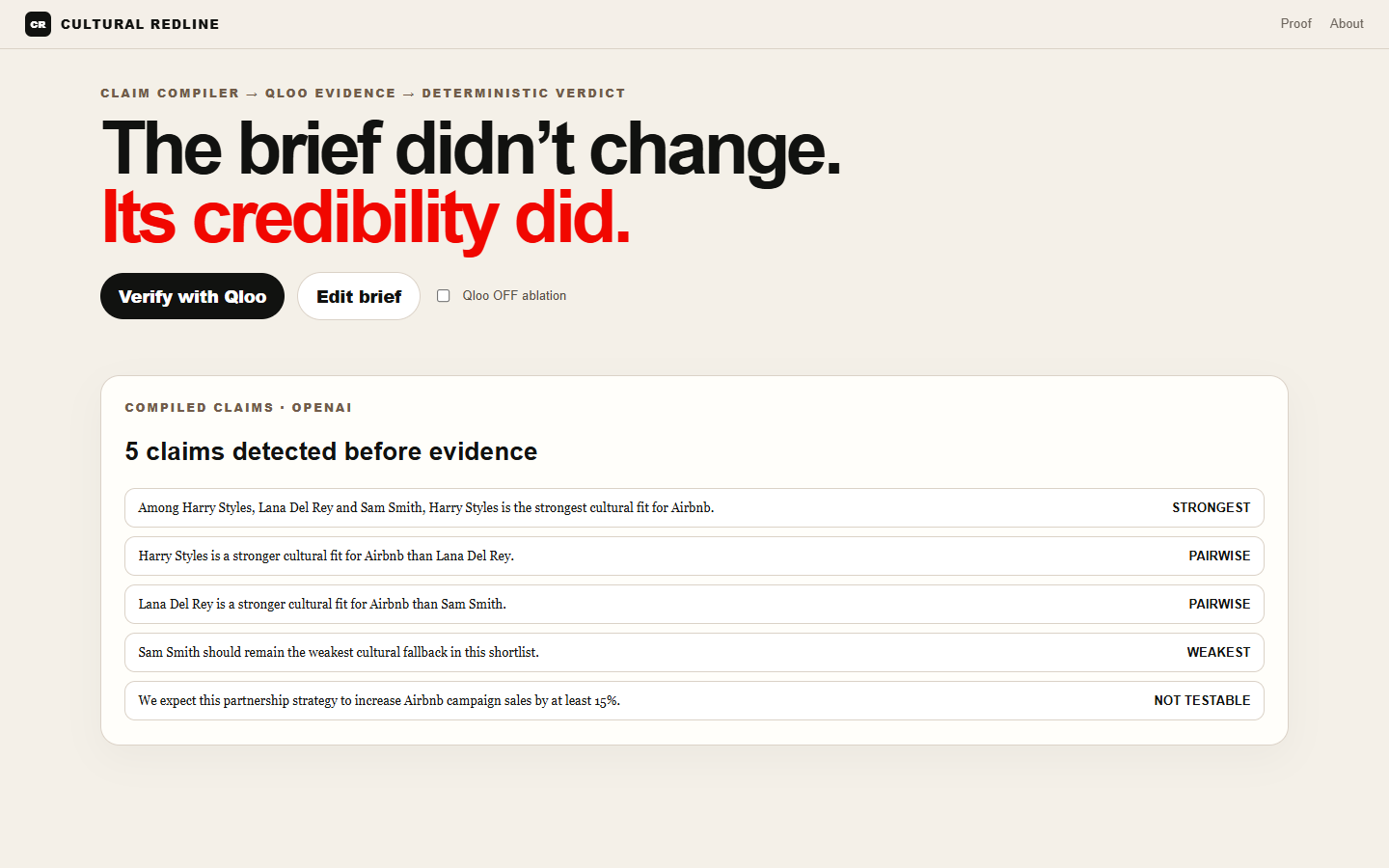
The LLM interprets the brief into explicit claim types before any cultural verdict is issued.
-
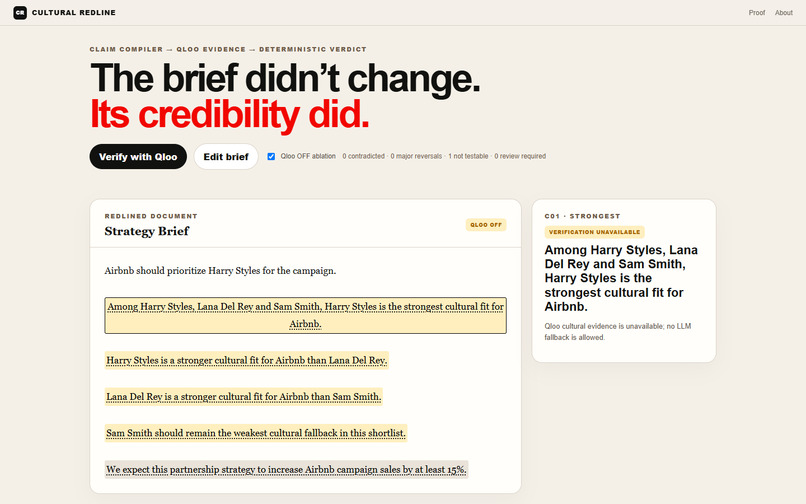
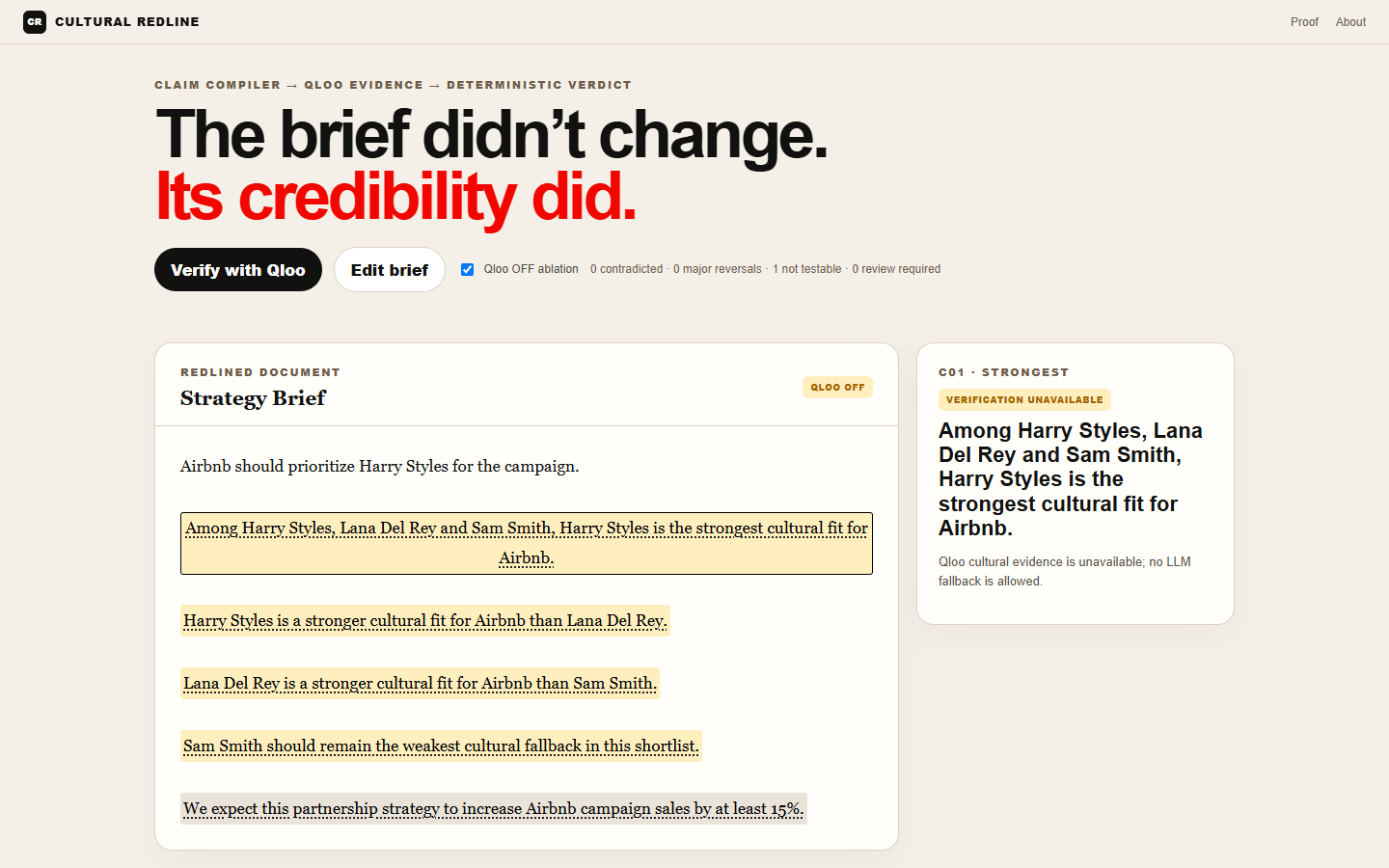
Remove Qloo and cultural verdicts disappear — no generic LLM fallback is allowed.
-
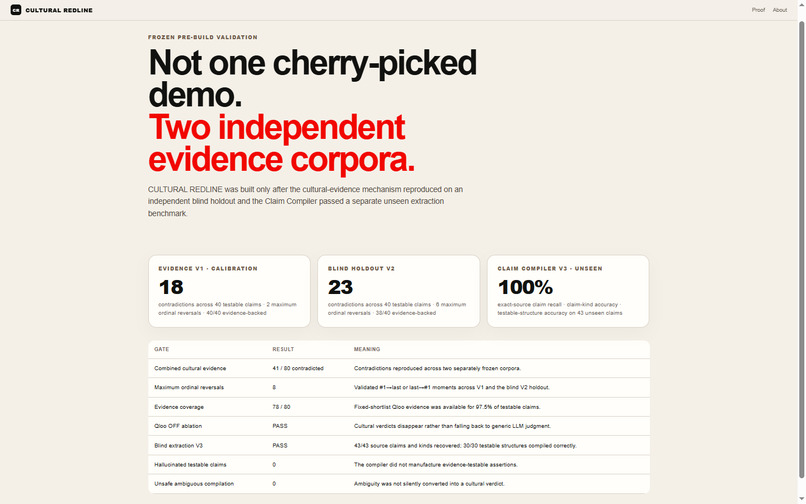
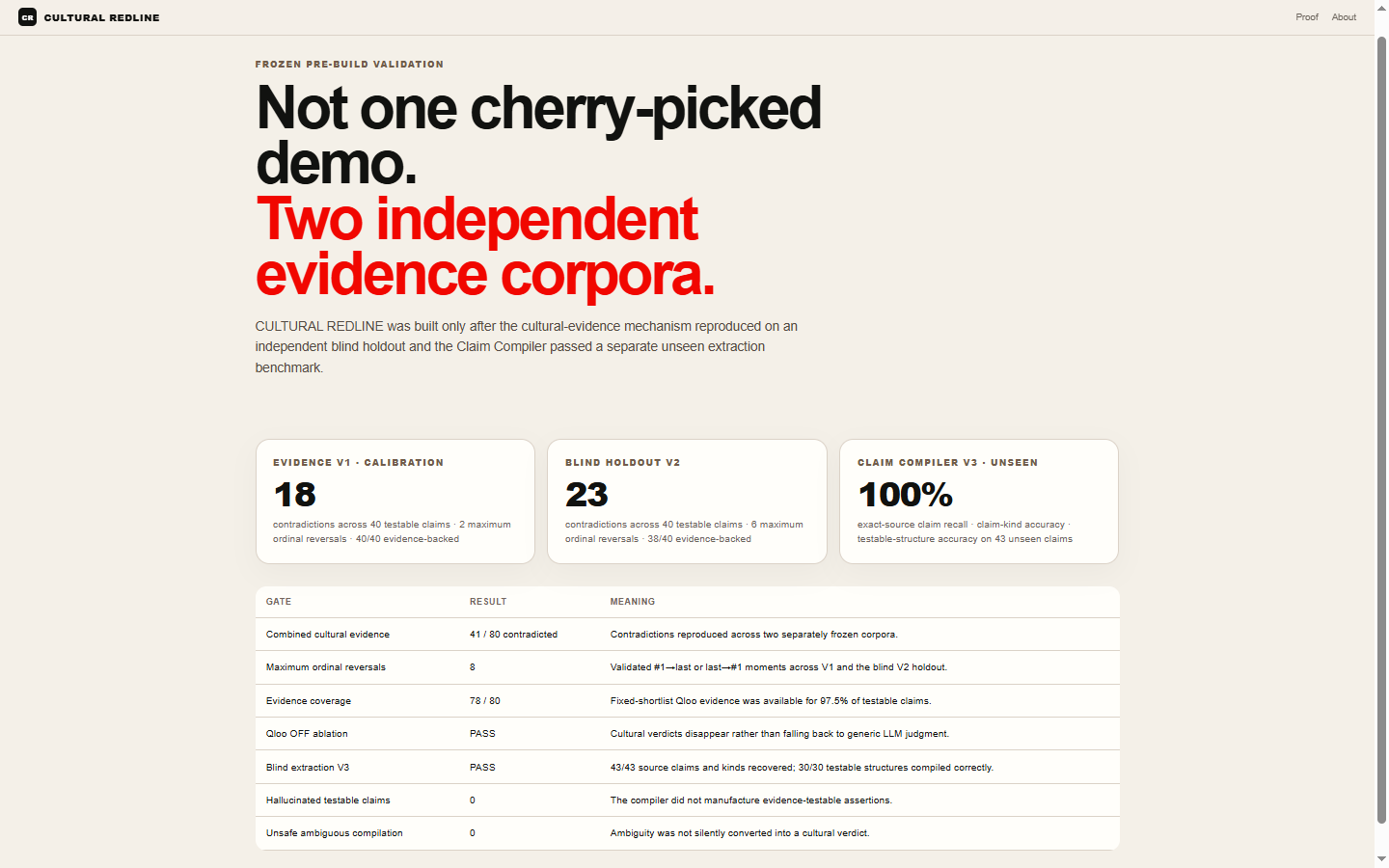
The demo is backed by two cultural-evidence corpora and a separate blind Claim Compiler benchmark.
Inspiration
Marketing teams do not have a shortage of AI-generated strategy.
They have a harder problem: polished briefs often contain cultural assumptions that sound confident without showing what evidence supports them.
A strategy may say:
- “Artist A is the strongest cultural fit.”
- “Artist B should be the weakest fallback.”
- “Creator A is a better cultural fit than Creator B.”
Those claims can influence sponsorships, partnerships, campaigns, and budgets, yet they are often treated as facts simply because they sound plausible.
We did not want to build another recommendation engine, and we did not want to build another copy-rewriting assistant.
Instead, we asked:
What if the strategy you already have could challenge its own assumptions?
That became CULTURAL REDLINE — an evidence redliner for cultural strategy.
Its product principle is simple:
Paste the strategy. Make every cultural assumption prove itself.
What it does
CULTURAL REDLINE audits an existing strategy document.
It does not start from a blank page and recommend what a team should write. It starts from a decision that has already been written down and asks whether its cultural claims survive evidence.
The system identifies culturally testable claims and compiles them into explicit evidence tests such as:
- strongest candidate in a fixed shortlist;
- weakest candidate in a fixed shortlist;
- pairwise cultural comparison;
- claims that exceed what cultural affinity can establish.
It then resolves the relevant entities and asks Qloo to rank the exact fixed candidate universe asserted by the document.
Deterministic code compares that ranking with the original claim.
Each sentence is marked as:
- SUPPORTED
- CONTRADICTED
- NOT TESTABLE
- REVIEW REQUIRED
The answer appears directly on the original document.
The Winning Moment
In our validated Airbnb strategy brief, the document expects:
- Harry Styles
- Lana Del Rey
- Sam Smith
Qloo returns:
- Sam Smith
- Lana Del Rey
- Harry Styles
That creates two maximum ordinal reversals in the same document:
- Harry Styles: claimed #1 → Qloo #3
- Sam Smith: claimed #3 → Qloo #1
The strategy said #1.
Qloo said #3.
The document is redlined immediately.
The brief didn't change. Its credibility did.
Try the Winning Moment
- Open https://cultural-redline.vercel.app/
- Click Load validated demo.
- Click Analyze cultural claims.
- Review the compiled claim types: STRONGEST → PAIRWISE → PAIRWISE → WEAKEST → NOT TESTABLE
- Click Verify with Qloo.
- Open the first CONTRADICTED claim.
- Observe the MAJOR REVERSAL — claimed #1 → Qloo #3.
- Scroll to the Winning Moment and inspect the full ranking flip.
- Toggle Qloo OFF ablation.
- Confirm that cultural verdicts become VERIFICATION UNAVAILABLE instead of falling back to generic LLM judgment.
Validation evidence: https://cultural-redline.vercel.app/proof
How we built it
CULTURAL REDLINE deliberately separates language interpretation, cultural evidence, and judgment.
1. The LLM interprets
OpenAI Structured Outputs identifies what each sentence is claiming and compiles it into a constrained claim representation such as:
STRONGESTWEAKESTPAIRWISENOT_TESTABLEREVIEW_REQUIRED
The LLM is never asked whether the cultural claim is true.
2. Qloo supplies the evidence
Qloo Search resolves the entities involved in the claim.
Qloo Insights then evaluates the exact fixed candidate shortlist asserted by the document.
If the brief says “A is stronger than B and C,” CULTURAL REDLINE tests A, B, and C. It does not quietly replace the shortlist with a different recommendation set.
3. Deterministic code decides
Explicit ordinal rules produce the verdict.
Examples:
- claimed strongest + observed rank #1 →
SUPPORTED - claimed strongest + observed rank #3 →
CONTRADICTED - claimed weakest + observed rank #1 →
CONTRADICTED - causal business outcome such as “this will increase sales by 15%” →
NOT_TESTABLE
The LLM cannot override the ranking or verdict rule.
4. The document reveals
The original strategy becomes the interface.
Contradicted claims are redlined. Clicking a claim opens an evidence drawer showing:
- the original assertion;
- the deterministic verdict;
- the fixed Qloo shortlist;
- the observed ranking;
- the verdict rule;
- an evidence receipt and response hash.
Challenges we ran into
Making Qloo structurally necessary
We built a Qloo OFF ablation.
With Qloo enabled, CULTURAL REDLINE can produce SUPPORTED and CONTRADICTED.
With Qloo disabled, it can still detect that a sentence contains a cultural claim, but verification becomes:
VERIFICATION UNAVAILABLE
There is deliberately no fallback to generic LLM knowledge.
Preventing the LLM from becoming the judge
Passing Qloo data back to a model and asking whether a claim “looks supported” would make the system impossible to audit.
We rejected that design.
The final contract is:
LLM interprets → Qloo evidences → deterministic code decides → document reveals
Reliable claim compilation
Natural language is messy.
We encountered malformed structured output, underspecified comparison contexts, ambiguous shortlists, and claims that exceeded what Qloo evidence could establish.
Rather than weakening the safety boundary, we added exact sentence anchoring, deterministic context recovery, shortlist-integrity checks, and explicit abstention states.
Avoiding a cherry-picked demo
A single spectacular ranking flip was not enough.
Before locking the product, we froze one cultural evidence corpus and then tested the mechanism again on an independent blind holdout.
We evaluated the Claim Compiler separately on unseen briefs.
Accomplishments that we're proud of
The effect reproduced on an independent holdout
Evidence V1
- 40 testable claims
- 18 contradictions
- 2 maximum ordinal reversals
Blind Holdout V2
- 40 testable claims
- 38 evidence-backed
- 23 contradictions
- 6 maximum ordinal reversals
Combined:
- 41 / 80 cultural claims contradicted
- 8 maximum ordinal reversals
The Claim Compiler passed a separate blind benchmark
The final unseen extraction benchmark contained 43 claims.
The final compiler achieved:
- 100% exact-claim recall
- 100% claim-kind accuracy
- 100% testable-structure accuracy
- 0 hallucinated testable claims
- 0 unsafe ambiguous compilations
Sponsor Necessity passed
When Qloo is removed, cultural verdicts disappear rather than falling back to generic AI judgment.
The original artifact became the product interface
The main interaction is not a recommendation dashboard.
The thing the team already works with — the strategy brief — is what visibly changes.
What we learned
The biggest lesson was that cultural intelligence becomes more useful when it participates in an evidence test, not only a recommendation flow.
We also learned that trustworthy AI benefits from separating responsibilities:
- the LLM interprets language;
- Qloo supplies cultural evidence;
- deterministic code computes the verdict;
- the UI makes the evidence legible.
Another important lesson was epistemic restraint.
Qloo affinity can help evaluate cultural relationships and rankings, but it does not establish causality, guaranteed behavior, or revenue lift.
So CULTURAL REDLINE prefers:
NOT TESTABLE
over manufactured certainty.
What's next for CULTURAL REDLINE
The current MVP focuses on the smallest powerful workflow:
existing strategy → explicit claims → Qloo evidence → visible redline
Next steps could include:
- DOCX and PDF import;
- collaborative strategy review;
- evidence policies for brand and sponsorship teams;
- additional Qloo-supported claim types and cultural domains;
- document-version comparison;
- evidence exports for approval and governance workflows;
- integrations with the tools where strategy is already written.
The broader opportunity is to make cultural verification a normal step before a strategy is approved.
Generative AI can create confident strategy faster than ever.
CULTURAL REDLINE asks the complementary question:
Before we act on it, what does the cultural evidence actually support?
Built With
- gpt-4o-mini
- next.js
- node.js
- openai
- qloo
- qloo-api
- qloo-api-qloo-insights
- qloo-insights
- react
- sha-256
- structured-outputs
- turbopack
- typescript

Log in or sign up for Devpost to join the conversation.