Inspiration
Brands are constantly entering unfamiliar cultural territories. Fashion houses move into hospitality, sportswear becomes lifestyle, and unexpected collaborations redefine what a brand can represent.
But how can you tell whether a cultural expansion actually makes sense?
As someone interested in branding, cultural strategy, and AI, I wanted to explore a question: Could an AI agent investigate a brand's cultural potential using real evidence instead of simply generating plausible recommendations?
Most brand-extension decisions rely on intuition, creative references, or AI-generated ideas that rarely explain why a cultural connection is credible.
I wanted to build something different: an AI cultural researcher that doesn't just suggest where a brand could go, but investigates why it might belong there, and recognizes when the evidence isn't strong enough.
That became Cultural Elasticity.
What it does
Cultural Elasticity is an agentic cultural-intelligence tool designed for brand strategists, consumer-insights teams, and creative agencies.
I built it around three capabilities:
- Discover cultural opportunities
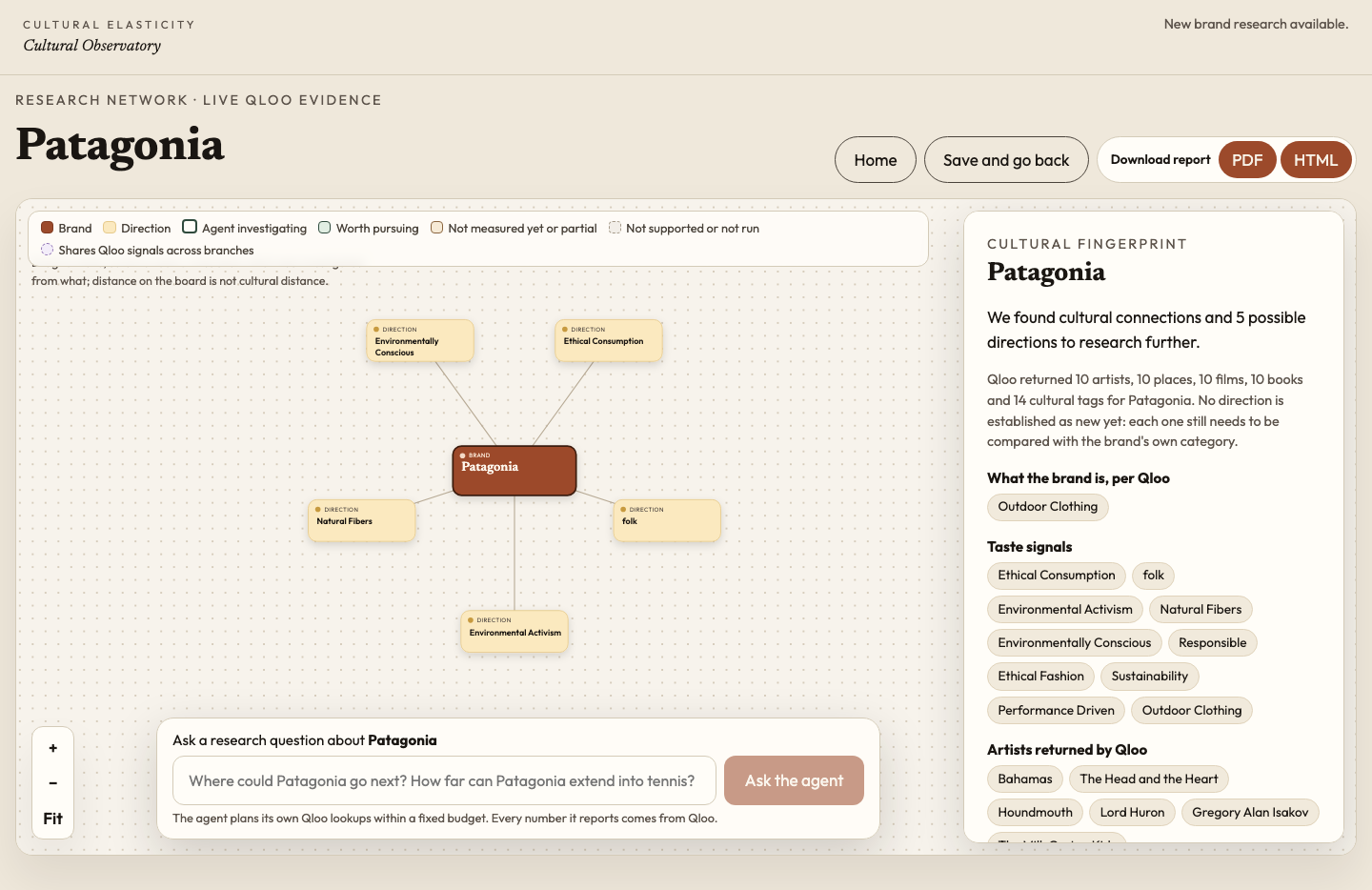
Enter a brand, and Qloo maps its cultural fingerprint: the artists, places, films, books, and taste signals associated with its audience.
I transform these relationships into an interactive cultural network, revealing potential directions across categories, lifestyles, and cultural domains.
- Investigate with an AI agent
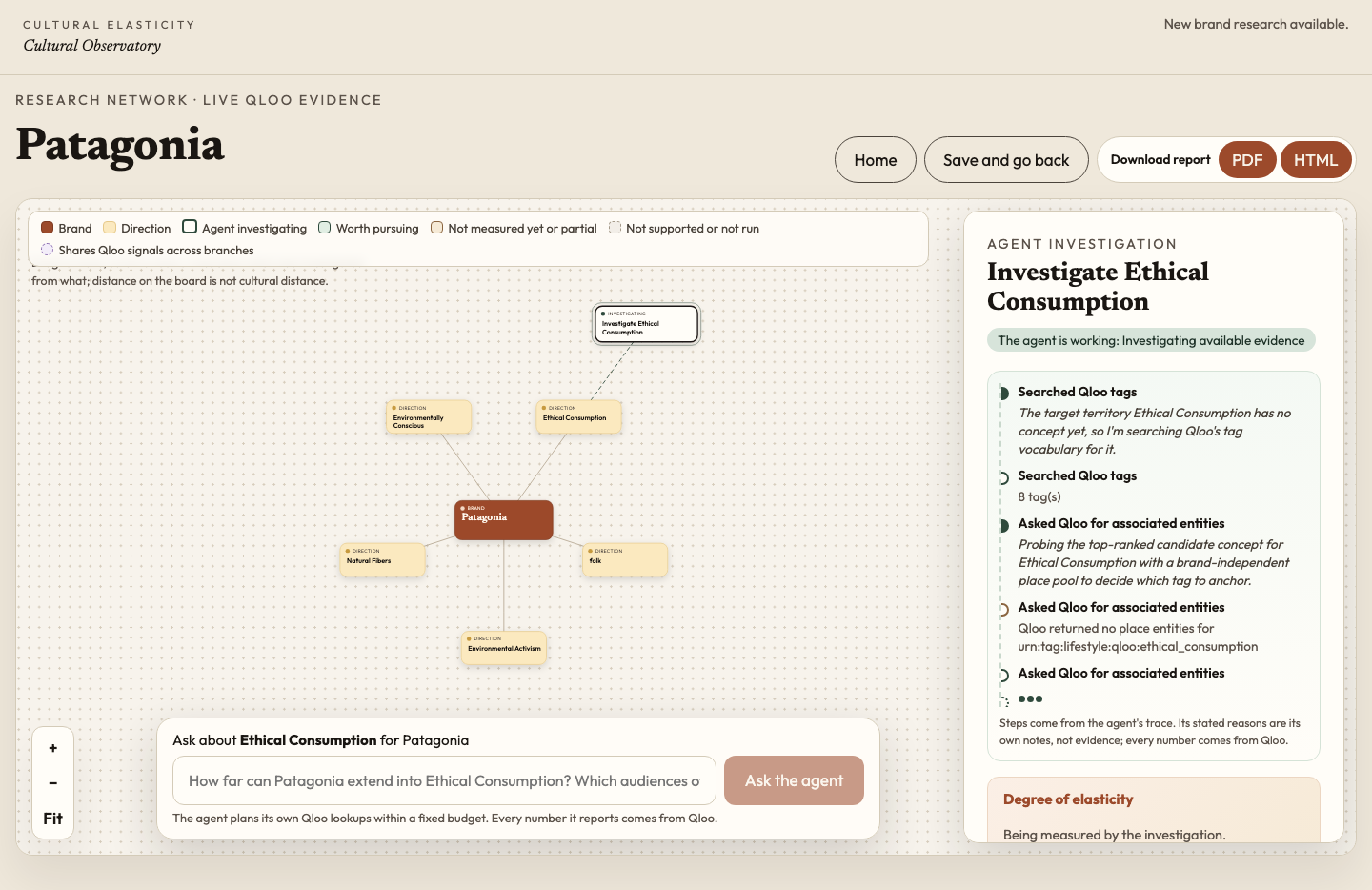
Select a direction or ask a research question, such as How far could Crocs extend into fine dining?
A Claude Haiku agent dynamically plans the investigation, selects governed Qloo tools, identifies relevant cultural entities, examines brand-conditioned associations, and builds comparable reference territories when the evidence permits.
Rather than following one predetermined sequence, the agent adapts its research path to the question and the evidence it discovers.
- Evaluate the evidence
Instead of allowing the language model to invent a cultural compatibility score, I implemented deterministic assessments based on what Qloo actually returns.
The result separates:
- Direct evidence: What Qloo reveals about the relationship.
- Comparative measurement: Where a territory ranks against valid alternatives, when a fair comparison exists.
- Strategic interpretation: What those observations could mean for the brand.
- Uncertainty: What remains unsupported, unproven, or worth investigating next.
Each investigation produces a decision-oriented reading that can be saved, revisited, and exported as an HTML or PDF report.
How I built it
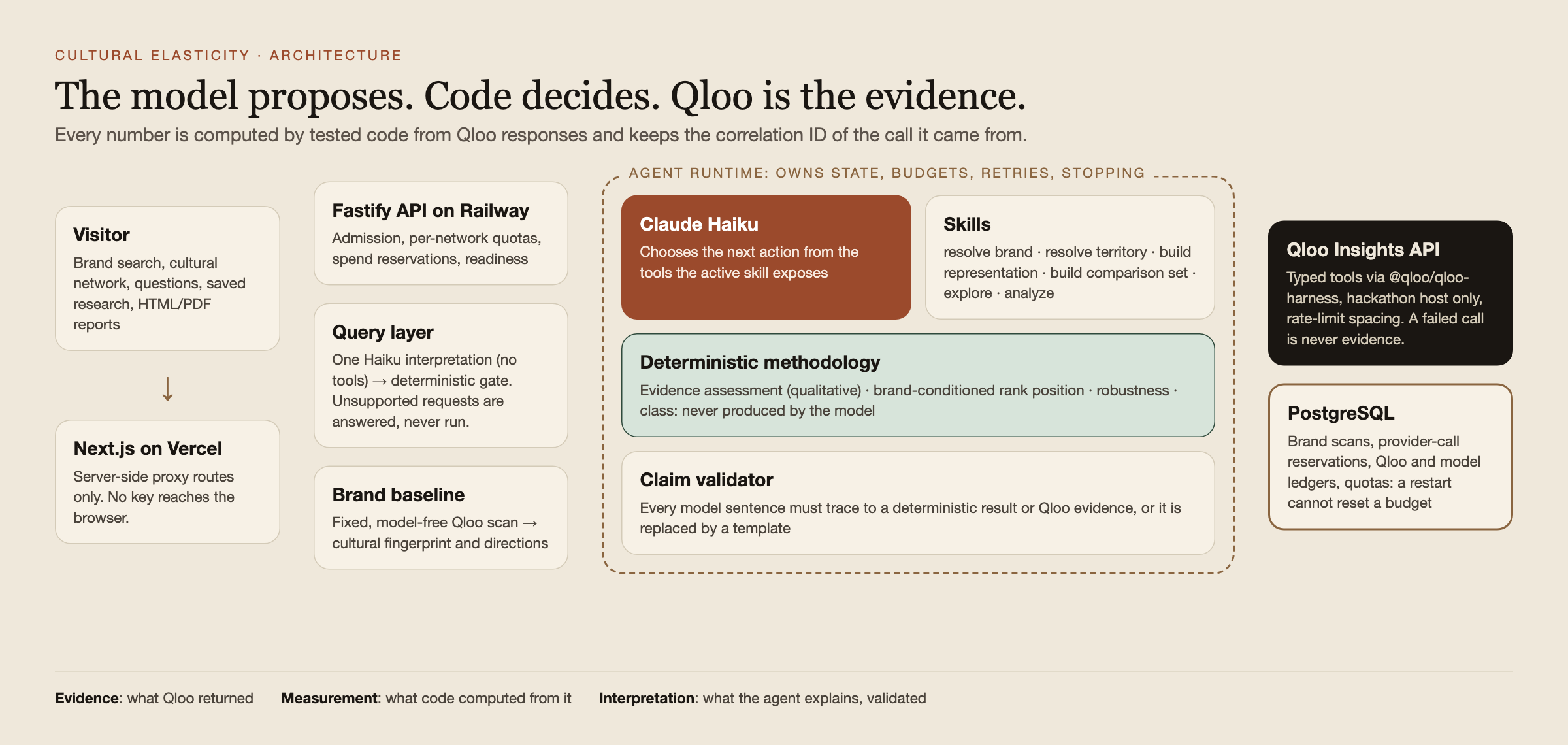
I designed Cultural Elasticity as a hybrid agentic architecture: AI handles dynamic research decisions, while deterministic software controls what can be trusted.
The stack includes:
- Qloo Insights API, accessed through the official Qloo MCP harness, for cultural evidence, entity resolution, recommendations, tags, and rankings.
- Claude Haiku for research planning, semantic interpretation, tool selection, and synthesis.
- *ypeScript, Node.js, Fastify, and Zod for the agent runtime, typed contracts, and validation.
- Next.js and React for the interactive research workspace.
- PostgreSQL for persistent brand scans, quotas, and provider-usage accounting.
- Vercel and Railway for the publicly accessible application and backend.
My core architectural principle is simple: the model proposes; the runtime decides.
The agent chooses what to investigate, but the runtime enforces tool permissions, budgets, evidence requirements, validation, and stopping conditions.
I also built automated tests, evaluation suites, and production observability to examine actual research behavior rather than relying on plausible-looking outputs.
Challenges I ran into
Cultural relationships are difficult to measure.
During my initial experiments with Qloo, I discovered that affinity values couldn't safely be compared across independent API calls. Some values saturated, while certain comparison methods returned results that weren't sufficiently discriminating.
I redesigned the methodology around brand-conditioned rankings within the same call, using multiple cultural exemplars to assess robustness.
**Technically valid evidence isn't always meaningful evidence.
During live testing, I encountered a case where a craft-related territory was represented by an inappropriate product-material tag. The resulting comparison was structurally valid but strategically misleading.
I introduced additional semantic checks to prevent the system from treating weak representations as convincing cultural relationships.
An intelligent agent shouldn't manufacture certainty.
Early investigations frequently ended without a valid comparative ranking. Instead of relaxing the evidence requirements, I introduced a direct-evidence assessment that explains what Qloo actually observed, independently of whether a quantitative comparison is possible.
This became one of the most important changes to the research engine.
Making real agentic research publicly accessible.
Because every investigation can invoke paid Qloo and model calls, I needed an architecture that could expose live research without uncontrolled spending.
I implemented durable spending ledgers, per-network allowances, bounded research budgets, and controlled provider access.
Accomplishments
One of my most interesting live results came from investigating Crocs and fine dining.
I initially expected a cultural break. Instead, Qloo's measured comparison placed fine dining in the middle of the validated reference set, producing a Credible stretch reading.
Rather than changing the methodology to fit my original intuition, I kept the result supported by the evidence.
For Patagonia and ethical consumption, the territory ranked first within its comparison set. However, the representation was insufficiently robust, so the system reported Not settled rather than claiming a strong cultural fit.
Both examples come from real hosted investigations using Qloo and Claude, not simulated research.
I also implemented durable execution and demonstrated recovery of interrupted research jobs from a journal without repeating committed paid provider calls during live recovery tests.
What I learned
The value of an AI research system isn't just what it discovers. It's what it can justify.
Building Cultural Elasticity reinforced an important distinction for me: an agent can be technically capable of investigating something without having sufficient evidence to draw a meaningful conclusion.
I learned to separate three responsibilities:
- Qloo provides the cultural evidence.
- The AI agent decides how to investigate it.
- Deterministic code evaluates what that evidence actually supports.
That separation is what makes the research inspectable, reproducible where the underlying evidence permits, and more accountable than a conventional generative-AI recommendation.
Limitations and what's next
Cultural Elasticity is a functional hackathon prototype, not a validated predictor of brand success.
Qloo's coverage determines which questions can be answered, comparative measurements depend on available reference territories, and complex investigations can take several minutes or finish with incomplete evidence.
The latest research improvements still require broader live evaluation and independent assessment of their strategic usefulness.
My next steps are to expand the investigation system to support brand-to-entity cultural relationships, enable durable agent execution in production, benchmark the results against LLM-only research, and validate the product with practicing brand strategists.
My long-term vision is to make cultural strategy more exploratory, evidence-based, and accountable through AI agents that investigate possibilities instead of simply generating them.
Built With
- anthropic
- claude
- fastify
- mcp
- next.js
- node.js
- playwright
- postgresql
- qloo
- qloo-insights-api
- railway
- react
- typescript
- vercel
- zod

Log in or sign up for Devpost to join the conversation.