Inspiration
AI agents are becoming increasingly capable of reasoning, planning, and executing tasks. Yet there is a fundamental gap: they often lack an understanding of human cultural taste.
Ask a generic AI agent to recommend an experience, plan an event, or identify an opportunity for a particular audience, and it may generate a technically reasonable answer. But does it understand the cultural connections that make an experience genuinely appealing?
We wanted to solve this problem.
Inspired by Qloo's ability to map relationships across music, film, dining, fashion, travel, and other cultural categories, we set out to build a platform that connects cultural intelligence with real-world locations and actionable opportunities.
Our idea was simple: What if cultural taste could help us discover not just what people like, but what experiences and opportunities could emerge from those connections?
That question became Cultural Collision Atlas.
What it does
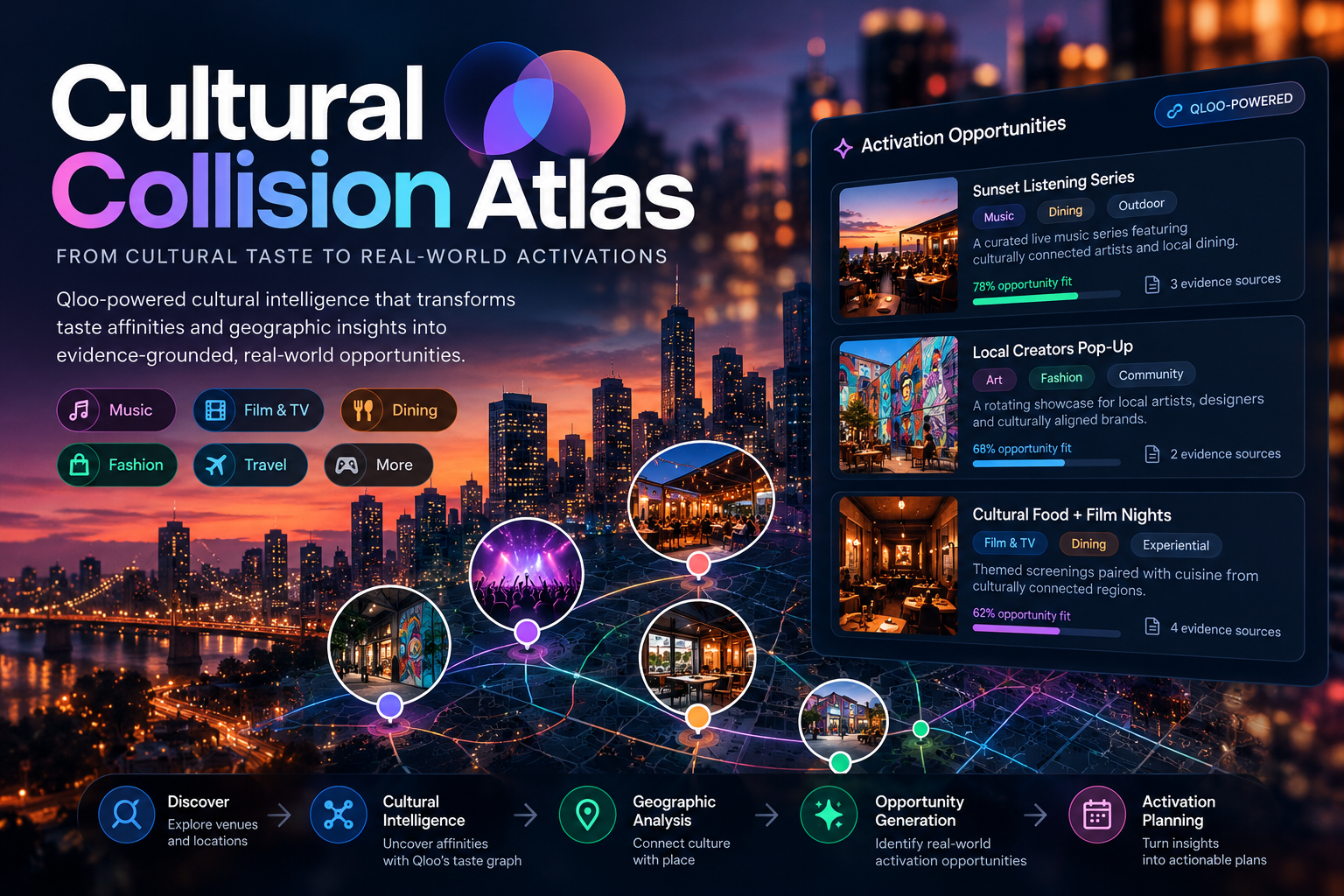
Cultural Collision Atlas is a Qloo-powered cultural intelligence and activation platform that transforms cultural affinities and geographic insights into evidence-grounded real-world activation opportunities.
The application connects five stages into one continuous workflow:
1. Discovery
Users explore venues and locations through a geographic discovery interface, identify relevant candidates, and build a foundation for further analysis.
2. Cultural Intelligence
Using Qloo's taste graph, the platform explores cultural affinities and relationships between interests. It identifies areas of cultural overlap and provides explainable insights rather than relying on generic recommendations.
3. Geographic Analysis
Cultural signals are combined with geographic context and venue information to identify potential opportunities. The platform keeps cultural intelligence, geographic signals, and venue facts distinguishable.
4. Opportunity Generation
The platform generates structured activation opportunities, including potential audience hypotheses, cultural themes, suggested activation formats, supporting evidence, missing information, and limitations.
5. Activation Planning
Users can carry discoveries and their associated analysis into a structured activation planner, turning promising opportunities into actionable plans.
The result is a workflow that connects what people love, where relevant opportunities may exist, and what experiences could be created.
How we built it
We built Cultural Collision Atlas as a full-stack web application, with a modular architecture connecting cultural intelligence, geographic discovery, analysis, and opportunity generation.
Technology stack:
- Frontend: React 19, Vite, TypeScript
- Backend: Node.js and Express 5
- Database: PostgreSQL and Drizzle ORM
- Cultural intelligence: Qloo API
- Geographic and venue discovery: Overture Maps data
- Mapping: MapLibre and OpenFreeMap
- API contracts: OpenAPI and Zod
- Testing: Automated API integration tests and frontend component tests
A major architectural decision was to keep the evidence-processing and opportunity-generation workflow structured and traceable.
The backend retrieves the relevant analysis context and validates it before generating opportunities. The browser cannot simply submit arbitrary evidence and have it treated as verified.
Our opportunity-generation layer uses deterministic rules to produce structured recommendations from available evidence. It distinguishes verified information from inferred suggestions and explicitly identifies missing evidence and limitations.
We also implemented context validation and stale-response protection so that results from an earlier candidate, location, or analysis cannot silently replace newer results.
The platform is designed to provide useful functionality without making paid generative AI services a mandatory dependency for its core opportunity-generation workflow.
Challenges we ran into
1. Turning cultural intelligence into practical opportunities
Finding cultural affinities is only the beginning. The harder problem was connecting those affinities to geographic context and possible real-world activations without making unsupported assumptions.
We addressed this by separating cultural evidence, venue facts, geographic signals, and inferred suggestions.
2. Avoiding misleading recommendations
A cultural affinity does not prove that two audiences are identical, and a geographic signal does not guarantee demand or commercial success.
We deliberately avoided fabricated audience sizes, demographic claims, footfall estimates, venue availability, and guaranteed outcomes. Recommendations instead include supporting evidence and explicit limitations.
3. Handling incomplete and changing data
Analysis can become outdated when a user changes locations, candidates, or discovery contexts. We implemented context validation and stale-response protection to prevent older asynchronous requests from overwriting current results.
4. Building a reliable geographic experience
Integrating geographic discovery and map visualization introduced external data and rendering dependencies. We worked on making the experience resilient, including a transition to a no-key vector-map solution and graceful handling of failures.
5. Building a complete product instead of a disconnected AI demo
We wanted every stage to connect to the next. This required designing shared API contracts, backend validation, frontend state management, and a consistent handoff from discovery to activation planning.
Accomplishments that we're proud of
- Built a complete workflow connecting venue discovery, cultural intelligence, geographic analysis, opportunity generation, and activation planning.
- Integrated Qloo's cultural intelligence into the central product experience.
- Developed explainable cultural overlap analysis and evidence-linked opportunity recommendations.
- Created a structured opportunity-generation engine that distinguishes verified evidence from hypotheses.
- Implemented missing-evidence and limitation indicators to make recommendations more transparent.
- Connected discovery candidates and analysis references across the application workflow.
- Added context-aware stale-response protection for asynchronous opportunity requests.
- Built a persistent discovery and activation-planning experience.
- Established automated tests and completed an end-to-end regression and build-readiness audit across the first three development phases.
Most importantly, we are proud that Cultural Collision Atlas does not simply generate ideas. It connects cultural signals to geographic context and presents the reasoning and evidence behind potential opportunities.
What we learned
We learned that cultural intelligence is most useful when it changes the decisions an application can make.
Qloo's taste graph is not just another recommendation API. It provides a cultural context that generic recommendation systems may not have, allowing us to explore relationships that would otherwise be difficult to identify.
We also learned the importance of separating evidence from inference. A useful intelligence platform should communicate not only what its data supports, but also what remains uncertain.
Another important lesson was that an agentic experience does not need to hide its reasoning behind a black box. Structured workflows, traceable evidence, context validation, and transparent limitations can make intelligent applications more useful and trustworthy.
Finally, we learned that the strongest product experiences emerge when discovery, intelligence, and execution are designed as connected stages rather than isolated features.
What's next for Cultural Collision Atlas
We see Cultural Collision Atlas as the foundation for a much larger agentic platform.
Our next major development direction is Phase 4: Autonomous Agent Workflows.
We envision a coordinated system of specialized agents:
- Research Agent: Consolidates cultural and geographic evidence, identifies gaps, and prepares research context.
- Cultural Strategist Agent: Develops culturally relevant activation concepts grounded in available taste signals.
- Planning Agent: Converts selected opportunities into structured execution plans.
- Risk and Validation Agent: Evaluates assumptions, identifies unsupported claims, and highlights operational risks.
- Orchestrator: Coordinates the agents, maintains shared workflow context, manages retries, and introduces human approval checkpoints.
Beyond this, we want to explore applications for event organizers, entertainment companies, hospitality businesses, retailers, destination marketers, and experience creators.
Our long-term ambition is to move from cultural discovery to culturally informed decision-making and, eventually, coordinated execution.
We believe the next generation of AI agents should understand not only how to complete a task, but also what makes the result meaningful to the people it serves.
Cultural Collision Atlas is our step toward that future.
Built With
- agentic-ai
- artificial-intelligence
- cultural-intelligence
- drizzle-orm
- express.js
- machine-learning
- maplibre
- node.js
- openapi
- overture-maps
- postgresql
- qloo-api
- react
- typescript
- vite


Log in or sign up for Devpost to join the conversation.