Inspiration
We were inspired by the idea that culture is one of the most meaningful aspects of one’s identity, but it is often lost, simplified, or inaccessible. As first generation immigrants, we faced the issue of learning about our culture.
What it does
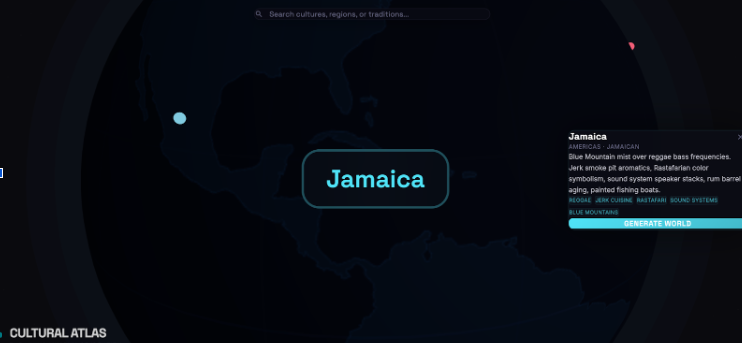
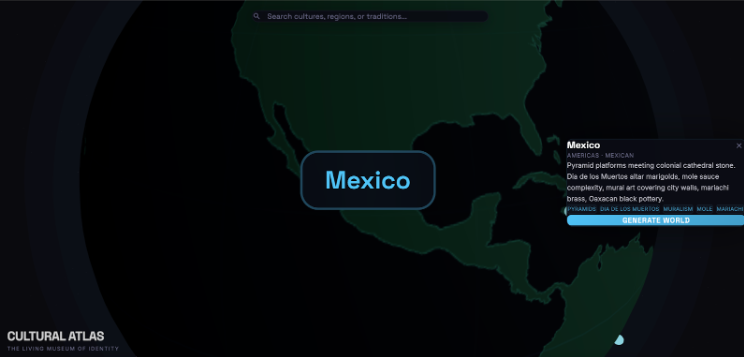
Cultural Atlas is an AI-Powered interactive map where users can explore their culture, simply by clicking on various regions. When a user clicks on a region, the app generates cultural insights in a visual format, highlighting both the historical context and modern identity, bringing culture to life.
How we built it
We built Cultural Atlas using Claude, and Claude’s API keys. We also integrated Gemini and used Cursor to prototype the frontend.
Challenges we ran into
One of our biggest technical hurdles was getting the interactive map to load reliably. Early on, we ran into persistent issues where the map would either fail to render entirely or take far too long to initialize — which was frustrating given how central the map experience is to Cultural Atlas. The map was rendering only as a faint, barely-visible outline rather than the vibrant, colorful representation we had envisioned. We spent a significant chunk of our build time debugging map tile configurations, tweaking rendering layers, and experimenting with different styling approaches.
Accomplishments that we're proud of
Despite the technical hurdles, we're genuinely proud of what we pulled together in such a short amount of time. First and foremost, we got the core experience working. A child can open Cultural Atlas, pick their heritage, and actually receive meaningful, Claude-powered cultural content about their background. We're also proud of how well the concept came together as a cohesive vision. We think the bones of that experience are genuinely there. Finally, we're proud of the idea itself. Out of everything we brainstormed, Cultural Atlas felt like the one with a real soul to it. Building something you actually believe in during a hackathon is rarer than it sounds, and that kept us going through all the debugging.
What we learned
We learned that prompt design is everything. Small changes can drastically change the output from the AI and the structure, hence carefully designing what we were inputting to claude. We also learned that AI is most powerful when we use it to amplify the human identity, not replace it. Even in a short amount of time, focusing on the user experience rather than the complexity leads to better results.
What's next for Cultural Atlas
We see Cultural Atlas evolving into a full platform for cultural preservation and exploration. We want to add user-generated cultural stories and archives. We also want to be able to integrate more complex visuals for many cultures, in the most accurate way possible. We also want to expand it into a language preservation tool. We would also like to incorporate audio elements - music, pronunciations, oral history, etc. Lastly, we would love to incorporate a community layer, where people can share their own traditions and things they learned with the Cultural Atlas community.
Built With
- api
- chatgpt
- claude
- gemini
- openai

Log in or sign up for Devpost to join the conversation.