-
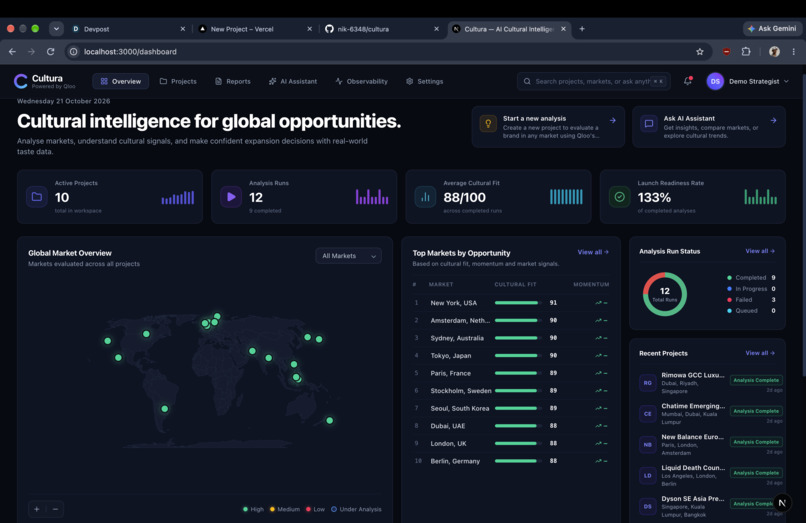
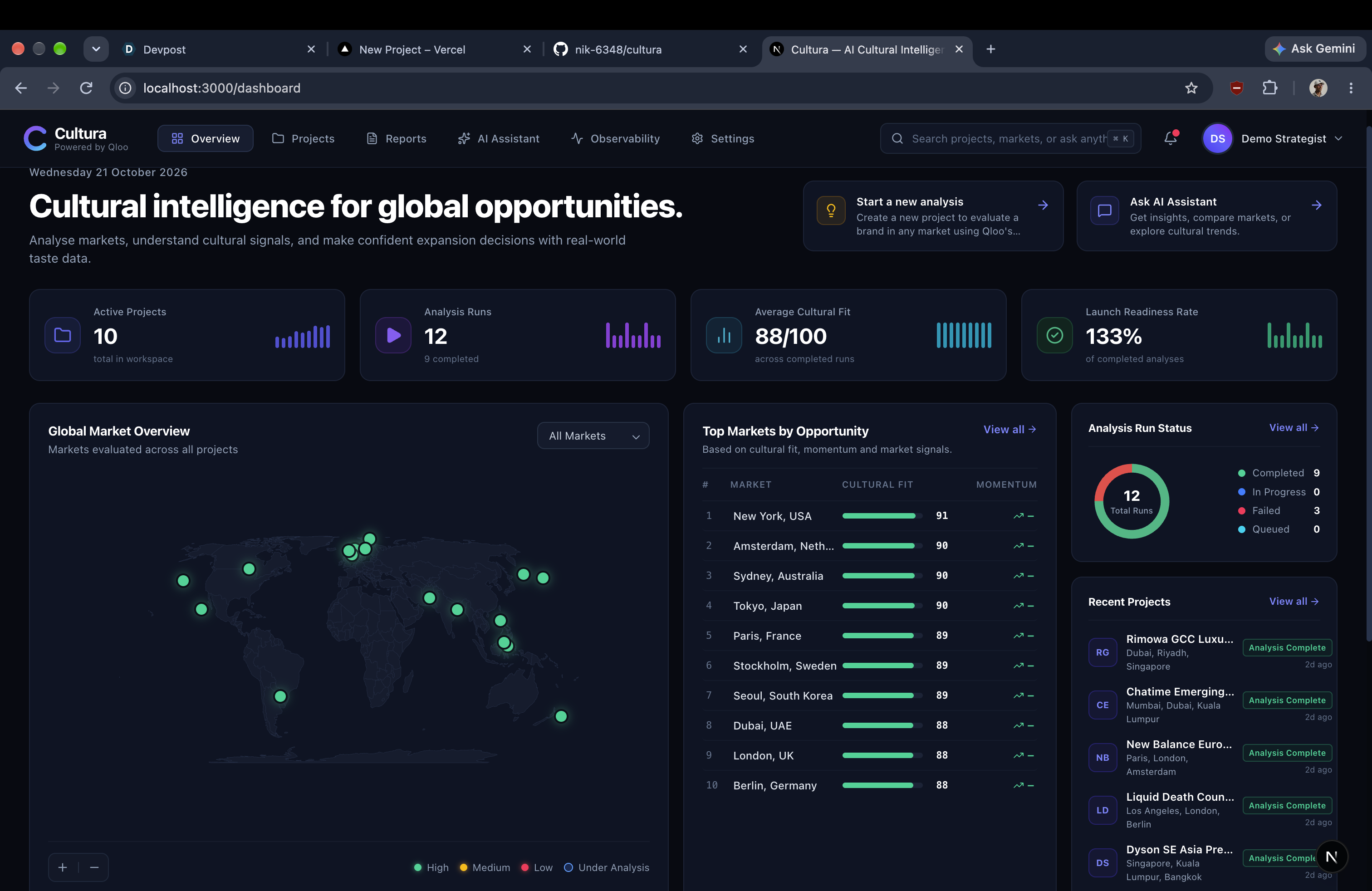
Overview
-
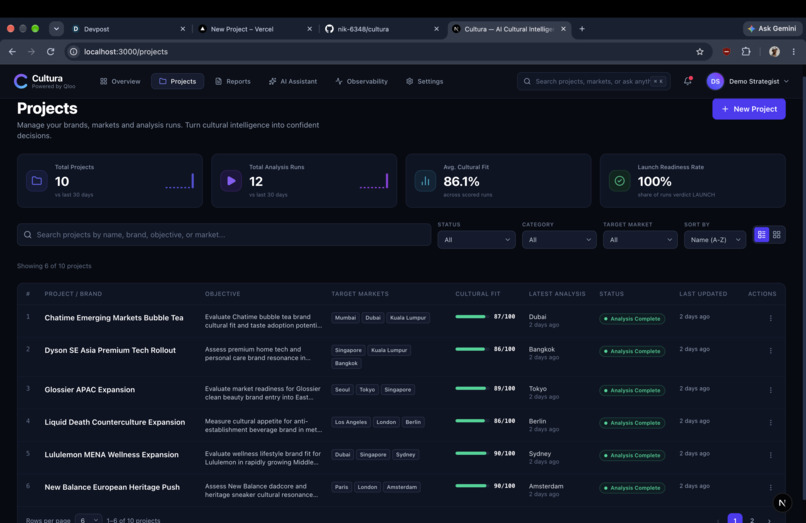
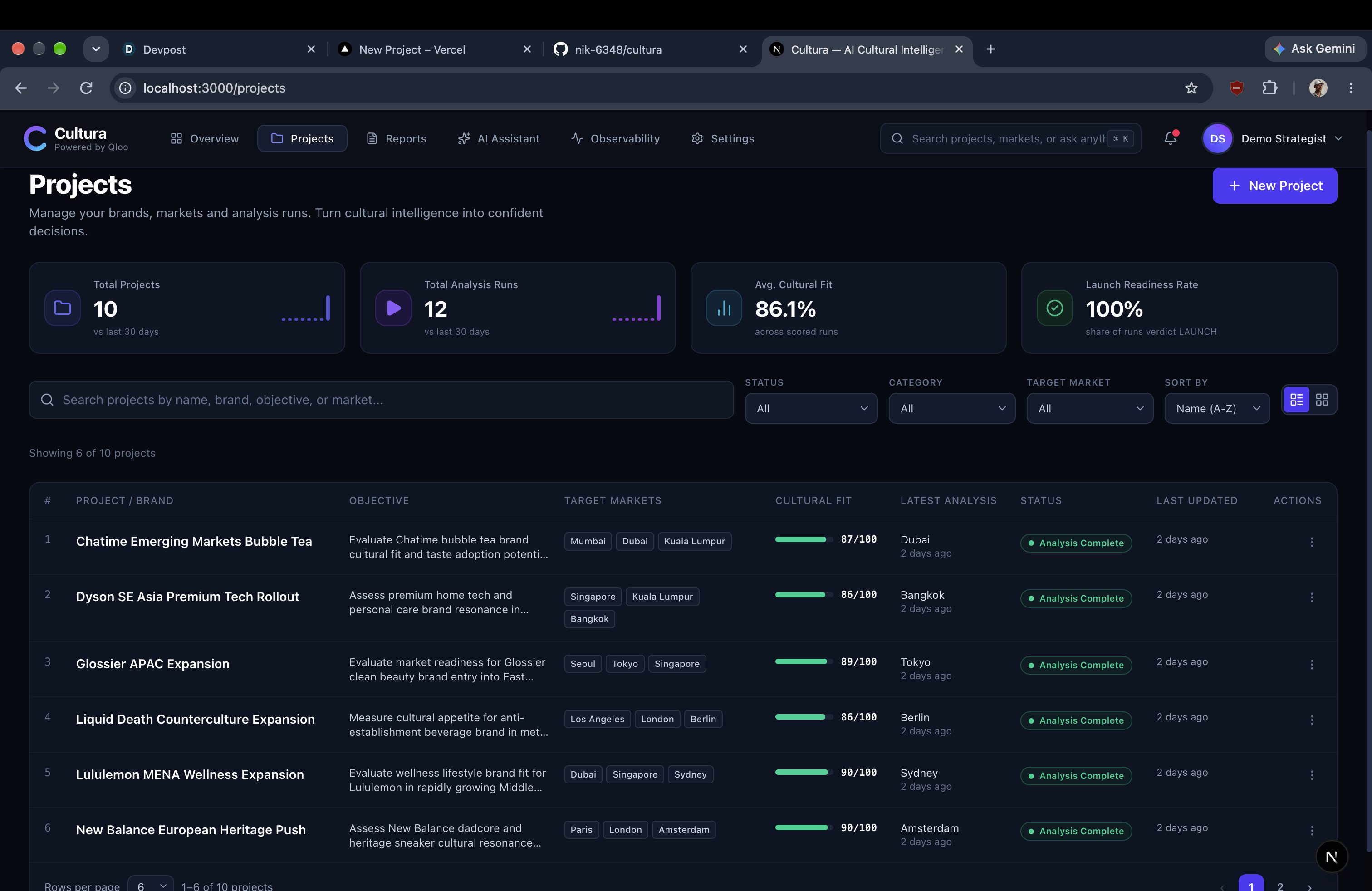
Projects
-
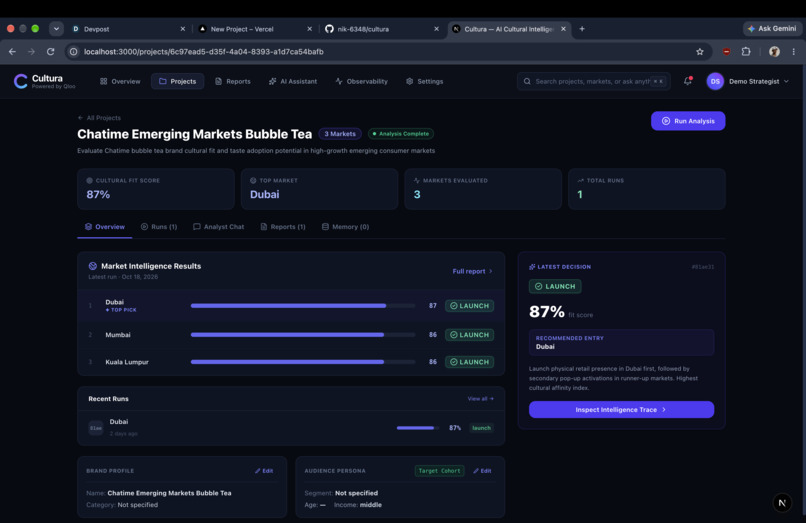
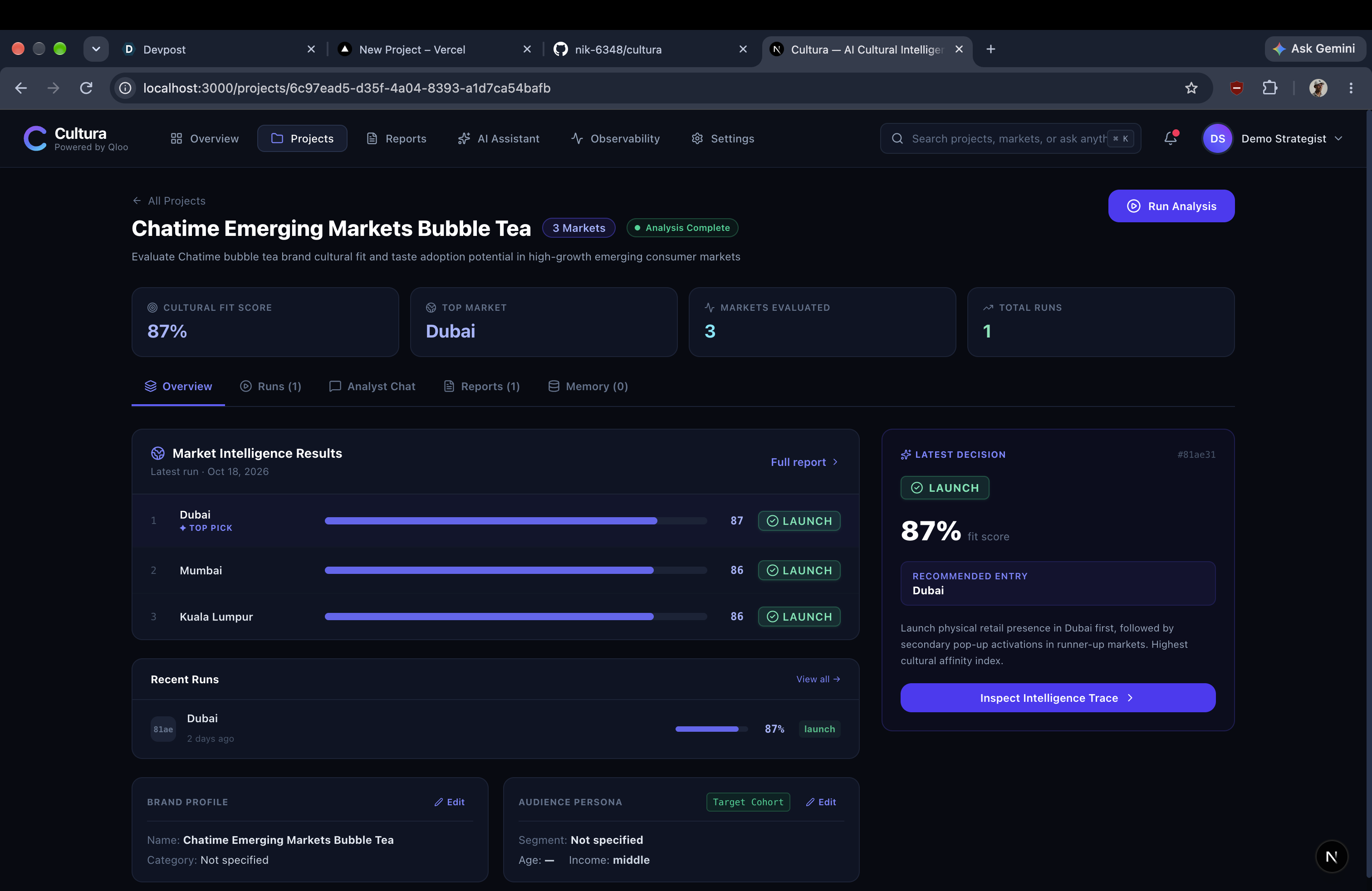
Projects Details
-
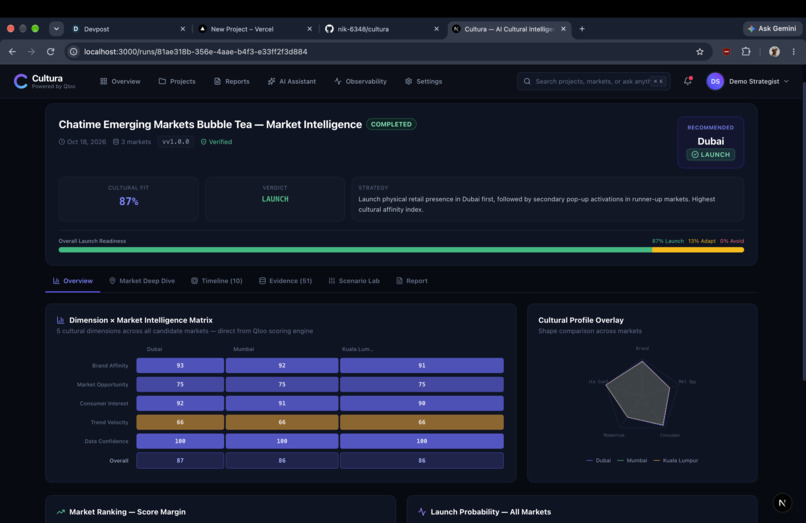
Market Overview
-
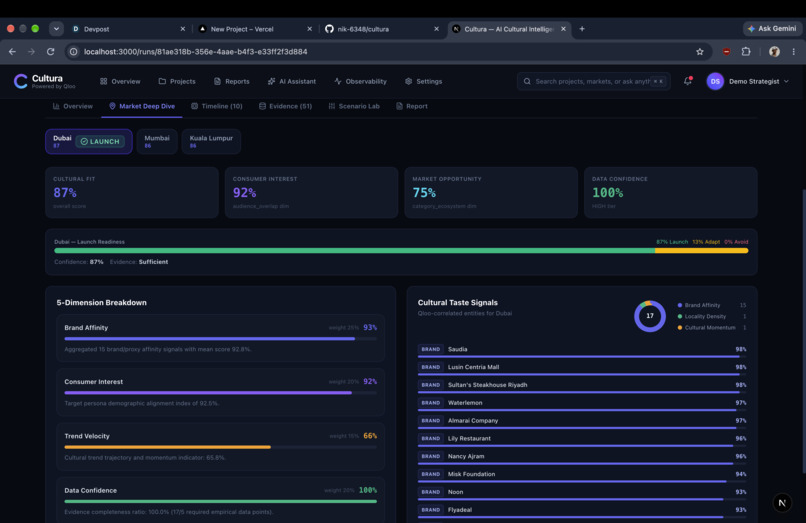
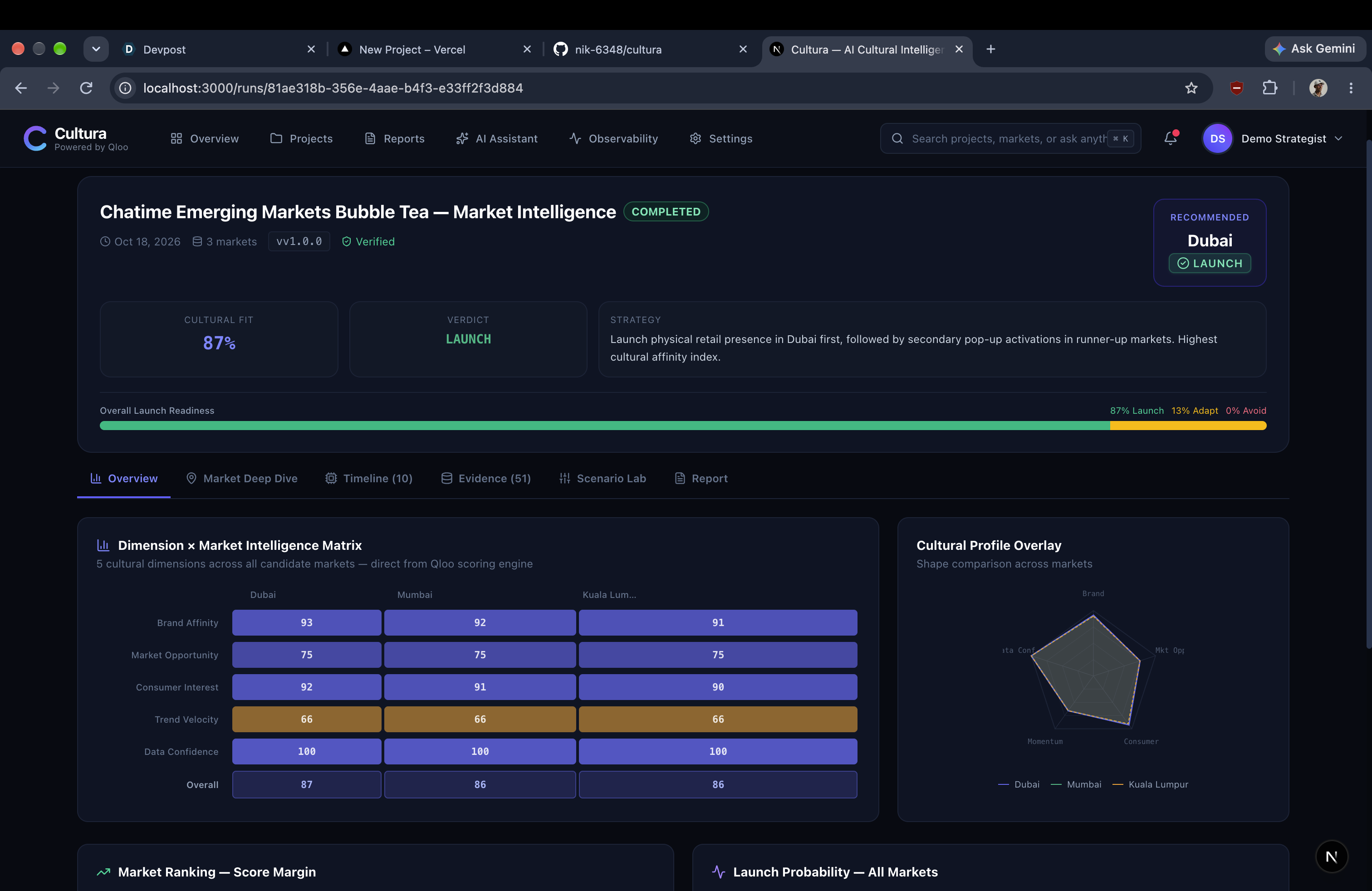
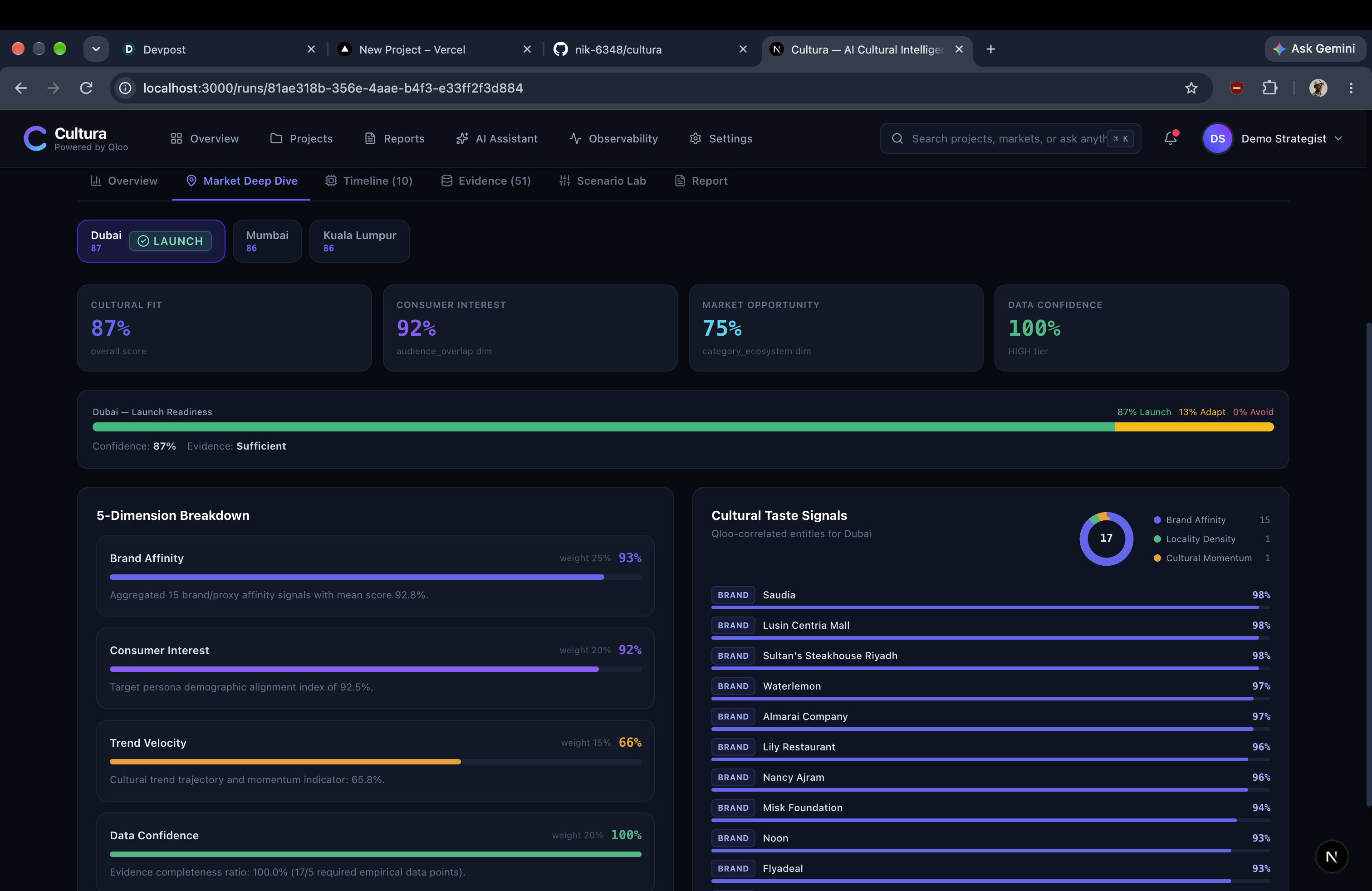
Market Deep Dive
-
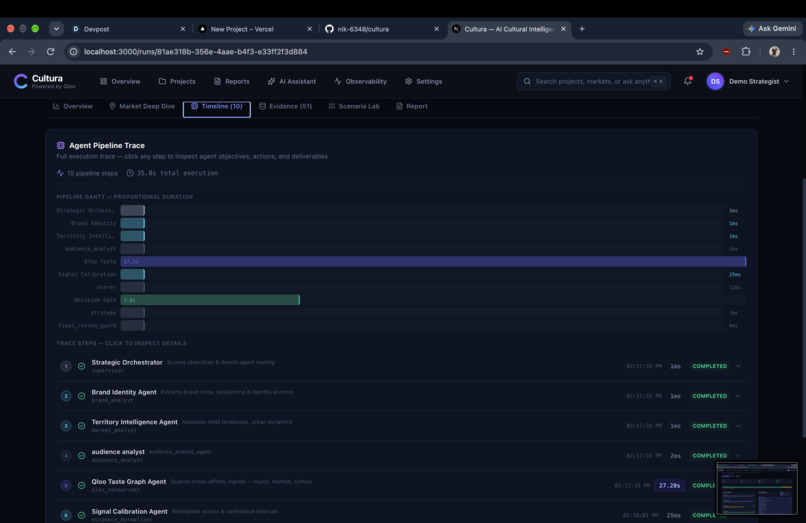
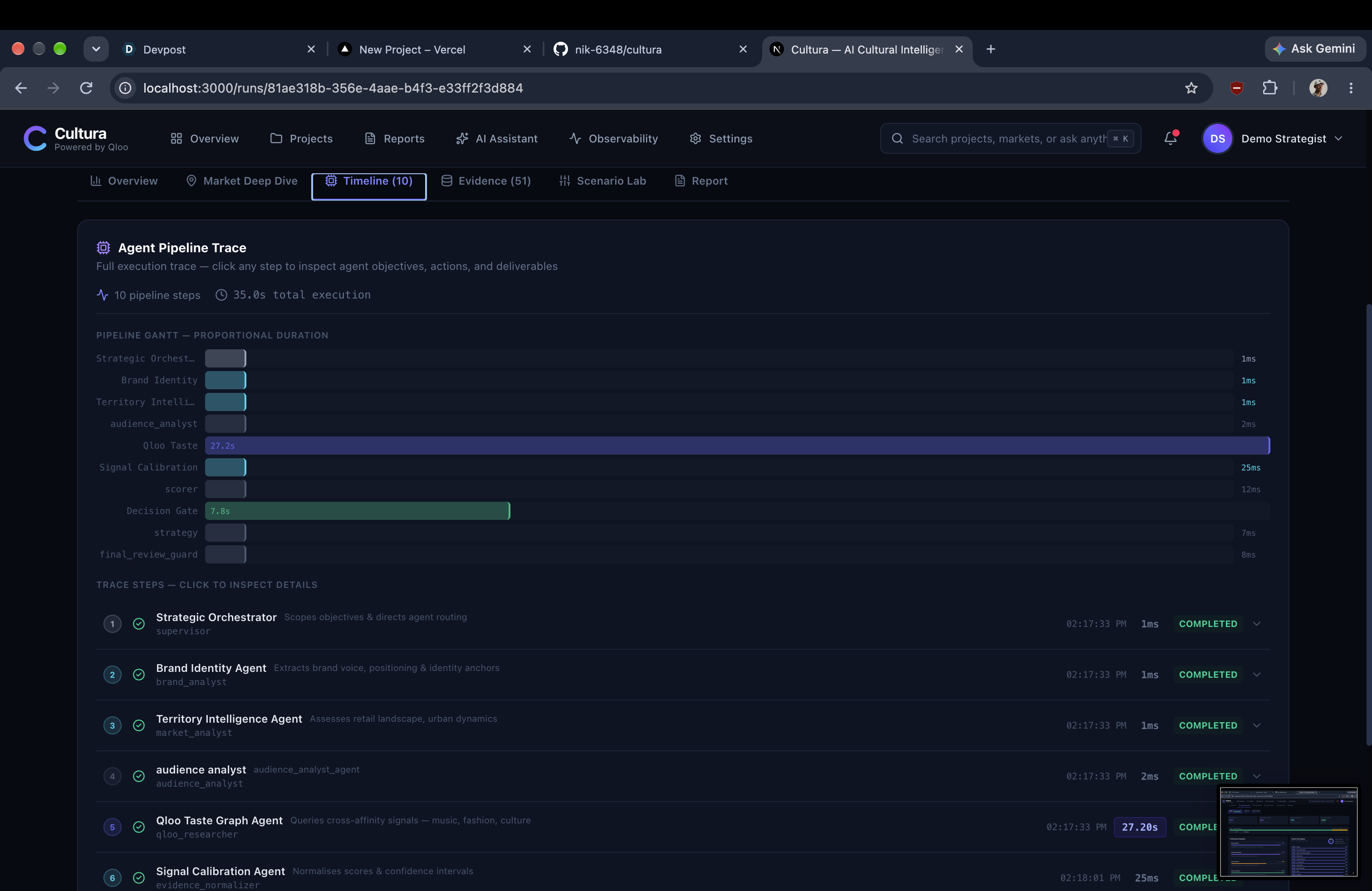
Decision Trace & Observability
-
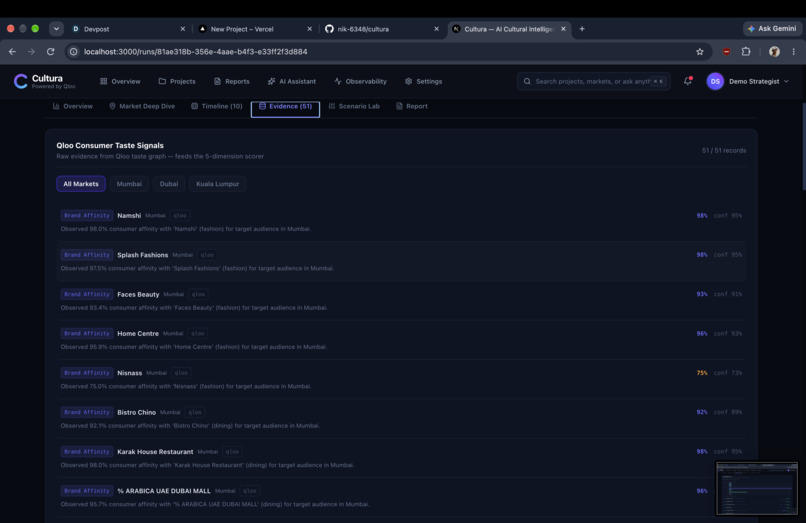
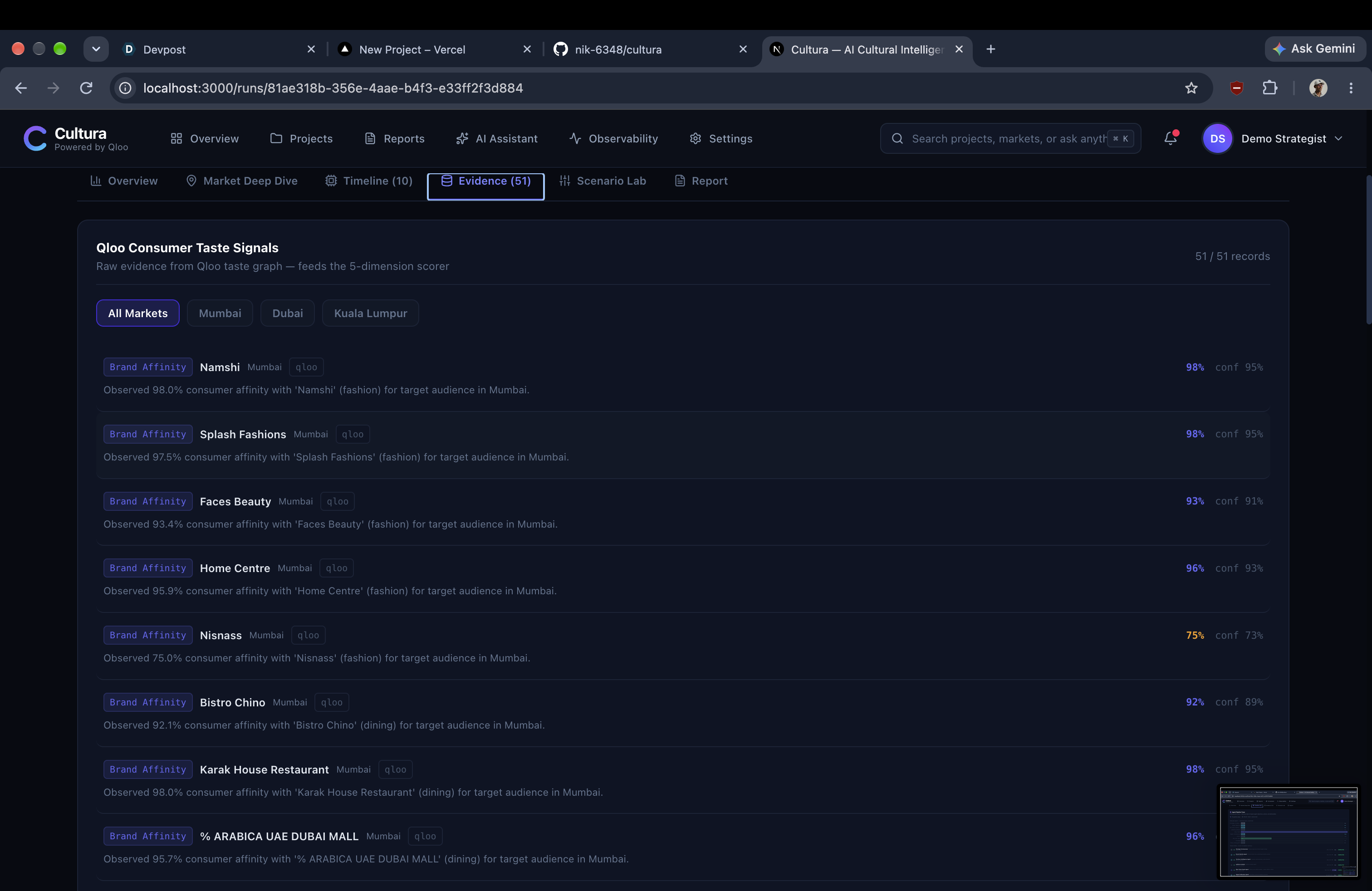
Evidence
-
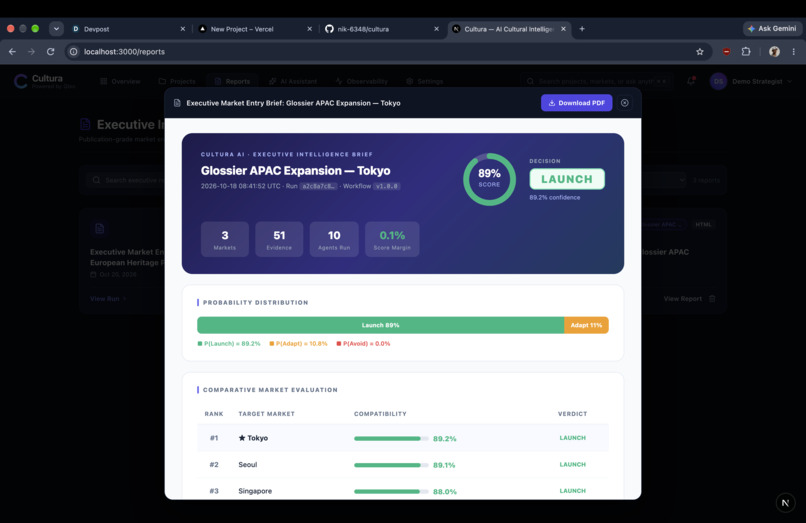
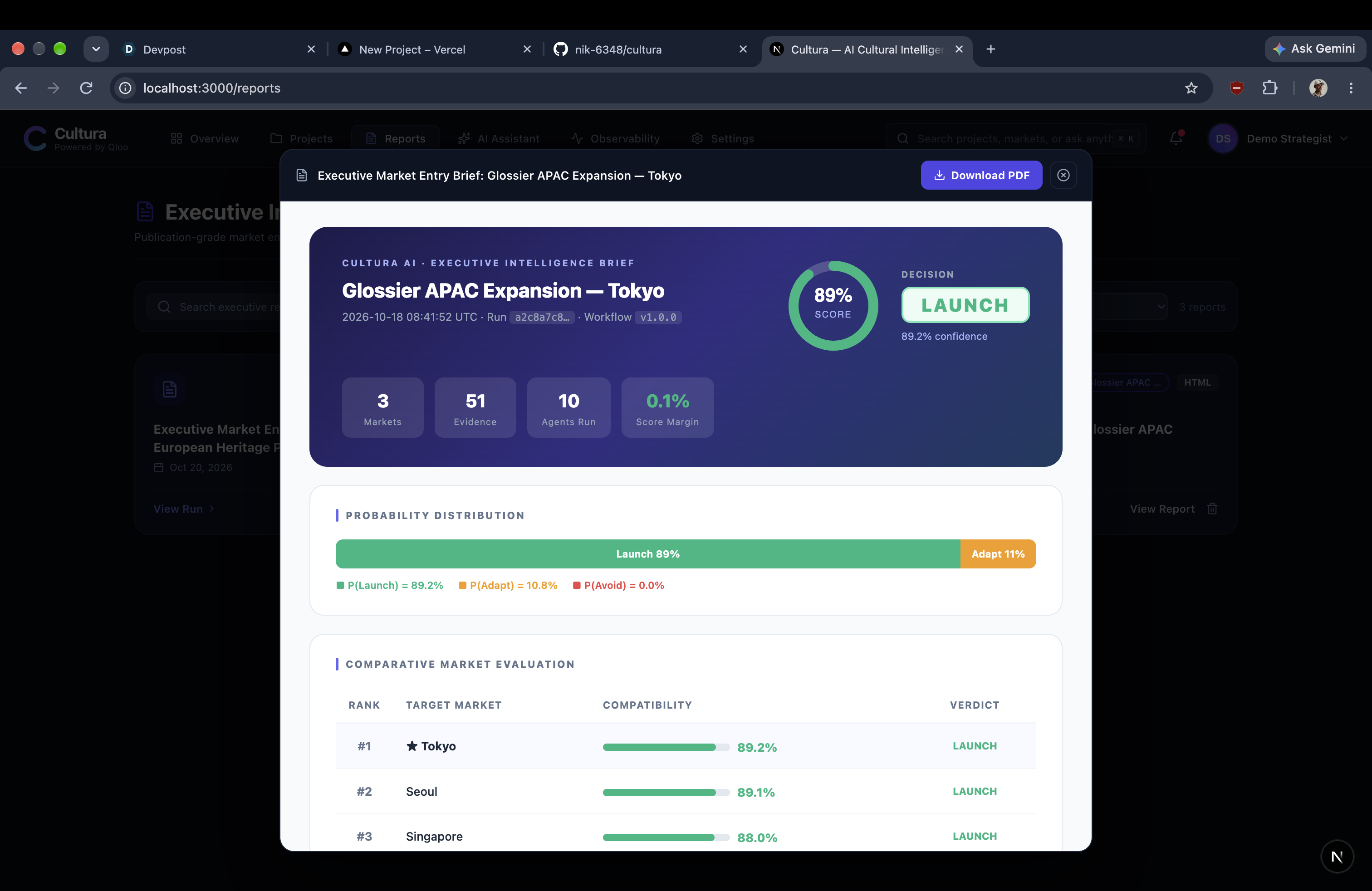
Reports
Cultura — Enterprise AI Cultural Intelligence Platform
Autonomous AI market intelligence platform powered by Qloo’s Taste Graph to calculate empirical cultural fit and guide global brand expansion.
Inspiration
Every year, multi-billion-dollar enterprise brands fail catastrophically when entering new international markets (e.g., Target losing $2.5B in Canada, Walmart exiting Germany after $1B in losses, or luxury brands blundering localized nuances across East Asia).
When evaluating these failures, we uncovered three systemic flaws in modern market research:
- Blind Demographic Extrapolation: Corporate strategists assume that a 25-year-old in Tokyo behaves like a 25-year-old in Berlin simply because they share an age and income bracket.
- Culturally Blind LLMs: When prompted for market strategy, generic LLMs (GPT-4, Claude) hallucinate generic, overly optimistic advice without empirical grounding, statistical validation, or real consumer affinity data.
- Zero Institutional Memory: Strategic lessons and local cultural nuances are lost across rotations, causing enterprises to repeat the exact same expensive mistakes.
We asked: What if autonomous AI agents didn’t just reason, but possessed genuine cultural taste and empirical grounding? This inspired Cultura—the first enterprise-grade cultural intelligence platform powered by Qloo's Taste AI™ and multi-agent orchestration.
What It Does
Cultura evaluates whether a brand or product will succeed in target global markets before a company commits capital. It replaces guesswork with empirical data, deterministic scoring, and typed governance:
- Conversational Plan-First Copilot: Strategists describe their concept in plain English or select a curated archetype. Cultura generates a strategic launch plan with candidate markets, target cohorts, and execution timelines.
- Autonomous 10-Node Multi-Agent DAG: A dedicated pipeline of specialized agents extracts Qloo taste data, evaluates cohort alignment, analyzes 6-month cultural momentum, screens for taboos, and synthesizes localized directives.
- Deterministic 5-Dimension Compatibility Scoring: Replaces subjective LLM score generation with reproducible fixed-point mathematics ($10^{-4}$ precision): $$\text{Score} = w_1 A_{\text{brand}} + w_2 A_{\text{audience}} + w_3 D_{\text{ecosystem}} + w_4 M_{\text{trend}} - P_{\text{coverage}}$$
- TypeSafe Jev System One Posture Gating: Strictly classifies market entries into probability-backed operational gates:
LAUNCH($\text{Score} \ge 0.75$, confidence $\ge 0.70$, zero critical taboos)ADAPT($0.55 \le \text{Score} < 0.75$, viable affinity requiring localized friction reduction)AVOID($\text{Score} < 0.55$, severe cultural misalignment)
- Interactive Pure SVG Analytics: Executive dashboards featuring 5-axis Cultural Resonance Radars (comparing candidate markets side-by-side) and 6-month cultural velocity trajectory curves.
- What-If Strategy Simulation Lab: Strategists can branch any evaluation to simulate alternative personas (e.g., "What if we target Gen Z gamers?") or retail formats ("What if we test an underground pop-up instead of a flagship?"), observing real-time delta shifts in Qloo affinity.
How We Built It
Cultura is engineered as an enterprise-grade monorepo combining state-of-the-art agentic orchestration with empirical cultural data:
- Cultural Intelligence Backbone: Qloo Taste AI™ API mapping affinities across fashion, dining, music, nightlife, film, literature, and physical urban venue density.
- Agentic Orchestration: LangGraph Multi-Agent DAG running 10 sequential, observable worker nodes:
OrchestratorAgent➔ 2.QlooTasteExtractionAgent➔ 3.DemographicAlignmentAgent➔ 4.TrendMomentumAgent➔ 5.RiskSensitivityAgent➔ 6.JevSystemOneGateAgent➔ 7.StrategySynthesisAgent➔ 8.ExecutiveBriefingAgent➔ 9.AuditLedgerAgent➔ 10.MemoryIngestionAgent.
- Backend Engine: Python 3.12, FastAPI, Pydantic v2, SQLAlchemy 2 (asyncpg), Alembic, and deterministic fixed-point arithmetic.
- Semantic & Institutional Memory: PostgreSQL 16 with
pgvectorstructured into a 4-layer memory hierarchy (Transient Cache, Session Context, Project Scope, and Cross-Workspace Institutional Memory). - Frontend Application: Next.js 16 (App Router), TypeScript, Tailwind CSS, pure SVG mathematical chart visualizers, and TanStack Query.
- Cryptographic Evidence Audit: Computes SHA-256 hashes of raw Qloo API response payloads, ensuring every strategic recommendation is fully auditable and tamper-proof.
Challenges We Faced
- Normalizing Cross-Domain Cultural Affinities: Qloo maps radically diverse entities—from Japanese hyper-pop artists and Berlin techno clubs to artisanal coffee roasters. Creating a normalized, multi-dimensional tensor that accurately reflects a brand’s total cultural footprint across unrelated lifestyle categories required deep mathematical modeling.
- Preventing LLM Decision Jitter: Traditional LLMs give different verdicts on identical data depending on temperature and prompt semantics. We eliminated this by decoupling numerical scoring from the LLM, relying strictly on deterministic math formulas and TypeSafe Jev gating boundaries.
- Sub-second Multi-Agent Execution: Coordinating 10 autonomous agents alongside external API calls threatened latency. We implemented an asynchronous DAG execution model paired with a high-speed L1/L2 vector cache layer in PostgreSQL.
Accomplishments That We're Proud Of
- Zero Hallucinated Recommendations: Every single strategic insight, venue recommendation, and audience affinity is grounded in verified Qloo entity IDs with cryptographic audit proofs.
- Production-Grade Architecture: Built a complete enterprise full-stack platform (FastAPI + LangGraph + Next.js 16 + pgvector) rather than a simple playground notebook or chat wrapper.
- Instant What-If Scenario Simulations: Strategists can execute counterfactual simulations in seconds, allowing boardroom decision-makers to stress-test expansion hypotheses before spending a single dollar.
What We Learned
Real human taste is fundamentally non-linear and high-dimensional. Demographics alone (age, gender, income) are poor predictors of culture. Two people with the same demographic profile in the same zip code can live in completely different cultural universes.
We learned that AI agents cannot be trusted with business-critical decisions unless they are anchored to an empirical cultural graph. Qloo provides the missing link that transforms LLMs from creative conversationalists into reliable strategic advisors.
What's Next for Cultura
- Live Campaign Sentiment Feedback Loop: Continuously updating post-launch market affinity scores using real-time social and transactional signals.
- Hyper-Localized Venue Anchor Matching: Automatically generating shortlist contracts for local brand partnerships, pop-up real estate leases, and co-marketing collaborations using Qloo's physical venue graph.
- Enterprise Multi-Tenant SaaS Rollout: Extending Cultura’s 4-layer institutional memory to support multinational conglomerates managing dozens of regional brand portfolios simultaneously.
Built With
- alembic
- asyncpg
- docker
- fastapi
- firebase-admin
- httpx
- jspdf
- langgraph
- lucide-react
- next.js
- openai
- pgvector
- pnpm
- postgresql
- pydantic
- python
- qloo-api
- react
- react-simple-maps
- ruff
- sqlalchemy
- tailwindcss
- typesafe-jev
- typescript

Log in or sign up for Devpost to join the conversation.