💡 Inspiration
The inspiration came from two places: the crushing "choice fatigue" of looking at a fridge full of random leftovers, and the realization that most recipe apps are boringly practical. We wanted to solve the food waste problem by turning it into a game of high-stakes molecular gastronomy. We asked: "What if your kitchen wasn't just a place to cook, but a laboratory to synthesize art?"
⚙️ What it does
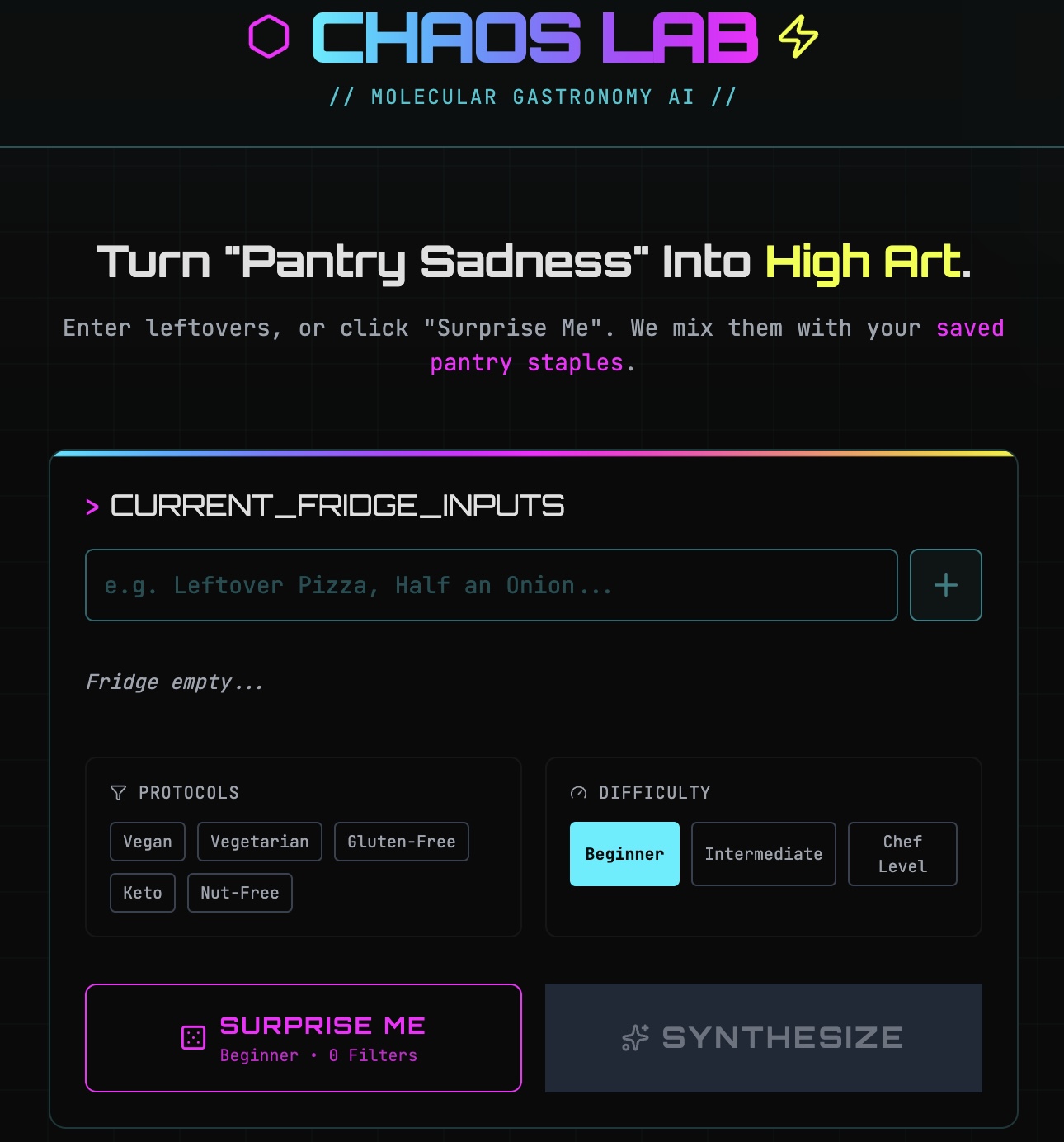
Culinary Chaos Lab is a "Neon-Noir" AI Alchemist. Users input their "Matter Inventory" (leftovers) and the lab cross-references them with a persistent "Pantry Databank."
- Matter Synthesis: Generates unhinged but chemically sound molecular gastronomy recipes.
- Matter State Logic: The AI understands physical reality (e.g., it knows you can't "un-toast" bread, but you can turn it into a "Sourdough Miso Reduction").
- Visual Construction: Uses Gemini to render high-fidelity visuals of the future meal.
- Viral Protocol: Generates a step-by-step social media storyboard for the "TikTok-era" chef.
🛠️ Built With
Languages & Frameworks
- TypeScript / JavaScript (ES6+): The primary logic and type-safety layer.
- React 19: For building a reactive, component-based user interface.
- Tailwind CSS: For the high-performance, utility-first styling of the "Cyber-Grid" UI.
- HTML5 & CSS3: For the structural foundation and custom neon animation keyframes.
AI Technologies
- Google Gemini 3 Flash-Preview: Used as the primary "Reasoning Engine" for recipe generation and culinary physics.
- Google Gemini 2.5 Flash-Image: Used for the "Visual Construction" of hyper-realistic food imagery.
- ChatGPT & Grok: Utilized extensively during the initial planning phase for brainstorming features, architectural mapping, and refining the complex system prompts before final integration.
🛠️ How we built it
The project was built as a modern Single Page Application (SPA). We focused on a "Zero-Backend" architecture, leveraging the browser's LocalStorage for persistent pantry data and direct API calls to Google's GenAI SDK. The planning phase involved multi-LLM validation (using ChatGPT and Grok) to ensure the "Matter State Logic" prompt was bulletproof before deployment.
🚧 Challenges we ran into
The biggest hurdle was Matter State Reasoning. Standard AI models often suggest impossible physics, like "un-boiling" pasta. We had to implement a specific "composite solid" logic in our system prompts to ensure the AI treats leftovers as fixed physical states. Additionally, maintaining high accessibility within a high-contrast "Neon" UI required deep refinement of our CSS variable architecture.
🏆 Accomplishments that we're proud of
We successfully bridged the gap between "unhinged creativity" and "practical utility." The "Surprise Me" feature consistently produces recipes that sound like they belong in a futuristic high-end restaurant, and the visual rendering is surprisingly appetizing despite the "Neon-Noir" aesthetic.
🧠 What we learned
We learned that prompt engineering is essentially "culinary physics" when dealing with food. By treating the AI as a physical simulator rather than just a text generator, the quality of the output transformed. We also mastered multi-model orchestration—using one Gemini model for logic and another for creative visualization in a single workflow.
🔮 What's next for Culinary Chaos Lab
- Veo Integration: Generating 7-second "Viral Protocol" videos of the cooking process.
- Live API Coach: A real-time voice assistant that guides you through the synthesis in "Zephyr's" voice.
- Matter Scanner: Using the camera to automatically identify "Matter Inventory" via Gemini's vision capabilities.
Synthesize responsibly.
Built With
- chatgpt
- css
- css3
- gemeni
- grok
- html5
- react
- tailwind
- typescript

Log in or sign up for Devpost to join the conversation.