-
-
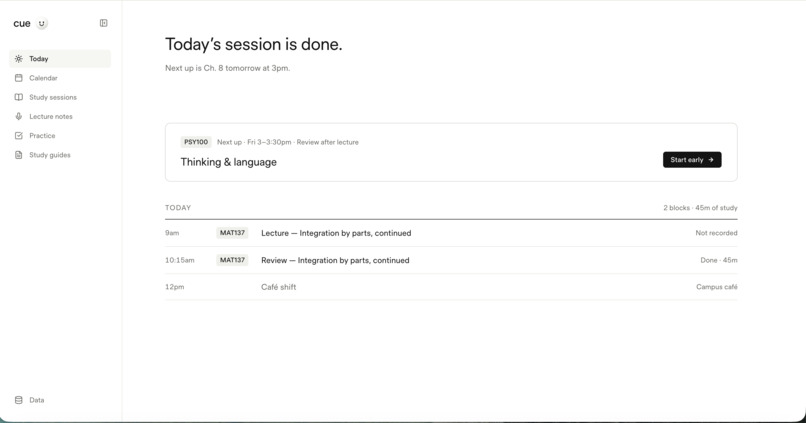
Home Page
-
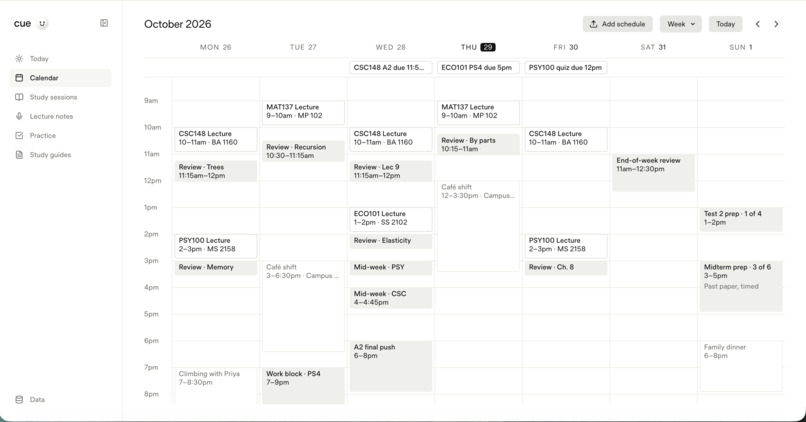
Calendar
-
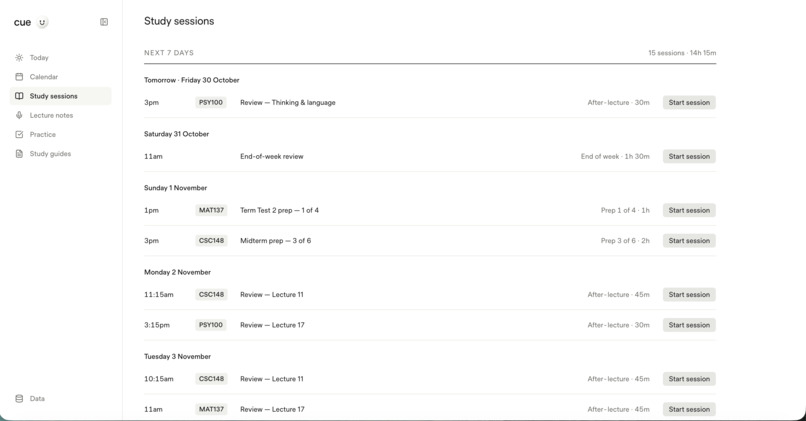
Study Session Overview
-
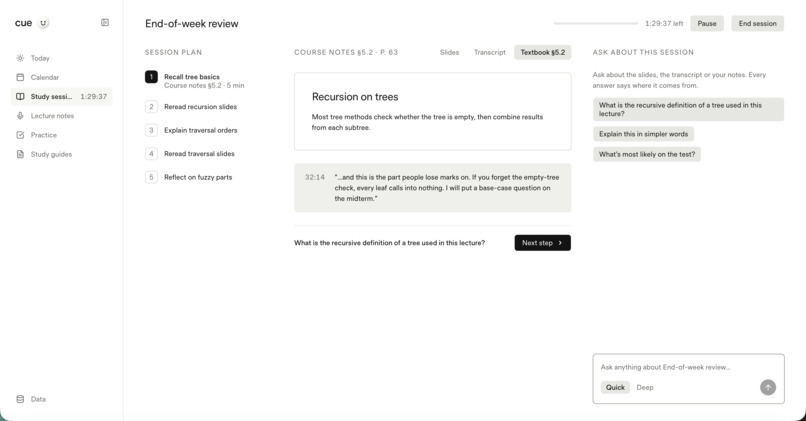
In-session review
-
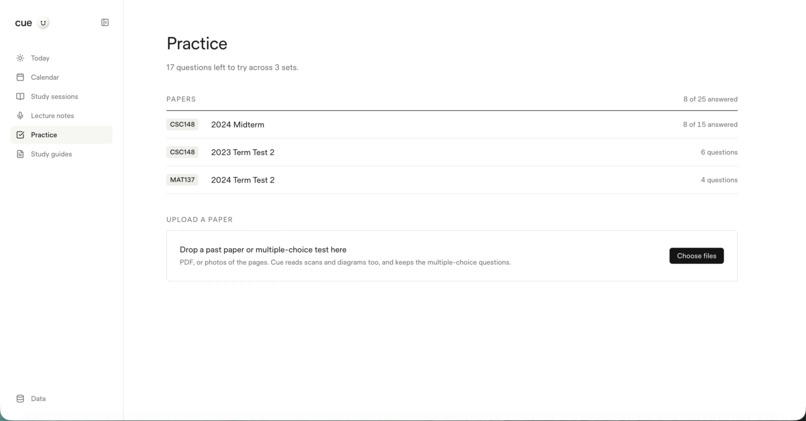
Practice Page (Multiple Choice, Flashcards, etc.)
-
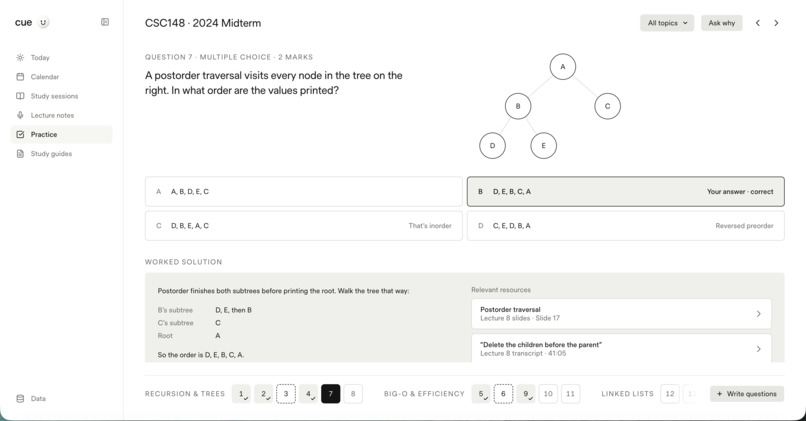
Multiple Choice Activity
-
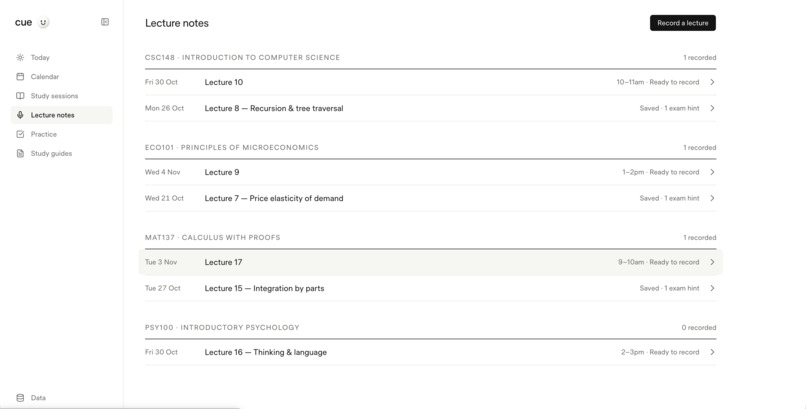
Lecture Notes and Recordings
-
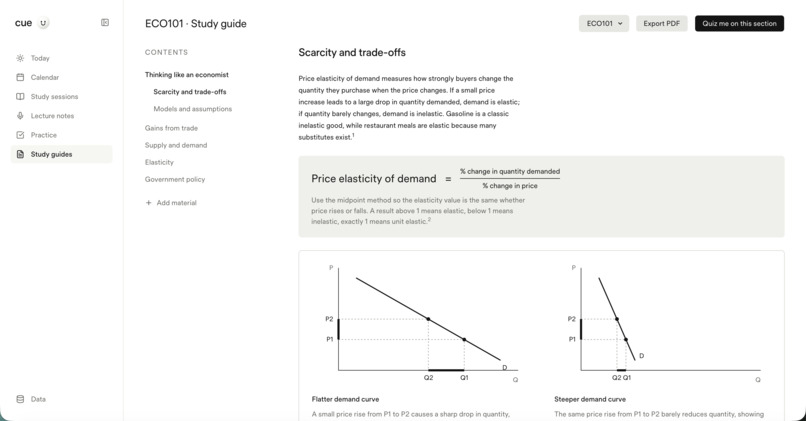
Study Guide (Summary of all information)
Inspiration
We’re students at the University of Toronto. In our time here, we’ve watched AI go from stumbling over high school math to writing working code and walking us through our own problem sets. We just finished our midterms, and we keep wondering what this means for students like us. If these models keep moving toward superintelligence, what does learning look like? How do we use them to learn more, not less?
The answer starts with how we used to learn. Before AI, learning meant searching. You pieced together answers from web pages and Stack Overflow threads written for someone else. Language models changed that. For the first time, you can get an explanation written for your exact problem. The internet made knowledge available to everyone. Language models make it specific to you.
And even concerning the nature of education in general, before you start learning you spend a lot of time on things that aren’t learning. Preparing for midterms, we hunted for slides on Canvas, scrubbed through lecture recordings, searched textbook PDFs, and tracked down past tests that had no answer keys. Before AI, you could argue this work was a necessary evil. Even if you were teaching yourself, you had to be the searcher. You found the resources, collected them and put them in order, and only then could you learn from them. Now AI can do that part for us, so we can spend our effort putting the information into memory.
Although, a model with empty context can’t do it on its own because it doesn’t know your course. It doesn’t know which slide your professor spent ten minutes on, which question was on last year’s midterm, or which mistake your professor said would cost marks. Cue does. It gathers your lectures, slides, textbook and past tests, so the only work left for you is the learning itself.
Finally, we’re optimistic because Cue runs on open models, so students can own their intelligence instead of renting it. Nemotron’s weights are public. Anyone can run the models on their own hardware and fine-tune them on their own courses. For students, where every dollar counts, that means no single company setting the price and no bill for every question. For universities, it means they can host the models on their own servers, so lecture recordings, course material and grades never leave campus, and professors can share their material without an outside company seeing it.
What it does
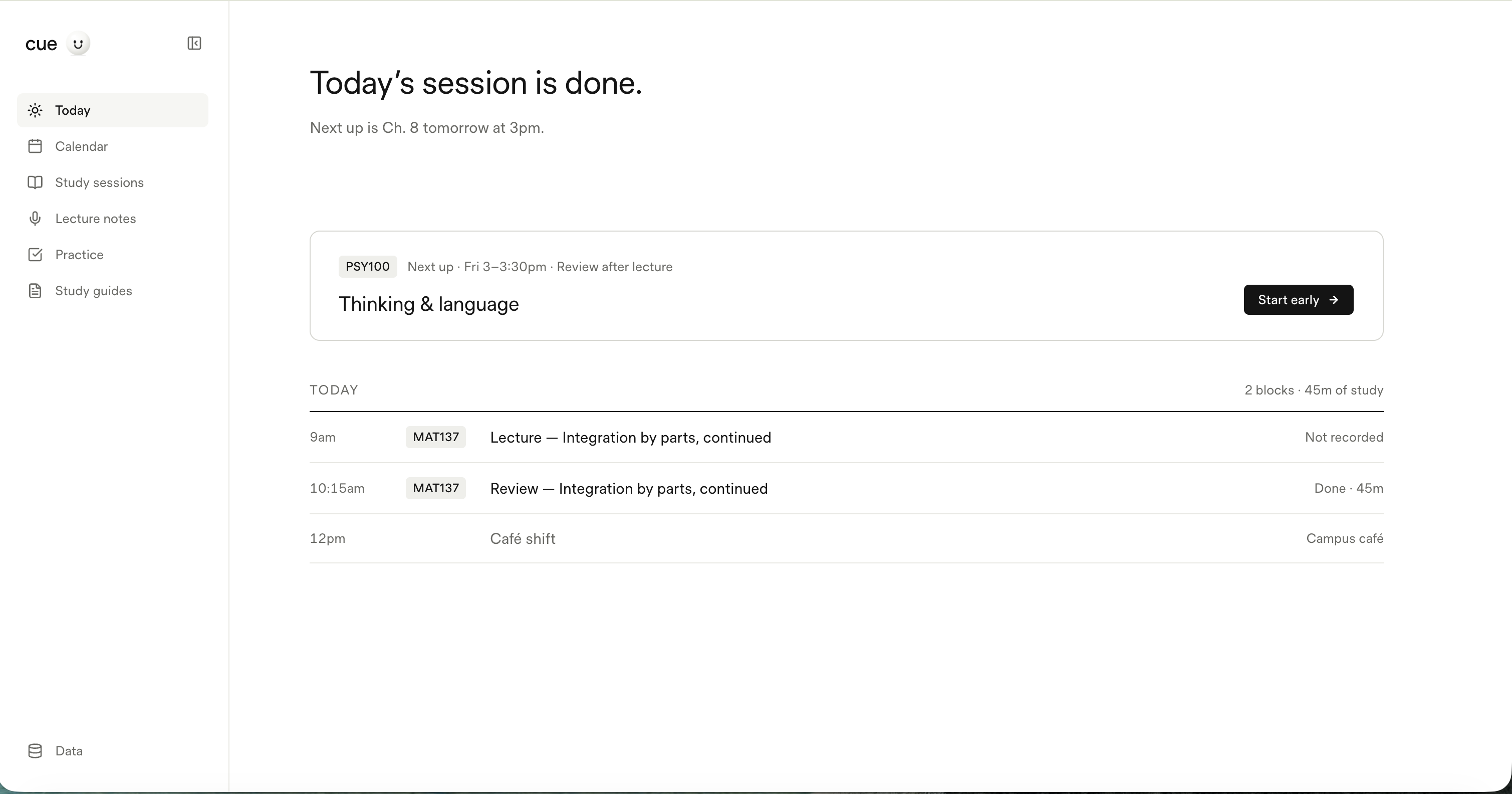
You add your schedule and course material once. From then on, Cue plans when you study, gathers the material for each session, and tests what you've learned.
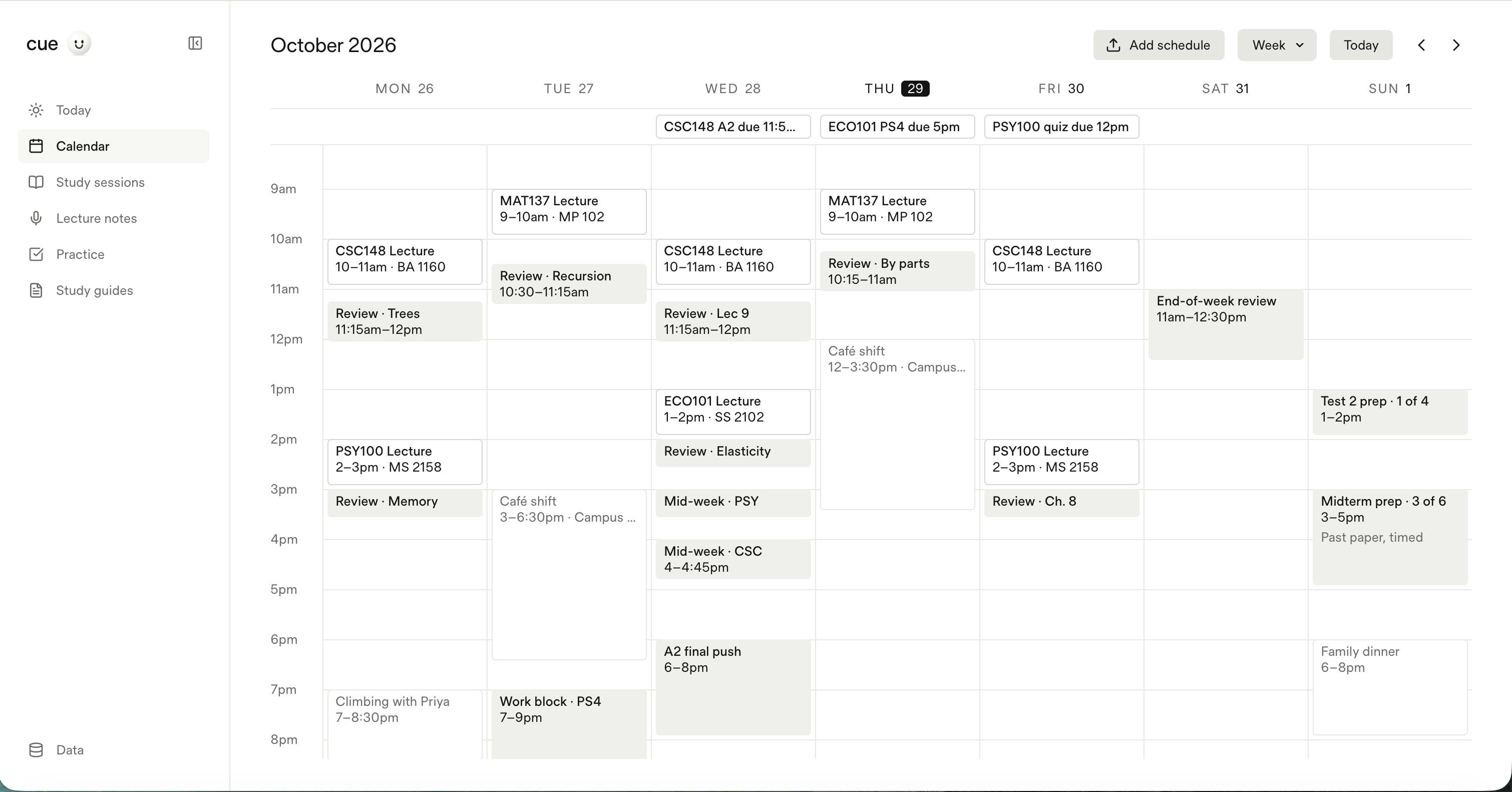
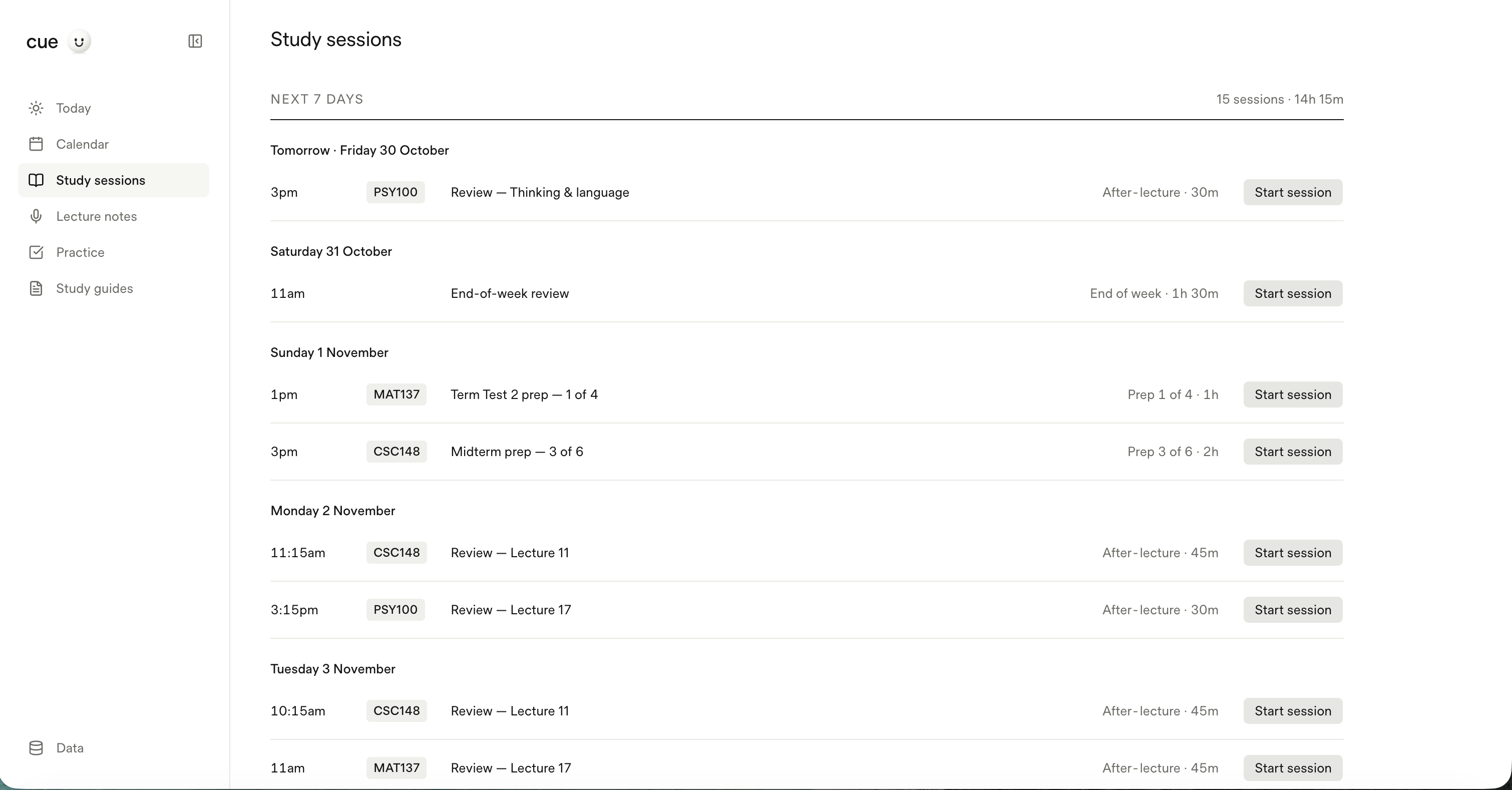
Calendar. Upload your timetable as a calendar file, screenshot or PDF, and Cue plans spaced review around it. You review each lecture soon after it ends, again mid-week, and more often as a test gets closer.
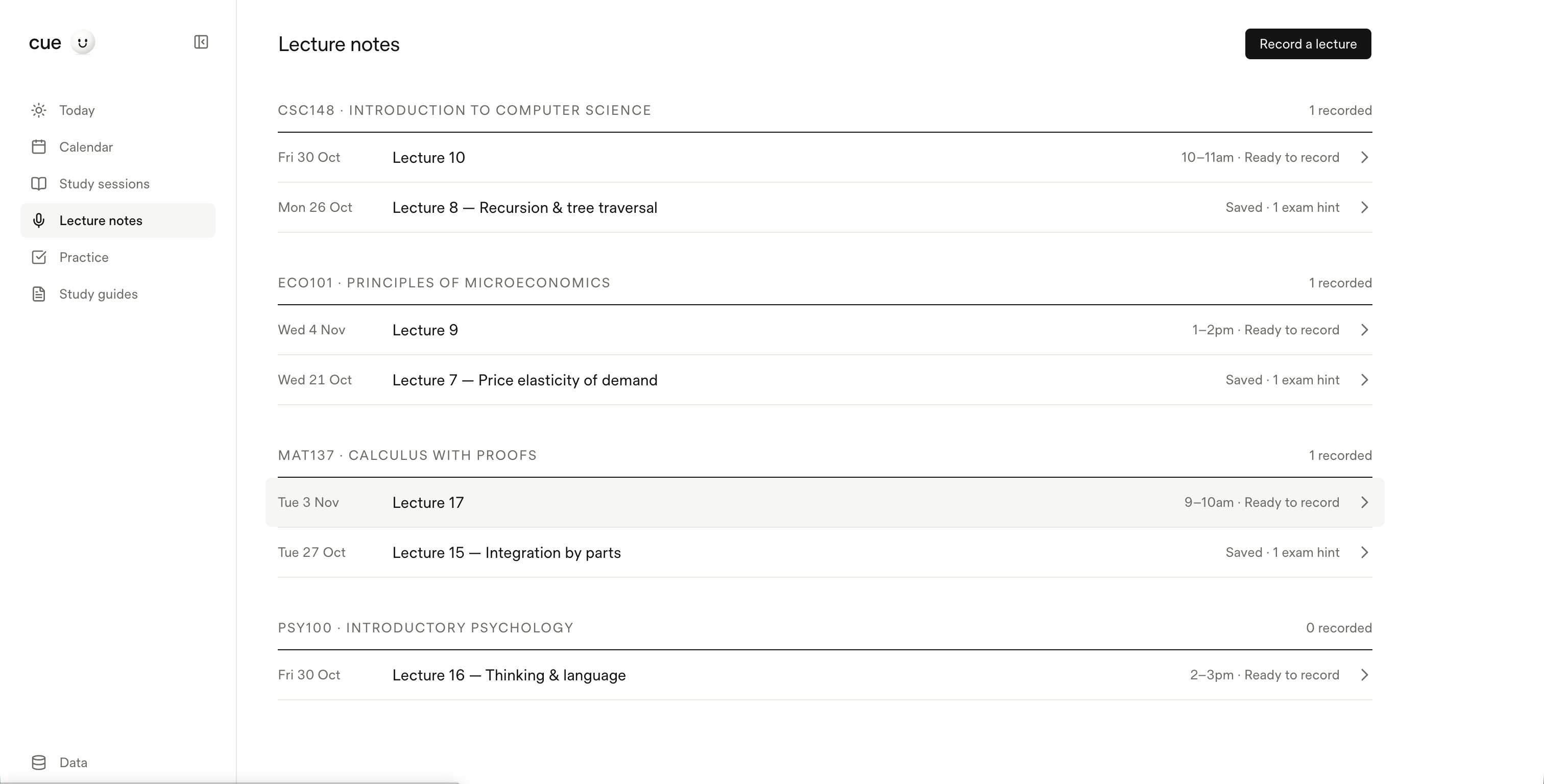
Lecture notes. Cue transcribes lectures live on your laptop. When your professor says "this will be on Term Test 2," Cue flags it and links it to that test. When class ends, Cue saves a summary and can start a review session right away.
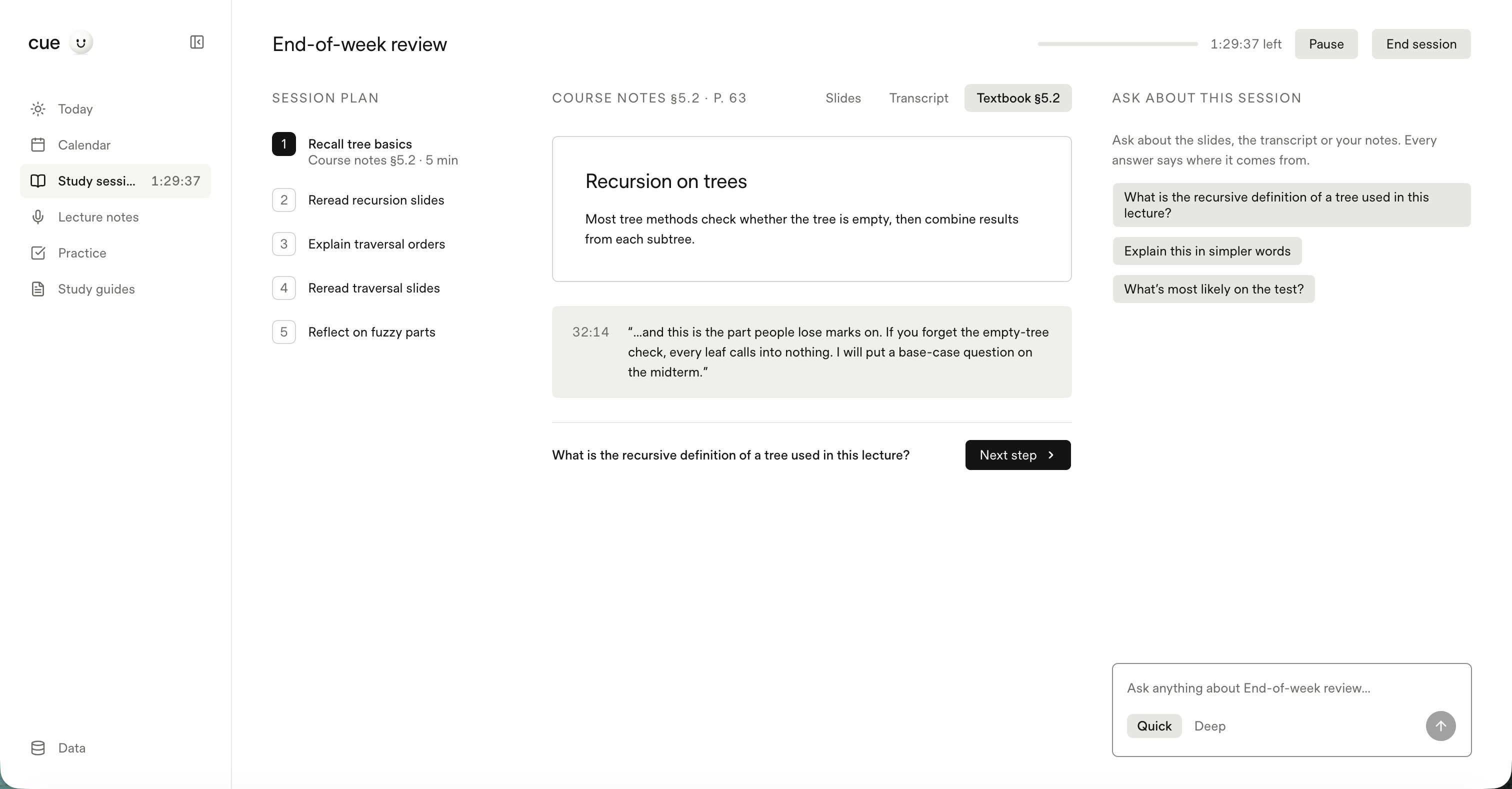
Study sessions. Cue opens the slides, transcript and textbook pages for the session's topic. Each step of the session plan ends with a question you answer from memory. Every answer from Nemotron cites the slide or lecture moment it came from.
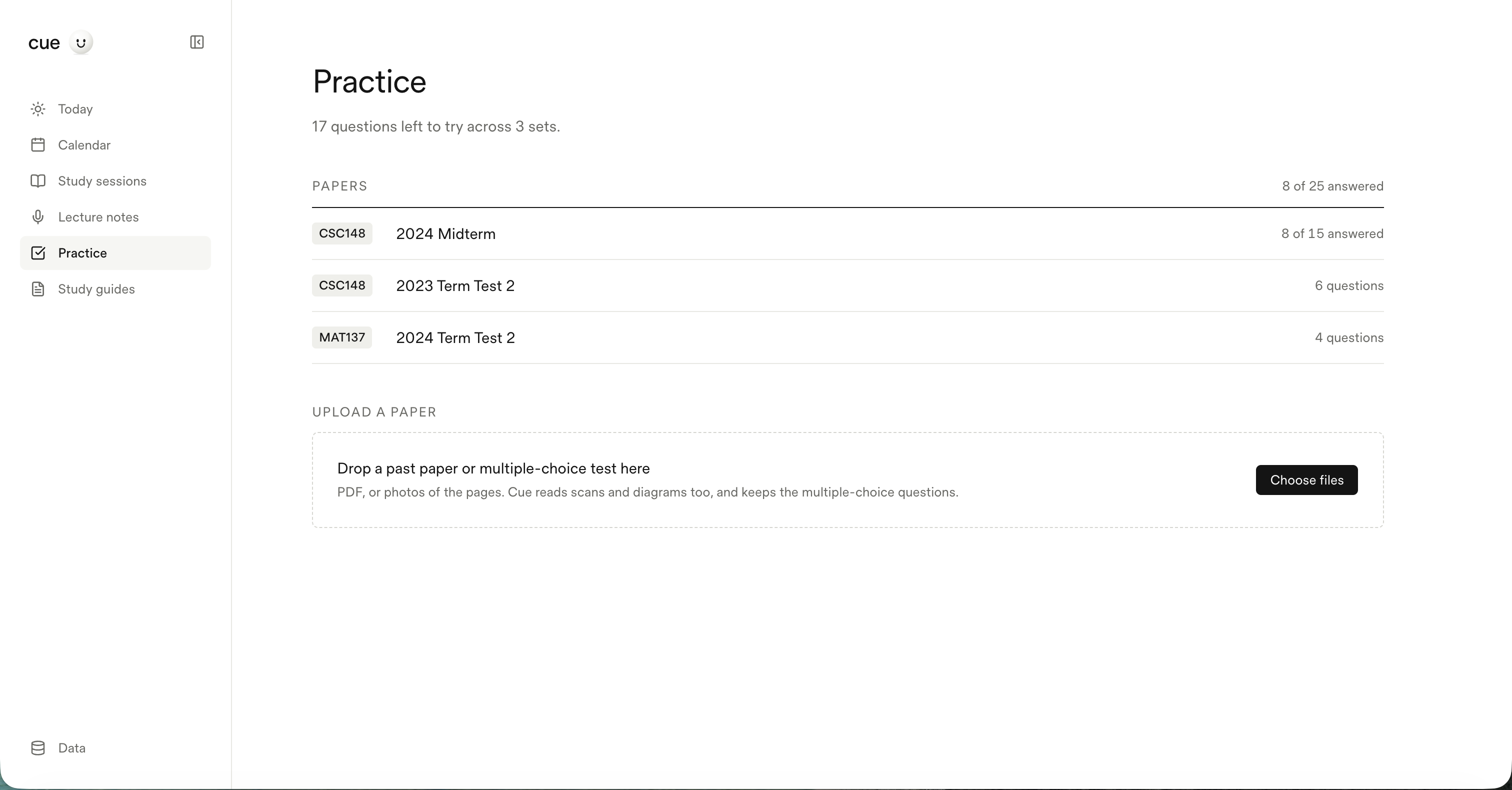
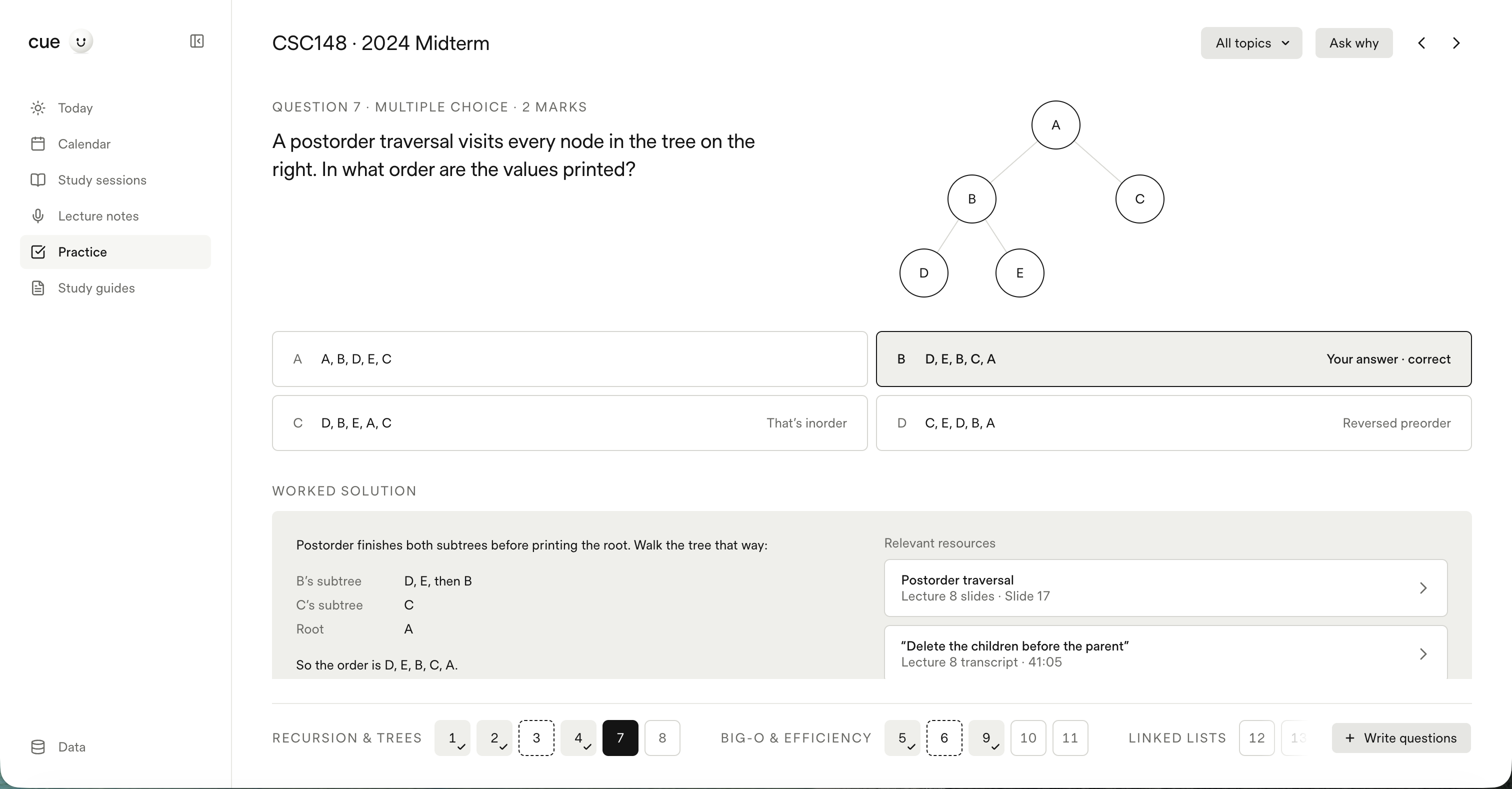
Practice. Upload a multiple-choice test, and Cue turns it into a practice set you can filter by topic. You answer first, then see a worked solution, even for past tests that never came with one. Cue can also write new questions. A second Nemotron call checks each one, and Cue keeps only questions with exactly one right answer.
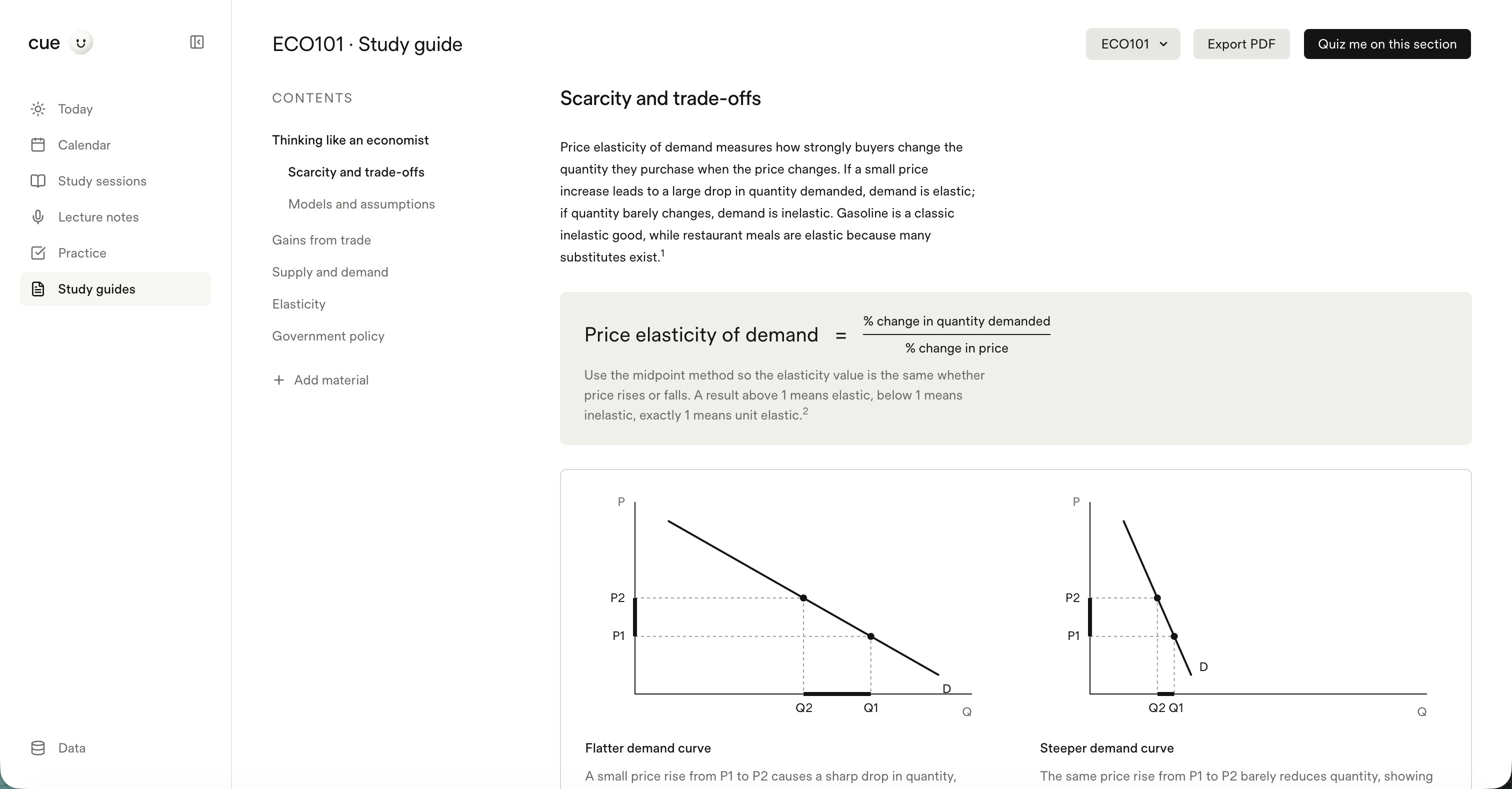
Study guide. Cue writes one study guide per course from your lectures, slides and textbook, with formulas, charts, code and a footnote for every source. Your professor's exam hints appear as callouts, and you can turn any section into a practice quiz.
How we built it
Following Learning Science
Students often lean on study habits that feel productive but don’t work well. Dunlosky reviewed ten common study techniques and rated rereading and highlighting among the least useful, even as we observe them being some of the most common techniques among our peers. AI can make this worse. A summary on demand is just faster rereading. An instant answer to every question removes the struggle that research demonstrates makes material stick. So for every feature, we asked whether it helps the student learn or does the learning for them, and we used AI only for the first.
The same review rated two techniques as the most useful. The first is spaced practice. Memory fades over time, roughly along Ebbinghaus’s forgetting curve, $R = e^{\frac{-t}{S}}. Here $R$ is how much you still remember after time t, and S is how strong the memory is. Each review makes $S$ larger, so reviews spread over days beat one long cram session, and we factored this into our automatic review scheduler. The second is practice testing. Trying to pull an answer out of memory rather than immediately reviewing your notes when you begin your session helps you remember it better than reading it again. This is why all of our review sessions start with a recall step rather than loading the students short term memory with class content.
In short, students rarely use either technique because both take effort, so Cue builds them in by default.
Technical Decisions
We designed the features first and picked the models second. For each feature, we worked out what type of work the feature needed to function, then chose the model that could do it. Calendar and Practice read images, because timetables arrive as screenshots and old tests as scans. Both use Nemotron 3.5 Super VL, a vision model.
The note taker cleans the transcript and listens for exam hints every few seconds during a live lecture. That job needs speed, so it uses Nemotron 3.5 Lightning. Transcription runs NVIDIA’s Parakeet model in the browser, so the audio never leaves the laptop. Worked solutions, session plans and new practice questions take careful reasoning, so they use Nemotron 3 Ultra with thinking on. Quick answers and the checks on new questions use Ultra with thinking off, which replies in about a second.
Every call goes through one server route to Nebius Token Factory.
Challenges we ran into
Most of our problems came down to stopping Cue from confidently teaching you nonsense. Overall, we spent most of our time on two problems.
We started with the schedule. We noticed that the study plan would break as soon as anything in the calendar caused conflict. So we built Cue’s study schedule to be dynamic rather than fixed. Cue will automatically rebuild the plan from your calendar whenever something changes using smart rules.
Our second problem was that Nemotron knows nothing about your course. To fix this, we gave it the necessary context by building a harness. Every passage we send gets a label, and Nemotron has to cite those labels. The server traces each citation back to its slide, transcript etc. If Nemotron cites anything we didn’t send, the server throws the citation out.
Accomplishments that we're proud of
This October, we spent too much of the midterm season getting ready to learn and too little of it learning. Cue exists to fix that. We’re students, not experienced engineers or education researchers (heck this is our first hackathon), and much of what we built here was new to us. Though we’re glad we tried to build it anyway.
We’re proud of what Cue chooses not to do. Cue never writes your assignment, and it never shows a solution before you’ve tried. A lot of AI is sold as a way to skip work, but we think the future is AI that enables humanity.
We’re also proud that Cue runs on open models. As students, we’re maybe too painfully aware of subscription pricing. Instead, we wanted to focus on a stack that could realistically be run on consumer hardware, or has the possibility of being run on consumer hardware in the years to come. Privacy wise, lecture audio also never leaves your laptop, allowing you to leverage intelligence without selling your data.
Finally, we’re proud that we got the opportunity to build on the existing efforts of the many scientists who came before us. Spaced review and self-testing come from more than a century of research, going back to Ebbinghaus in the 1880s. The people at NVIDIA trained the models. We connected the two and pointed them at a problem we have, and created something that we found genuinely useful.
Finals are in December, and we’ll study for them with Cue!
What we learned
Cue helps students most when it does less. Its best features handle the necessary work and leave the thinking to the student. We didn’t always need the biggest model. Lightning is fast enough to keep up with a live lecture, and for that job speed mattered more than power. Efficiency is important! It helped to start with a problem we’d lived through. We spent October dealing with it, so we knew what Cue had to fix. If we built a product for a vague audience, it would be difficult to determine whether we’d actually built something helpful..
What's next for Cue
We’ll start at the University of Toronto. We’ll share Cue with friends and classmates and use it ourselves for finals in December. We want to know two things: whether students using Cue spend more of their time learning, and whether they do better on their exams. If they do, we’ll open Cue to more students and more universities. If they don’t, we’ll find out why and change it.
Built With
- nebiusaistudio
- next.js
- node.js
- nvidianemotron
- nvidiaparakeet
- openaisdk
- react
- shadcn/ui
- tailwindcss
- typescript
- webgpu

