-
-
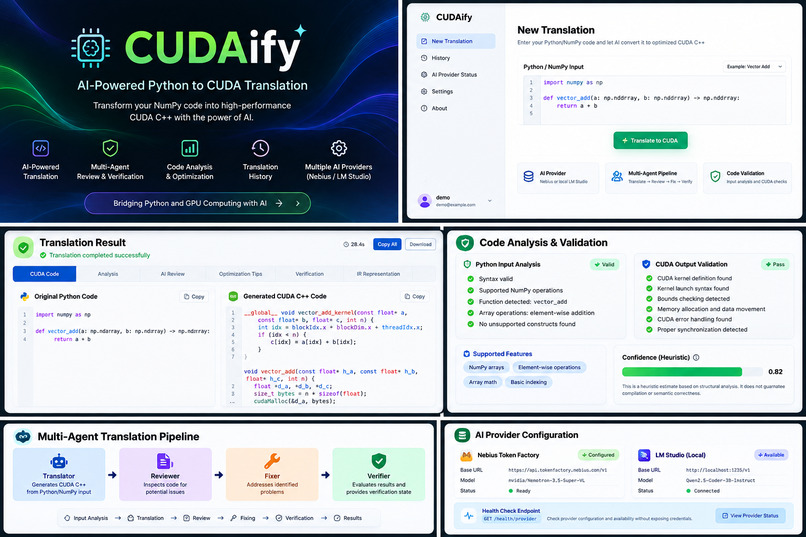
CUDAify: AI-Powered Python to CUDA Showcase
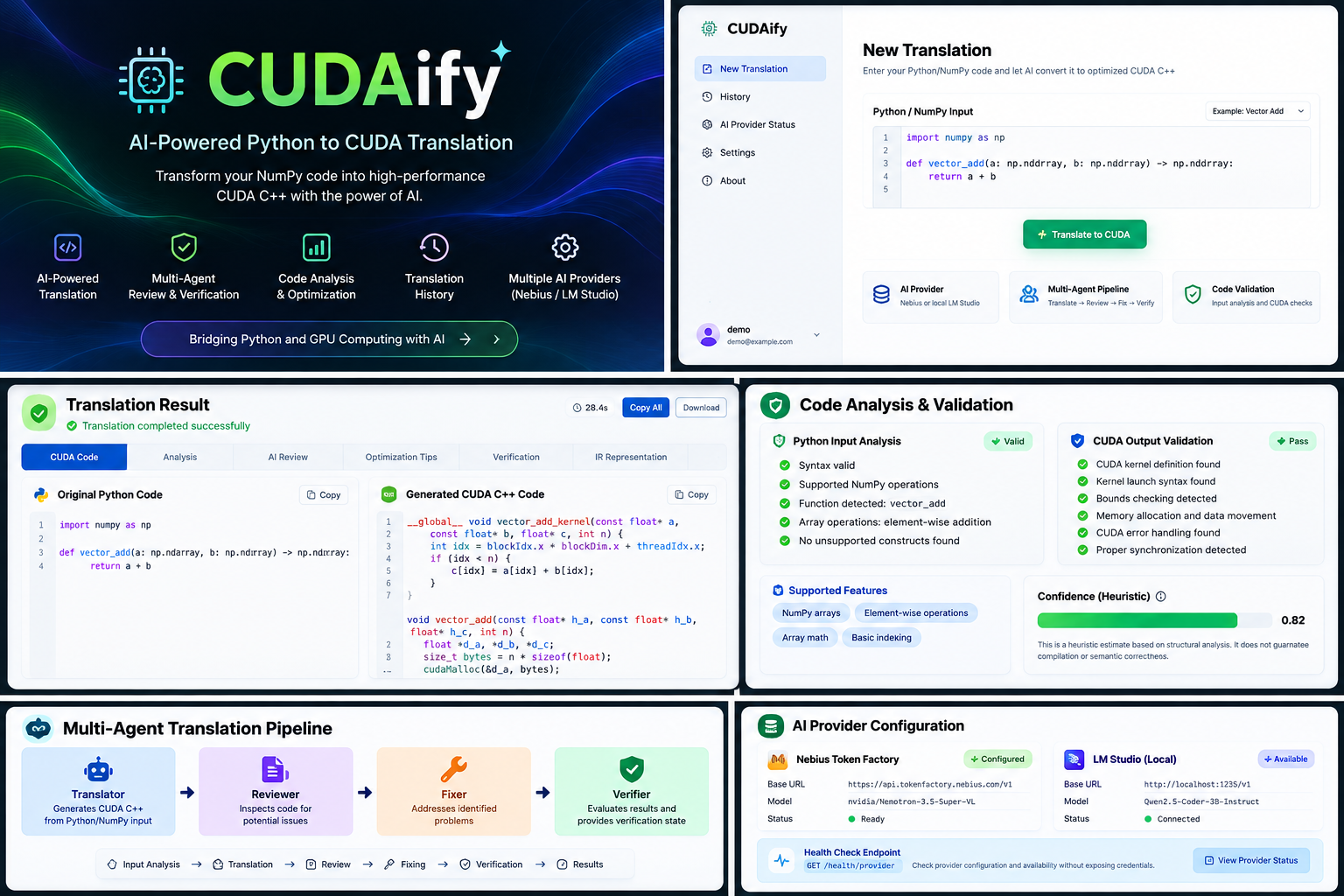
CUDAify: Bridging Python and GPU Computing with AI
💡 Inspiration
Python has become one of the most popular languages for artificial intelligence, data science, and numerical computing. Libraries like NumPy make complex mathematical operations accessible, but translating these operations into GPU-oriented CUDA C++ can be challenging, particularly for developers who are new to parallel programming.
We wanted to explore a simple question: What if AI could help developers move from familiar Python and NumPy code toward CUDA C++ without requiring them to navigate every step of the translation process manually?
That idea inspired CUDAify—an AI-assisted Python-to-CUDA translation platform designed to make GPU programming more approachable while helping developers inspect and evaluate the generated code.
🚀 What It Does
CUDAify transforms supported Python and NumPy code into CUDA C++ using an AI-powered translation workflow.
Its key capabilities include:
- AI-Powered Translation: Converts supported Python/NumPy operations into CUDA C++ code.
- Multi-Agent Workflow: Uses specialized translation, review, fixing, and verification stages to improve the generated output.
- Code Validation: Checks Python input for certain unsupported constructs and examines generated CUDA code for expected structural elements.
- CUDA Intermediate Representation: Provides an intermediate representation to support code analysis and translation insights.
- AI Code Review: Identifies potential issues in generated code and provides review findings.
- Optimization Guidance: Offers heuristic tuning recommendations to help developers explore potential CUDA optimization opportunities.
- Translation History: Stores translation records and associated analysis in a database.
- Multiple AI Providers: Supports Nebius Token Factory and a compatible local inference server such as LM Studio.
- Verification-Aware Reporting: Distinguishes generated code and available analysis from stronger claims that require actual compilation, execution, or benchmarking.
CUDAify is built around an important principle: generating code is only one part of the process. Developers also need useful feedback about what has—and has not—been verified.
🛠️ How We Built It
We built CUDAify as a web-based application with a Python backend and an interactive frontend.
The backend uses FastAPI to handle application endpoints and translation workflows, while Streamlit provides the user interface. SQLite stores translation history and related information.
The AI integration supports Nebius Token Factory for hosted inference and LM Studio for compatible local inference. This allows the application to use either a hosted model or a locally served coding model, depending on configuration and availability.
The translation workflow is organized around specialized stages:
- Translator: Generates CUDA C++ from supported Python/NumPy input.
- Reviewer: Inspects the generated code for potential problems.
- Fixer: Attempts to address identified issues.
- Verifier: Evaluates the available evidence and reports the resulting verification state.
Additional components provide input analysis, CUDA structural checks, intermediate-representation analysis, optimization advice, and persistent translation history.
We also developed automated tests for important application behavior, provider configuration, and verification rules. These tests help us catch regressions and make the project more reliable as it evolves.
🧠 What We Learned
Building CUDAify taught us that AI-assisted code generation requires more than a good prompt.
First, generated code is not necessarily correct code. A model can produce CUDA C++ that looks plausible while still containing compilation errors, memory-management problems, incorrect indexing, or semantic differences from the original Python program.
Second, validation needs clear boundaries. Syntax and structural checks are useful, but they cannot establish semantic equivalence or prove that a CUDA program runs correctly on a GPU. Those claims require stronger evidence.
Third, AI workflows benefit from specialized stages. Separating translation, review, fixing, and verification makes the process easier to inspect and provides opportunities to identify potential issues before presenting the result.
Finally, provider flexibility matters. Supporting hosted and local inference gives developers more control over how they run AI-assisted workflows, although local inference still depends on the available hardware and model.
🧩 Challenges We Faced
One of our main challenges was designing a workflow that could generate useful CUDA code without overstating its reliability.
Python and NumPy support a broad range of operations, while CUDA programming introduces additional concerns such as parallel indexing, memory management, kernel launches, and synchronization. Not every Python construct can be translated reliably through a general-purpose AI model.
We addressed this by introducing input checks, output-structure validation, review stages, and explicit verification states. These mechanisms help identify potential problems, but they are not substitutes for compiling and executing the generated CUDA code.
Another challenge was supporting different AI inference providers. Hosted services and local inference servers can differ in configuration, model identifiers, availability, and error behavior. We worked to make these paths configurable and to provide clearer diagnostics when a provider is unavailable or incorrectly configured.
Testing and security also required careful attention. We added automated regression tests and improved verification handling so that stronger status claims cannot simply be accepted from untrusted client input.
🔮 What's Next
CUDAify is an evolving project, and several important opportunities remain:
- Expand syntax-aware analysis and the supported NumPy operation set.
- Improve semantic-equivalence testing against Python reference implementations.
- Integrate real CUDA compilation and execution where suitable tooling and GPU access are available.
- Build a reproducible benchmarking workflow based on actual measurements.
- Improve diagnostics for memory management, indexing, and parallelization.
- Evaluate translation quality across a broader collection of representative workloads.
These improvements would help move CUDAify from AI-assisted code generation toward a more comprehensive, evidence-driven development workflow.
🌍 Our Vision
We want to make GPU programming more approachable without hiding the complexity that makes correctness important.
CUDAify explores how AI can help developers bridge the gap between high-level numerical Python and lower-level GPU programming—with transparency about limitations, practical feedback, and a clear distinction between generated code and verified results.
Our goal is not just to generate CUDA code. It is to help developers understand, inspect, and improve the code AI generates.


Log in or sign up for Devpost to join the conversation.