-
-
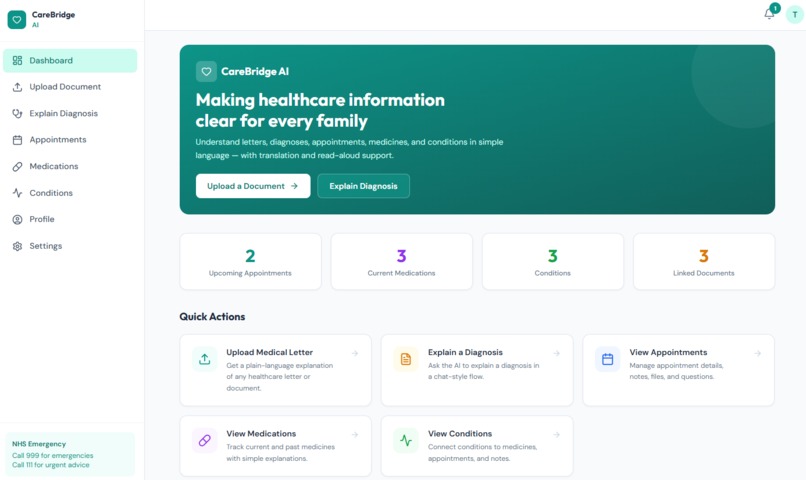
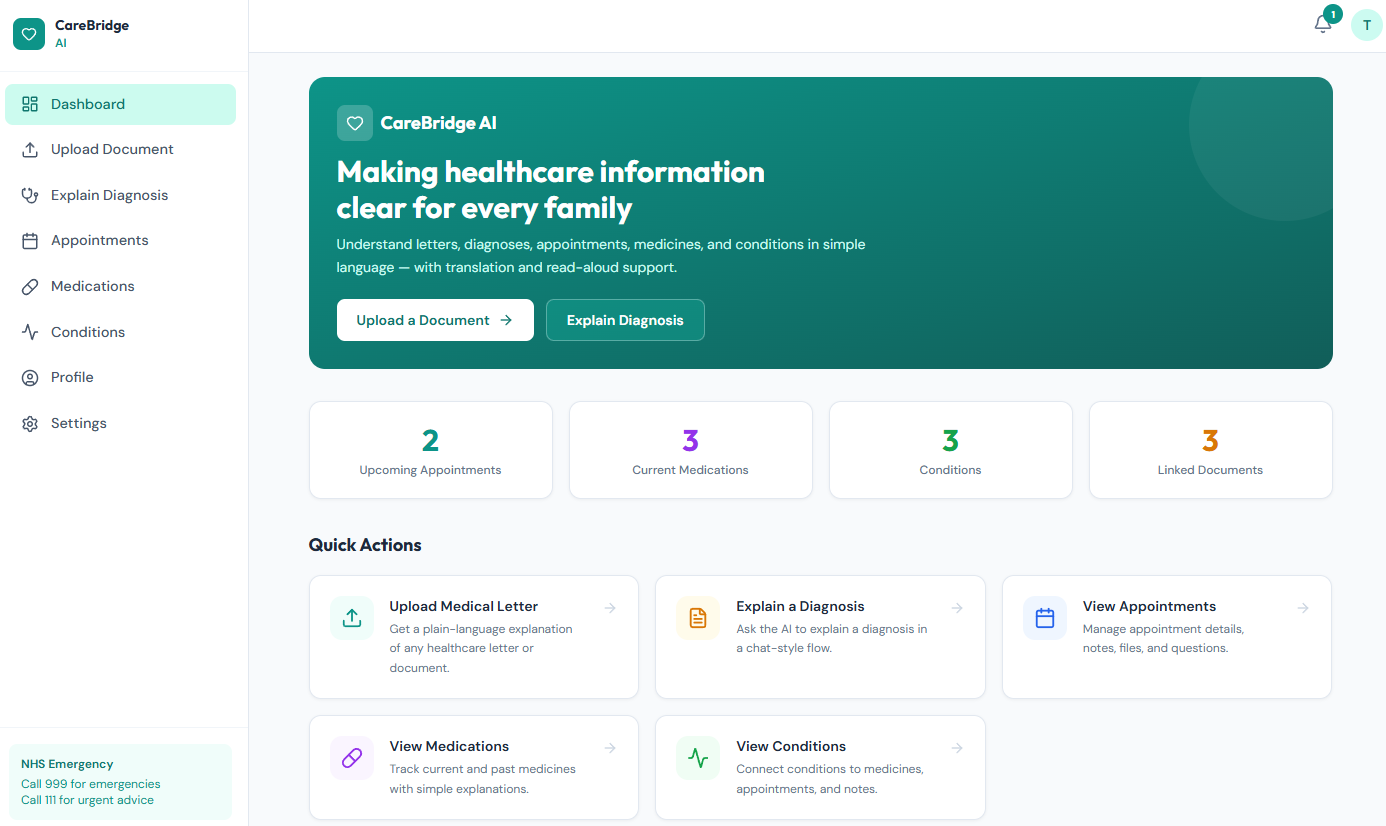
CareBridge Homepage
-
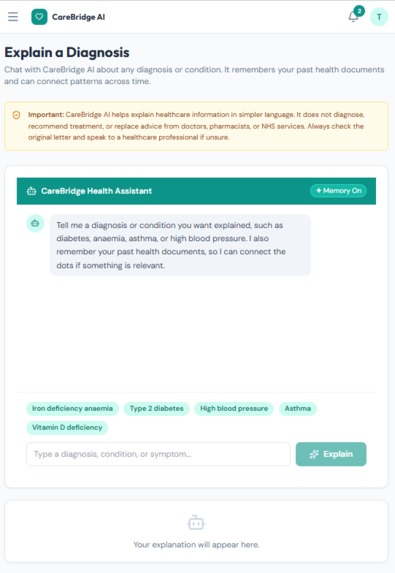
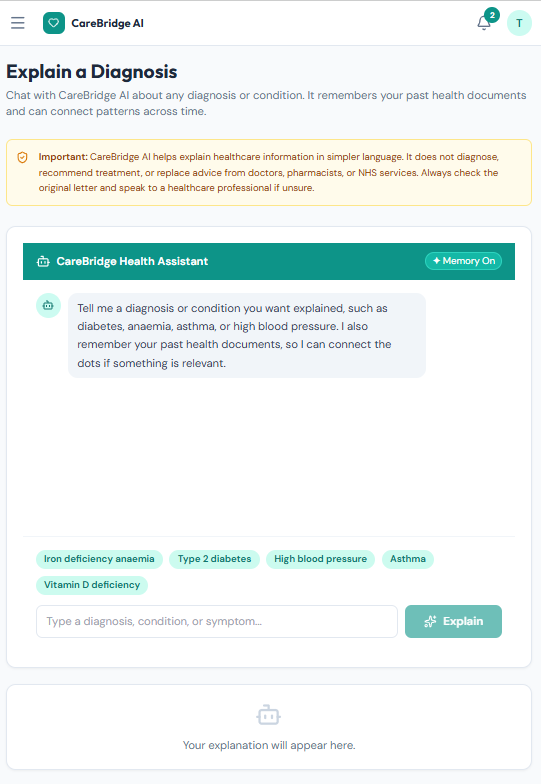
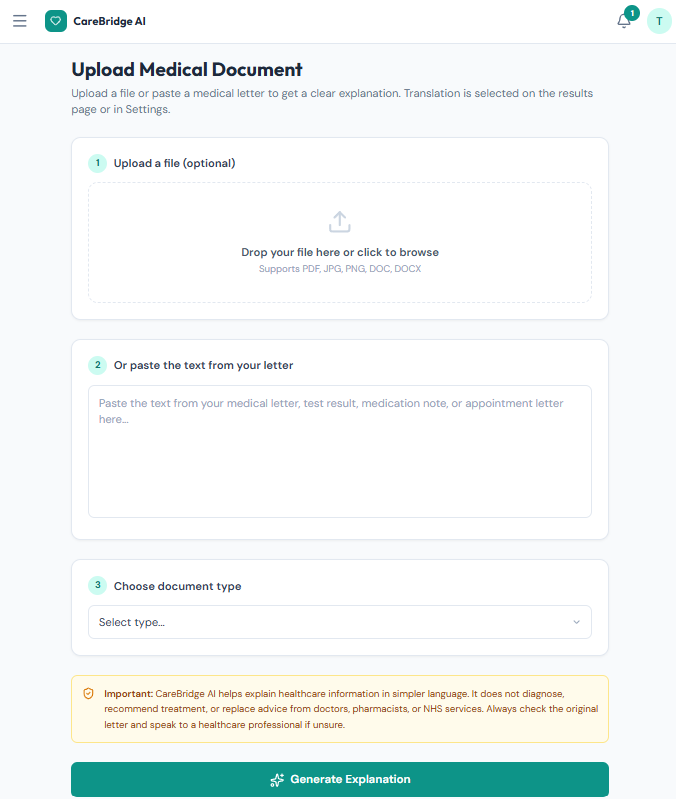
Explain Diagnosis Tab
-
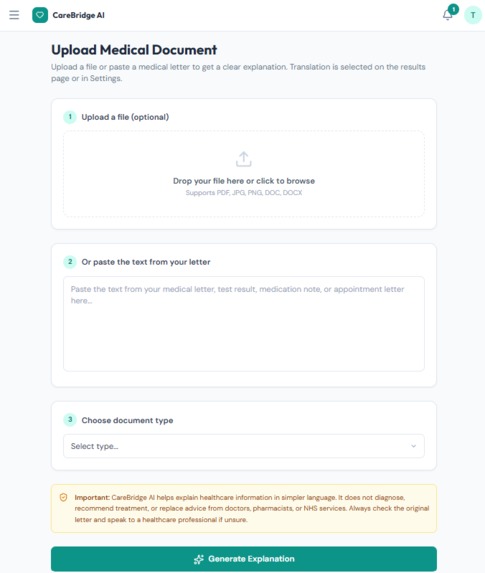
Upload Document Tab
-
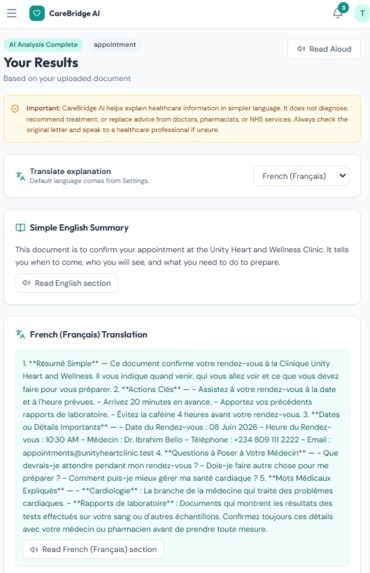
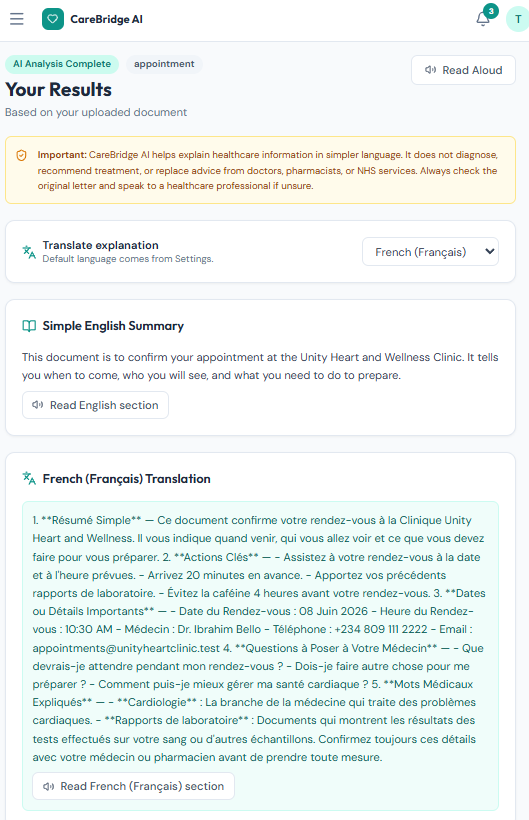
Example Document Summary with Translation
-
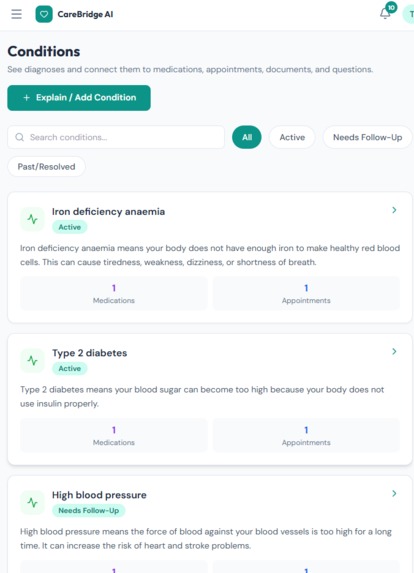
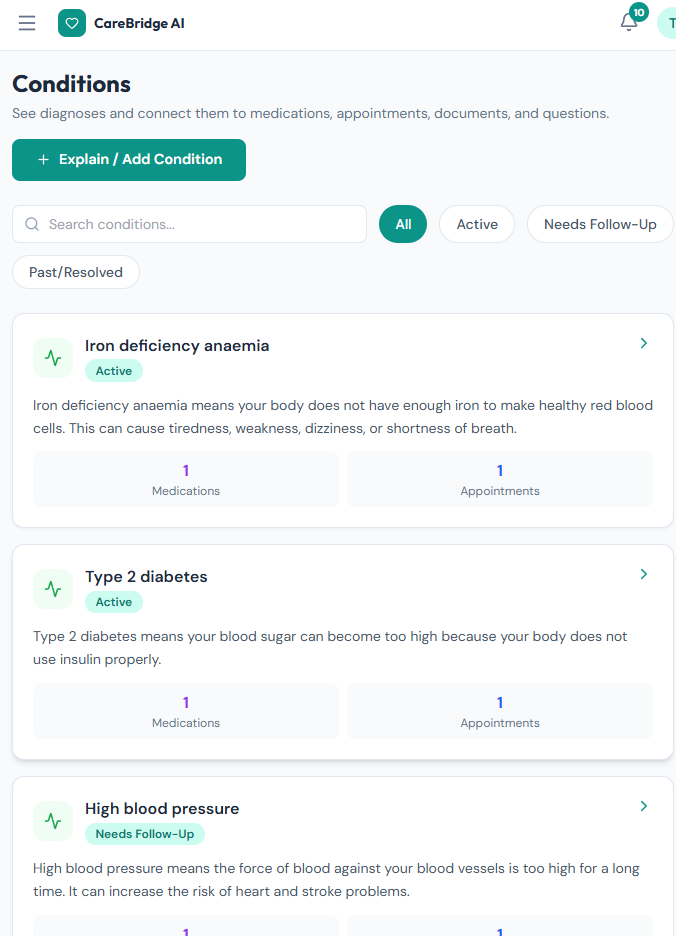
Conditions Overview Tab
-
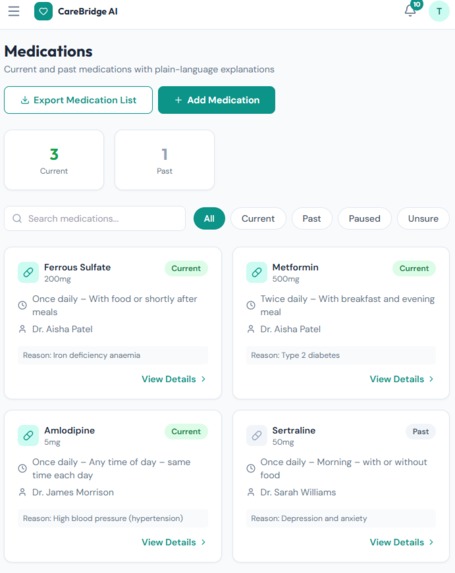
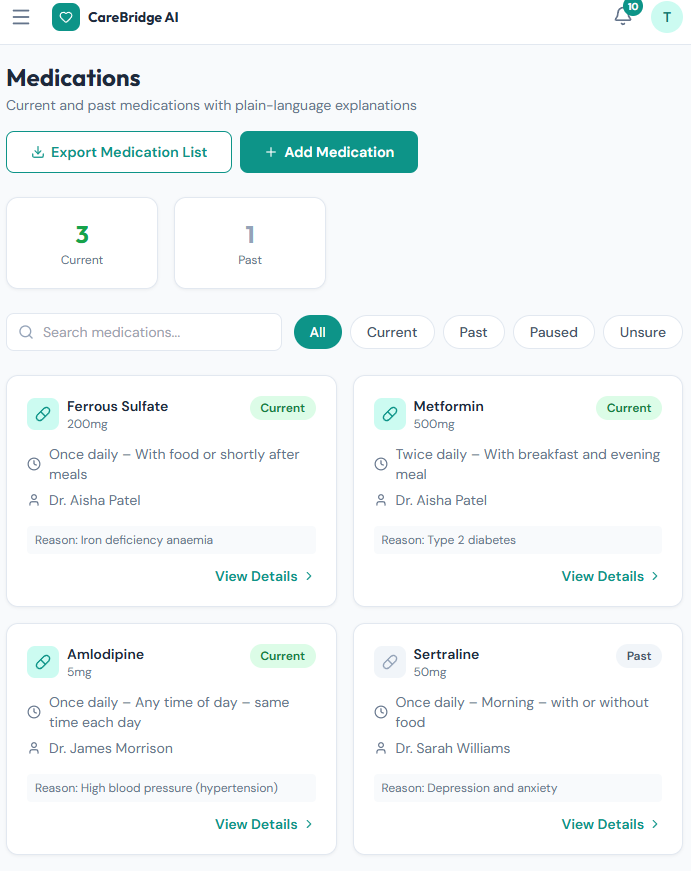
Medications Tab
-
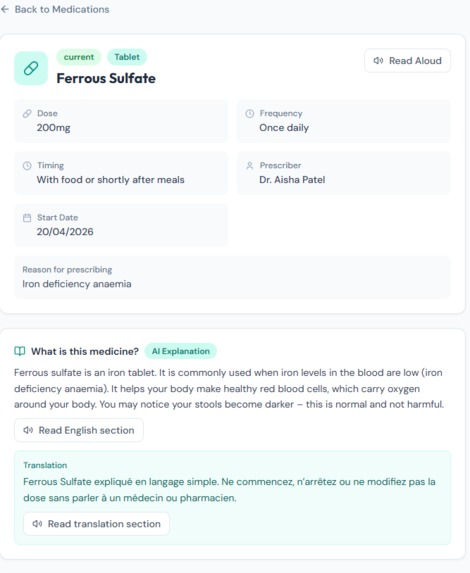
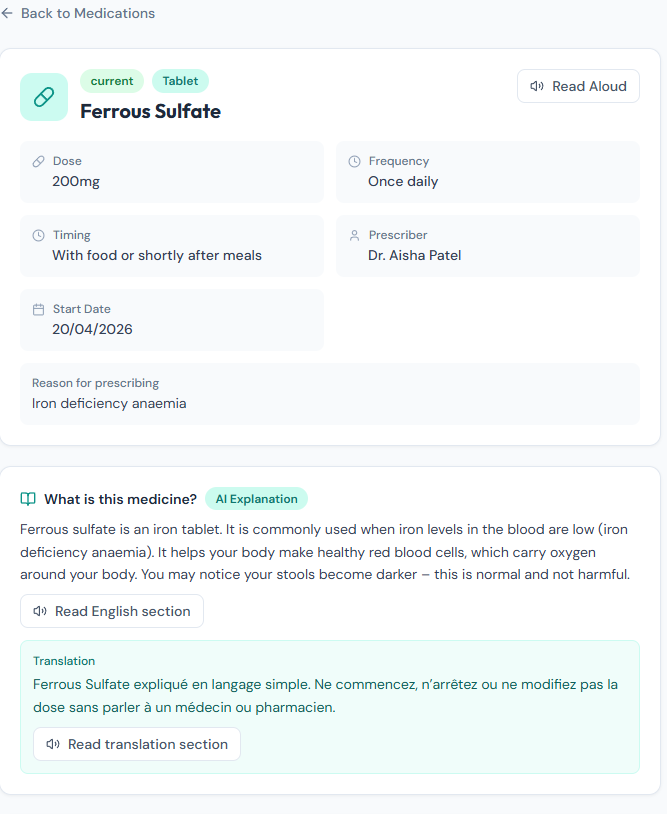
Medication Example Page
-
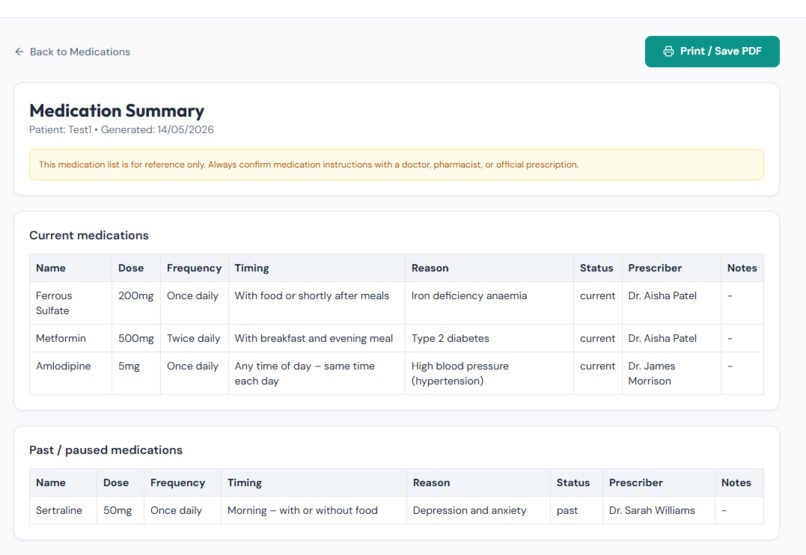
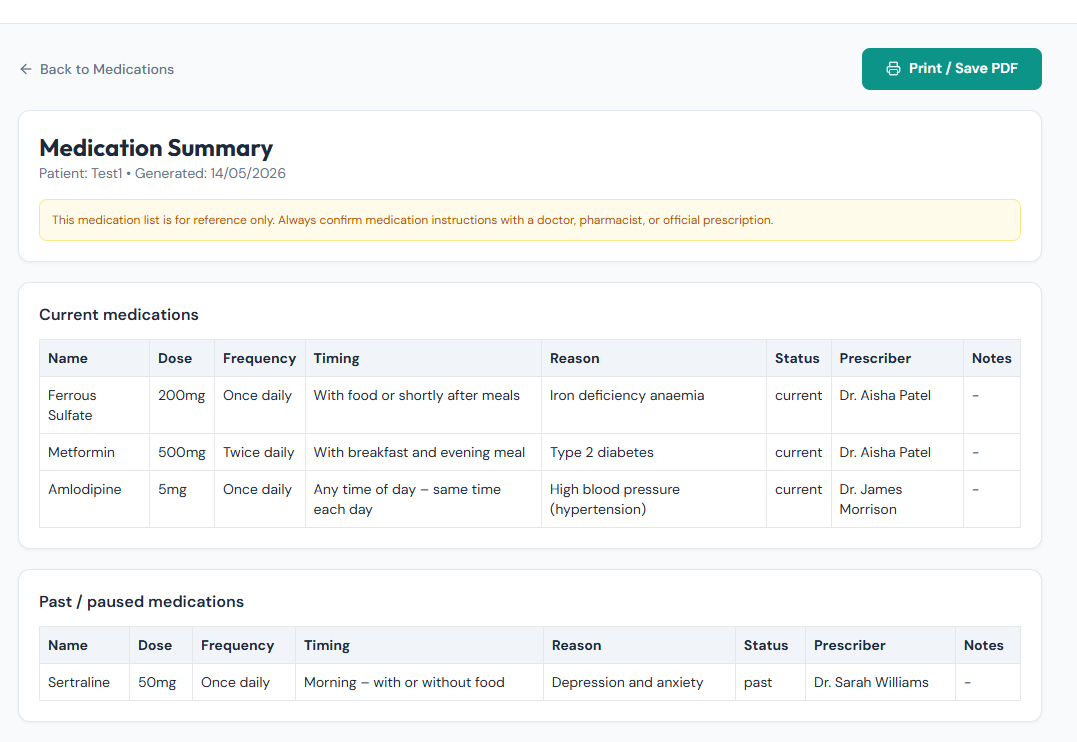
Medication Summary Page
-
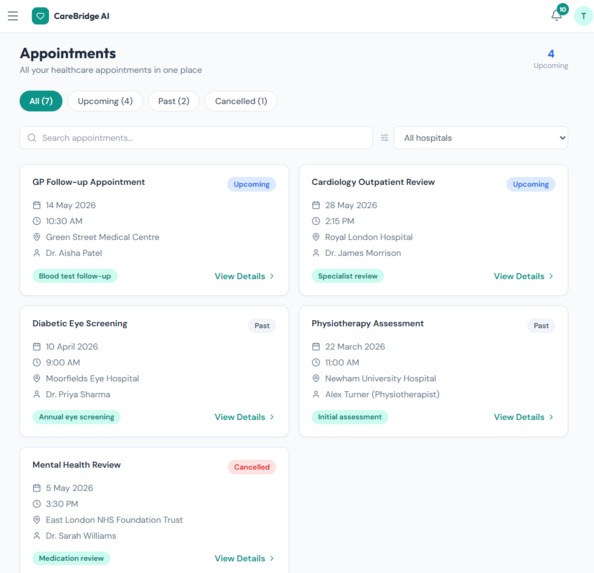
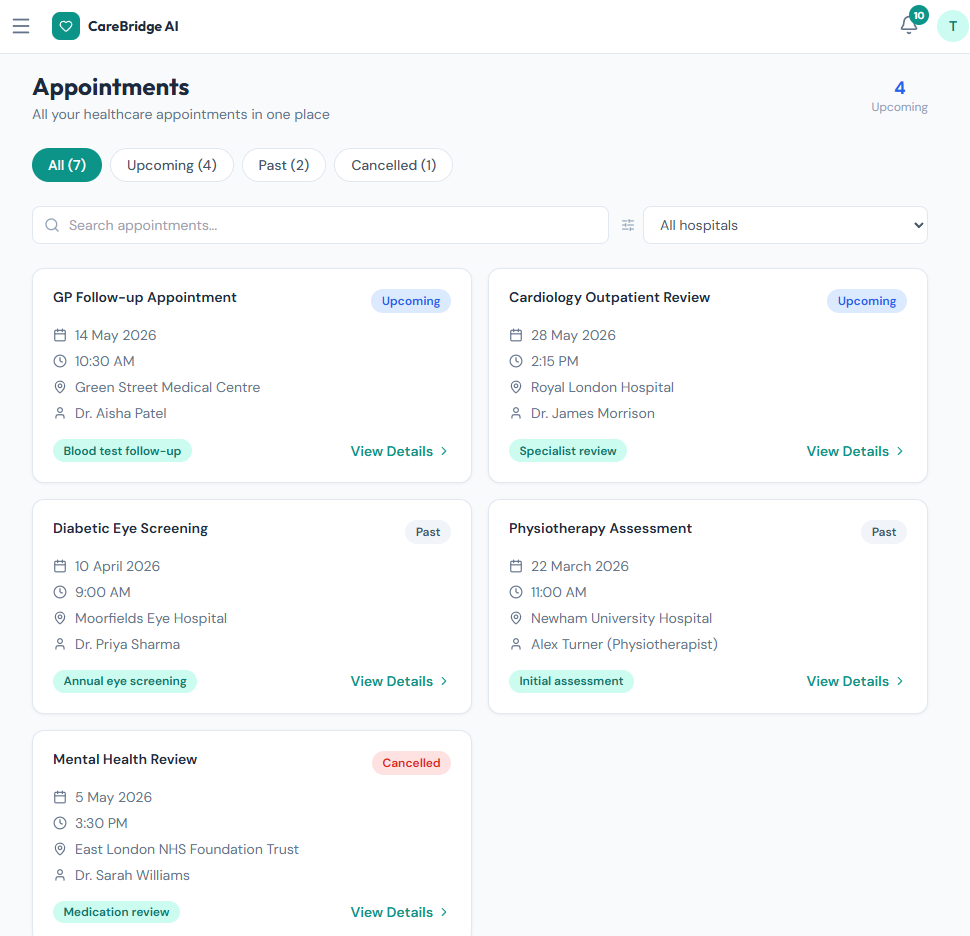
Appointment Tab
-
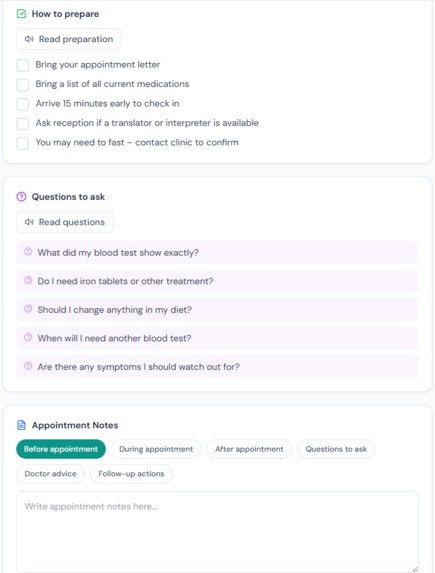
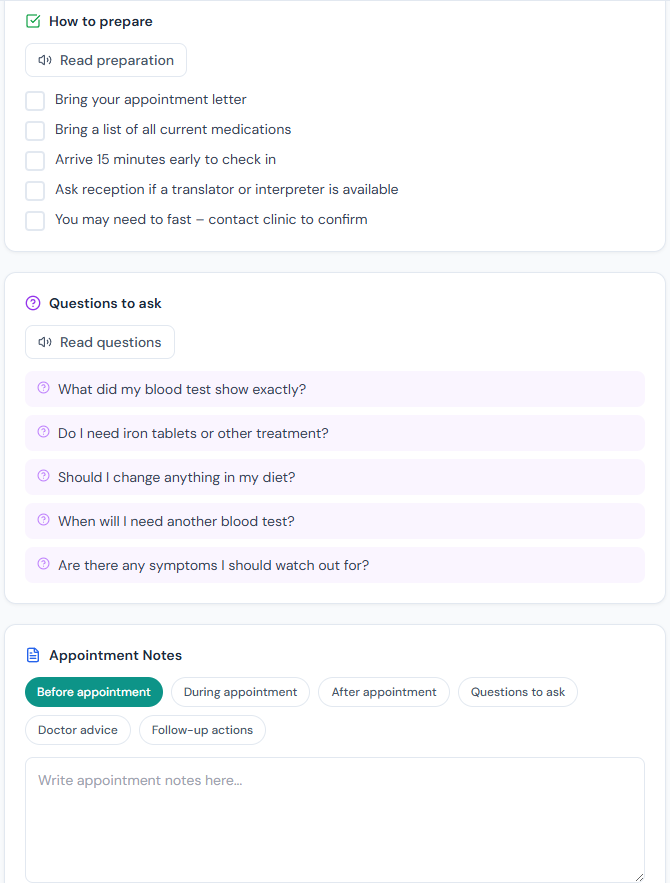
Appointment Example Page
Inspiration
CareBridge was inspired by the real challenges many immigrant families face when trying to understand healthcare information. Medical letters, appointment details, test results, diagnoses, and medication instructions are often written in complex medical language. For people who are not fully confident in English, or who have low health literacy, this can make healthcare feel confusing, stressful, and inaccessible.
As Team CTRL-ERs, we were especially inspired by families where children or younger relatives often have to translate medical information for parents or grandparents. Even when someone understands English, explaining medical terms clearly can still be difficult. We wanted to create a platform that helps families understand healthcare information in a safer, simpler, and more accessible way.
What it does
CareBridge is a multilingual health communication assistant that helps users understand, organise, and act on healthcare information.
Users can upload medical documents such as appointment letters, test results, medication notes, or diagnosis-related documents. CareBridge uses OCR and AI-powered document extraction to read the uploaded content, identify important information, and convert it into clear, structured support.
Key features include:
- A diagnosis explainer chatbot connected to a backend AI agent
- Medical document upload with OCR support
- AI extraction of appointment details from uploaded letters
- AI extraction of medication names, doses, frequencies, and instructions
- Simplified explanations of medical information in plain language
- Translation and multilingual text-to-speech support
- Appointment management with appointment notes
- Medication tracking with doses, frequency, status, and related conditions
- A conditions section linking diagnoses to related appointments and medications
- Notifications for useful user actions
- Calendar export for appointments
- Location-based emergency number guidance
- Safety reminders explaining that CareBridge does not replace doctors, pharmacists, NHS services, or emergency care
The aim is not to diagnose users or provide treatment decisions. Instead, CareBridge helps people understand existing healthcare information, organise it in one place, and prepare better questions for healthcare professionals.
How we built it
Team CTRL-ERs built CareBridge as a web application using React, Vite, and Tailwind CSS for the frontend. We designed it as a dashboard-style platform with separate sections for uploading documents, explaining diagnoses, managing appointments, tracking medications, viewing conditions, changing settings, and checking notifications.
We used React Router to organise the platform into multiple pages and make it feel like a realistic healthcare support product rather than a single-page demo. We also used browser-based text-to-speech to allow users to listen to explanations in different languages.
For the backend, we used FastAPI in Python to create API endpoints for processing user requests and connecting the frontend to backend logic. We integrated Supabase as the database and storage layer so CareBridge can store uploaded documents, appointments, medications, conditions, notes, and related user data.
For document support, we added upload functionality and OCR processing so medical letters and images can be read and processed. We also built AI-powered extraction to identify appointment details and medication information from uploaded documents. The diagnosis explainer is connected to a backend AI agent, allowing users to ask about a condition and receive a clear, structured explanation.
The result is a working MVP that combines frontend interaction, backend processing, AI explanation, OCR/document extraction, and database integration.
Challenges we ran into
One of the biggest challenges was making sure CareBridge stayed safe and responsible. Because the project is related to healthcare, we had to be careful not to make the AI act like a doctor. We designed CareBridge to explain information, organise records, and suggest questions, rather than diagnose users or recommend treatment decisions.
Another challenge was working with real-world medical documents. Appointment letters and medication notes can vary a lot in format, wording, and clarity, so extracting useful details from them required careful structuring and fallback behaviour.
Multilingual text-to-speech was also challenging. Browser-based text-to-speech is free and useful, but the available voices depend on the user’s device and browser. This made it difficult to guarantee that every supported language would work perfectly across all devices.
We also had to manage the complexity of connecting multiple systems together. CareBridge combines React, FastAPI, Supabase, OCR, AI extraction, text-to-speech, calendar export, and several connected data sections. Making these parts work together within the hackathon timeframe required prioritisation and clear division of tasks.
Accomplishments that we're proud of
Team CTRL-ERs is proud that CareBridge addresses a real and personal social-good problem. The platform is designed around families who often struggle silently with healthcare communication, especially when language barriers or medical jargon make important information harder to understand.
We are proud that CareBridge is more than a basic chatbot. It works as a connected healthcare support platform where conditions, medications, appointments, uploaded documents, notes, and explanations are linked together.
Some accomplishments we are proud of include:
- Building a working multi-page healthcare support platform
- Creating a diagnosis explainer connected to a backend AI agent
- Adding medical document upload and OCR support
- Automatically extracting appointment details from uploaded letters
- Automatically extracting medication names, doses, frequencies, and instructions
- Integrating Supabase for database and storage support
- Connecting the React frontend to a FastAPI backend
- Adding multilingual text-to-speech support
- Creating appointment notes and calendar export functionality
- Designing conditions, medications, and appointments to link together
- Keeping responsible AI and healthcare safety at the centre of the project
Most importantly, we are proud that CareBridge focuses on accessibility, family support, and health literacy.
What we learned
We learned that building AI for social good requires more than simply adding a chatbot. Healthcare information often needs to be simplified, translated, organised, and connected to a user’s wider context, such as their appointments, medications, and conditions.
We also learned more about:
- Building a multi-page React application with React Router
- Designing accessible and user-friendly interfaces with Tailwind CSS
- Connecting a frontend application to a FastAPI backend
- Using Supabase for database and document storage
- Working with OCR and document processing
- Using AI to extract structured information from unstructured medical text
- Building chatbot-style diagnosis explanation flows
- Implementing text-to-speech for accessibility
- Structuring connected data across appointments, medications, conditions, and documents
- Designing responsible AI boundaries for healthcare-related tools
A key lesson was that safety is just as important as functionality. CareBridge should help users understand information and prepare for conversations with healthcare professionals, but it should not replace professional medical advice.
What's next for CareBridge
Next, we would like to expand CareBridge beyond the current MVP into a more complete family health support platform. Now that we have built the core features, including document upload, OCR, AI extraction, the diagnosis chatbot, appointment management, medication tracking, and database integration, our next focus is improving personalisation, accessibility, and support for families and carers.
Future improvements include:
- Adding an allergies tracker so users can record allergies, reactions, severity, and related notes
- Building smarter notifications and reminders for upcoming appointments, follow-up actions, and medication reviews
- Creating a family/carer access feature so users can manage or view a parent’s, grandparent’s, or relative’s health information with consent
- Expanding language support to help more communities access healthcare information in their preferred language
- Improving multilingual text-to-speech reliability across different devices and browsers
- Adding stronger privacy and permission controls for shared family access
- Creating clearer consent settings so users can decide who can view or manage their information
- Adding more personalised question suggestions based on a user’s conditions, medications, appointments, and past notes
- Improving calendar integration with reminders and preparation checklists
- Making the interface even more accessible for elderly users and people with low literacy
Long term, CareBridge could become a trusted support platform for families, carers, and patients who need healthcare information explained clearly, safely, and in a way they can understand.
Built With
- fastapi
- javascript
- python
- react
- supabase
- tailwindcss
- vercel
- vite
- webspeechapi


Log in or sign up for Devpost to join the conversation.