-
-
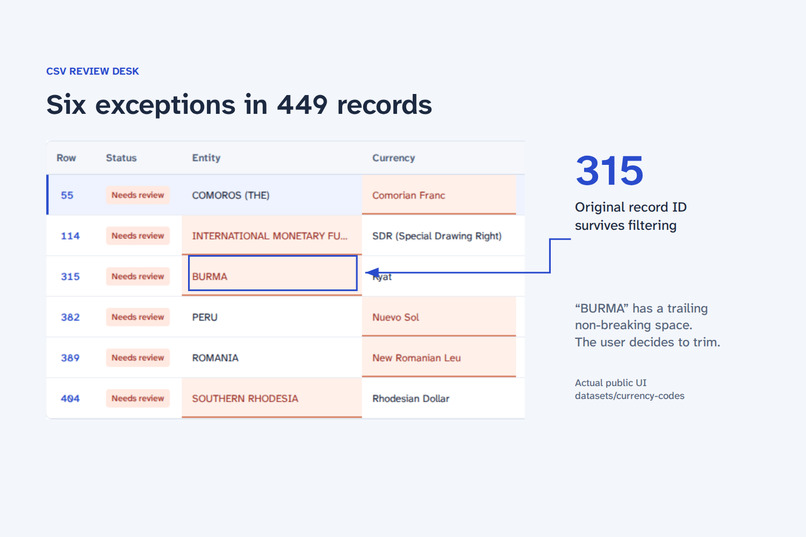
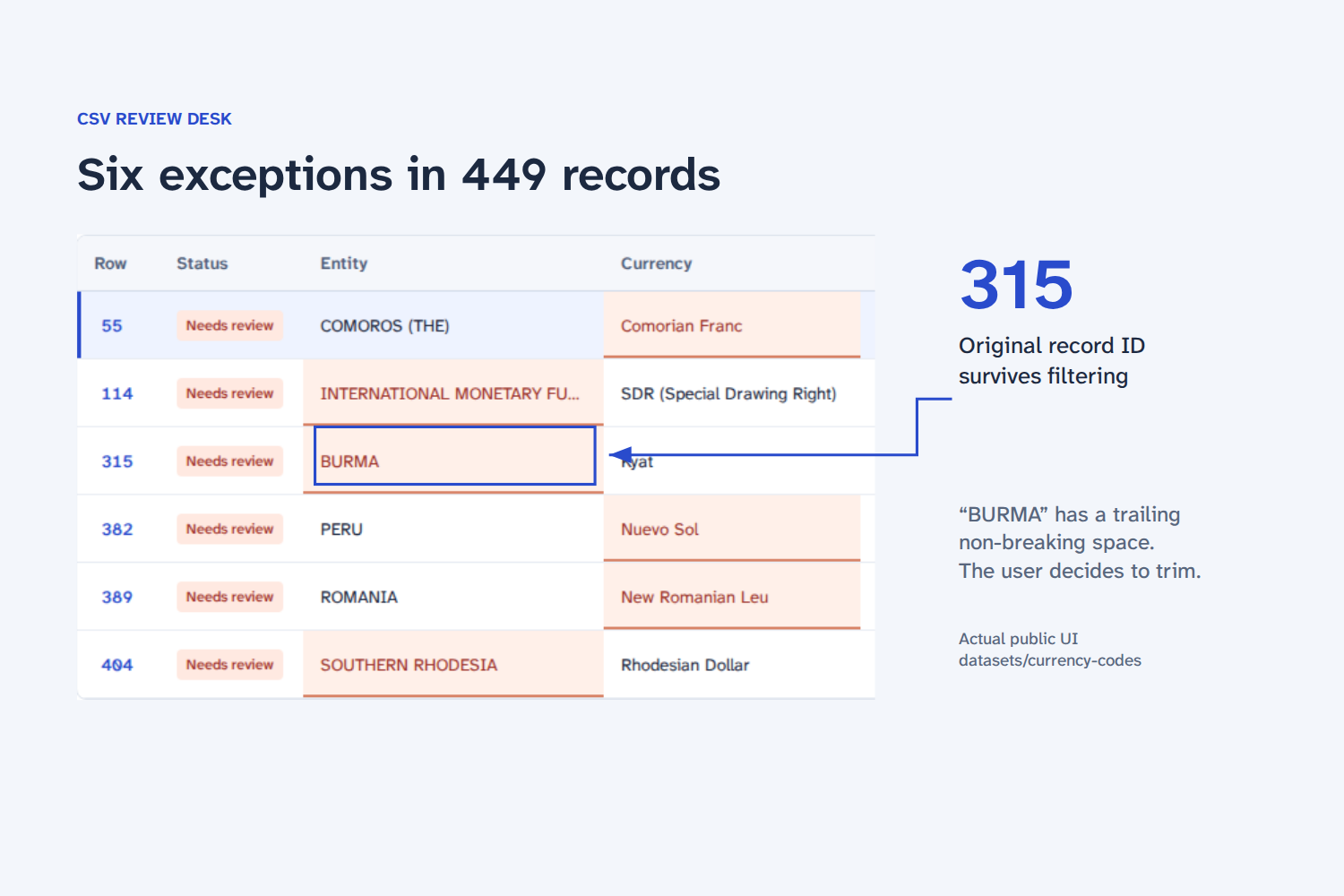
Six review rows in a real 449-record dataset, with original record identifiers preserved
-
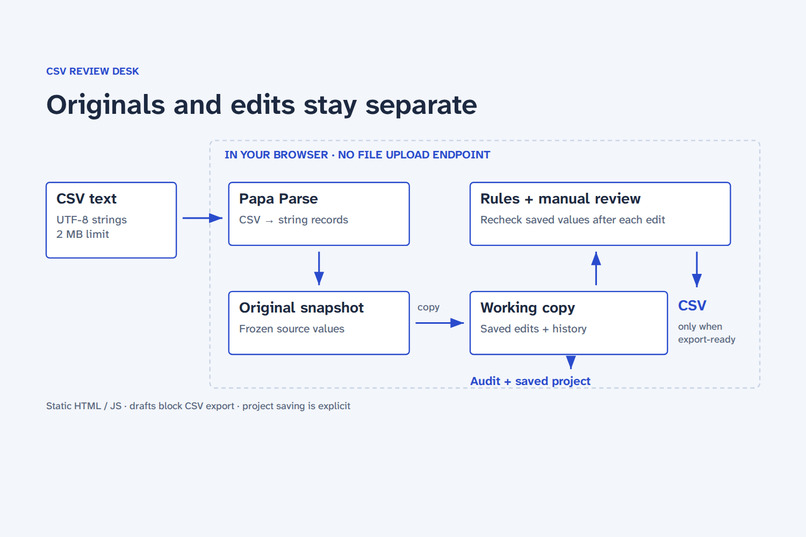
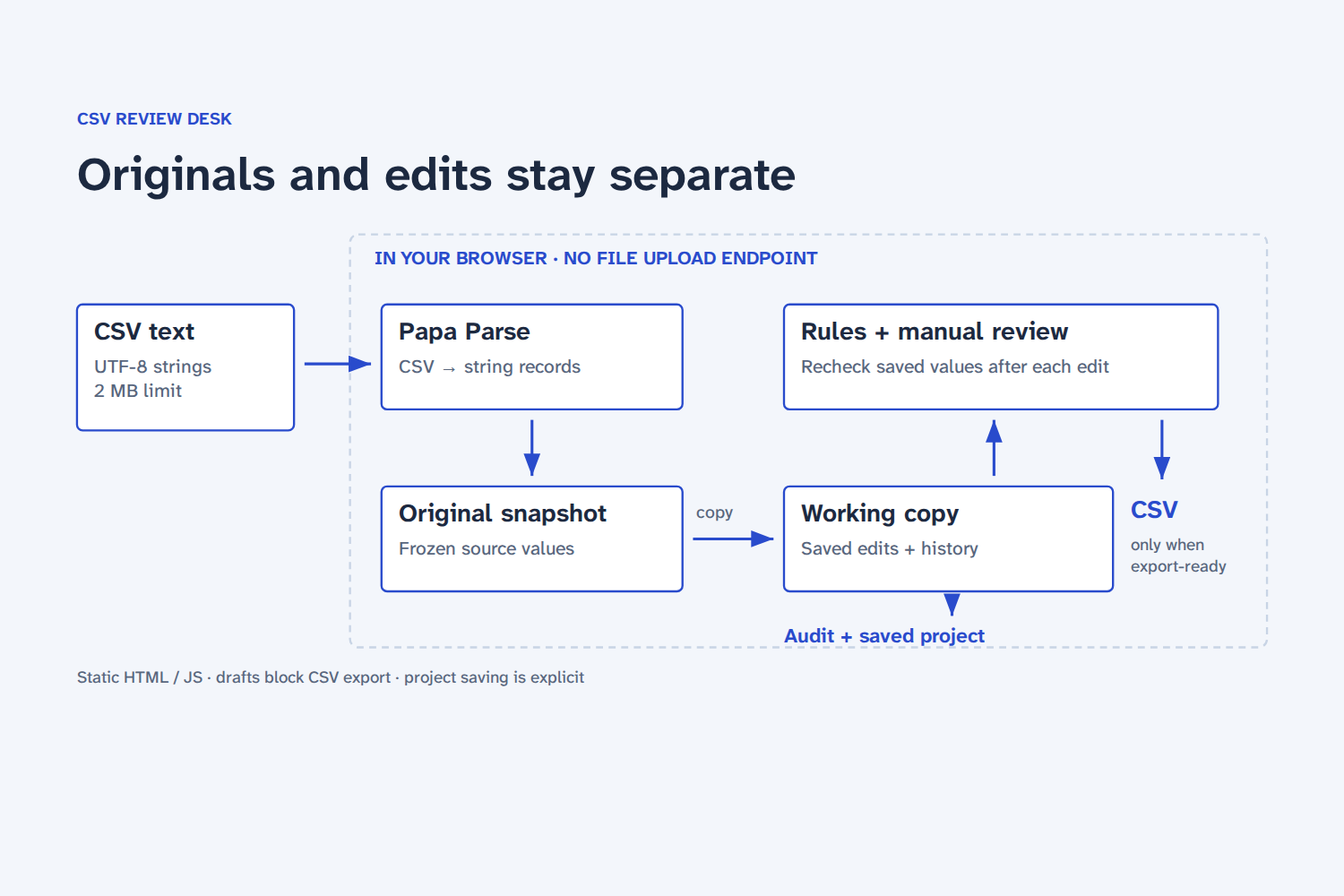
Original snapshots, working copies, validation, and separate output paths.
-
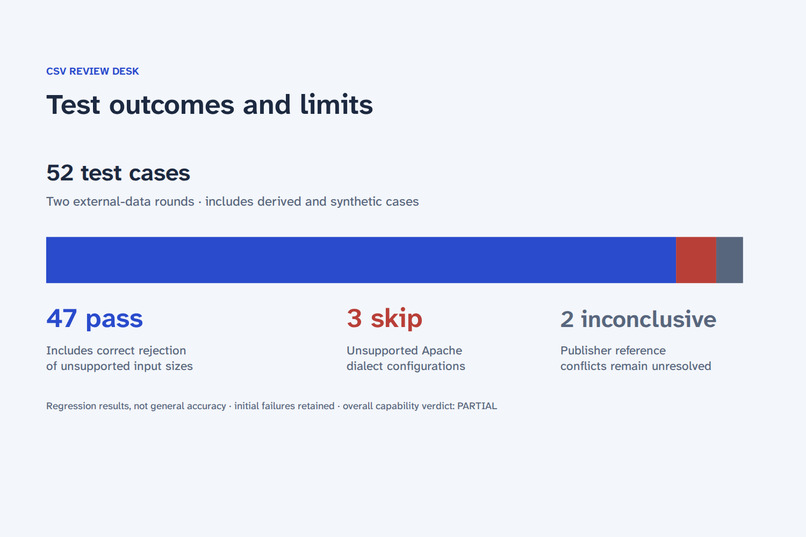
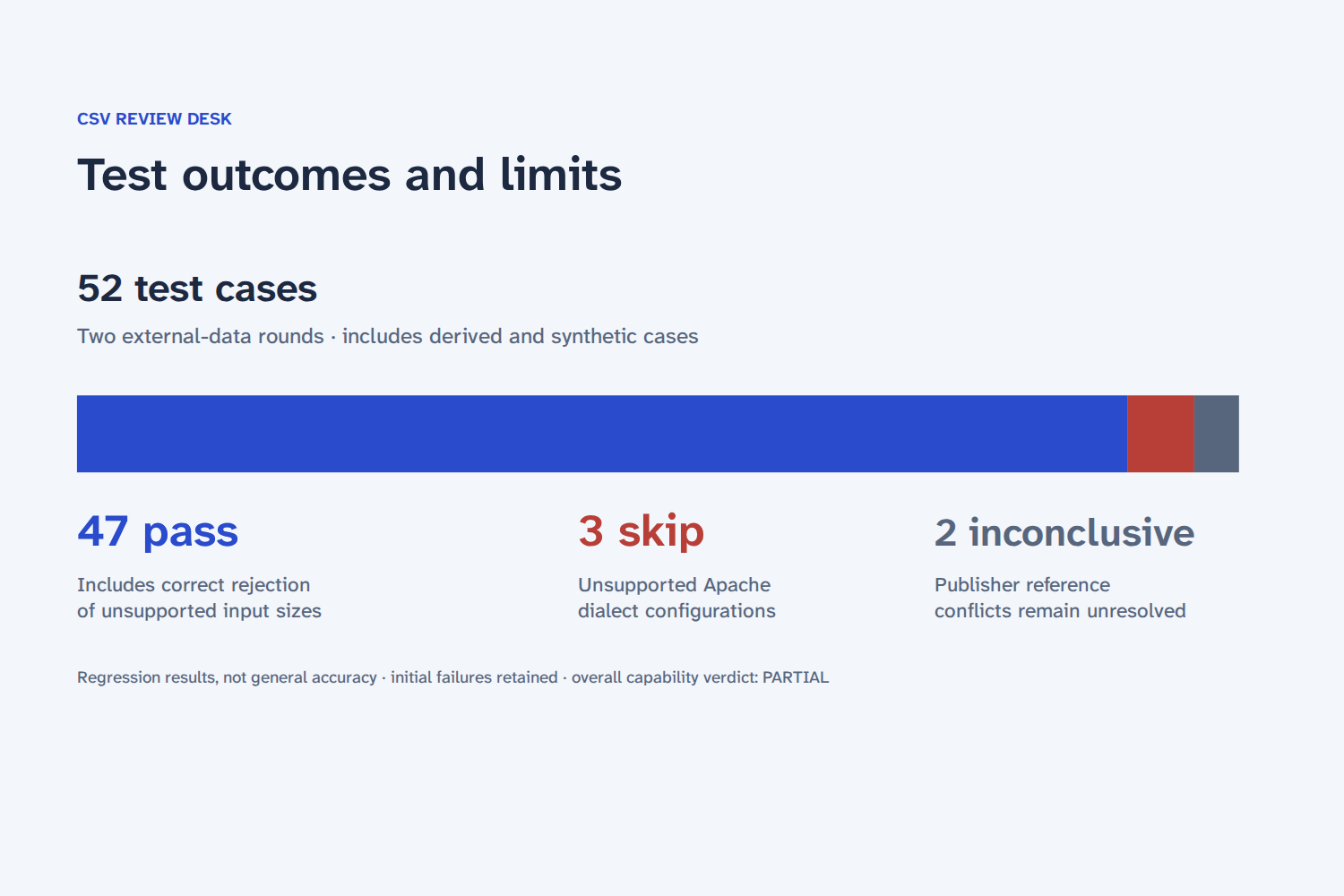
Test outcomes with unsupported cases and unresolved reference conflicts visible.
Inspiration
A CSV handoff can look simple—until a leading zero disappears, a date becomes ambiguous, or an invisible space causes trouble.
The difficult part isn't always finding the errors. It's deciding which values should change, which should stay untouched, and how to explain those decisions afterward.
Our research showed that capable CSV editors and import tools already solve many parts of this problem. Rather than recreate everything, we focused on one specific challenge:
Helping people review small CSV files, resolve exceptions, and preserve a traceable record of every change.
What it does
CSV Review Desk is a browser-based, local review workspace for UTF-8 CSV and TSV files.
It provides a complete workflow from importing raw data to exporting a reviewed file with an audit trail.
1. Import & Map
- Open a CSV/TSV file or paste CSV content.
- Map source columns to the fields needed for export.
- Preserve original record numbers and source values.
2. Validate & Detect Issues
- Run basic checks or configure custom validation rules.
- Check required fields, exact uniqueness, email format, real ISO dates, and allowed values.
- Filter problematic records to focus on exceptions.
3. Review & Repair
- Edit cells directly through the table or inspector.
- Preview whitespace changes before applying them.
- Save edits, undo operations, or exclude records with explicit reasons.
- Keep unsaved drafts separate from committed changes.
4. Export & Resume
- Export a reviewed CSV alongside an audit trail.
- Save a project containing drafts, changes, and history.
- Resume an unfinished review later.
Privacy & Scope
All file processing happens locally in the browser.
- No account required.
- No file-upload endpoint.
- Supported limits: 2 MB, 5,000 records, and 50 columns.
- Passing configured checks does not guarantee acceptance by a destination system.
How we built it
Technology Stack
- Frontend: HTML, CSS, and JavaScript modules
- CSV Parsing: Papa Parse
- Hosting: GitHub Pages
- Processing: Client-side validation, editing, and export
The application is entirely static. Parsing, validation, and editing execute directly in the browser.
Data Integrity
We designed the internal workflow around preserving the original data.
Text-first parsing: Parsed values remain text, so identifiers such as 008 are not automatically converted to 8.
Immutable source snapshot: The original dataset remains separate from the editable working copy.
Atomic row edits: Changes to a record are committed together, preventing partial updates.
Undo history: Operations retain the information needed to restore previous values and row structures.
Review Interface
The UI follows the user's review process rather than exposing disconnected editing features.
- Highlighted exceptions make problematic records easier to find.
- Shared drafts keep the table and inspector consistent.
- Clear save actions distinguish drafts from committed edits.
- Active checks remain visible throughout review.
- Uncommitted drafts block CSV export.
- New changes invalidate previously generated exports.
- Projects are persisted only when explicitly saved.
Challenges we ran into
1. Handling Real-World CSV Structures
Simple examples did not expose all parsing edge cases.
Sparse semicolon-delimited and tab-delimited files sometimes confused automatic delimiter detection. Short records also required careful treatment of missing cells.
Undo was particularly challenging: restoring a record meant recovering its original structure, not simply replacing a changed value with an empty string.
2. Managing Editing State
A value can appear corrected in a draft while the saved dataset still fails validation.
We needed to ensure that:
- Drafts and committed values were clearly distinguishable.
- Filtering preserved original record numbers.
- Column mapping changes did not silently commit partial drafts.
- Export reflected only valid, committed review state.
3. Explaining Validation Boundaries
A review tool must communicate what it has—and has not—checked.
For example, a text-only review should not imply that email validity, required fields, or duplicate records were validated.
We made the active validation scope explicit to avoid creating false confidence.
Accomplishments that we're proud of
Complete Review Workflow
We delivered a working end-to-end process:
Import → Map → Validate → Review → Repair → Undo → Export
The application also supports saving and resuming review projects with their drafts and history.
Real-World Dataset Verification
We tested CSV Review Desk against a public 449-record currency-code dataset.
An independent cell-by-cell comparison confirmed:
- 449/449 records retained
- Only 6 approved outer-whitespace trims changed
- Leading zeros preserved, including Albania's numeric code
008
This verified that the review process could apply intended corrections without silently modifying unrelated values.
Automated & External Testing
| Test category | Result |
|---|---|
| Automated tests | 38 passing |
| External-data cases | 52 evaluated |
| Met defined expectations | 47 |
| Unsupported dialect cases | 3 skipped |
| Publisher-reference conflicts | 2 inconclusive |
The external-data results cover two testing rounds and include derived cases, synthetic cases, and expected input rejections.
These results demonstrate tested behavior under defined conditions, not a general accuracy score.
What we learned
Data Preservation Requires More Than Text Parsing
Keeping identifiers as strings prevents some problems, but dependable CSV review requires more.
We learned the importance of:
- Atomic changes to avoid partially updated records.
- Reliable undo that restores original data structures.
- Visible drafts that distinguish proposed edits from saved changes.
- Explicit validation rules that explain exactly what was checked.
- Traceable decisions that make exports easier to review.
Real Data Exposes Unexpected Failures
External datasets revealed issues that controlled examples had missed.
Retaining evidence of initial failures helped us evaluate fixes without hiding the problems that motivated them.
We also learned to distinguish successful engineering tests from evidence of user adoption or superiority over existing tools.
What's next for CSV Review Desk
Short-Term Goals
- Prepare a focused competition demo demonstrating the full CSV review workflow.
- Create a concise first-use guide.
- Gather feedback from complete CSV handoffs.
- Improve validation-rule explanations and independent edge-case coverage.
Longer-Term Direction
We intend to explore broader file formats and larger datasets when real usage demonstrates the need.
The guiding principle remains the same:
Every change should be intentional, every exception should be understandable, and the original data should remain protected.

Log in or sign up for Devpost to join the conversation.