-
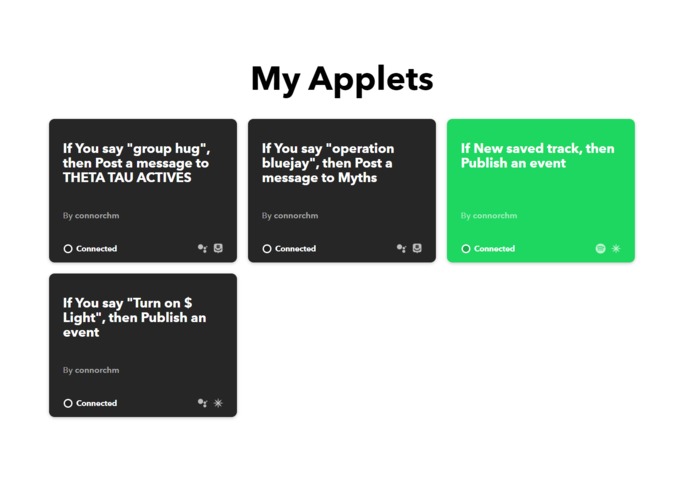
Applets made with IFTTT
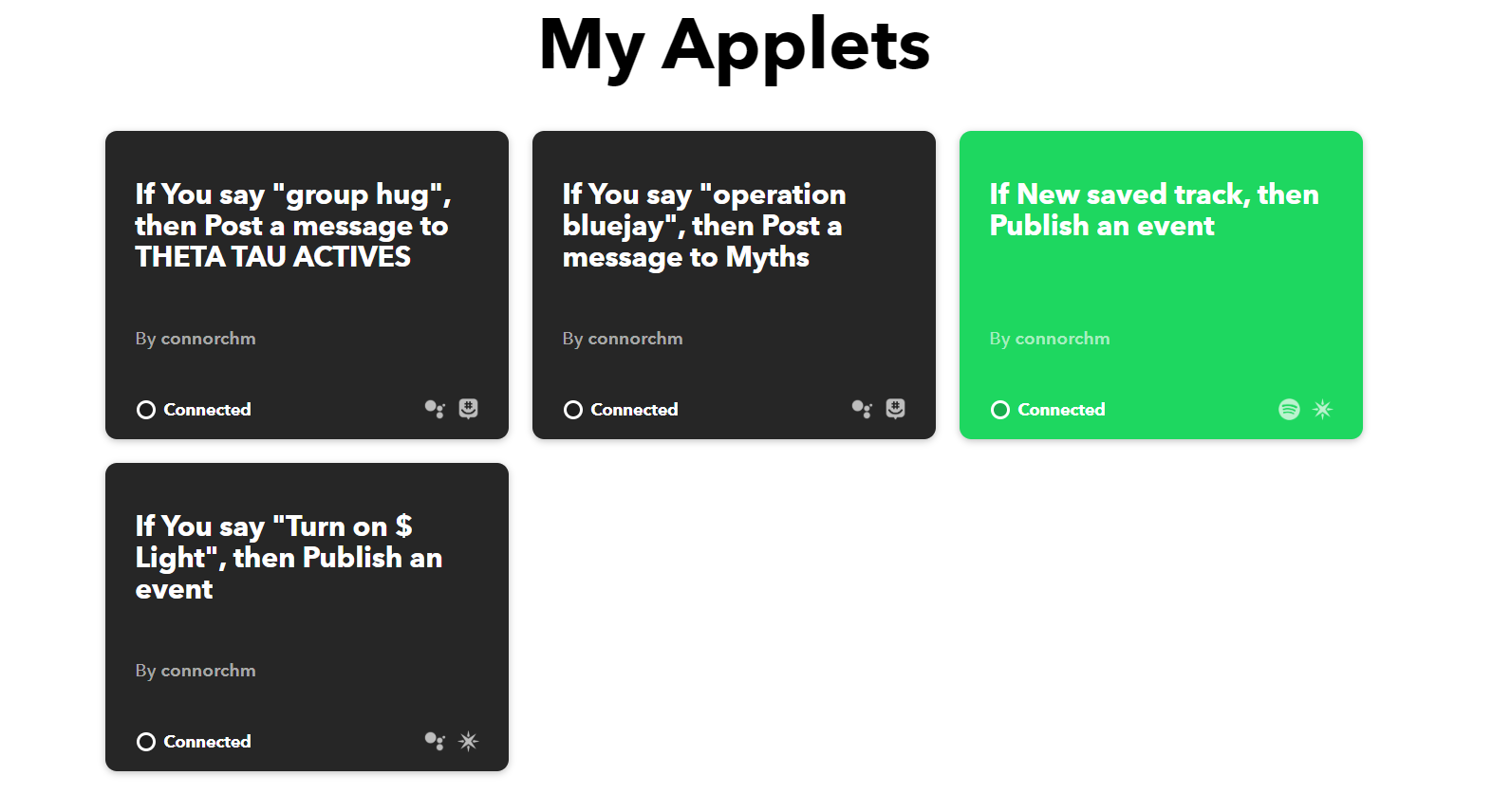
What it does:
This project intends to let the user add devices to a network of hardware via Arduino or Raspberry Pi and control it with Google Assistant. Now it is possible to add different software to GA's capabilities while adding hardware is possible but not useful as input delay is high.
How I built it:
We used software called If This Then That (IFTTT), which is a streamlined webHook website that allows supported software to form user-defined connections and functions. IFTTT was where we connected our Google Home/Assistant to our Raspberry Pi and Arduino hardware. IFTTT, allows users to define a flag that would trigger an event. The 'flag' in our case was specific voice commands using Google Assistant (this could be anything) and the 'event' would be the connected software/hardware triggering an action. Some things we tested with it included sending specific messages based on an unrelated phrase and triggering an LED to turn on based on a phrase.
Challenges I ran into:
Most challenges we ran into were hardware and WiFi related. We did not have a monitor for our Pi, so connecting it to WiFi was a challenge as we could only issue a command via a laptop emulator, which confounded proper setup. The biggest challenge we had, related to the way we connected IFTTT to Pi/Arduino. For the Pi, the issue was configuring it so that it would look for the IFTTT triggers in a responsive manner. The flaw for the Pi/IFTTT connection was that it would take several minutes for the Pi to find or process the trigger, which greatly reduced the utility of this project. Later, when trying to configure Arduino with IFTTT, or main problem was establishing a server between the Arduino and IFTTT.
Accomplishments that I'm proud of:
We were able to utilize IFTTT and Google Assistant to work with most types of software, including ones not directly supported by the IFTTT website. While Pi was not particularly responsive, we were still able to successfully trigger it via voice commands through Google Assistant.
What I learned:
We all gained valuable insight into software-hardware interconnectivity, especially using Pi and Arduino. We also improved our troubleshooting skills for hardware.
What's next for CSUF theta tau hack:
We do not have a set direction for our project at the moment but we have talked about some possible future implementations. First is making our own version of IFTTT, which could be more modular and useful for hardware. Another possibility is that we could make a hub for IFTTT connections that could be easier managed by the user.
Built With
- arduino
- google-assistant
- ifttt
- python
- raspberry-pi

Log in or sign up for Devpost to join the conversation.