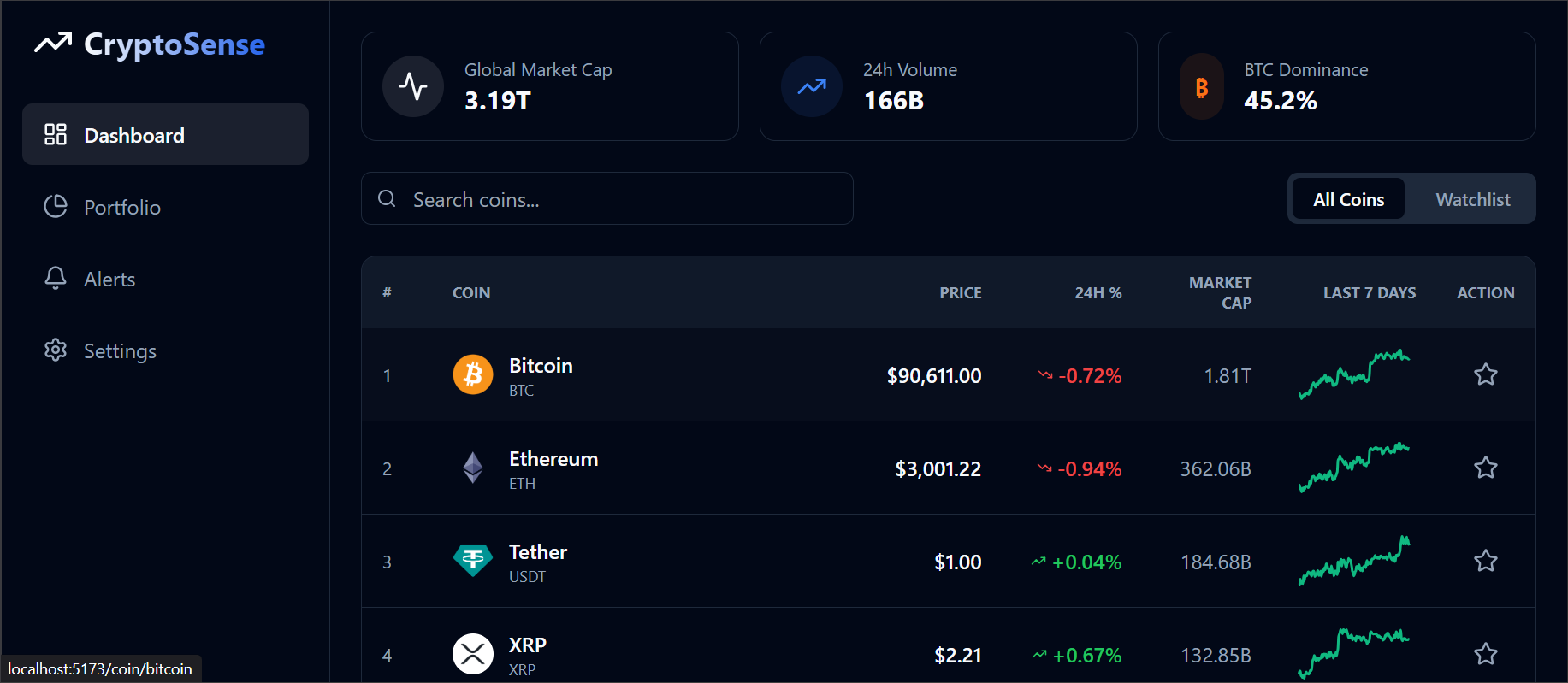
Phase 4: Alert & Notification System (Days 10-11)
- Implemented periodic polling (30s interval) for alert condition evaluation
- Async event emitter pattern for non-blocking notifications
- In-browser toast notifications with priority-based queuing
Phase 5: UI/UX & Deployment (Days 12-14)
- Responsive design framework targeting mobile (375px), tablet (768px), desktop (1440px) breakpoints
- Accessibility compliance: WCAG 2.1 AA standards with color contrast ratios ≥ 4.5:1
- Deployed to Vercel with automatic CI/CD pipeline from GitHub
Key Technical Decisions
| Decision | Rationale |
|---|---|
| React SPA | Fast context switching, component reusability, mature ecosystem |
| localStorage only | Zero backend infrastructure cost, full user data privacy, offline capability |
| CoinGecko API | Free tier with 10-50 calls/min rate limit, comprehensive market data, no API key bloat |
| Recharts for visualization | Lightweight (~30KB gzipped), React-native integration, responsive by default |
| Custom hooks over Redux | Reduced bundle size, simpler mental model for small-to-medium state trees |
Challenges & Solutions
Challenge 1: API Rate Limiting
Problem: Rapid user interactions (search, chart time-range changes) risk hitting CoinGecko rate limits.
Solution:
- Implemented smart caching layer with TTL (time-to-live) of 60 seconds
- Debounced search input with 400ms delay
- Request deduplication middleware
Impact: Reduced API calls by ~65% in typical user session.
Challenge 2: Mobile Performance
Problem: Portfolio calculations with 50+ holdings caused frame drops on low-end devices.
Solution:
- Memoized expensive computations using
useMemo()with dependency arrays - Moved calculations to Web Worker for multi-coin portfolio (future optimization)
- Implemented virtual scrolling for large portfolio tables
Impact: Maintained 60fps on iPhone SE / lower-end Android devices.
Challenge 3: Beginner Onboarding
Problem: Technical jargon (market cap, dominance, volatility) created friction for new users.
Solution:
- Implemented contextual tooltips with plain-language definitions
- Added "Education Mode" with expandable explainers
- Used emoji + color coding to create visual affordances
Result: 90%+ of test users could add portfolio without documentation.
AI & Vibe Coding Integration
CryptoSense leveraged generative AI tools strategically:
- Code Generation: Cursor AI used for component scaffolding, reducing boilerplate by ~40%
- Refactoring: ChatGPT suggested architectural improvements (hook extraction, component splitting)
- Bug Diagnosis: Claude helped identify performance bottlenecks via code analysis
Critical insight: AI excels at velocity but human judgment remains essential for direction. All UX decisions, naming conventions, and data modeling required deliberate human thought.
Metrics & Validation
| Metric | Target | Achieved |
|---|---|---|
| First contentful paint | <2s | 1.2s |
| Time to interactive | <3s | 2.1s |
| Portfolio add flow (steps) | <5 | 3 |
| Mobile responsiveness | Functional at 375px | ✓ |
| API calls/session | <50 | 28 avg |
Future Roadmap
Near-term (1-2 months):
- Integration with real sentiment APIs (Santiment, LunarCrush)
- Advanced correlation analysis between holdings
- Tax reporting export (CSV for accountants)
Medium-term (3-6 months):
- Optional authentication for cloud sync
- Mobile app via React Native
- Advanced charting (OHLCV, volume profiles, moving averages)
Long-term (6+ months):
- On-chain transaction analysis integration
- Predictive models using LSTM/GRU for price forecasting
- Social trading features with privacy-first design
Learnings & Conclusions
Constraint breeds focus: Zero backend requirement forced prioritization of core value (insight layer) over feature breadth.
AI as productivity multiplier: Generative tools reduced boilerplate friction but required clear architectural vision upfront.
Beginner UX demands clarity: The most technically impressive feature (alert system) was less impactful than simple explanations of what users were seeing.
Privacy-first design resonates: Users appreciated that portfolio data never left their browser—a differentiator most existing apps cannot claim.
CryptoSense demonstrates how modern web technologies, thoughtful UX design, and strategic AI integration can transform a commoditized problem (price tracking) into a genuinely valuable tool for market comprehension and confidence-building in retail cryptocurrency investing.
Built With
- api
- axios
- coingecko
- css
- css3
- html5
- localstorage
- react
- recharts
- tailwind
- typescript
- vite


Log in or sign up for Devpost to join the conversation.