-
-
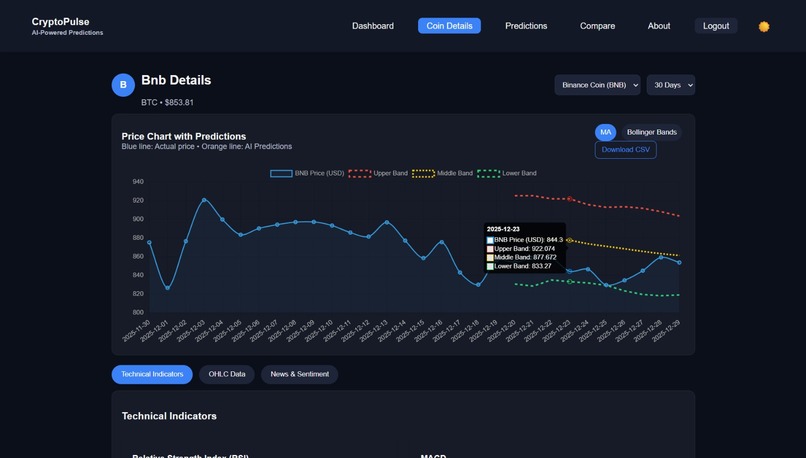
analysis image
About the Project — CryptoForecast AI
Inspiration
The rapid growth of cryptocurrency markets and their extreme volatility inspired me to explore how Artificial Intelligence (AI) can help analyze and predict price trends. While many existing platforms provide live prices and charts, most rely on manual or rule-based analysis. This motivated me to build a system that goes beyond visualization, focusing on machine-learning–based forecasting that is transparent and educational.
What I Learned
Through this project, I gained both conceptual and practical knowledge in:
- Understanding time-series data in financial markets
- Applying machine learning models for prediction
- Using TensorFlow and Keras for deep learning
- Implementing Dense and LSTM neural networks
- Performing data preprocessing and feature scaling
- Designing an end-to-end ML pipeline
- Building REST APIs using Flask
- Connecting backend logic with a frontend dashboard
- Understanding the difference between analysis vs prediction
How the Project Was Built
The project follows a modular and layered architecture.
1. Data Collection
Historical cryptocurrency price data is collected using external APIs.
The dataset contains open, high, low, close, and volume values.
2. Data Preprocessing
Before training, the data is:
- Cleaned to remove missing values
- Transformed into numerical features
- Normalized using scaling techniques
- Converted into time-series sequences
Normalization ensures stable learning: [ x' = \frac{x - \min(x)}{\max(x) - \min(x)} ]
3. Machine Learning Model
The project uses TensorFlow with Keras to build neural networks.
Models Used:
- Dense Neural Networks – feature-based learning
- LSTM (Long Short-Term Memory) – time-series prediction
LSTM is especially effective because it can remember long-term patterns in sequential data.
4. Model Training Process
During training:
- Historical data is fed into the model
- Predictions are compared with actual values
- Error is calculated using Mean Squared Error (MSE)
[ MSE = \frac{1}{n}\sum (y_{true} - y_{pred})^2 ] - Model weights are updated using backpropagation
- Trained models are saved as
.h5files
5. Prediction Pipeline
Once trained:
- The saved model is loaded
- Incoming data is preprocessed using the same scaler
- Predictions are generated
- Results are returned through an API
This ensures consistency between training and inference.
6. Backend Integration
A Flask-based backend:
- Exposes REST APIs
- Loads trained ML models
- Handles prediction requests
- Returns responses in JSON format
7. Frontend Dashboard
The frontend is built using:
- HTML
- CSS
- JavaScript
It provides:
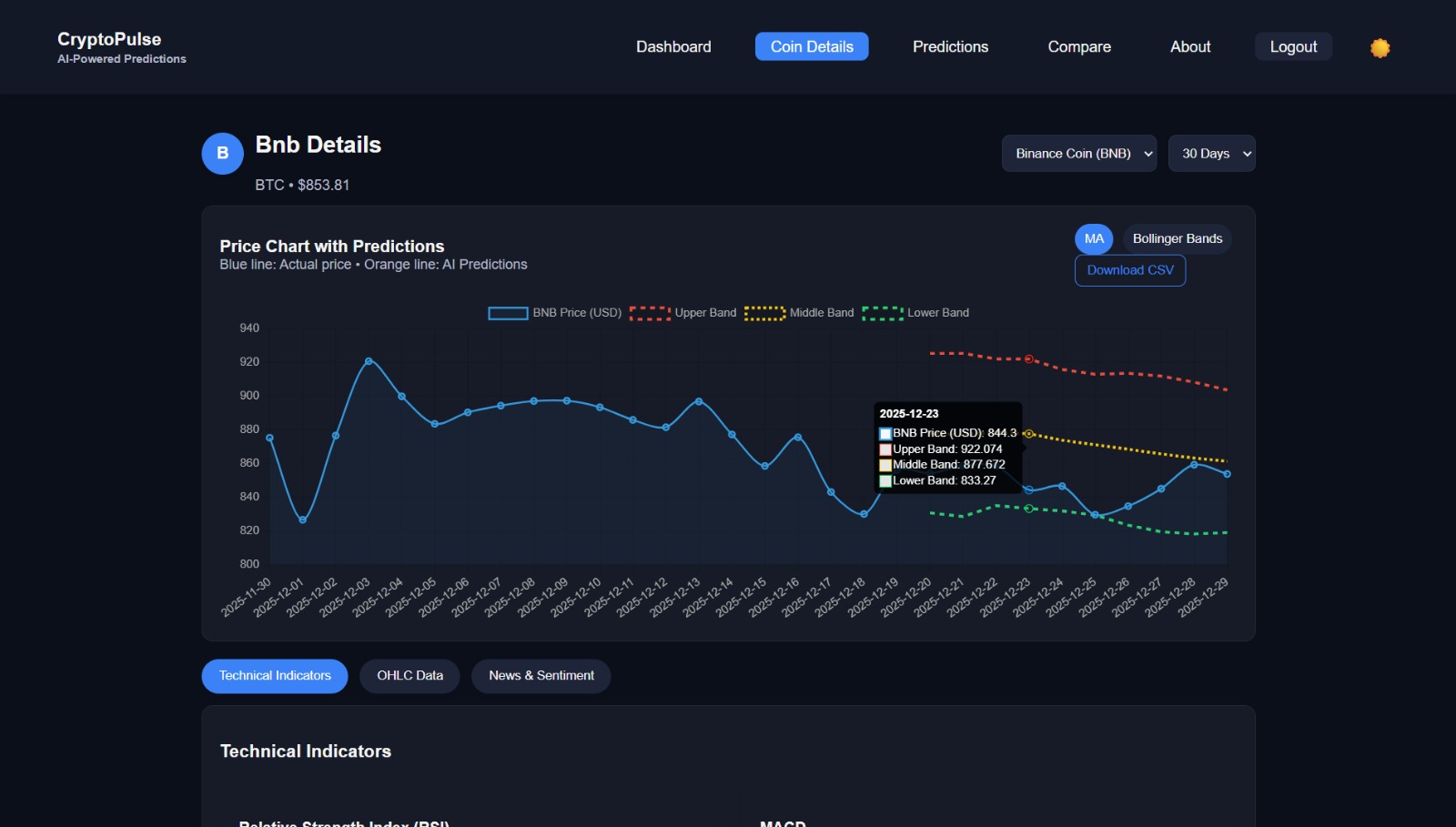
- Real-time price visualization
- Prediction results
- Interactive user interface
The frontend communicates with the backend via asynchronous API calls.
Challenges Faced
1. Handling Time-Series Data
Understanding how to convert raw prices into meaningful sequences for LSTM was challenging.
2. Model Overfitting
Early versions overfitted on small datasets. This was reduced using:
- Proper data scaling
- Train–test splitting
- Simpler architectures
3. Pipeline Consistency
Ensuring identical preprocessing during training and prediction required careful design.
4. Backend–Model Integration
Connecting Flask APIs with ML models and handling responses correctly required debugging.
5. Performance Optimization
Balancing accuracy vs execution speed was necessary for smooth prediction.
Outcome
The final system successfully: Analyzes historical cryptocurrency data Learns patterns using machine learning Predicts future price trends Displays results through a web dashboard
Conclusion
CryptoForecast AI demonstrates how artificial intelligence, machine learning, and web technologies can be combined into a complete predictive system. The project transforms raw market data into actionable insights and provides a strong foundation for further enhancements such as sentiment analysis, automated retraining, and cloud deployment.
Built With
- cryptopanic-api
- css
- flask
- github
- html
- javascript
- keras
- python
- rest-apis
- scikit-learn
- tensorflow


Log in or sign up for Devpost to join the conversation.