-
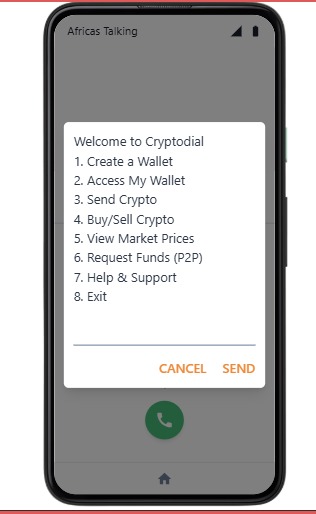
The Main menu of cryptodial
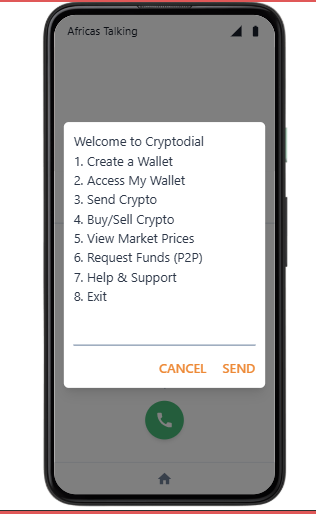
Inspiration
Feature phones continue to dominate the mobile phone market in Africa, a stark contrast to many other regions where smartphones have become the norm. Of the 40 to 50 million mobile phones shipped across the continent each quarter, more than half are feature phones. Meanwhile, a significant portion of the African population remains unbanked, restricting their access to modern financial services and leaving them disconnected from the rapidly advancing digital economy.
Cryptodial was born from the vision of bridging this gap—bringing the power of blockchain and cryptocurrency to everyone, regardless of their device or banking status. By enabling seamless, borderless transactions, Cryptodial empowers individuals with financial freedom, unlocking new opportunities for trade, remittances, and true digital inclusion across Africa.
What It Does
Cryptodial is a USSD-based API service that grants users access to multiple blockchains, making cryptocurrency transactions possible even on feature phones. Whether on a simple keypad phone or a high-end smartphone, users can:
- Create and manage wallets
- Send and receive cryptocurrency
- Check wallet balances and transaction history
- Access real-time market data
- Switch between multiple blockchain providers dynamically
Cryptodial is designed to be simple, fast, and accessible, ensuring that anyone—regardless of their technical background—can tap into the world of decentralized finance.
How I Built It
Cryptodial is structured as a modular and extensible framework, allowing seamless integration of multiple blockchains. At its core, it consists of:
- Africa's Talking API – For handling USSD services and messaging
- Express Server – Managing API requests and handling user sessions
- BaseChain Interface – Defining blockchain interactions (send, receive, balance check, transaction history)
- Blockchain Implementations – Located in the
chainssubfolder, each blockchain has its own class implementingBaseChain - Resolver System – Maps user input (e.g.,
"etn"for Electroneum) to the correct blockchain class - Provider System – Allows dynamic switching between different blockchain providers
- JSON-based USSD Menu System – Defines navigation, messages, and actions for user interactions
Each module functions independently but works together to create a scalable and flexible system.
Challenges I Ran Into
Building Cryptodial came with several challenges, the biggest being user identification and private key management.
User Identification: Since USSD doesn't support persistent sessions, mapping users to wallets without storing phone numbers was difficult. I implemented a system that assigns user IDs linked to public keys, allowing seamless authentication without exposing personal information.
Private Key Security: USSD transmits data in plaintext, making it unsafe to send private keys directly. The solution was to send keys only once during wallet creation, requiring the user to store them securely. Future interactions rely on public keys and signatures to verify transactions.
Database Workflow: To ensure reliable data persistence, transactions are logged immediately when initiated, with a background process verifying completion and retrying failures when necessary. This prevents data loss from network disruptions.
Transaction Tracking: Implemented a logging mechanism that records transaction statuses, allowing users to retrieve pending transactions if USSD sessions disconnect.
Despite these challenges, Cryptodial successfully enables blockchain interactions over USSD, making decentralized finance accessible to millions without smartphones or bank accounts.
Built With
- africastalkingapi
- ankr
- express.js
- mongodb
- typescript