-
-
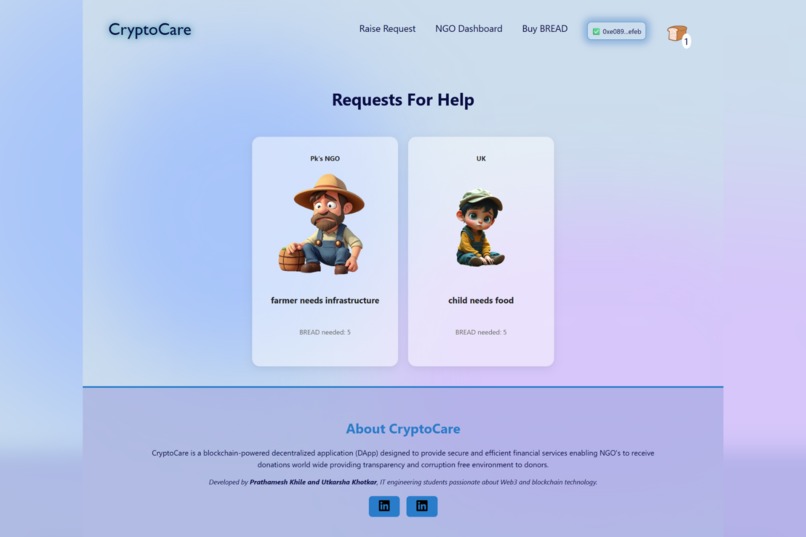
Cryptocare - Crypto with a heart that cares
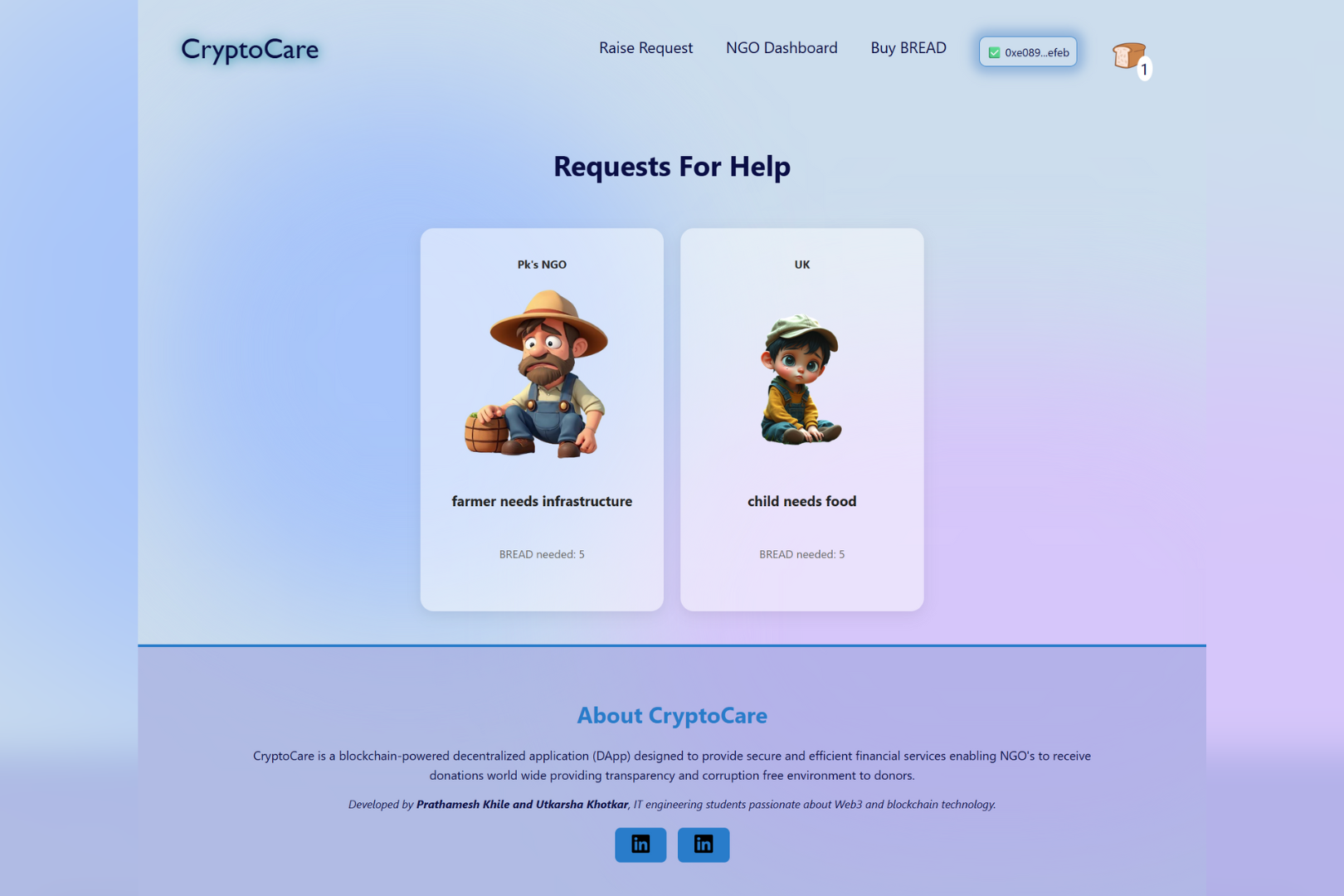
CryptoCare
Our Inspiration
The inspiration for CryptoCare came from a desire to combine the transparency and efficiency of blockchain technology with the urgent need for trustworthy and traceable NGO donations. We saw how difficult it can be for people to know whether their contributions are actually reaching those in need.
By introducing a gamified and symbolic currency like 'bread', we wanted to make the donation process more engaging and accessible, even for those unfamiliar with crypto. Additionally, platforms like Giveth and The Giving Block showed us the potential of blockchain for social good, and we wanted to take that further by emphasizing verified NGO listings and real-time donor impact tracking.
Ultimately, our goal is to create a corruption-free, transparent, and user-friendly system that empowers both NGOs and donors.
What It Does
CryptoCare is a blockchain-based donation platform designed to help NGOs collect donations transparently and efficiently using cryptocurrency.
Features:
Connects Donors & NGOs via MetaMask
Users (donors and NGOs) connect their MetaMask wallets to use the platform.Verifies NGOs
NGOs register with details like name, purpose, location, and contact info. Only verified NGOs can raise donation requests.Uses "Bread" as Currency
Donations are made in units of "bread" (1 bread = 0.00054 ETH ≈ 1 USD), making it simple and symbolic.Allows NGOs to Raise Requests
NGOs can request donations by specifying the beneficiary (e.g., child, farmer), help category (e.g., food, education), description, and amount of bread needed.Enables Donors to Buy & Donate Bread
Donors buy bread and donate it directly to NGO requests. A thank-you card appears after a successful donation.Tracks Fulfilled Requests
Once a request is fulfilled, it’s removed from the active list and marked as "Request Fulfilled" in the NGO dashboard.Ensures Transparency & Trust
All actions are handled via smart contracts for secure, tamper-proof transactions.
How We Built It
We built CryptoCare using a full-stack decentralized architecture to enable transparent donations and efficient bread distribution for NGOs via blockchain technology.
Idea & Design
We identified a gap in how NGOs receive and utilize donations, especially for basic necessities like food. We designed a DApp where NGOs can register, raise categorized requests (e.g., children, women), and receive tokenized “BREAD” units from donors.
Smart Contracts
- Built using Solidity to manage NGO registration, request creation, donation flows, and BREAD token redemption.
- Written and tested using Hardhat and integrated with Ethers.js.
Frontend (React.js)
- Built the UI using React with React Router and CSS Modules.
- MetaMask and Ethers.js used for wallet interaction.
Web3 Integration
- NGOs register once (verified on-chain).
- Donors buy BREAD tokens using ETH and donate to requests.
- NGOs can redeem BREAD tokens back to ETH securely.
Testing & Deployment
- Core flows tested on Hardhat's local blockchain.
- Deployment plans on Ethereum testnet.
Challenges We Ran Into
Smart Contract Design & Security
- Preventing double registration or double redemption by NGOs.
- Ensuring ETH ↔ BREAD conversion is fair and secure.
On-chain Data Limitations
- Optimizing request storage using IDs and mappings to reduce gas and fit storage limits.
Web3 Integration
- Complex wallet interaction handling and async blockchain operations using Ethers.js.
Local Testing
- Simulating real ETH donations using Hardhat and frequent redeploys.
UI/UX Flow Control
- Dynamic routing and conditional rendering based on user roles (donor/NGO).
Error Handling & Feedback
- Implemented detailed error messages and UI feedback for MetaMask issues and failed transactions.
Accomplishments That We're Proud Of
End-to-End DApp Functionality
Fully functional platform with NGO request creation, ETH donations, and BREAD redemption.
Smart Contract Logic with Real Utility
Solidity-based secure contract system for tracking donations and request fulfillment.
Role-Based Dynamic Dashboard
Custom NGO dashboard with real-time blockchain data fetching.
Seamless Web3 Integration
Smooth UX with MetaMask and Ethers.js for both tech and non-tech users.
Bread-for-Good Token Model
Gamified token system to symbolize donations and allow ETH redemption.
Community-Oriented Design
Verified NGOs and transparent request tracking make philanthropy more engaging and decentralized.
What We Learned
Blockchain Development in Practice
Improved skills in Solidity and real-world smart contract design.
Integrating Web3 with Frontend
Built deep understanding of Ethers.js, React integration, and wallet-based flows.
Decentralized Architecture Design
Learned to manage on-chain roles, request logic, and token economies.
UX in a Web3 World
Understood the importance of clarity, accessibility, and feedback in blockchain apps.
Handling Edge Cases & Gas
Optimized for gas usage and built logic to cover common blockchain edge cases.
Collaborative Problem Solving
Successfully divided tasks, resolved frontend/backend contract integration, and tackled blockers.
What’s Next for CryptoCare
NGO Authentication
Plans to add NGO's authentication for more security and reliability for the donations.
Decentralized Identity (DID) Integration
Plan to use Polygon ID or Worldcoin for verifying NGO and beneficiary identities securely.
Analytics & Impact Reports
Dashboards for donors to see impact reports and donation histories.
Tokenomics and Incentives
Incentive rewards for active NGOs and donors to encourage platform use and growth.
Multi-Chain Deployment
Deployment on Polygon or Base for reduced gas fees and scalability.
Community Governance
Moving toward DAO-based governance for feature voting, NGO onboarding, and ecosystem control.
Built With
- blockchain
- ethereum
- hardhat
- node.js
- react
- sepolia
- solidity
- vscode


Log in or sign up for Devpost to join the conversation.