-
-
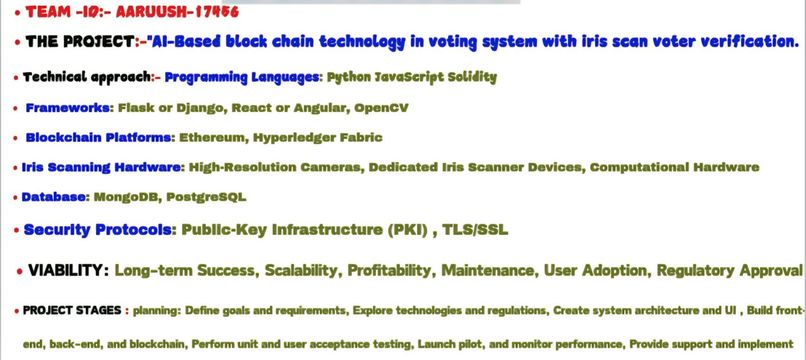
A brief description of the project with technology included
Inspiration
Here’s the inspiration for the idea, simplified:
- Need for Secure Elections:
Problems like vote tampering and fraud inspired the need for a more secure way to vote.
- Advances in Biometric Technology:
Seeing how iris scans can accurately identify people led to the idea of using them for reliable voter verification.
- Blockchain’s Proven Security:
Blockchain’s success in securing data in finance and other fields showed it could keep votes safe and tamper-proof.
- AI for Faster and Smarter Verification:
AI can quickly verify identities and detect fraud, making the voting process faster and more secure.
- Desire to Modernize Voting:
Current voting methods can be outdated. The idea was to use new tech to make voting easier, safer, and more trustworthy.
- Remote Voting Needs:
During the COVID-19 pandemic, the need for remote and contactless voting became clear. A digital solution could help voters participate safely.
- Inspiration from Other Uses of Tech:
Seeing how banks use biometrics, AI, and blockchain inspired the idea to apply these technologies to voting.
What it doesHere's a simplified breakdown of how such a system could be built, along with the potential challenges:
How It Was Built:
- Iris Scan Integration:
Develop or integrate an iris scanning system to capture and verify the unique patterns of each voter's eye.
Use AI algorithms to accurately match the scanned iris to the registered voter database.
- AI-Based Verification:
Implement AI to detect and prevent spoofing (e.g., fake eyes or images) and ensure only real, live users are verified.
Utilize machine learning to improve the accuracy and speed of verification over time.
- Blockchain Voting Platform:
Design a decentralized blockchain-based voting platform to store and record votes.
Use smart contracts to automate vote counting and ensure transparency, immutability, and security.
Allow real-time reconfirmation of votes, ensuring each vote is cast as intended and is counted accurately.
- Data Security and Encryption:
Encrypt all data during transmission and storage to protect voter information.
Ensure that all voter identities remain private, even as votes are recorded publicly on the blockchain.
Challenges:
- High Accuracy Requirement:
Ensuring the iris scanning and AI verification system has a high level of accuracy to prevent errors and misidentification.
- Privacy Concerns:
Balancing the need for voter identification with data privacy, especially when dealing with sensitive biometric information.
- Integration Complexity:
Combining multiple technologies (AI, blockchain, biometric systems) into a seamless, user-friendly platform.
- Scalability Issues:
Ensuring the system can handle a large number of voters simultaneously without delays or crashes, especially during peak times.
- Resistance to Tampering:
Protecting against potential cyberattacks or attempts to manipulate votes, requiring robust encryption and security protocols.
- Cost and Accessibility:
Addressing the cost of hardware for iris scanning and ensuring it is accessible to all voters, including those in remote areas.
Built With
- backend-api-services
- backend-integration.-javascript-(node.js
- biometric-analysis
- blockchain-programming.-c++/java:-high-performance-computing
- complex-query-processing.-ipfs-(interplanetary-file-system):-decentralized-storage
- core-feature-optimization.-frameworks:-tensorflow/pytorch:-neural-networks
- cost-effective-deployment.-aws-s3/azure-blob-storage:-secure-file-storage
- data-encryption
- data-storage-solutions.-aws-lambda/azure-functions:-event-driven-computing
- decentralized-applications-(dapps)
- decentralized-ledger
- deep-learning-models
- environment-consistency.-android/ios:-mobile-app-development
- file
- flexible-schema
- image-recognition.-express-(node.js):-middleware-integration
- machine-learning-algorithms
- machine-learning-integration.-databases:-mongodb:-nosql-database-management
- microservices-architecture
- native-vs.-cross-platform-apps
- on-demand-scaling
- peer-to-peer-networks
- react):-frontend-frameworks
- real-time-data-handling.-postgresql/mysql:-sql-database
- responsive-design.-platforms:-ethereum/hyperledger:-smart-contract-deployment
- rest-api-development
- scalable-data-storage.-aws-rekognition/azure-face-api:-image-processing
- server-side-scripting.-react/angular/vue.js:-component-based-ui-design
- serverless-computing
- sharing.
- state-management
- structured-data
- system-level-programming
- transaction-security.-docker:-containerization
- user-authentication.-cloud-services:-amazon-web-services-(aws)/microsoft-azure/google-cloud-platform-(gcp):-cloud-hosting
- user-interface-design.-solidity:-smart-contract-development


Log in or sign up for Devpost to join the conversation.