-
-
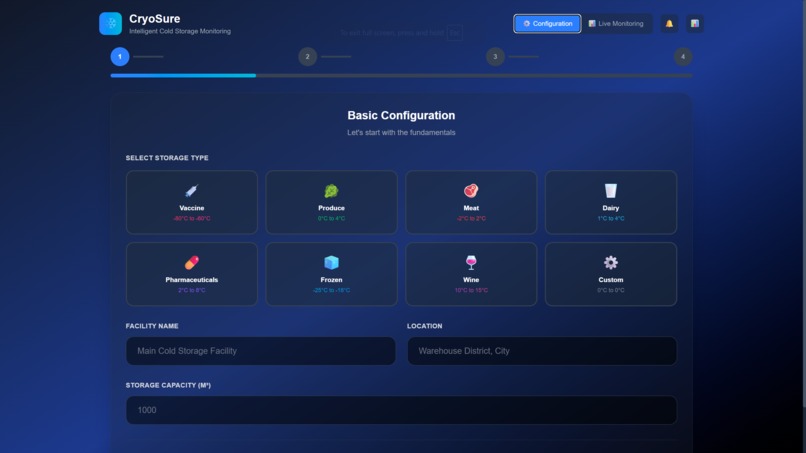
Configuration screen
-
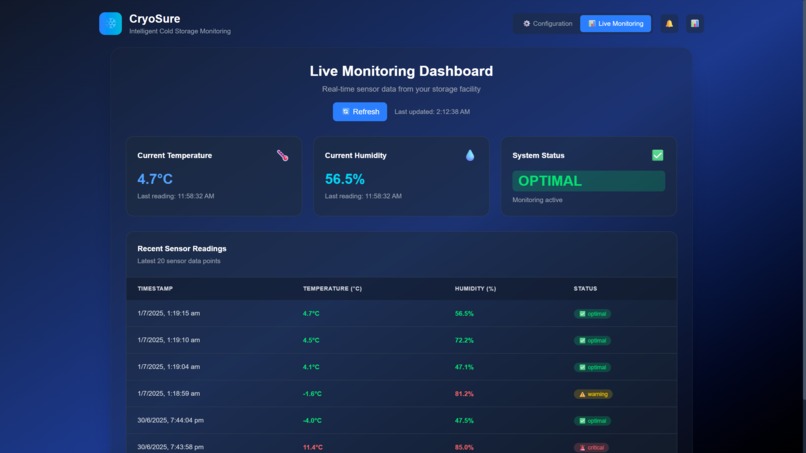
Live Monitoring
-
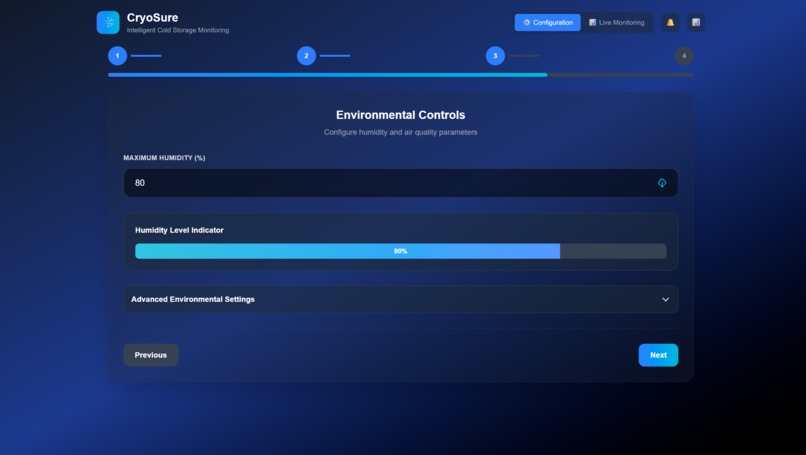
Humidity configuration
-
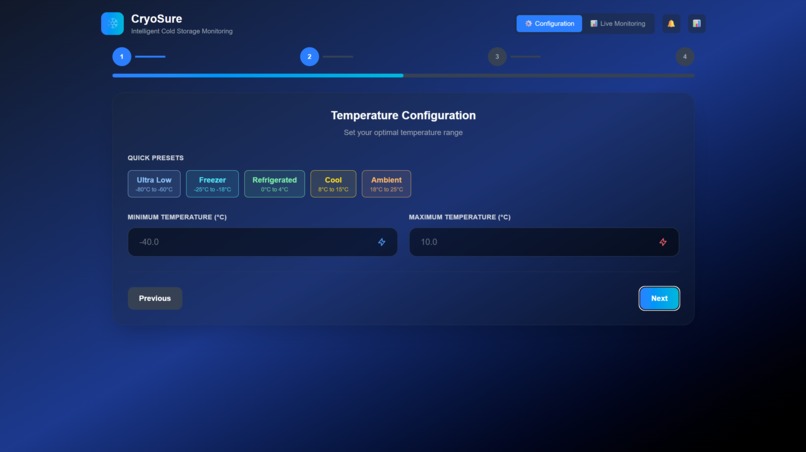
Temperature configuration


About the Project
What Inspired Us
The inspiration behind CryoSure stems from the critical yet often vulnerable nature of the global cold chain. We were struck by the staggering statistics on massive product spoilage:
- Nearly one-fifth of the world's food supply is lost annually, contributing to a global economic cost of US $1 trillion.
- The pharmaceutical industry loses an estimated $35 billion annually due to temperature control failures.
- Up to 50% of vaccines are wasted globally every year.
These figures highlight not just immense financial drains, but also profound impacts on food security, public health, and environmental sustainability. Traditional monitoring methods often rely on manual checks or post-facto analysis, rendering them "too late to take corrective action." Additionally, running constant, server-heavy systems to track and predict these issues is incredibly costly.
We were inspired to build a reactive, real-time serverless solution that could truly prevent these catastrophic losses while being inherently cost-efficient.
What We Learned
Building CryoSure was an intensive and rewarding learning experience in serverless architecture and event-driven design patterns on AWS. We gained deep insights into:
Event-Driven Flows
Mastering the integration of AWS IoT Core rules with Lambda functions to create a truly real-time, event-driven anomaly detection pipeline.
Dynamic Configuration Management
Implementing a robust system where critical application parameters (like anomaly thresholds) could be updated instantly via a web frontend and stored in DynamoDB, showcasing a flexible and responsive backend.
API-Driven Solutions
Designing and securing REST API endpoints using Amazon API Gateway to serve both configuration updates and data retrieval requests for the frontend.
Scalability & Cost Optimization
Understanding the inherent scalability and cost efficiencies of AWS Lambda and other serverless services:
- Pay-per-use model
- No idle compute costs
- Effective alternative to constant, server-intensive predictive systems
Inter-service Communication
Navigating IAM roles and permissions to enable secure and seamless communication between AWS services (IoT, Lambda, DynamoDB, SNS, API Gateway).
Full-Stack Serverless Development
Connecting the dots from device simulation through backend processing and alerting, all the way to a user-friendly React frontend.
How We Built Our Project
CryoSure was constructed as a modular, entirely serverless application on AWS:
1. Data Ingestion (AWS IoT Core)
- Simulated IoT devices send temperature and humidity data to an MQTT topic in AWS IoT Core.
- IoT Core acts as the secure entry point for all sensor data.
2. Anomaly Detection & Persistence (AWS Lambda & DynamoDB)
- An AWS IoT Rule triggers the
CryosureAnomalyDetectorLambda function. - Lambda retrieves the latest dynamic thresholds from
CryosureColdStorageConfigDynamoDB table. - It evaluates the incoming sensor data and stores the reading, including anomaly status, in
ColdChainSensorDatatable.
3. Real-time Alerting (Amazon SNS)
- If an anomaly is detected, a message is published to
CryosureAnomalyAlertsSNS Topic. - SNS sends immediate email/SMS notifications to subscribed stakeholders.
4. Dynamic Configuration API (API Gateway & Lambda)
- POST /config endpoint in API Gateway triggers
UpdateColdStorageConfigLambda. - Stores updated config (e.g., temperature thresholds) into
CryosureColdStorageConfigtable.
5. Frontend Data Retrieval API (API Gateway & Lambda)
- GET /sensordata endpoint in API Gateway triggers
GetSensorDataLambda. - Fetches latest sensor data from
ColdChainSensorDatatable for display.
6. Web Frontend (React.js)
- A React.js application allows users to:
- Update thresholds
- View sensor data in real-time
- Communicates with the above API Gateway endpoints.
Challenges We Faced
Asynchronous Flow Debugging
- Tracing issues across multiple asynchronous Lambda invocations, IoT rules, and API Gateway integrations.
- Required deep understanding of CloudWatch Logs and serverless observability.
Resource Constraints for Advanced ML
- We envisioned integrating:
- Amazon Bedrock for generative AI insights
- Amazon SageMaker for predictive analytics
- However, these services incur high costs not suitable for our hackathon budget.
- Thus, we implemented a rule-based anomaly detection system that is:
- Robust
- Cost-efficient
- Highly effective for our core problem
Built With
- amazon-api-gateway-(rest-api)
- amazon-cloudwatch
- amazon-dynamodb
- amazon-sns-(simple-notification-service)
- amazon-web-services
- amazon-web-services-(aws)
- aws-iot-core-(mqtt)
- aws-lambda
- python-3.9
- react.js-(built-with-vite)
- tailwind-css


Log in or sign up for Devpost to join the conversation.