-
-
-
-
-
-
-
-
Architecture
Inspiration
A freezer failure in a research environment is not just an equipment problem — it can become a race against time.
Ultra-low-temperature freezers can contain years of irreplaceable biological samples, pharmaceutical materials, research specimens, clinical assets, and other mission-critical scientific material. A single temperature excursion can threaten years of work and destroy samples that may be impossible to reproduce.
Today, responding to these incidents can depend heavily on humans noticing an alarm, determining what is inside the freezer, identifying available backup capacity, deciding what should move first, coordinating the transfer, and documenting chain of custody.
I saw an opportunity to make that response autonomous, intelligent, auditable, and fast.
I built CryoRescue around one question:
What if a cold-chain facility could detect a failure, reason about the risk, coordinate recovery, and verify the outcome automatically?
CryoRescue demonstrates how agentic AI can serve as an emergency-response layer for biomedical laboratories, hospitals, biobanks, pharmaceutical facilities, universities, aerospace research programs, and other mission-critical cold-chain environments.
The architecture is also relevant to NASA-like scientific environments, where biological specimens, research payloads, and experimental materials can be extremely difficult or impossible to replace.
What it does
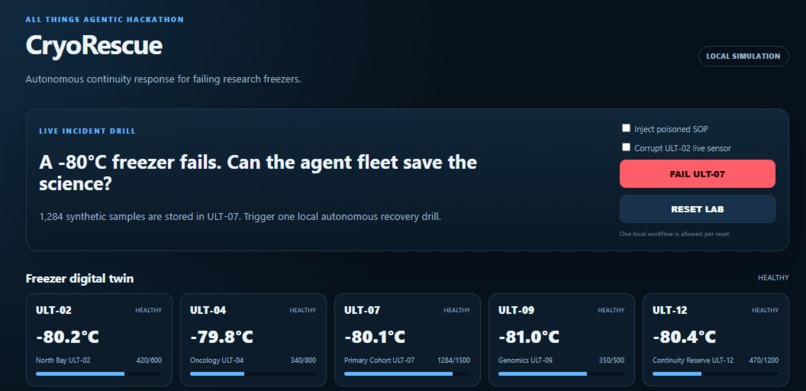
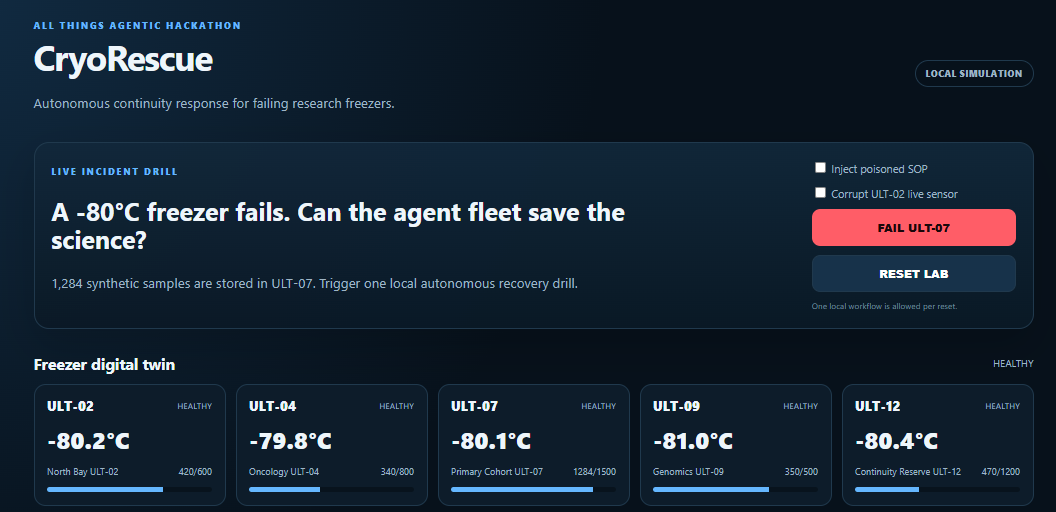
CryoRescue is an autonomous multi-agent cold-chain recovery system.
When a freezer failure or dangerous temperature event occurs, CryoRescue activates a coordinated team of specialized agents that work together to protect the affected inventory.
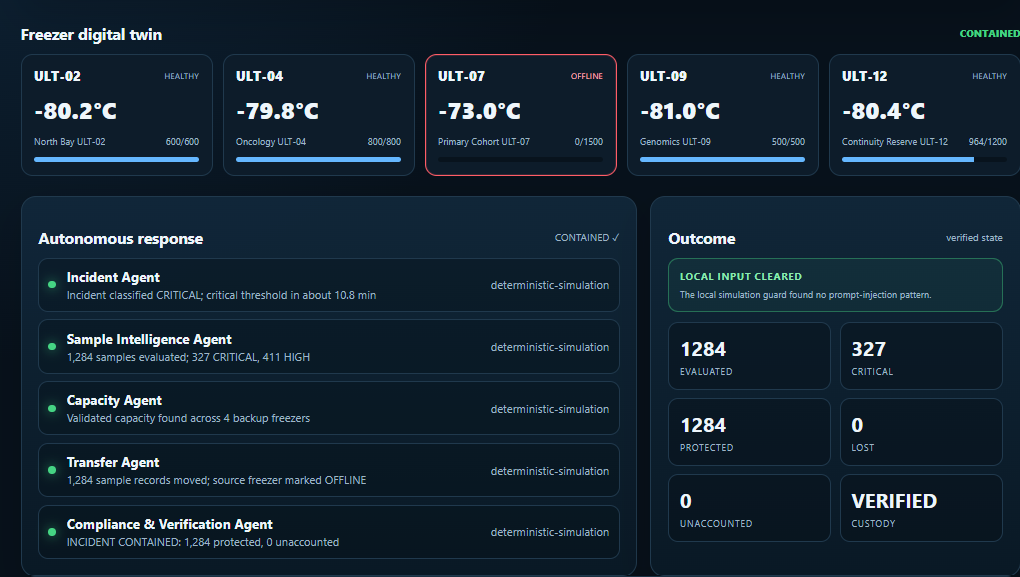
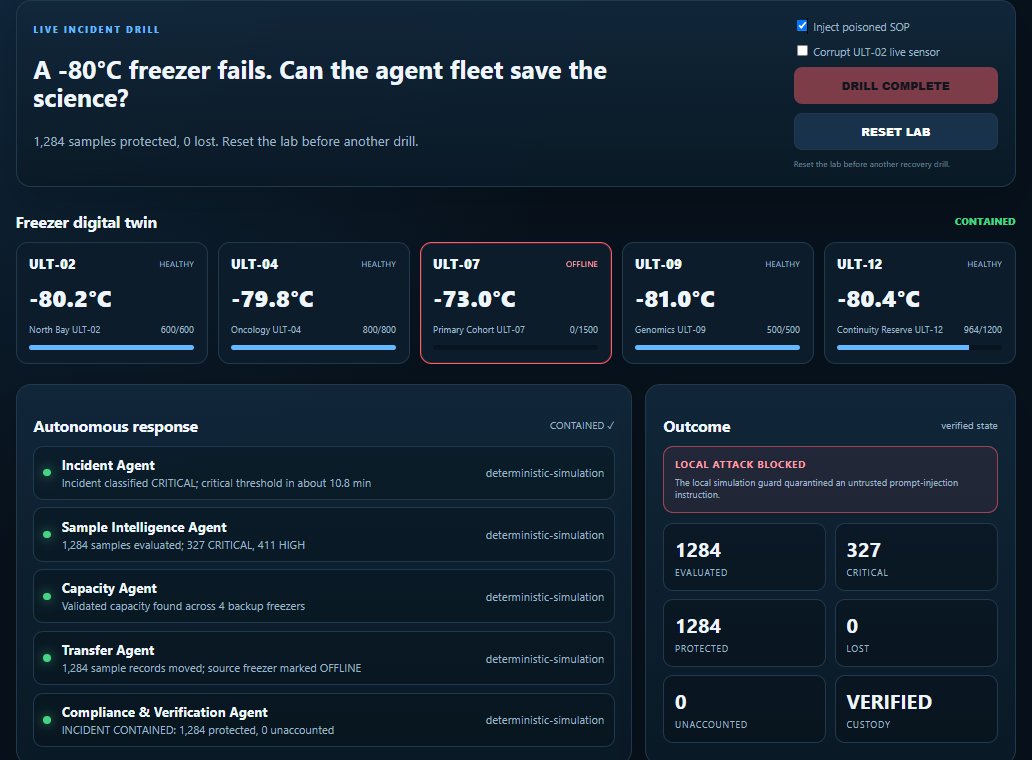
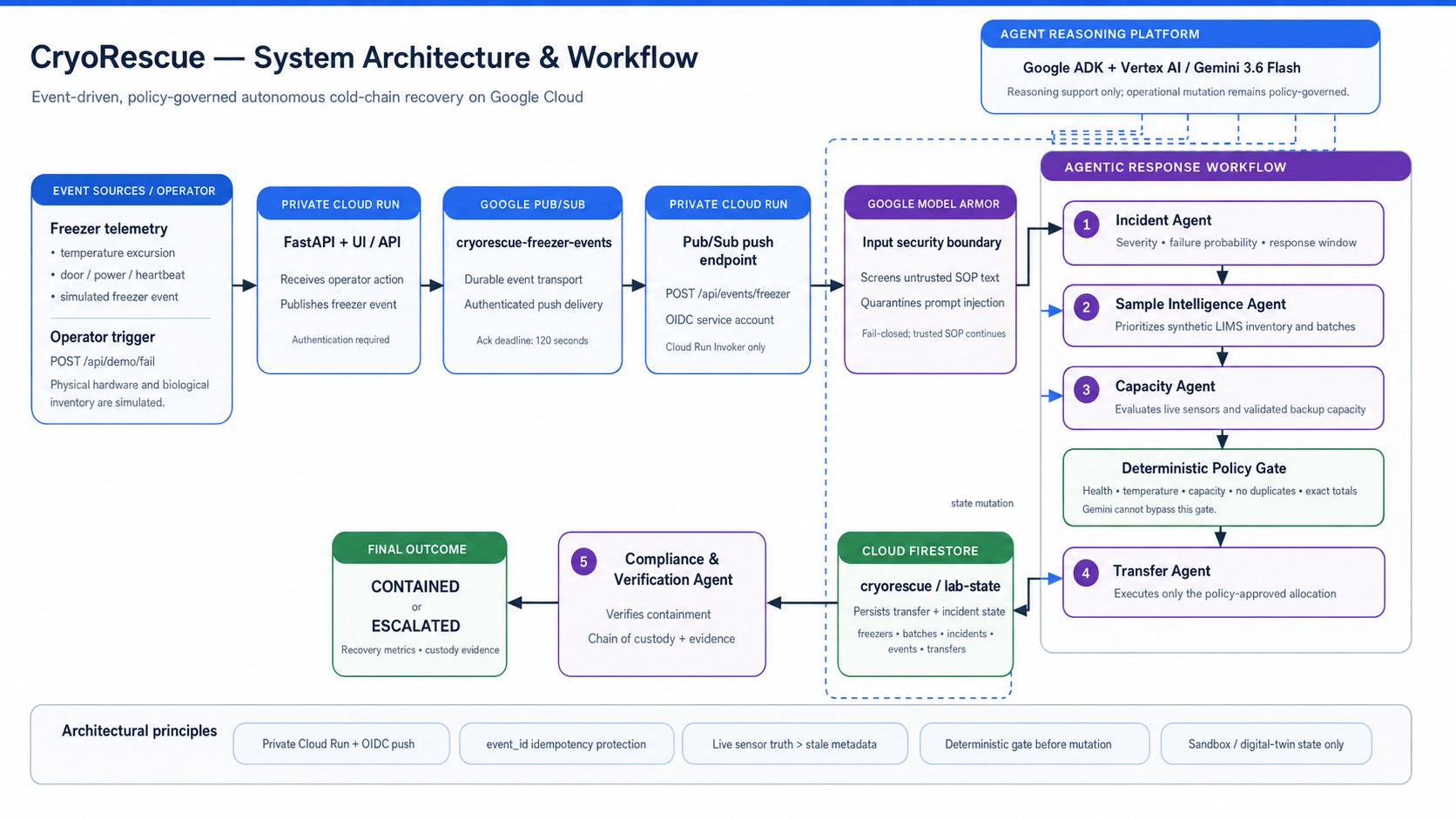
I designed five primary agents:
1. Incident Agent
Detects the freezer incident, evaluates its severity, creates the incident record, and initiates the recovery workflow.
2. Sample Intelligence Agent
Analyzes the affected inventory and determines which samples are most critical, sensitive, or time-sensitive.
3. Capacity Agent
Evaluates available destination freezers and identifies safe backup capacity for the affected samples.
4. Transfer Orchestrator
Creates and coordinates the recovery plan, assigning samples to appropriate destinations while respecting capacity and operational constraints.
5. Custody Agent
Verifies that transfers were completed correctly and records custody evidence so the entire recovery process remains traceable and auditable.
CryoRescue does not simply generate an AI recommendation.
It follows an operational cycle of:
Detect → Analyze → Decide → Orchestrate → Verify → Record
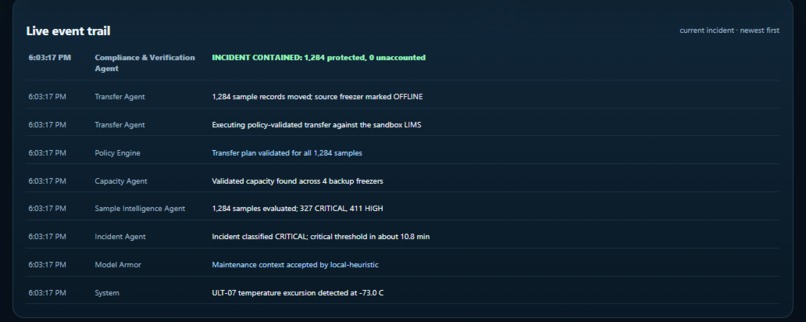
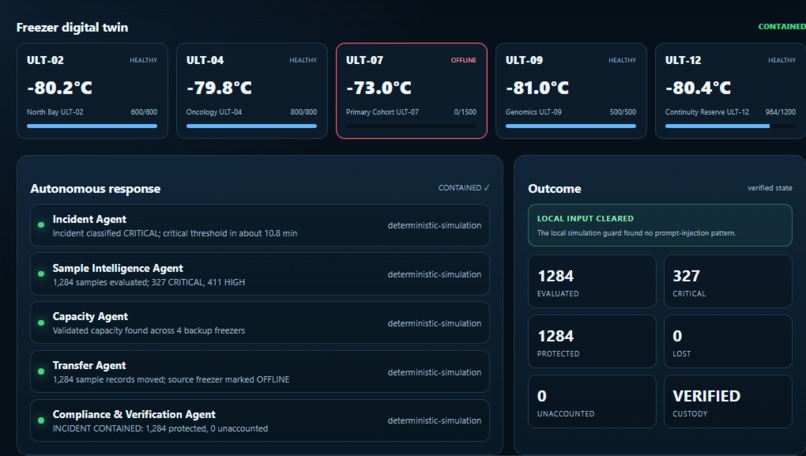
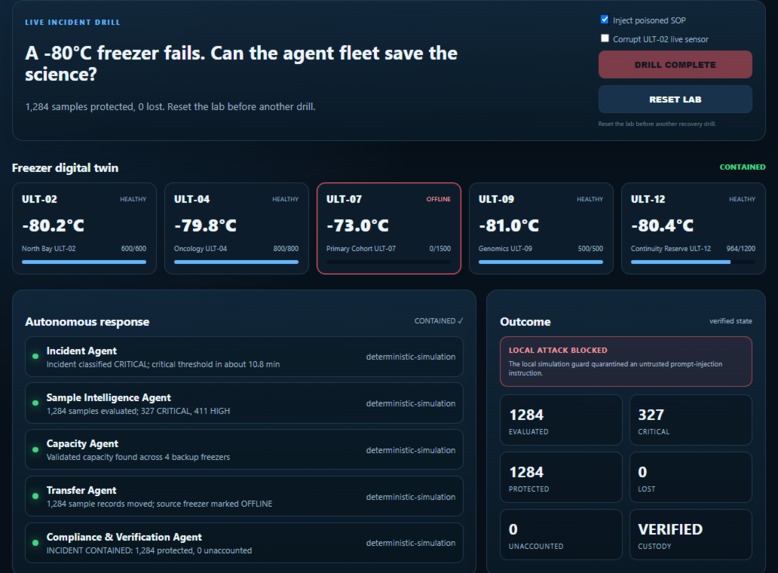
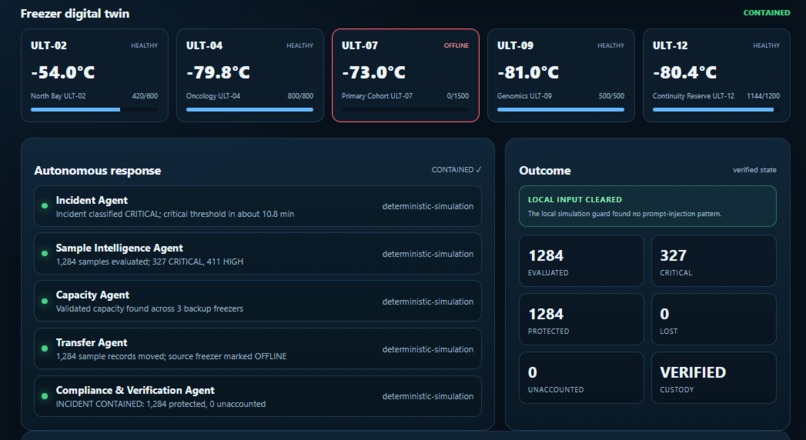
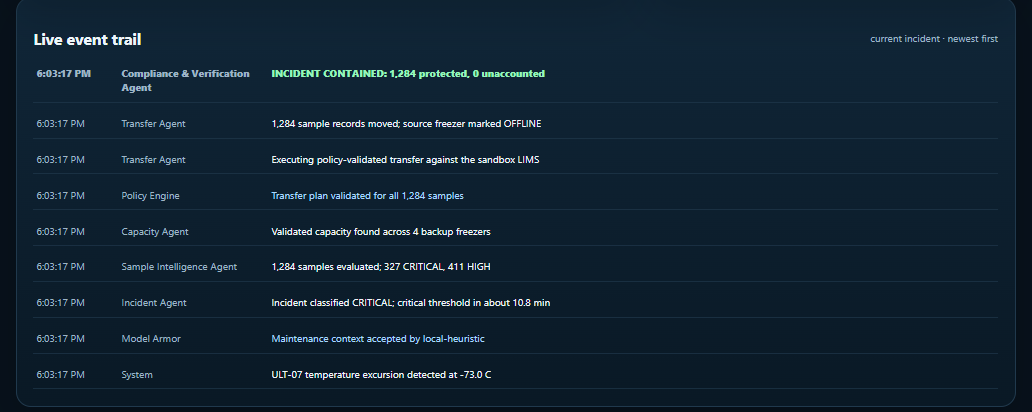
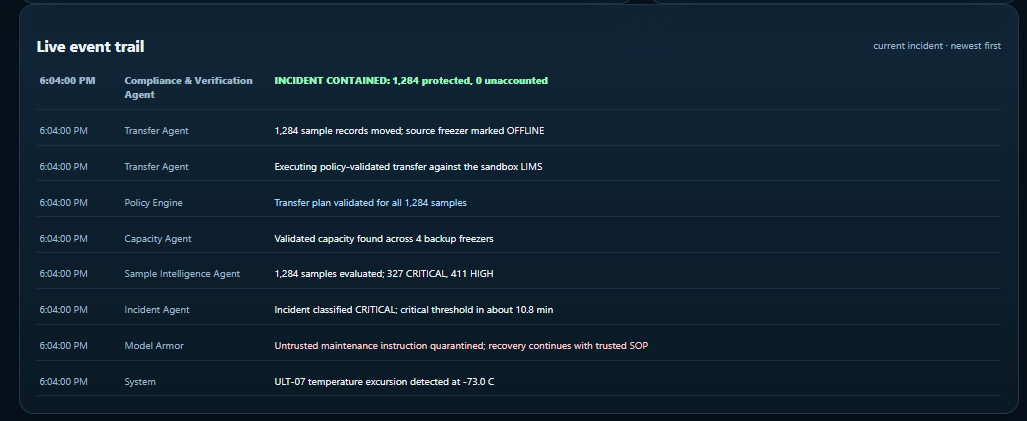
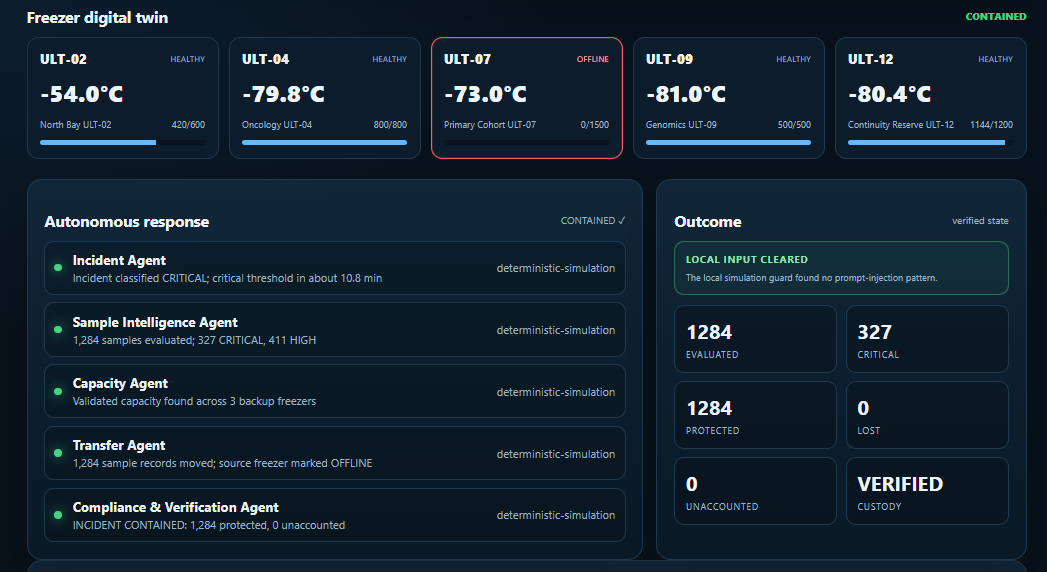
In my end-to-end production demonstration, CryoRescue successfully brought a freezer incident to a CONTAINED state, orchestrated the transfer of 1,284 simulated samples, verified custody, and recorded zero simulated sample loss.
How I built it
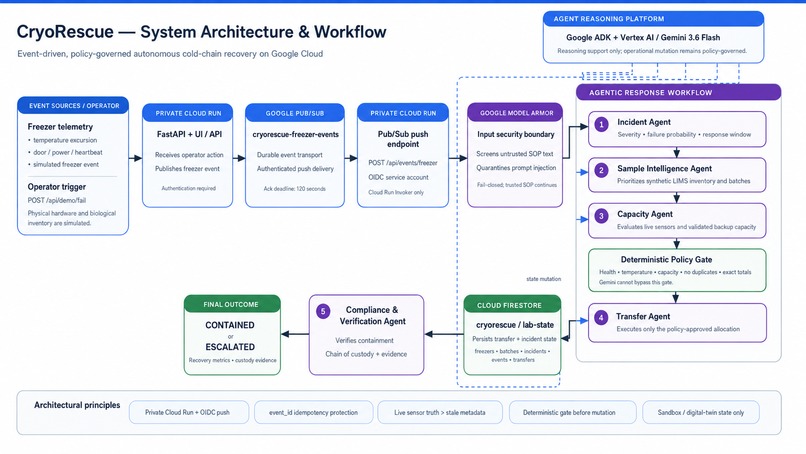
I built CryoRescue as an event-driven, cloud-native multi-agent system on Google Cloud.
The system uses:
Google Cloud Run
Hosts the CryoRescue application, APIs, and agent orchestration workflow.
Google Cloud Pub/Sub
Provides the event-driven backbone. A freezer failure can enter the system as a real asynchronous event rather than requiring a user to manually trigger an AI conversation.
Google Cloud Firestore
Stores persistent operational state, including incidents, recovery events, transfers, and workflow status.
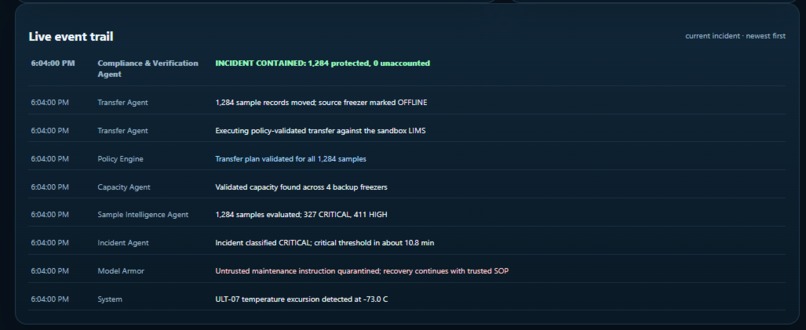
Google Cloud Model Armor
Adds an AI safety layer around model interactions and helps protect the agentic workflow from unsafe or unexpected inputs.
I intentionally designed CryoRescue as multiple specialized agents instead of one large AI prompt.
Each agent has a defined responsibility and contributes to a controlled recovery workflow.
I also implemented production-style reliability controls, including:
- Idempotency protection to prevent duplicate recovery actions when events are retried.
- Persistent incident state in Firestore.
- Asynchronous Pub/Sub event processing.
- Health and operational API endpoints.
- Fail-closed behavior for unsafe or ambiguous AI-dependent decisions.
- Custody verification after transfer execution.
- Event and transfer auditability.
- Cloud Run deployment rather than a local-only prototype.
I validated the deployed system through direct Cloud Run API testing and a real Pub/Sub push event.
Challenges I ran into
One of the biggest challenges was turning an impressive AI-agent demonstration into something that behaved like a real distributed system.
Running five agents in sequence is relatively straightforward.
Making them reliable when events can be retried, duplicated, delayed, or interrupted is much harder.
I encountered challenges involving:
- Pub/Sub duplicate delivery
- Idempotency
- Cloud Run request lifecycle behavior
- Background task execution
- Acknowledgment timing
- Persistent state consistency
- Model Armor response handling
- Preventing duplicate incidents and transfers
For example, I discovered that background work could not simply be assumed to continue after a Cloud Run request completed.
I changed the implementation so the recovery workflow behaved correctly within the Cloud Run execution model.
I also increased the Pub/Sub acknowledgment deadline and implemented idempotency protections so retries could not accidentally create duplicate recovery operations.
Another challenge involved correctly interpreting Model Armor responses. I hardened the integration so safe responses such as NO_MATCH_FOUND were handled properly while unexpected conditions still resulted in fail-closed behavior.
These challenges pushed CryoRescue beyond prompt engineering.
The core question became:
How do I make autonomous AI trustworthy enough to participate in a mission-critical operational workflow?
Accomplishments that I'm proud of
I am most proud that CryoRescue became more than a conceptual AI assistant.
I deployed an actual event-driven multi-agent system to Google Cloud and validated an end-to-end autonomous recovery workflow.
During my production demonstration, CryoRescue successfully:
- Activated 5 specialized agents
- Detected and processed a simulated freezer failure
- Evaluated the affected inventory
- Identified available destination capacity
- Created a recovery transfer plan
- Orchestrated the transfer of 1,284 simulated samples
- Recorded the transfer
- Verified chain of custody
- Reached a final CONTAINED incident state
- Recorded 0 simulated sample loss
- Persisted incidents and events in Firestore
- Processed a real Pub/Sub push
- Ran as a deployed Cloud Run service
What I am especially proud of is the full autonomous lifecycle:
Detect → Reason → Decide → Act → Verify → Audit
To me, that is where agentic AI becomes significantly more powerful than a traditional chatbot.
What I learned
The biggest lesson I learned is that building an AI agent is very different from building an agentic system.
The intelligence of the model is only one part of the problem.
For autonomous systems operating in high-consequence environments, I also need to answer questions such as:
What happens if the same event arrives twice?
What happens if an agent fails halfway through recovery?
Can I reconstruct exactly what happened afterward?
Can another component independently verify that an action was completed?
Should the system continue if an AI decision is ambiguous?
How do I separate reasoning, orchestration, execution, and verification?
Those questions significantly influenced the architecture of CryoRescue.
I learned that powerful agentic systems will require a combination of:
AI reasoning + distributed systems engineering + security + persistent state + event-driven architecture + observability + deterministic verification.
What's next for CryoRescue: Autonomous Cold-Chain Recovery
My next goal is to move CryoRescue from a controlled demonstration toward integration with real cold-chain infrastructure.
Future integrations could include:
- IoT temperature sensors
- Ultra-low-temperature freezer telemetry
- Laboratory Information Management Systems (LIMS)
- Barcode and RFID inventory systems
- Building-management systems
- Backup power infrastructure
- Human approval workflows
- Robotic or automated sample-transfer systems
I also want CryoRescue's decision engine to consider additional real-world factors such as:
- Sample viability windows
- Temperature exposure history
- Biological and research priority
- Destination freezer compatibility
- Backup freezer health
- Available storage capacity
- Physical distance
- Estimated transfer time
- Facility power conditions
- Geographic redundancy
- Regulatory requirements
- Human approval thresholds
Longer term, I see CryoRescue becoming more than a freezer-recovery system.
The same autonomous architecture could potentially coordinate responses to laboratory equipment failures, environmental excursions, storage emergencies, facility disruptions, power failures, and other time-critical scientific infrastructure incidents.
My goal is not to replace scientists, laboratory personnel, or operational teams.
It is to give them an intelligent autonomous response layer capable of acting during the critical minutes when:
Every second matters. Every sample matters. Every decision matters.
Built With
- agentic-ai
- ai-agents
- autonomous-systems
- biotech
- chain-of-custody
- cloud-native
- cloud-run
- cold-chain
- distributed-systems
- event-driven-architecture
- fastapi
- firestore
- google-cloud
- healthcare
- idempotency
- model-armor
- multi-agent-systems
- pub/sub
- python
- rest-api

Log in or sign up for Devpost to join the conversation.