Inspiration
Moving to a new city, starting at a new campus, or entering a new phase of life can be exciting and isolating at the same time. Existing social platforms are good at giving people more content to consume, but they rarely make it easier to find a few compatible people and actually do something together.
Cruvio started with a simple question: what if a social app optimized for real-world connection instead of attention? The product promise became equally simple: find your people and do something real.
What it does
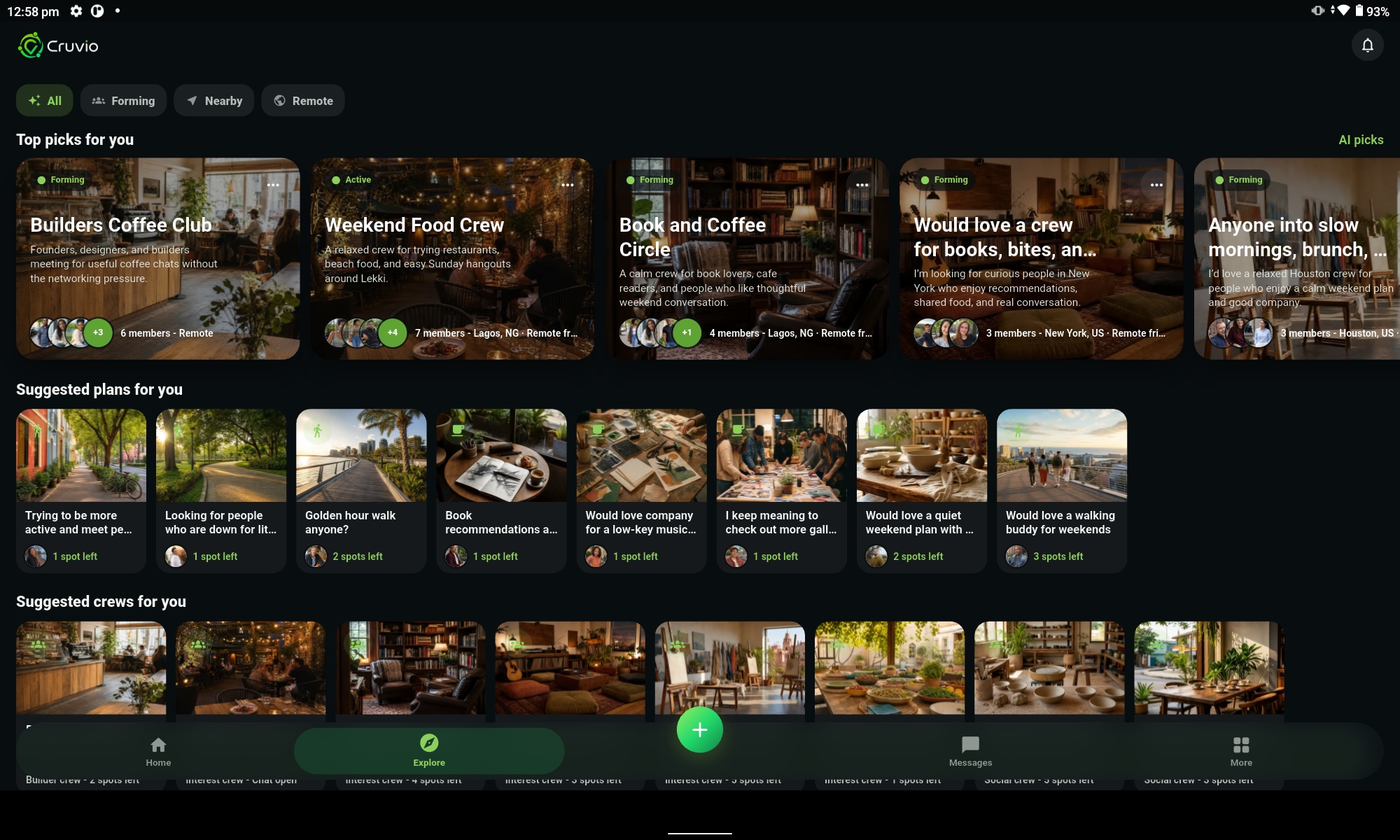
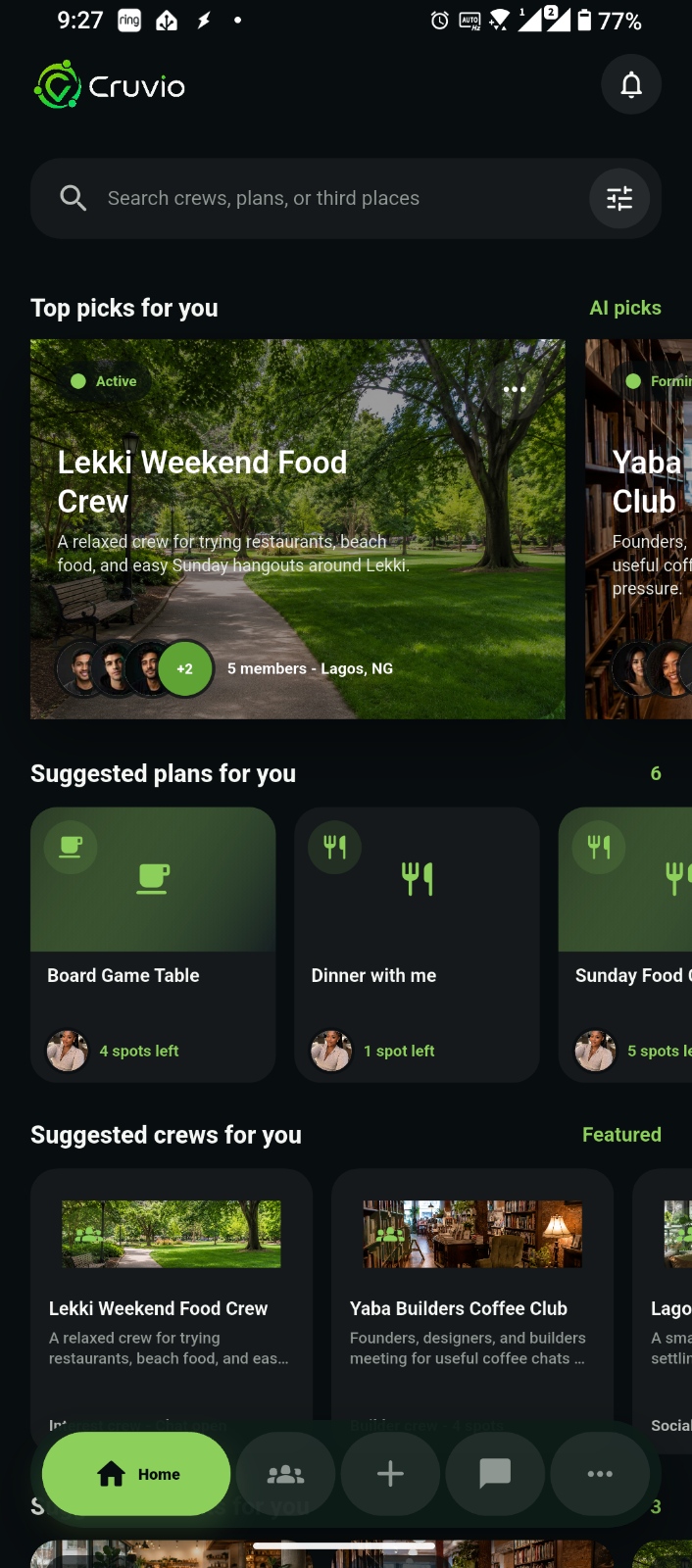
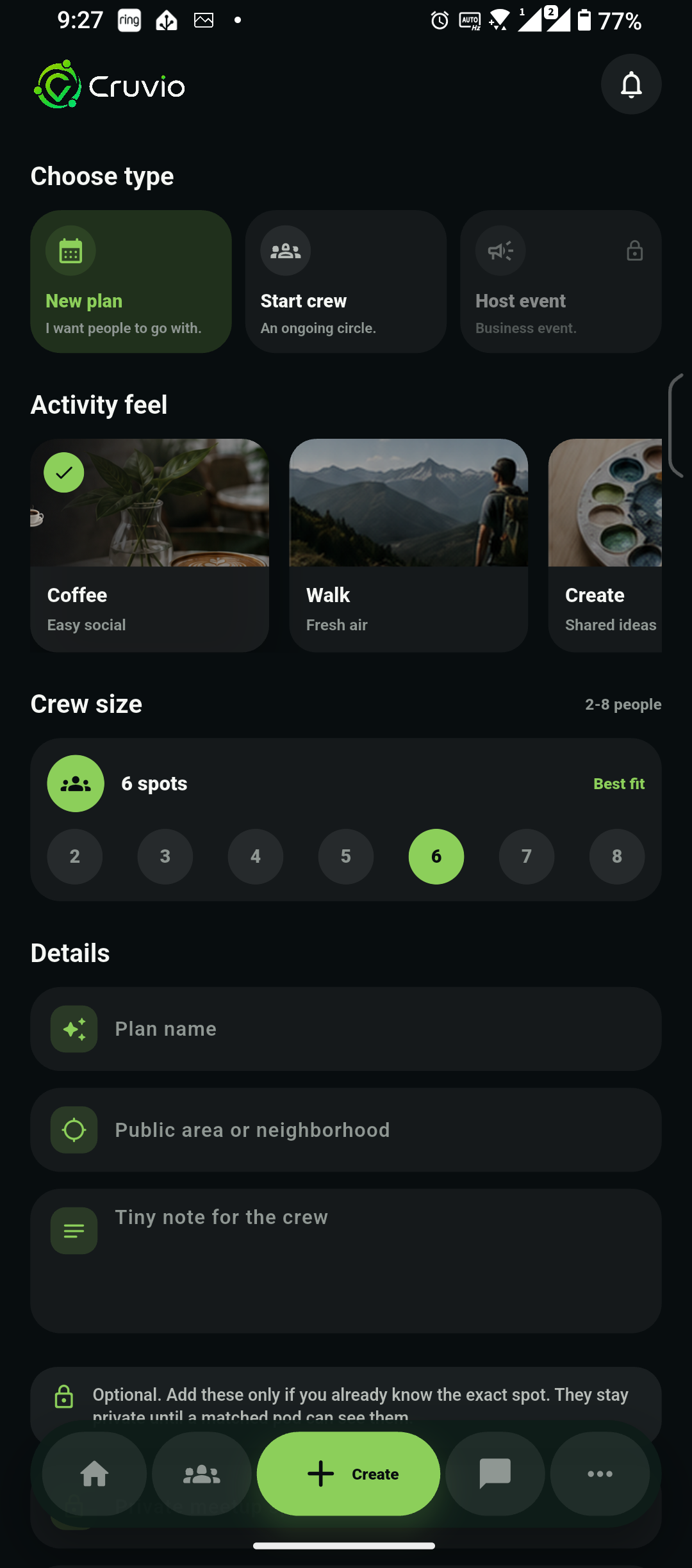
Cruvio helps people discover like-minded friends and move from shared interests to small, intentional group experiences.
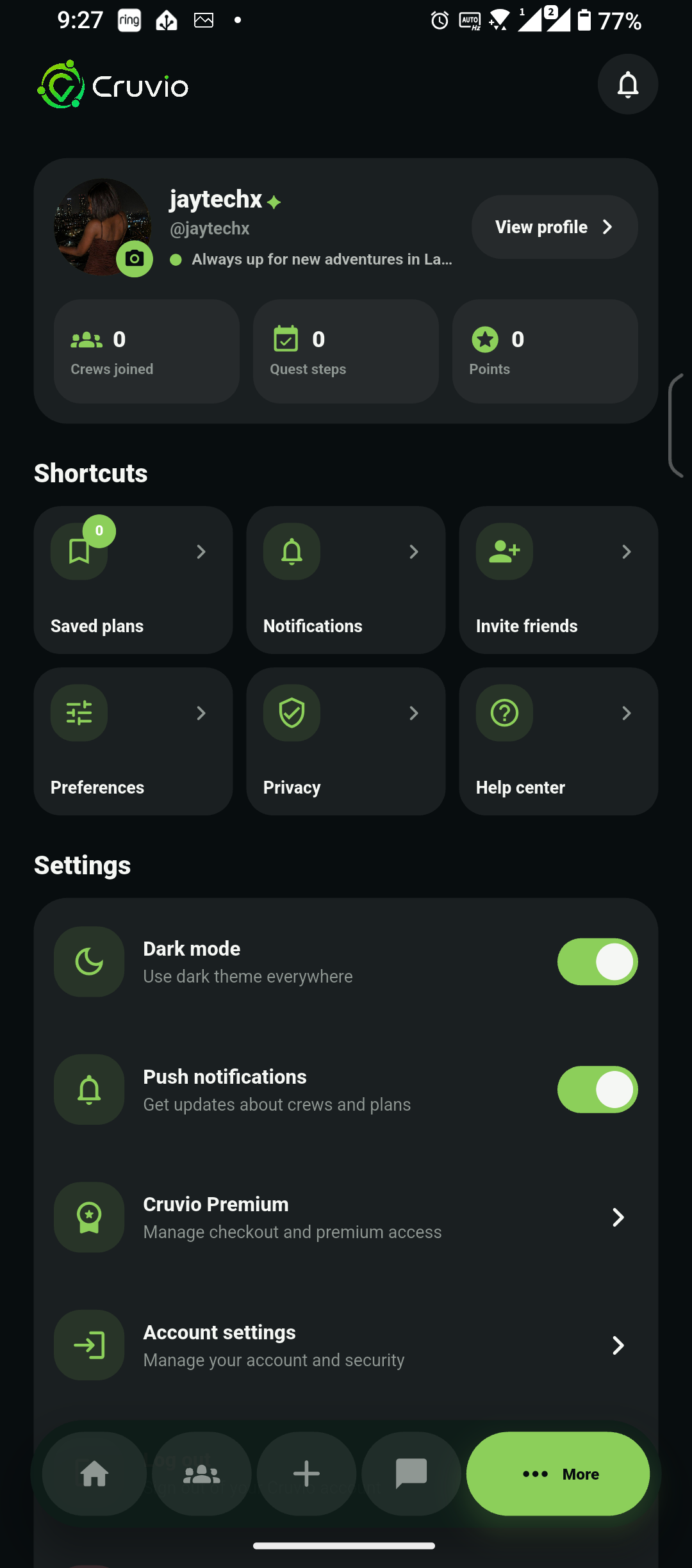
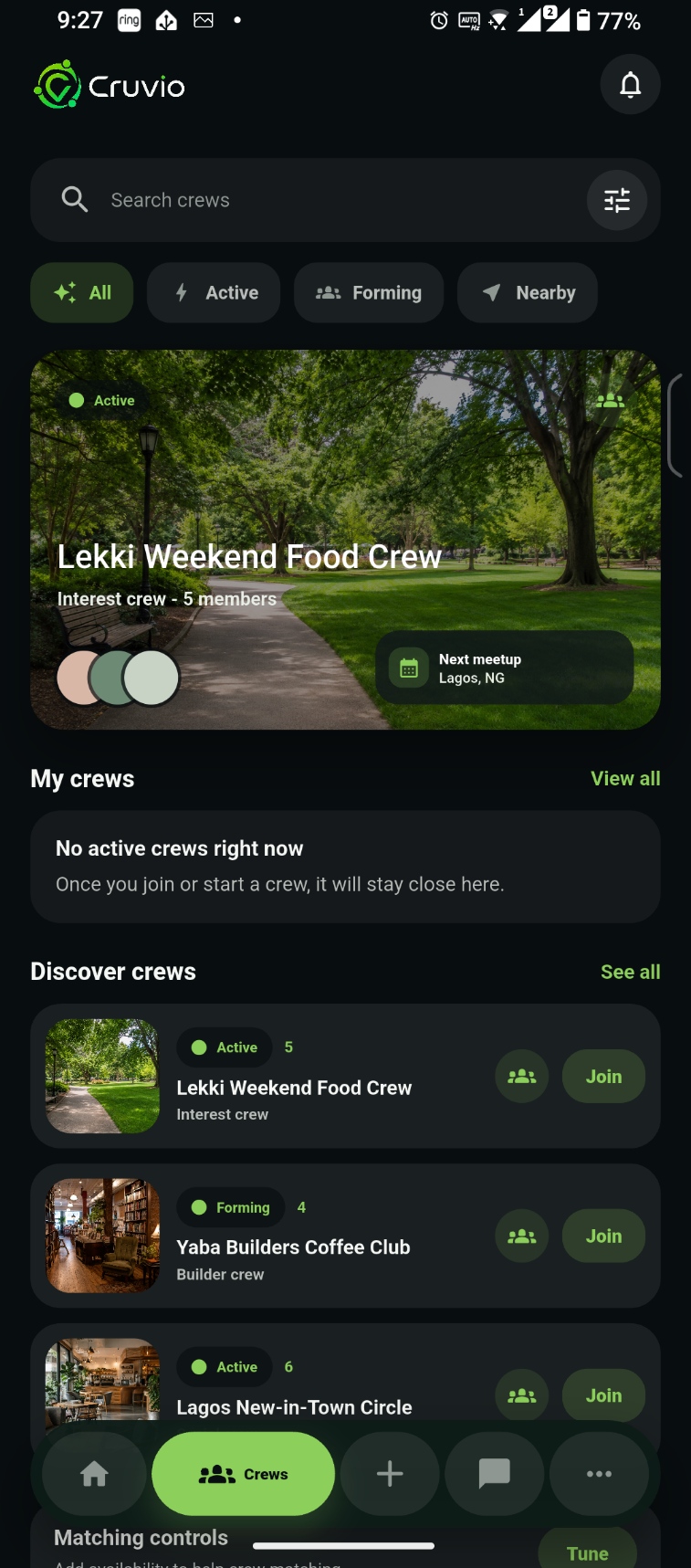
Plans are short-term outings: trying a restaurant, visiting a gallery, taking a walk, or attending something together. Crews are persistent circles built around shared interests, goals, or life situations. Events are local experiences hosted by verified businesses. Discovery begins across the user's country and can fall back to remote or hybrid crews when local options are limited. Participation is intentional. People express interest in a plan or request to join a crew before gaining access to its group conversation. Capacity remains understandable. Pending, accepted, full, leave, and reopened states are reflected throughout the experience. Safety stays reachable through reporting, blocking, controlled membership, and protected meeting details.
Cruvio deliberately avoids becoming an endless public feed, a follower contest, or an open-direct-message network. It is designed around smaller groups and clearer next steps.
How we built it
Cruvio is a Flutter application for iOS and Android. Flutter and Dart power the mobile experience, while Riverpod keeps state and feature workflows outside the UI. Supabase provides authentication, PostgreSQL, Row Level Security, Storage, Realtime, and server-side Edge Functions. Trigger.dev runs durable background work, while server-side AI capabilities use OpenRouter so model access and sensitive keys never live inside the mobile app.
The backend treats plans, crews, and events as related but distinct products. PostgreSQL remains the source of truth, sensitive mutations go through server-side functions, and membership operations are designed to be repeatable and safe when clients retry.
What changed during Build Week
Cruvio had an existing mobile foundation before Build Week. During the submission period, I meaningfully extended and hardened it by:
Completing the end-to-end plan, crew, and event participation flows across Flutter and the backend. Adding country-first discovery with remote and hybrid crew fallback so users are less likely to face an empty experience. Improving join requests, plan interest, organizer review, acceptance confirmations, capacity handling, leaving, and reopening availability. Tracing and correcting plan-versus-crew wording and behavior across details, messages, conversations, and organizer controls. Improving conversation stability, message presentation, group previews, and leave behavior. Strengthening event ownership, participation, conversion, and frontend/backend contract consistency. Adding targeted tests and operational safeguards for the flows most likely to fail across multiple layers.
How Codex and GPT-5.6 were used
GPT-5.6 powered my primary Codex build workflow. I used Codex as an engineering collaborator across the Flutter application, Supabase Edge Functions, database contracts, and tests, not as a decorative add-on.
For each flow, I asked Codex to trace the complete path from the screen a user sees, through repositories and providers, into server-side operations and back into refreshed UI state. GPT-5.6 helped reason about inconsistent membership states, capacity races, plan/crew/event terminology, discovery fallback behavior, and conversation lifecycle problems. Codex then helped implement focused changes, add regression coverage, run verification, and surface related risks.
I remained responsible for the product decisions, reviewed the changes, tested the real flows, and refined the experience on actual devices. Dated commits and the submitted Codex session show the Build Week work and the decisions behind it.
Challenges we ran into
The biggest challenge was that plans, crews, and events look similar at first glance but have different ownership, duration, privacy, capacity, and conversation rules. Reusing UI and backend logic without mixing those concepts required careful tracing across the entire product.
Another challenge was keeping asynchronous state trustworthy. A request can be pending, accepted, declined, full, reopened, or invalidated by another action. The screen, backend, and conversation access all need to agree, even after navigation, refreshes, retries, and another member leaving.
We also had to balance useful discovery with scale. Country-wide results prevent starvation, but queries, ranking, remote fallback, realtime updates, and background jobs must remain affordable and reliable as the user base grows.
Accomplishments that we're proud of
I am proud that Cruvio is a coherent mobile product rather than a single isolated prototype screen. A user can discover opportunities, understand the differences between them, express interest, be reviewed, enter a group conversation, and leave safely.
I am also proud of the cross-layer hardening completed during Build Week. Several issues appeared small in the UI but required coordinated fixes across Flutter state, server contracts, database behavior, and tests. Codex and GPT-5.6 made it possible to inspect those paths systematically while keeping human product judgment at the center.
What we learned
We learned that social-product trust often depends on small pieces of clarity: whether a button says the right thing, whether capacity updates immediately, whether a pending request remains visible, and whether a conversation belongs to a plan, crew, or event.
We also learned that AI-assisted development is most effective when it is paired with concrete constraints, real repository context, targeted tests, and device verification. The value was not simply generating more code; it was reasoning across a large system and finding inconsistencies that were easy to miss when reviewing one file at a time.
What's next for Cruvio: Find Your Crew
Next, Cruvio will improve matching quality and operational scale, expand quests that help new groups take their first real action, strengthen safety and moderation tools, and learn from testers in more cities and countries. The long-term goal is to make it easier for anyone entering a new place or life phase to move from I wish I had people to do this with to we already made a plan.
Built With
- android
- api
- artificial
- codex
- dart
- edge
- flutter
- gpt-5.6
- ios
- openai
- openrouter
- postgresql
- riverpod
- supabase
- trigger.dev
Log in or sign up for Devpost to join the conversation.