-
-
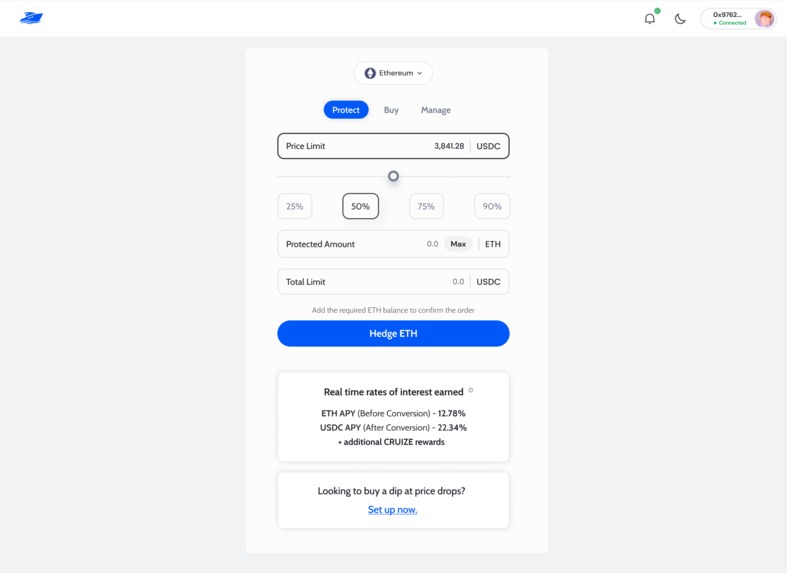
Protect (Hedge) screen
-
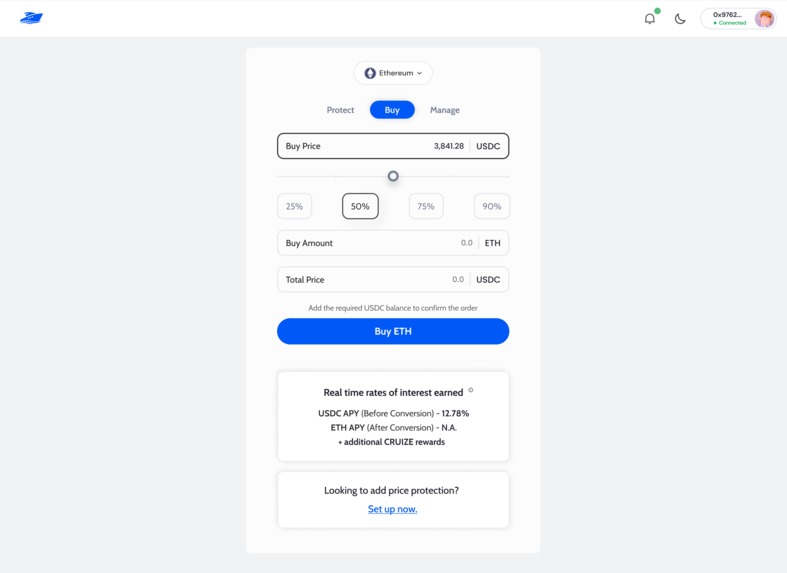
Buy screen
-
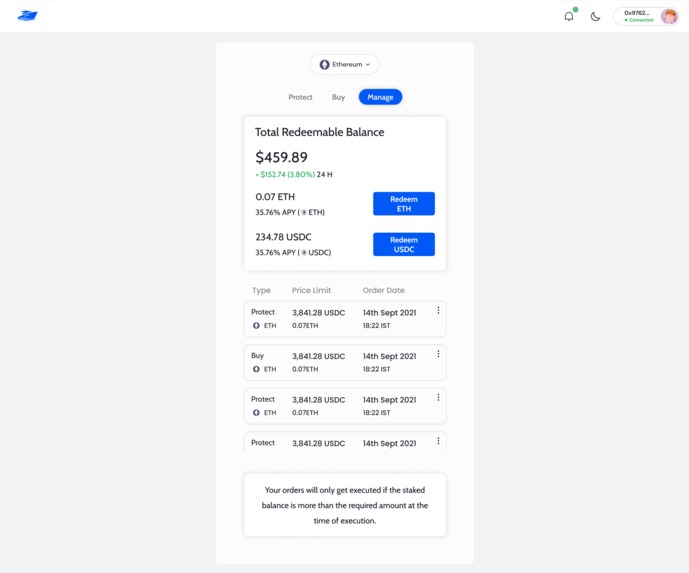
Manage screen


Inspiration
The idea of Cruize was conceived as a tool to counter the unpredictable volatility of the crypto market. While decentralised finance has enabled a global, open and censorship-resistant alternative to the current financial system, widespread adoption is hindered by the erratic fluctuations in the market and the lack of automated tools to hedge against them. Liquidity mining and yield farming have enabled better income opportunities, but the current market dynamics lead to capital inefficiencies and impermanent losses that limit the utility and upside potential of staked assets.
We created Cruize to provide investors with an interface that automates their trading strategies to hedge their assets against price drops, as well as automate investments using pre-determined prices. While limit orders are useful as hedging strategies, they remain active only for a limited time and rely on order books that don’t guarantee execution unless orders are matched in time. Cruize creates an experience similar to limit orders but instead uses algorithms to execute orders and offers strategy creation without expiry limits.
However, since staked assets that are hedged remain inefficient as idle capital, we also added the functionality to generate yield on the staked assets. This ensures that assets that are set up for automated strategy execution are also generating passive earnings while remaining exposed to active orders. Investors can therefore ‘set and forget’ their assets for automated earnings, investing and downside protection.
What it does
Cruize lets investors set automated orders on their assets either as a hedging strategy or to automate timely investments into assets. The interface provides functionality for adding price floors for limiting losses as well as automating buy orders to buy assets at favourable prices.
The protocol integrates with DEXes and uses Chainlink price feeds to monitor market prices of assets in real-time and uses algorithms to execute automated trades at set prices. This removes the need for constant price monitoring as well as order matching by using automation to fill orders at set prices.
Protect. Investors can hedge their assets by setting price limits on their staked tokens and when the market falls to the set limits, the tokens are automatically converted to a reserve of stablecoins that limit losses in value.
Buy. Investors can also use stablecoins (USDC in the beginning) to set buy orders to invest into assets at dip prices when markets fall or any other set price, that execute automatically without manual intervention.
While assets have active orders, the protocol also routes them to generate yield through aggregated strategies that maximize earnings on assets. Investors can therefore set their assets up for automated earnings and downside protection without any manual intervention.
How we built it
We built Cruize using popular Web3 technologies like React, Moralis and Web3.js to build the frontend and Solidity, Chainlink, Truffle and Ganache to work on the backend. We also used integrations with popular DeFi applications to streamline the workflow for our protocol.
- We used Chainlink Price feeds to monitor the real-time asset prices and Chainlink Keepers to set up scheduled jobs. These prices have to be compared with the set price points by investors using Cruize.
- An integration with a DEX (Uniswap), is used to supply the liquidity needed for conversions during order executions.
- For yield generation, an integration with Aave provides lending interest on the staked assets by routing them to Aave pools.
- Chai, Ganache and Truffle for testing smart contract functionality.
Here is the technical architecture flowchart of the protocol:

What's next for Cruize Finance
After building out the first demo of our protocol for the hackathon, we will be focusing on restructuring the technical architecture to enable permanent price floors on assets. This will ensure that irrespective of market movements, assets will be exposed to permanent price protection even if asset prices cross the set price floors multiple times before withdrawal. We are working on a model that does this without redundant conversions and saves big on transaction fees and gas costs.
We will also be targeting a mainnet launch after some more intensive testing and work on the backend to optimise the workflow. Work on a more detailed white paper and token economics research will also be a main priority.


Log in or sign up for Devpost to join the conversation.