Inspiration
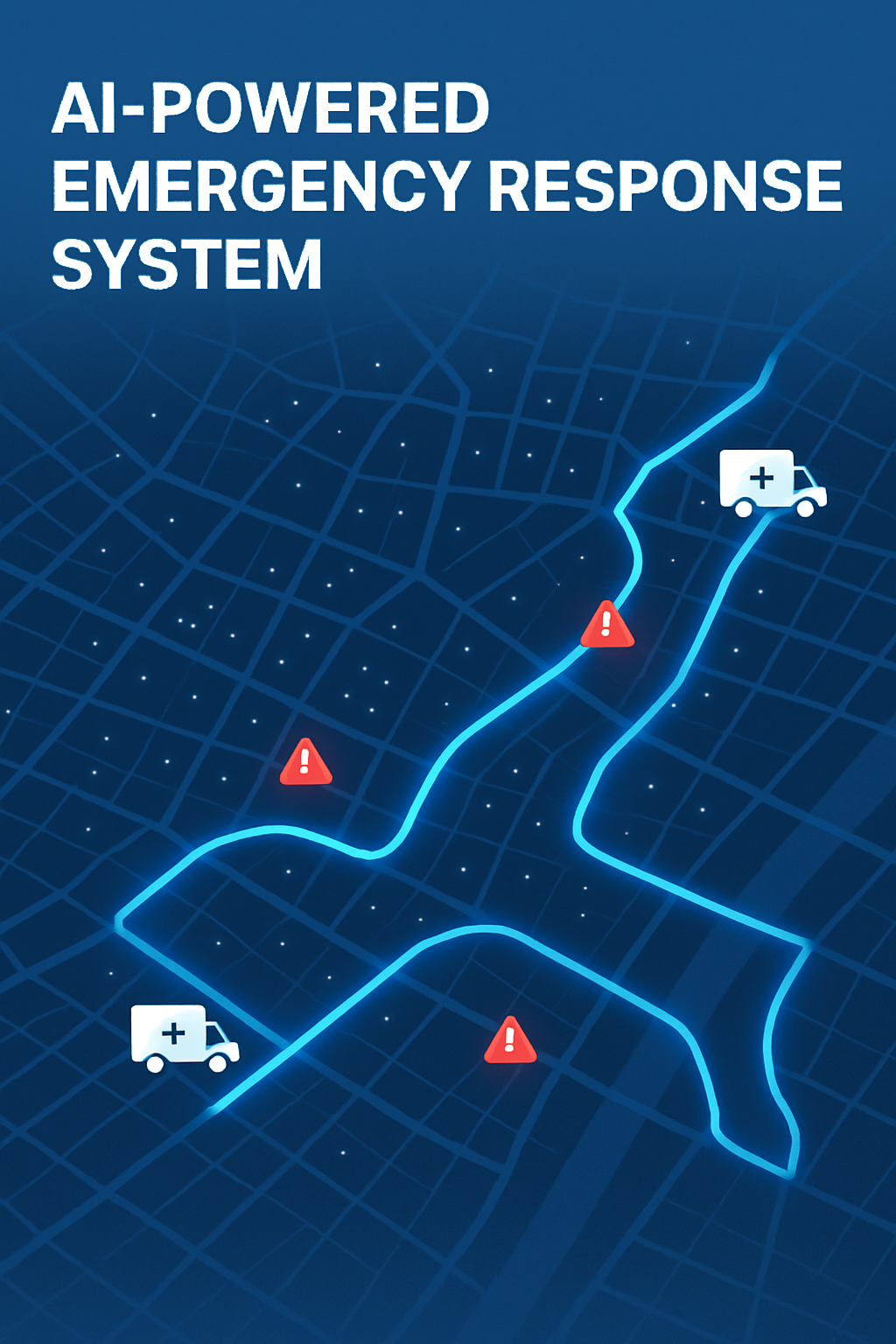
With frequent delays faced by ambulances in crowded Indian cities due to traffic jams and unpredictable events, it became clear that traditional static routing is insufficient. This motivated creating an intelligent, adaptive system using AI and crowdsourced data to improve response times and save lives.
What it does
The system aggregates crowdsourced inputs, real-time sensor data, and traffic information to dynamically optimize emergency vehicle routes. It continuously adjusts recommendations based on current road conditions, hazards, and crowd densities to ensure faster emergency responses.
How we built it
- Integrated mobile crowdsourced inputs and public sensor feeds for live data.
- Developed multi-agent AI workflows powered by IBM Granite models and Agent Development Kit for decision-making.
- Employed n8n for automating data ingestion, processing, and routing orchestration.
- Deployed the full workflow on Kubernetes for scalable and fault-tolerant infrastructure.
Challenges we ran into
- Noisy and incomplete crowdsourced data necessitated robust preprocessing.
- Designing automation workflows to handle multiple asynchronous data streams while maintaining responsiveness.
- Balancing AI model complexity with real-time inference demands.
- Configuring Kubernetes for seamless scaling and high availability.
- Ensuring AI agents propose only safe, reliable routes.
Accomplishments that we're proud of
- Successfully built a real-time adaptive routing prototype leveraging multi-agent AI and automation.
- Created scalable workflows merging diverse data sources with n8n.
- Demonstrated improvements over static routing methods in dynamic scenarios.
- Achieved stable Kubernetes deployment for mission-critical use.
What we learned
- Multi-agent AI is essential for flexible, adaptive decision-making in changing environments.
- Real-time data fusion from heterogeneous sources presents unique challenges needing careful handling.
- Workflow automation tools accelerate development and integration.
- Production systems require robust orchestration, scaling, and monitoring.
- Responsible AI development demands integrated safety controls and explainability.
Sample math expression used in optimization heuristics
The dynamic routing problem can be formulated as minimizing the expected travel time ( T ) for an emergency vehicle:
[ \min \mathbb{E}[T] = \min \sum_{i=1}^n \frac{d_i}{v_i} ]
where ( d_i ) is the distance of segment ( i ), and ( v_i ) is the variable speed affected by crowd density and hazards, estimated via crowdsource data and sensor inputs.
Built With
- azure
- css3
- github
- google-cloud
- html5
- ibm-agent-development-kit
- ibm-granite-ai-models
- influxdb
- javascript/typescript
- kubernetes
- mongodb
- n8n
- python
- react
- vs-code

Log in or sign up for Devpost to join the conversation.