-
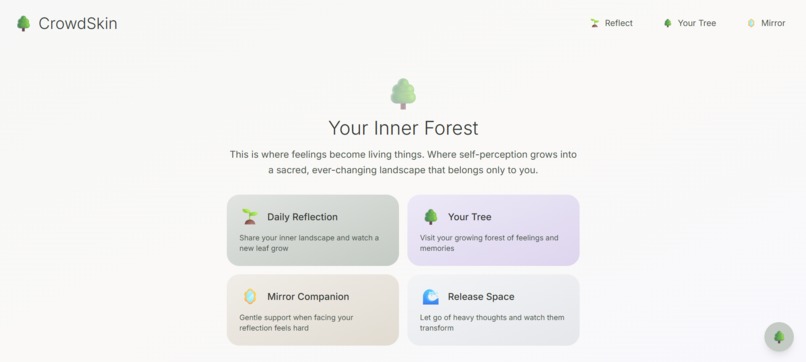
Main Page
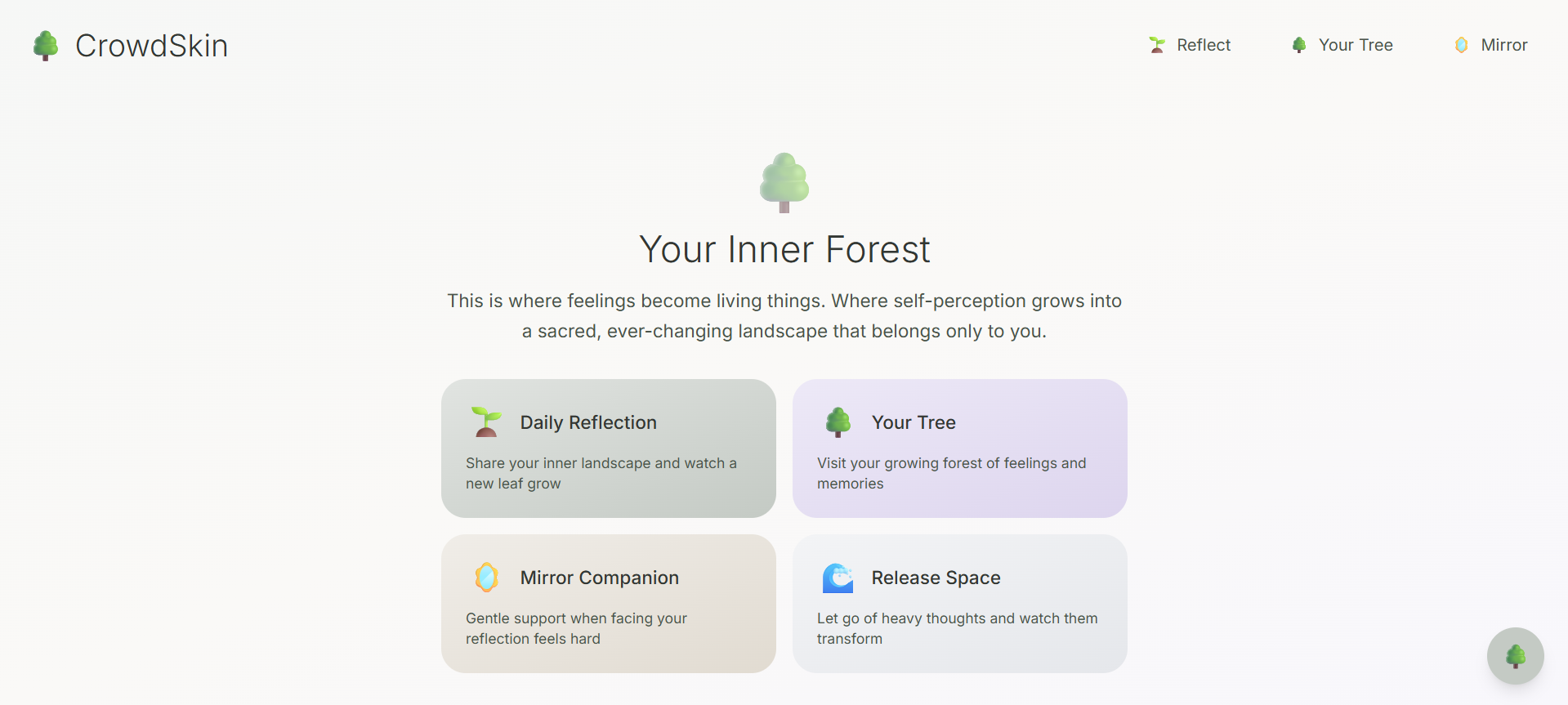
Inspiration
We noticed how often students look in the mirror and feel disconnected from what they see, not because their bodies have changed, but because their perception has. Conversations with friends revealed that so many of us silently struggle with distorted body image, yet most apps focus only on fitness, weight, or self-improvement. We wanted to build something radically different: an app that doesn’t ask you to fix yourself, but lets you see how you feel, symbolically and safely. That's how CrowdSkin was born.
What it does
CrowdSkin helps students turn daily emotional reflections into a growing tree made of symbolic leaves. Each day, users describe how their body feels through shape, color, and emotional tone—and the app uses that input to generate a unique, expressive leaf. That leaf floats upward and attaches to their personal tree's canopy, never on the trunk or ground, creating a visual, evolving map of self-perception. Over time, this tree becomes a personal forest of feelings, showing not how you look, but how you’ve felt about yourself over time. No photos. No comparisons. Just presence, reflection, and growth.
How we built it
We used a low-code approach with a custom visual growth system powered by shape-color mapping logic. The tree builder uses a physics-inspired branch expansion algorithm to ensure that every leaf grows in the correct canopy area, forming a visually accurate and emotionally symbolic tree. We designed the UI to be highly responsive across mobile and desktop, with soft animations, accessible design options (like dyslexia-friendly fonts and motion controls), and touch interactions for leaf zoom, memory echo, and silent release journaling. The sketch-to-tree transition was our favorite detail—we designed it to feel seamless and almost magical.
Challenges we ran into
Creating a tree growth system that looked organic, but was based on symbolic emotion data, was tougher than expected. Getting the emotional language interface right—where students feel safe describing how they feel in abstract terms—took a lot of iteration. Ensuring the tree’s shape remained realistic without leaf overlap on the trunk required precise logic and testing. Designing for both mobile and laptop while keeping animations smooth and meaningful was a constant balance between aesthetics and performance.
Accomplishments that we're proud of
The moment when a user sees their unique leaf float up and attach to the tree—in the exact color and shape they imagined—feels profoundly personal. The symbolic "roots" feature for burying hard emotions invisibly was a late addition, and it ended up becoming one of the most powerful features. The way the entire experience avoids photos, likes, or metrics—and still feels emotionally validating—is something we’re really proud of. The tree looks truly different for every user. That uniqueness matters.
What we learned
Emotional design isn’t about adding soft colors and affirmations—it's about building trust, slowing down interaction, and letting users feel seen without pressure. Visual feedback (like leaves and blossoms) can carry much more emotional weight than text if done right. Students don’t need another app telling them to be “better.” They need one that lets them feel enough, as they are.
What's next for CrowdSkin
We want to let users walk through their full tree over time—seasons, storms, quiet years. A full “forest mode.” Add an audio diary option to let students record their feelings instead of writing them. Allow gentle, anonymous affirmations from peers as glowing light breezes across the tree. And finally, offer private exports of their tree as personal reflection art, because how you’ve felt deserves to be remembered.
Built With
- ambient-sound-assets
- animation-engine
- cloud-sync-backend
- custom-logic-blocks
- google-fonts
- lovable.app
- responsive-design-toolkit


Log in or sign up for Devpost to join the conversation.