-
-
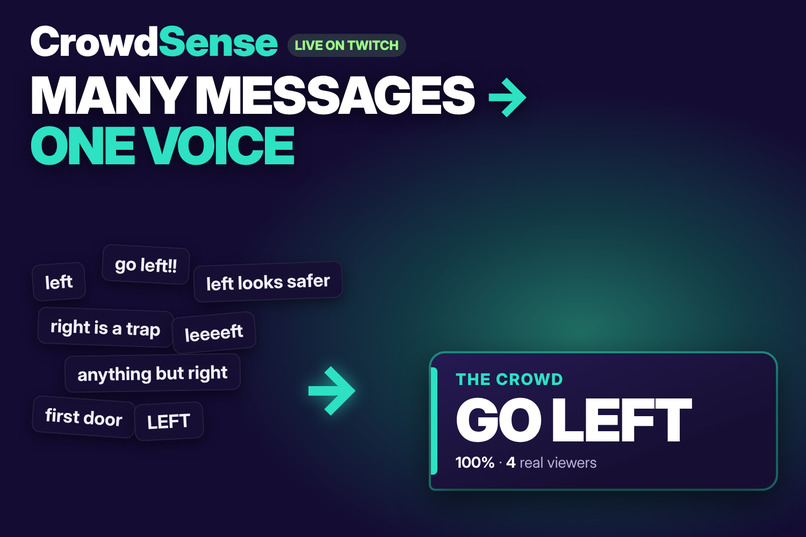
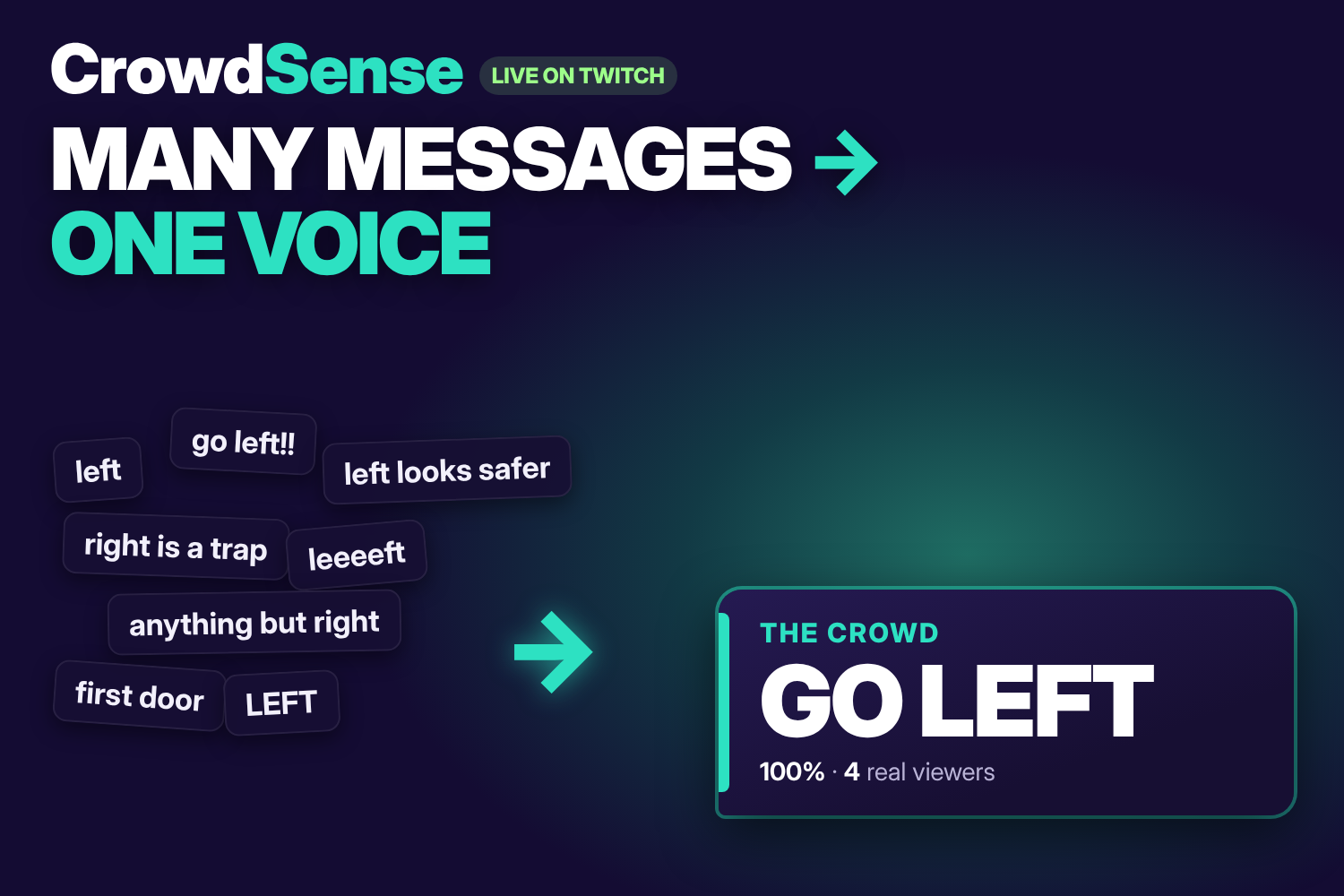
Many messages → one voice. CrowdSense turns natural Twitch chat into one clear signal.
-
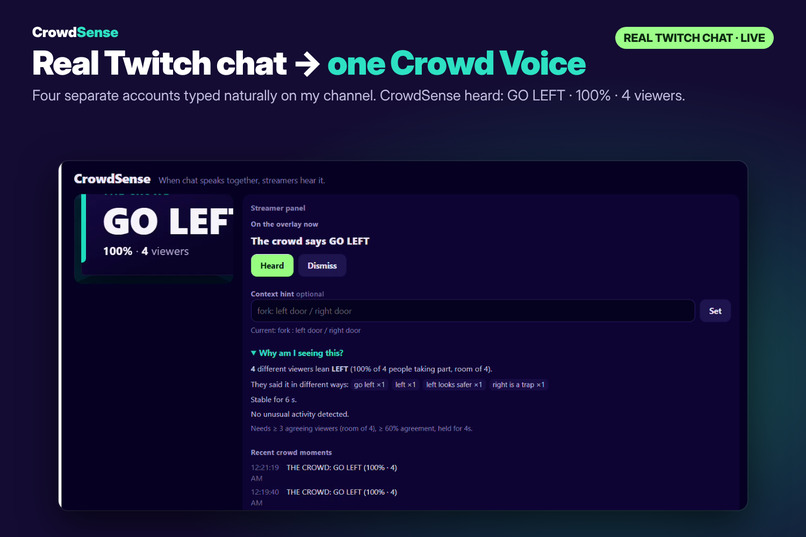
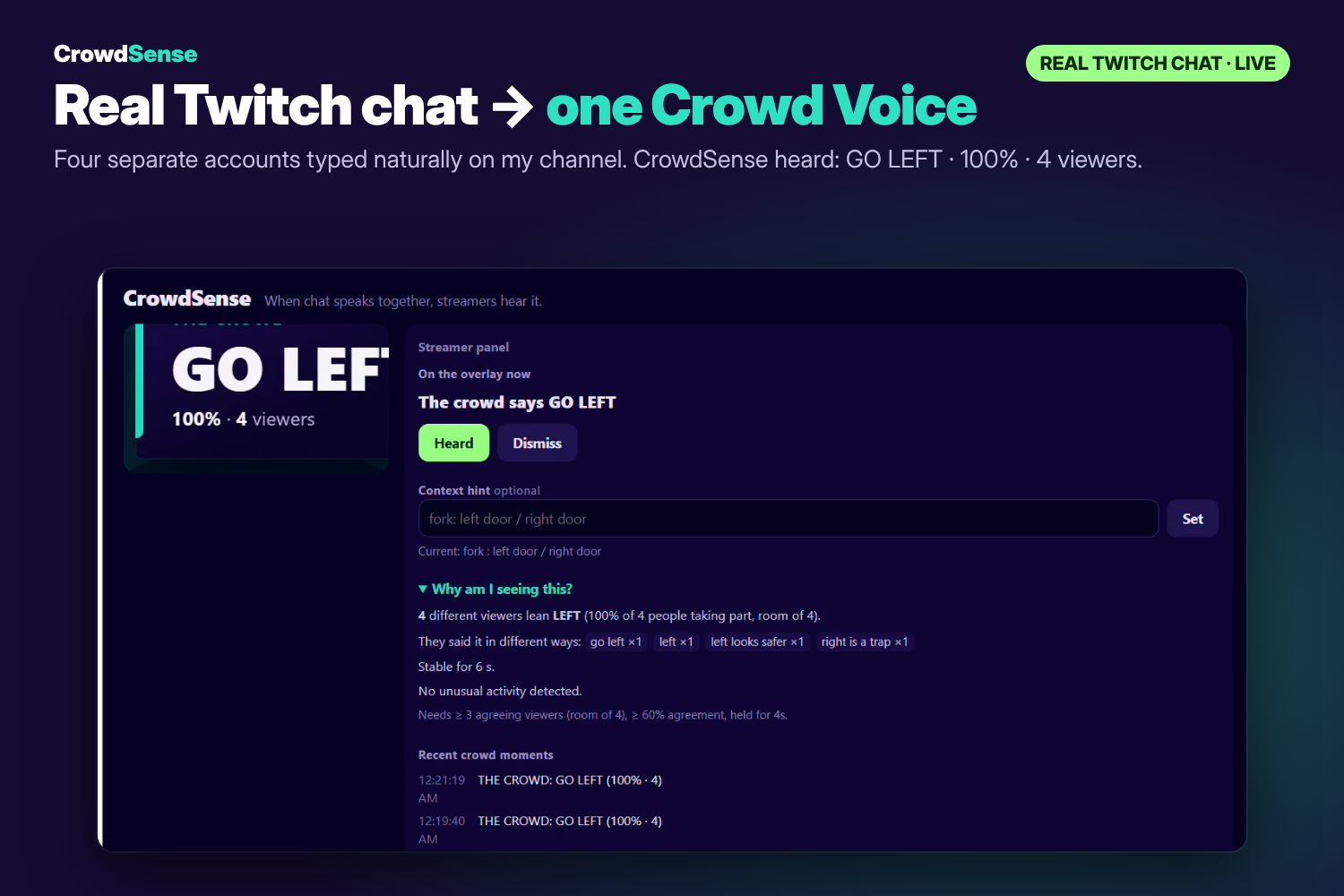
Real Twitch chat, live. Four accounts used different wording and CrowdSense produced GO LEFT.
-
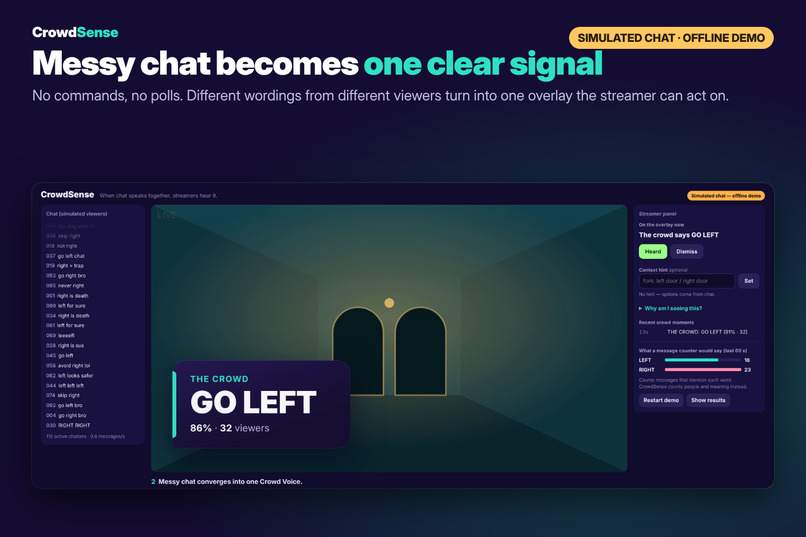
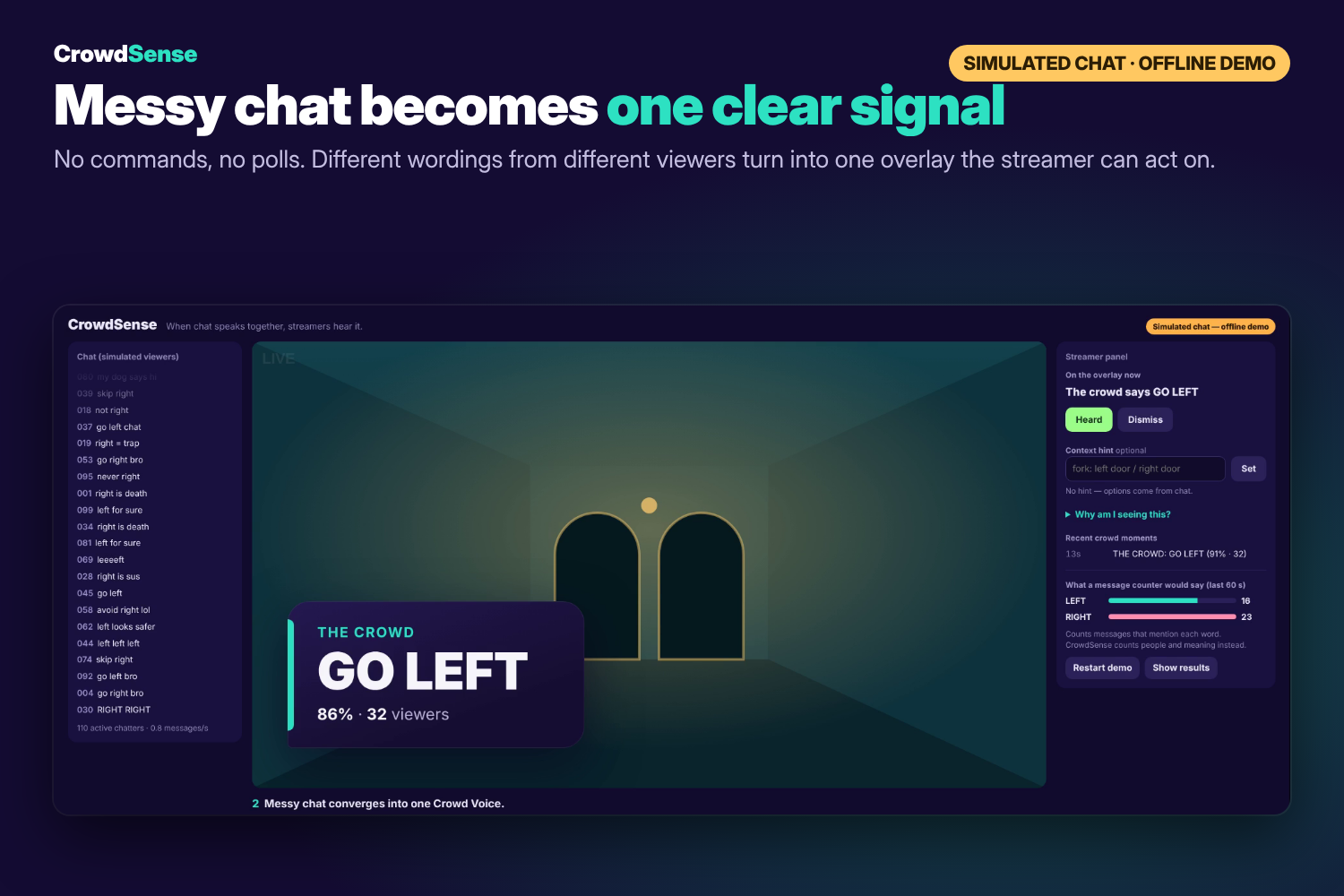
Different words, same meaning. CrowdSense groups natural phrasing into one Crowd Voice.
-
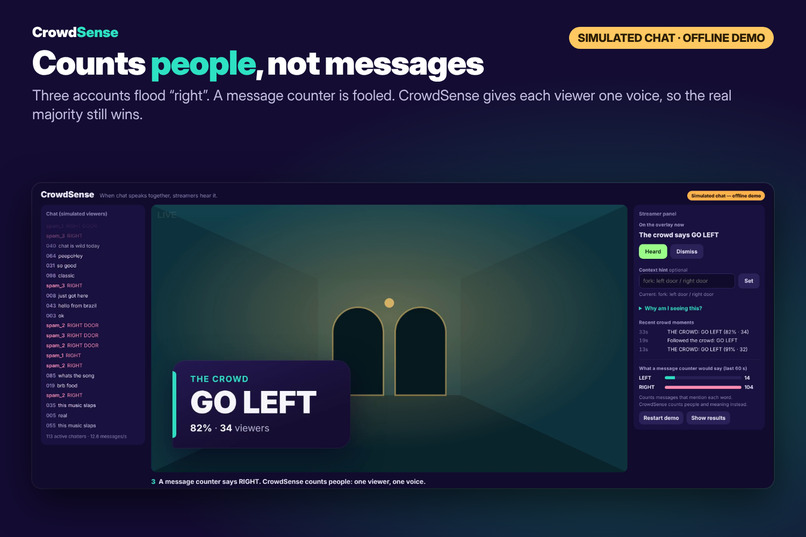
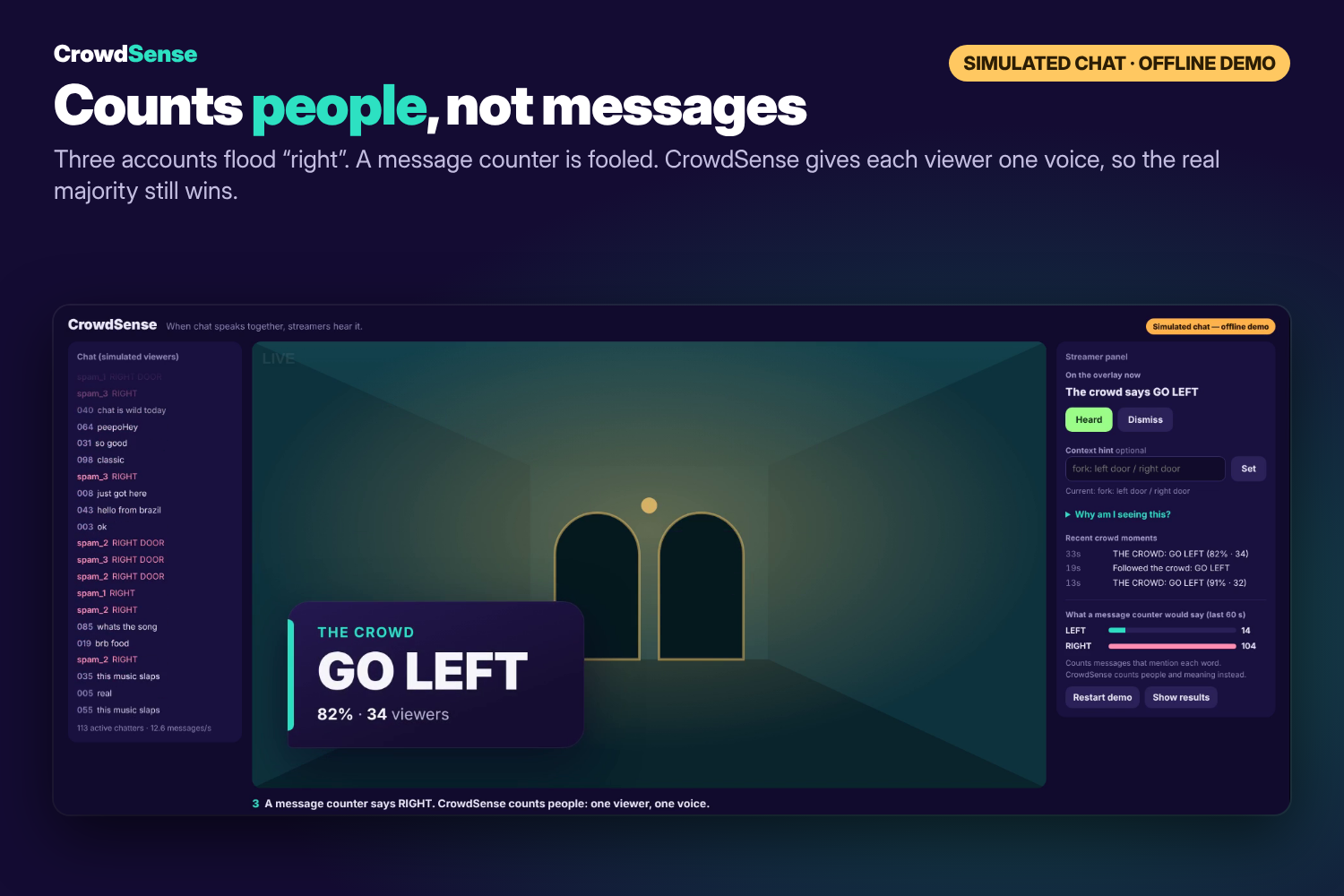
People, not messages. Spam cannot outweigh the real majority.
-
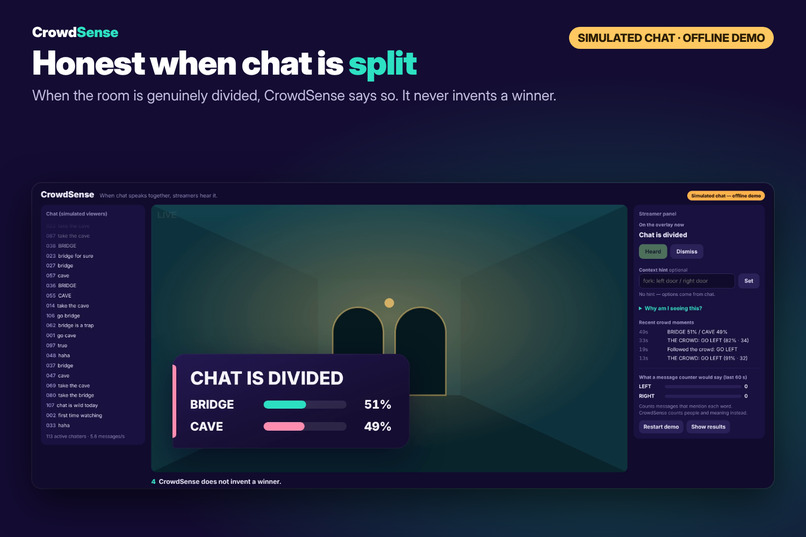
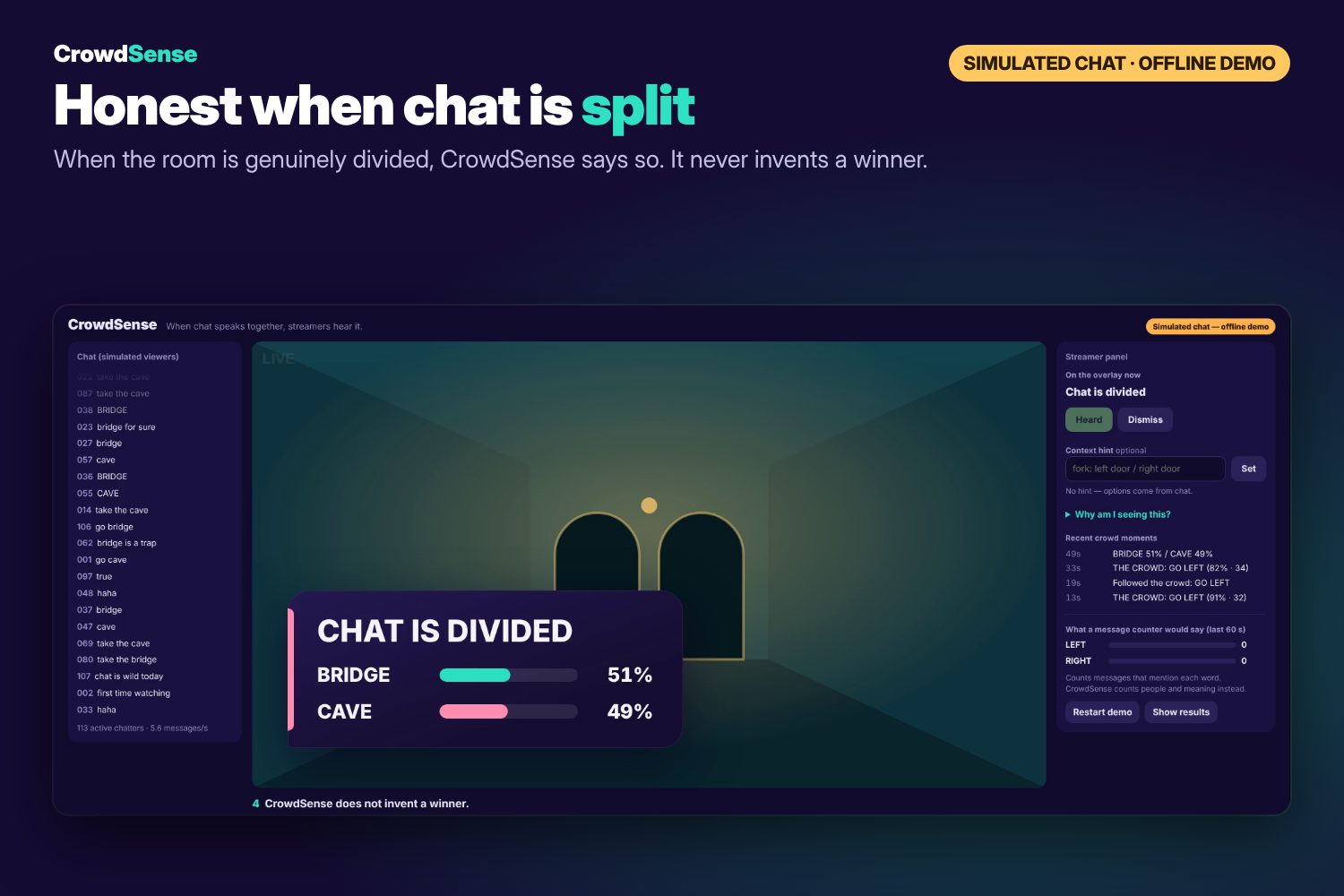
Honest when chat is split. CrowdSense shows no winner when there is no clear majority.
-
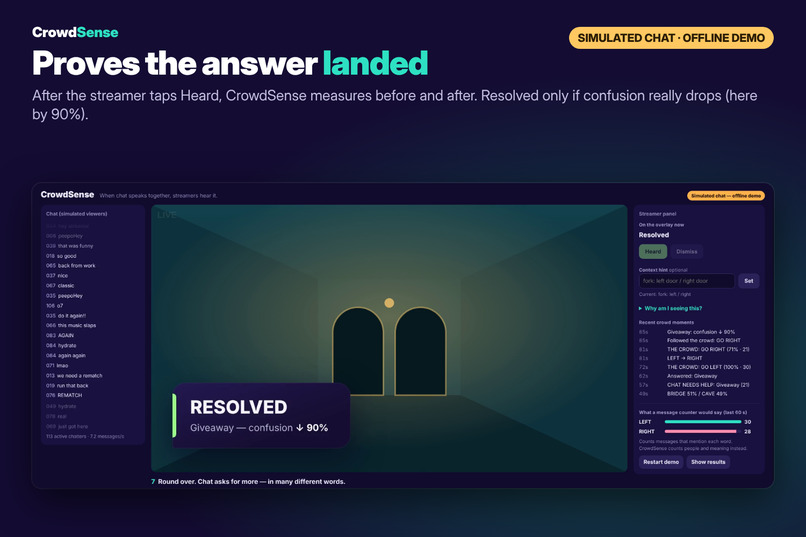
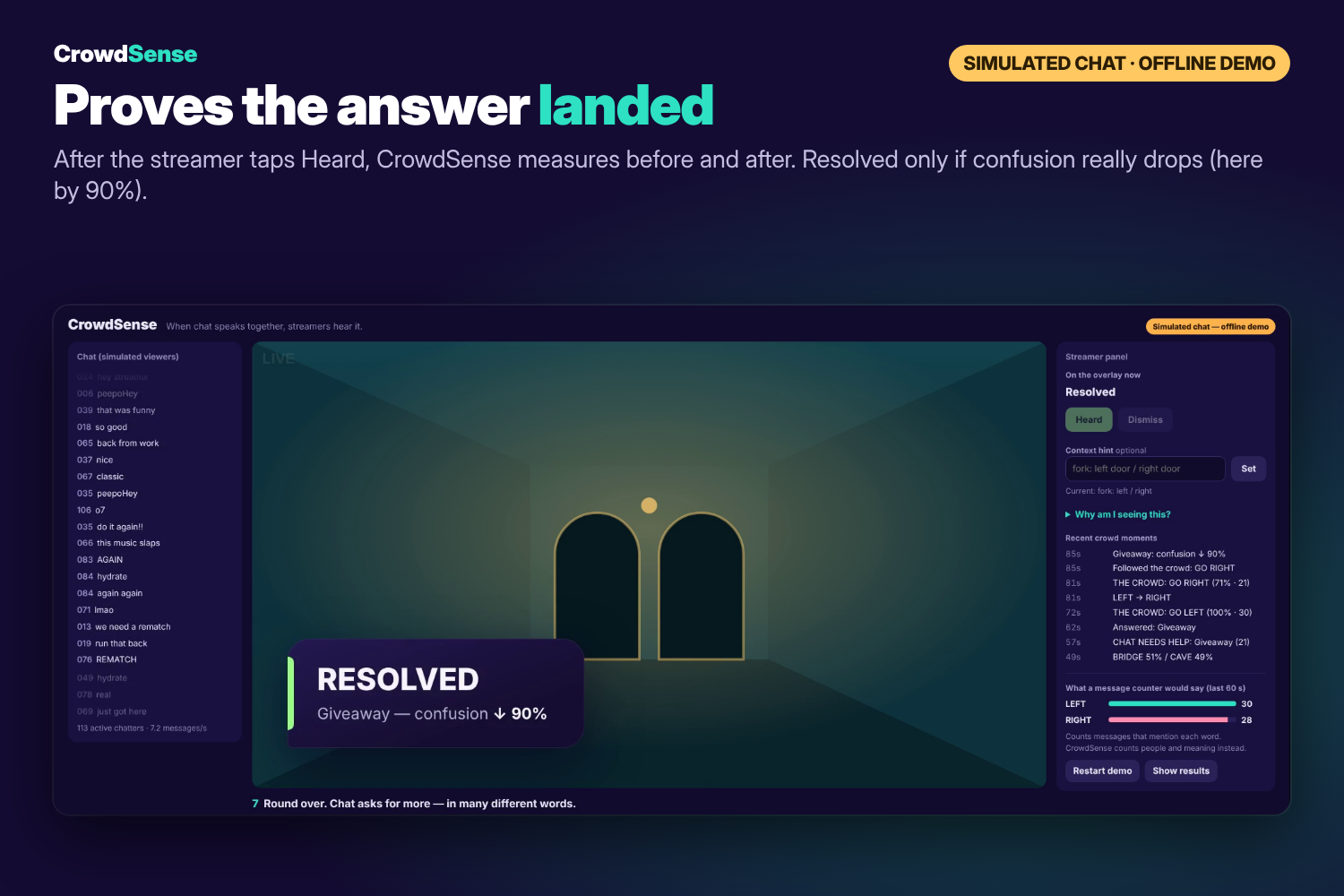
Measures whether the answer actually helped by comparing confusion before and after.
-
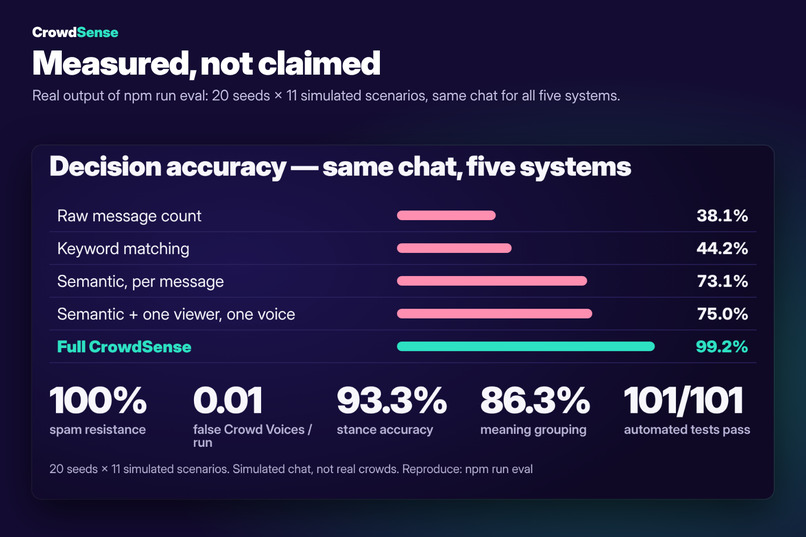
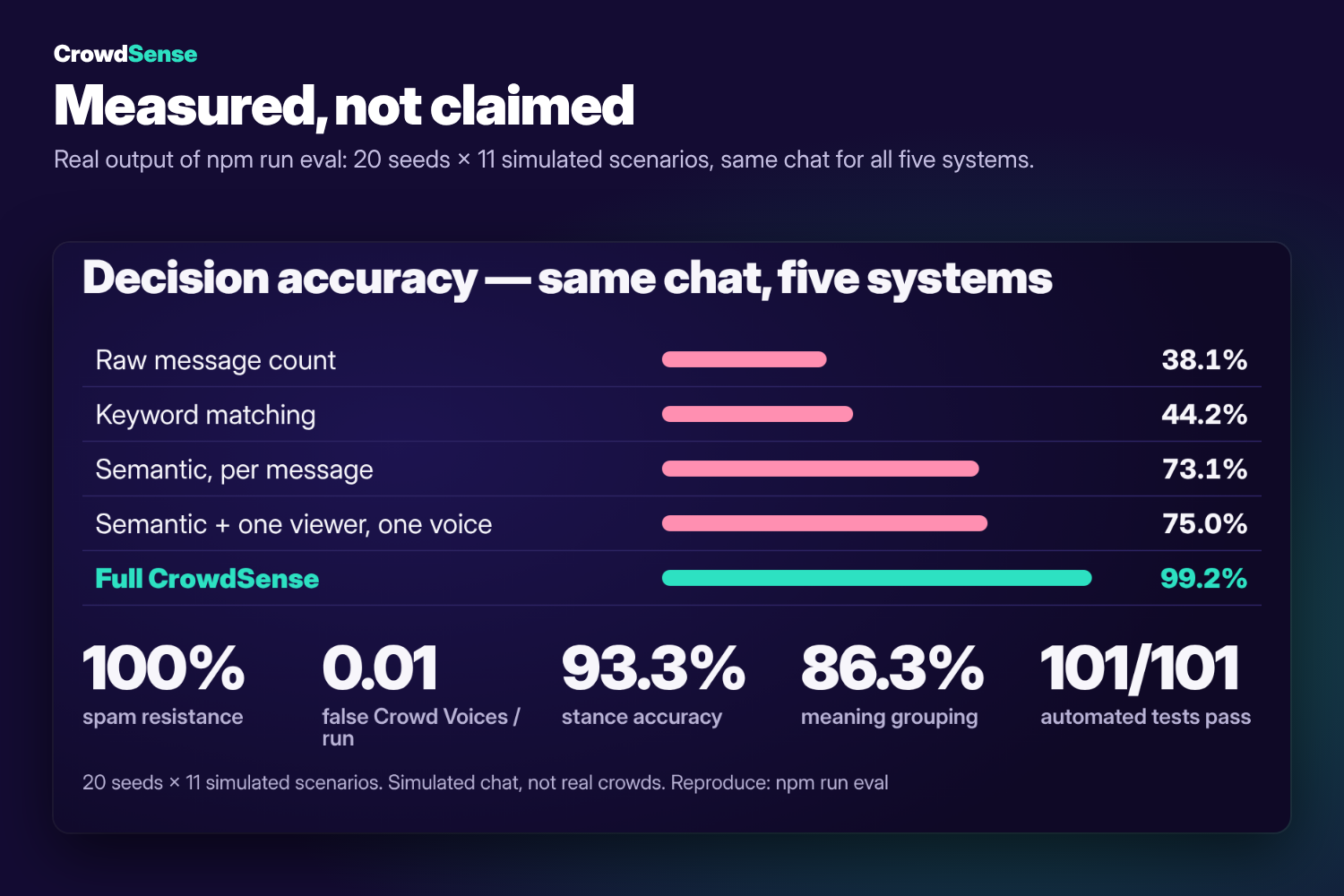
Measured, not claimed: 99.2% simulated accuracy and 101/101 tests passing.
-
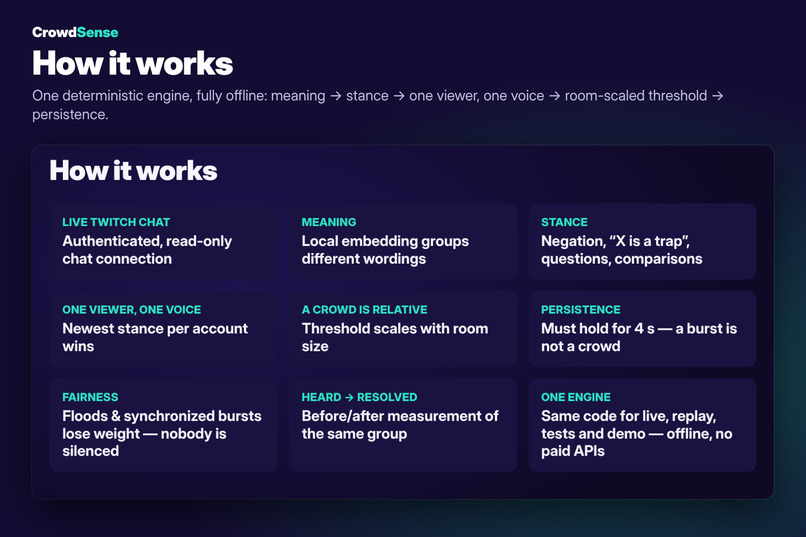
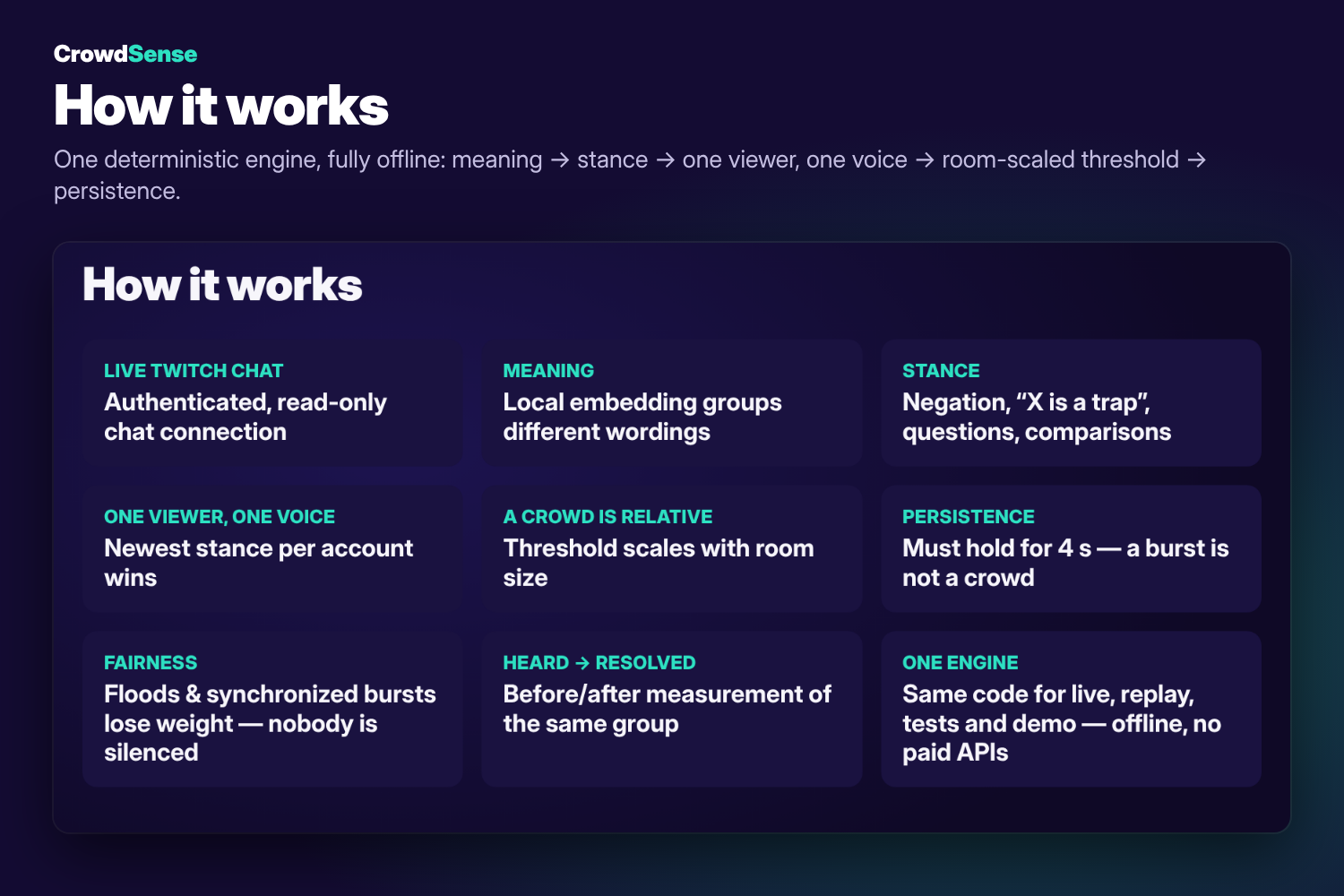
Meaning → stance → one viewer, one voice → stable Crowd Voice.
-
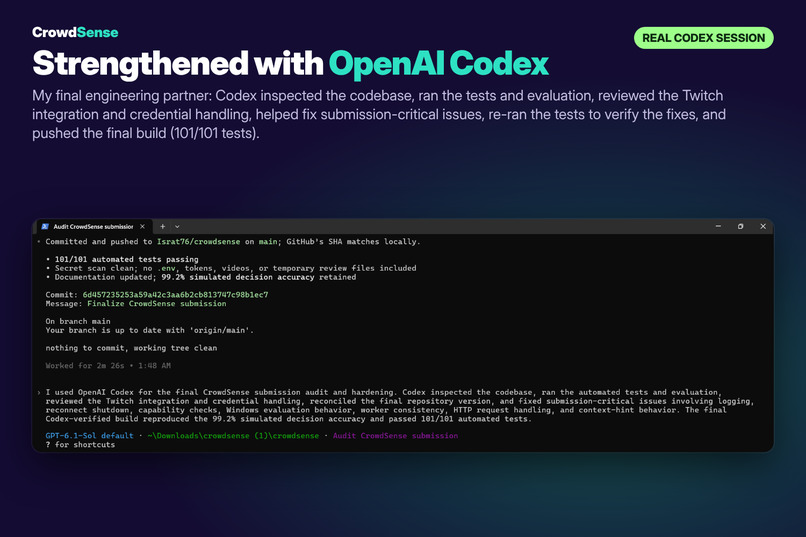
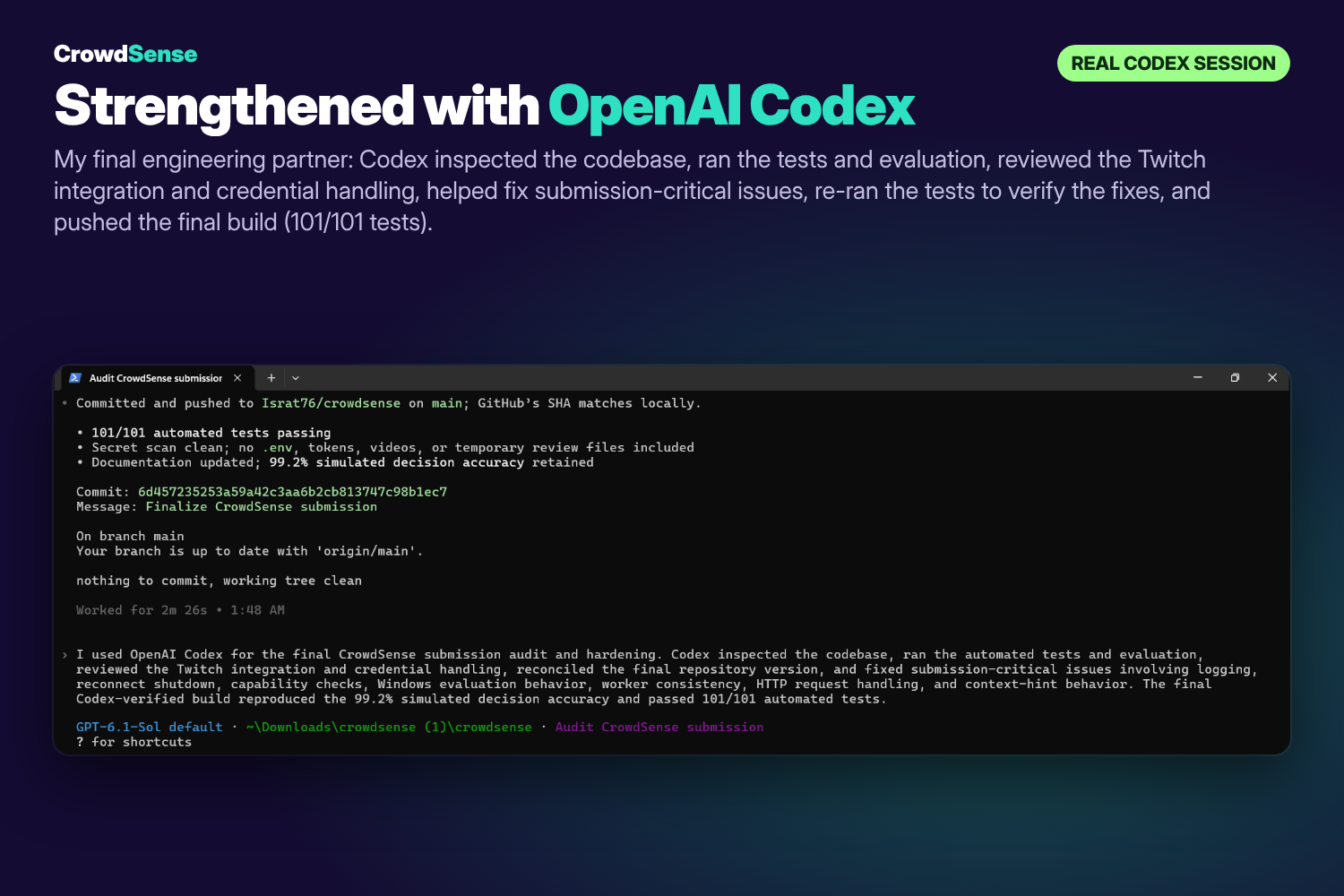
OpenAI Codex — tested, debugged, strengthened, and finalized CrowdSense
Inspiration
Twitch chat moves fast. When many viewers want the same thing, the streamer often sees only a wall of messages.
Existing solutions usually ask viewers to change how they communicate: use commands, vote in a poll, or repeat the same message louder.
I wanted to build something different: What if people could just talk naturally, and the streamer could still hear the crowd as one clear voice?
That became CrowdSense.
CrowdSense turns chaotic Twitch chat into one clear Crowd Voice, so streamers can instantly understand what their audience wants — without polls, commands, or letting spammers speak louder than everyone else.
What it does
Viewers can write naturally:
- “left”
- “go left”
- “left looks safer”
- “right is a trap”
Even though the wording is different, CrowdSense can recognize that these viewers support the same decision and show: THE CROWD — GO LEFT
The key idea is simple: One viewer = one voice.
If one person spams “RIGHT” 50 times, they still count as one person.
CrowdSense can also recognize when chat is divided, confused, asking for something like a rematch, or suddenly exploding with excitement.
When the streamer responds, they can press HEARD, and CrowdSense can measure whether the confusion actually decreased before showing RESOLVED.
How I built it
Every message goes through the same CrowdSense engine whether it comes from live Twitch chat, a replay, or the offline demo.
The system combines:
- meaning grouping for different ways of saying the same thing
- stance and negation handling
- one-viewer-one-voice deduplication
- time decay so old opinions fade
- room-relative crowd thresholds
- stability checks so a short burst does not become a fake Crowd Voice
- a Twitch overlay and streamer control panel
I also tested CrowdSense live on my own Twitch channel using four separate real accounts.
Different messages such as “left,” “go left,” “left looks safer,” and “right is a trap” were received live and produced: THE CROWD — GO LEFT · 100% · 4 viewers
Challenges I faced
One challenge was understanding the difference between mentioning an option and actually supporting it.
For example:
“Why is everyone saying left?”
contains the word “left,” but it should not count as a vote.
Another challenge was stopping spam from becoming fake agreement. CrowdSense solves this by counting people instead of messages.
I also had to define what “a crowd” means for both tiny and large Twitch channels, and make sure agreement persists long enough to be meaningful.
Live testing also exposed practical issues around context hints, reconnect behavior, Windows evaluation, and the live interface.
What I learned
The biggest lesson was that understanding live chat is not mainly about counting words.
It is about understanding who is speaking, what they mean, and whether many independent people agree at the same time.
That changed CrowdSense from a message-counting tool into a crowd-understanding system.
Results
On reproducible simulated evaluation scenarios:
- 99.2% decision accuracy
- 100% spam resistance
- 93.3% stance accuracy
- 86.3% meaning-grouping accuracy
- 101/101 automated tests passing
These evaluation results are from simulated scenarios, not a large real Twitch audience.
How I used OpenAI Codex
I used OpenAI Codex as the final engineering partner for CrowdSense. In the main Codex session, it inspected the full codebase, ran the automated test suite and evaluation, reviewed the Twitch integration and credential handling, identified submission-critical issues, and helped fix them. This included problems involving debug logging, reconnect shutdown, capability checks, Windows evaluation behavior, worker-seed consistency, and HTTP request handling. Codex then re-ran the tests and evaluation to verify the fixes and pushed the final build.
Codex helped me systematically validate, debug, harden, and finalize CrowdSense for submission.
What's next
The next step is testing CrowdSense with larger real Twitch communities and improving semantic understanding for sarcasm, unusual phrasing, and more complex multi-option decisions.
The goal stays simple: Viewers should not have to shout louder to be heard.
Built With
- ai
- analytics
- automation
- chat
- codex
- crowdsourcing
- css
- event-detection
- hackathon
- html
- human-computer-interaction
- javascript
- natural-language-processing
- node.js
- openai
- realtime
- spam
- sse
- stance
- streaming
- testing
- twitch
- twitch-chat
- ux
- websocket
