-
-
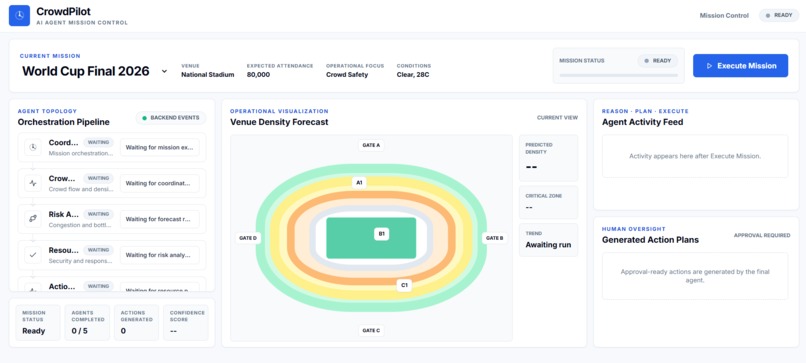
Frontend
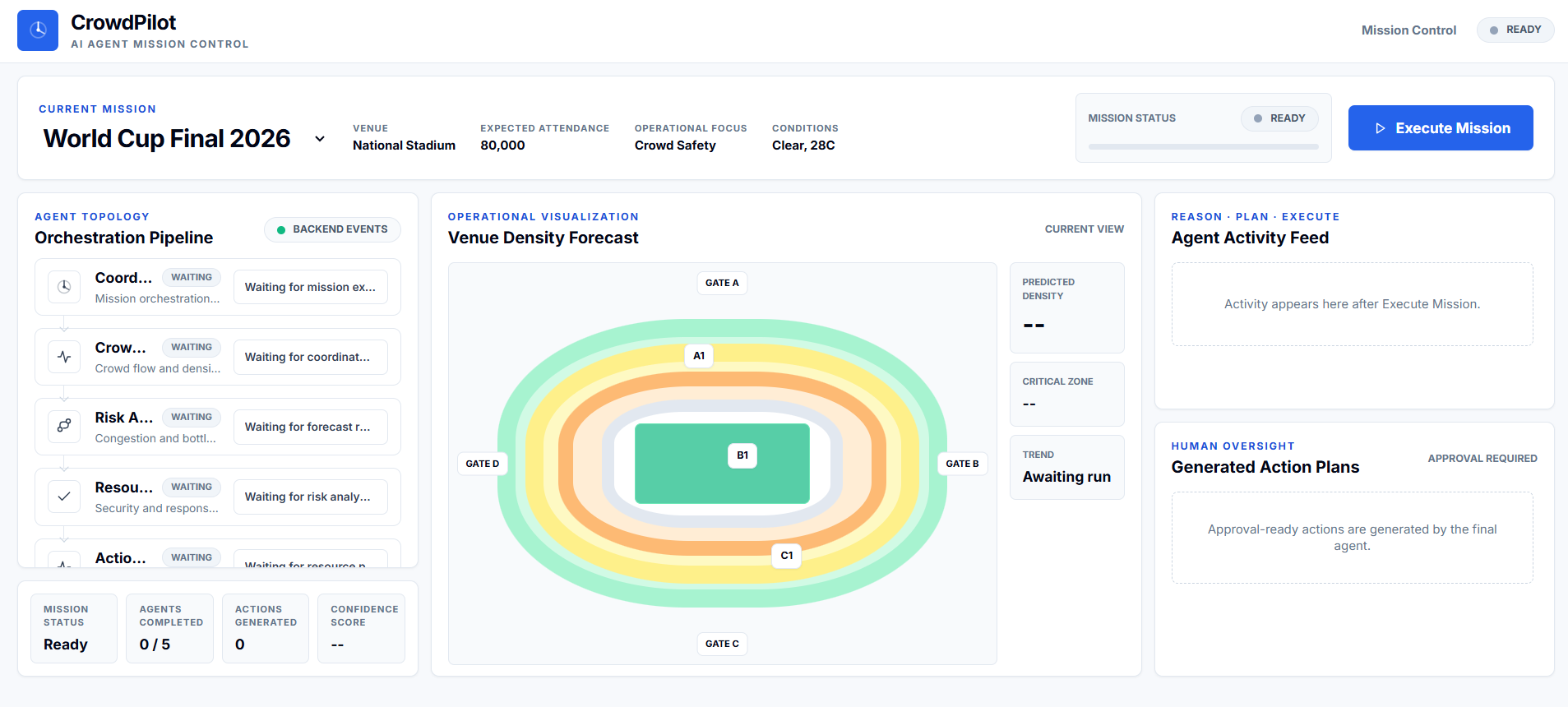
Inspiration
Large-scale events such as football matches, concerts, festivals, and public gatherings require thousands of operational decisions to be made before, during, and after an event.
Operations teams must analyze historical event records, review previous incidents, evaluate available resources, and follow established response procedures. Although this information exists, it is often scattered across different systems, reports, and documents.
As a result, valuable time is spent searching for information instead of making decisions.
We wanted to explore a simple question:
What if an AI agent could access operational knowledge instantly and generate deployment plans before problems escalate?
This inspired us to build CrowdPilot AI — an operational planning agent that transforms historical event intelligence, incident response playbooks, and resource information into actionable deployment recommendations for crowd safety teams.
What it does
CrowdPilot AI acts as an operational planning agent for large-scale events.
Given information about an upcoming event, CrowdPilot can:
- Analyze historical event patterns
- Assess crowd risk levels
- Retrieve incident response playbooks
- Review available operational resources
- Recommend deployment strategies
- Generate structured operational action plans
Instead of manually reviewing multiple sources of information, event operators can delegate planning tasks to CrowdPilot and receive a data-driven operational strategy within seconds.
How we built it
CrowdPilot AI was built using a multi-agent architecture powered by Gemini and MongoDB Atlas.
Each agent is responsible for a specialized operational task:
- Forecast Agent analyzes historical crowd and event information
- Incident Agent retrieves incident response procedures
- Resource Agent evaluates available operational resources
- Operation Agent generates final deployment recommendations
MongoDB Atlas serves as the operational memory layer of the system.
We designed collections to store:
- Historical event records
- Incident reports
- Risk classifications
- Emergency response playbooks
- Resource inventories
- Generated operation plans
Using MongoDB MCP (Model Context Protocol), agents can directly retrieve operational knowledge during execution.
Rather than embedding procedures inside prompts, CrowdPilot dynamically accesses MongoDB to retrieve relevant operational intelligence before making decisions.
This approach allows the system to remain scalable, maintainable, and continuously improve as more operational data becomes available.
Challenges we ran into
One of the biggest challenges was designing a workflow where multiple agents could collaborate while maintaining consistent operational context.
Another challenge was integrating MongoDB MCP into the agent workflow. Instead of relying on hardcoded rules, we needed agents to retrieve operational knowledge dynamically from MongoDB collections and transform raw operational data into structured decision-making outputs.
We also had to design data schemas that could support historical analysis, incident management, resource allocation, and operational planning within a single unified system.
Accomplishments that we're proud of
- Built a complete multi-agent operational planning workflow
- Successfully integrated MongoDB MCP into real agent execution
- Created a unified operational knowledge layer using MongoDB Atlas
- Enabled agents to retrieve and use live operational intelligence
- Eliminated hardcoded response procedures in favor of data-driven planning
- Generated structured deployment plans grounded in operational data
What we learned
This project taught us that the effectiveness of an AI agent depends heavily on the quality and accessibility of its operational knowledge.
We learned that MongoDB is not simply a database for storing information. When combined with MCP, it becomes an operational memory layer that agents can actively use during reasoning and decision-making.
We also gained hands-on experience in:
- Multi-agent orchestration
- Operational data modeling
- Retrieval-based planning
- AI workflow design
- Scalable knowledge architectures
What's next for CrowdPilot AI
Our next goal is to move from operational planning to real-time operational assistance.
Future enhancements include:
- Live event monitoring
- Real-time incident detection
- Dynamic resource reallocation
- Integration with IoT and surveillance systems
- Predictive risk forecasting
- Command center dashboards for operational teams
Ultimately, we envision CrowdPilot AI becoming a real-time operational copilot for crowd safety teams, helping organizations make faster, more informed decisions during large-scale events.
Built With
- fastapi
- google-agent-development-kit
- google-gemini-3
- mcp
- mongodb-atlas
- mongodb-mcp-server
- python


Log in or sign up for Devpost to join the conversation.