Inspiration
There is a lack of awareness and attention devoted to tracking space debris. At any given time, there are less than a hundred "eyes" on the sky specifically looking for space debris in Low Earth Orbit (LEO).
What it does
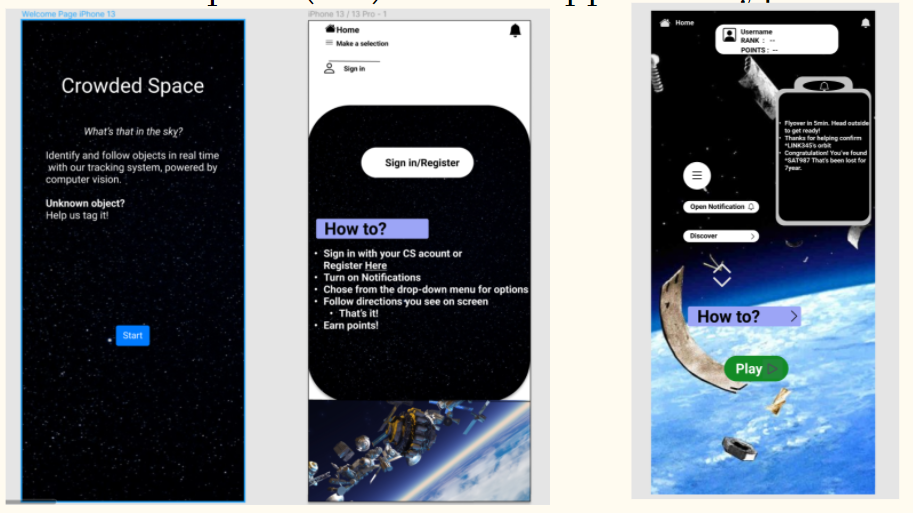
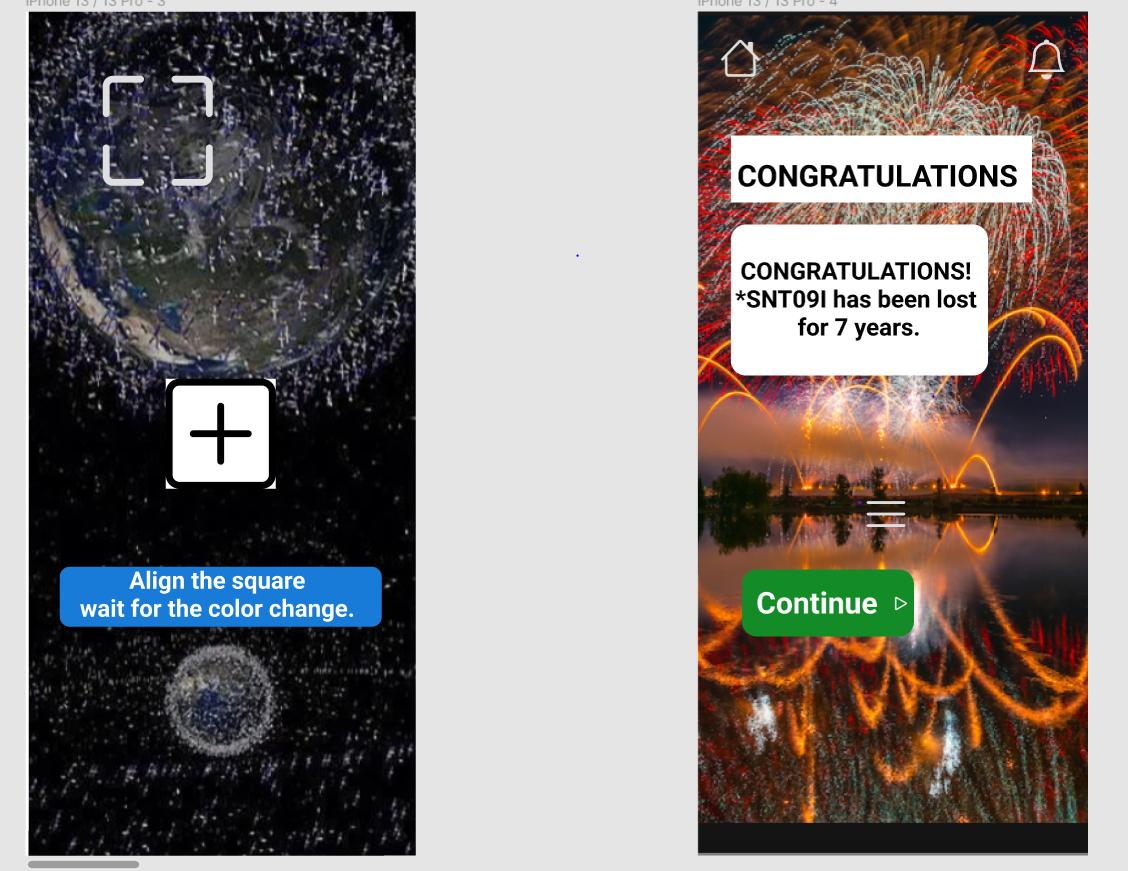
An app that enables anyone to point their camera at the sky and participate in the live tracking of space objects/debris. Using AI, we automatically display boxes around discernable space debris and match objects against a central space debris database. If an object is unknown, we leverage machine learning and the crowd to help confirm the object's orbit and additional details by notifying users in the predicted orbital path to go outside and help them position their cameras with the best field of view. The more users that help us with confirmed sightings, the more accurate the object model becomes which is continuously updated. If known objects are lost or need updating, our userbase can be enlisted to help too!
How we built it
Github Repo Proposed Tech Stack: Front End React; Back End node.js. SQL-based database potentially hosted on AWS services. Computer vision using ML tensorflow object recognition. API calls for orbit determination (of space objects).
Demo Tech: Computer vision written in Python utilizing opencv
Challenges we ran into
Our coding experience is minimal, composed of students in CS. We spent the majority of the time designing and framing the problem and proposed solution. We are grateful for the subject matter experts present at the hackathon (thank you!), and were able to learn about fundamental aspects of space object tracking and astronomy. Only one member had experience in web app development and the language used (and it was only 1 project's worth!), so over 50% of technical time was spent understanding the basics of the client/server structure, learning javascript, and setting up machines for coding. We had difficulty obtaining a training data set and handling api calls for a tensorflow or opencv-based computer vision implementation in JS, so wrote a demo in Python.
Accomplishments that we're proud of
We built a proof of concept engine that can programmatically and in real-time process a video feed and encapsulate flying objects.
What we learned
- Resolving power is a critical factor but having potentially thousands of cameras pointed at the sky, on demand, updating data on thousands of objects in real time becomes much more realistic.
- There is a lot of pollution at ground level where most of our initial users' cameras would be but by increasing incentives and rewards for participating, users may contribute by sending capturing devices into the sky using weather balloons and other methods. Getting above the clouds makes space observation that much easier.
- Human eyes are limited in the wavelengths it can "see". Many prosumer grade sensors can receive IR and other wavelengths which can open up the field of view many times over.
What's next for CrowdID.space
We'll continue building the computer vision capabilities while building the machine learning model to calculate details of flying objects to match against a known space debris database. We estimate that by the end of February 2022, we could launch an actual beta app for space fans to test.
Go to www.crowdid.space to sign up!

Log in or sign up for Devpost to join the conversation.