-
-
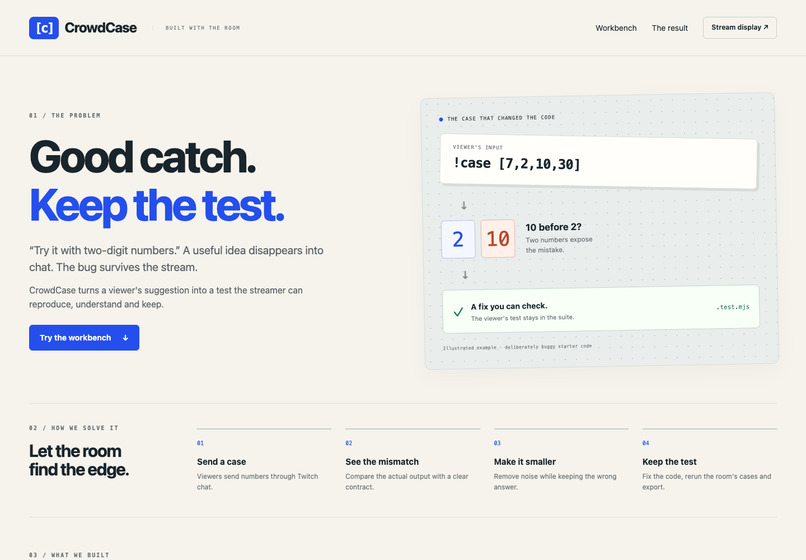
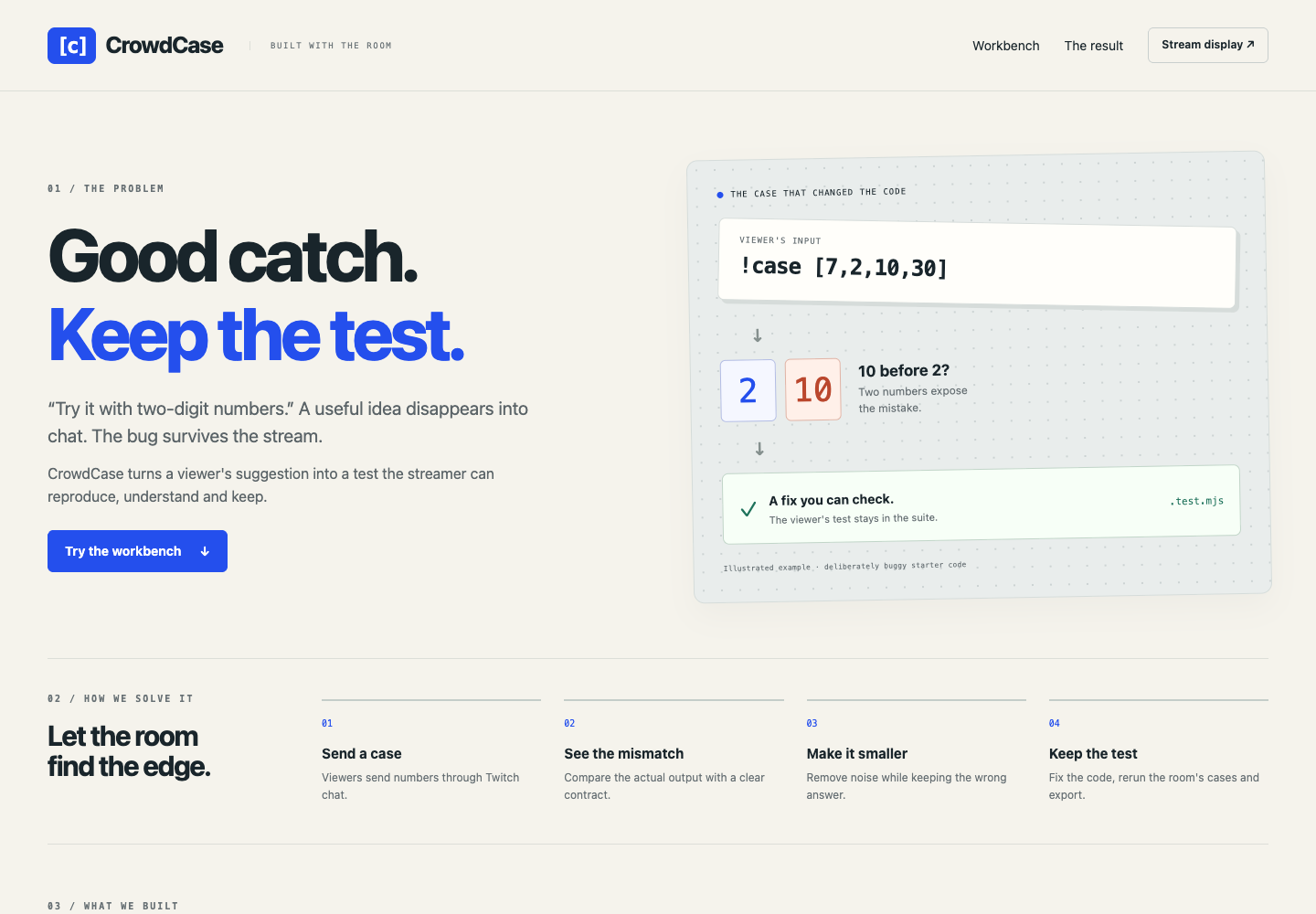
The problem: useful viewer suggestions can disappear before they become reproducible tests.
-
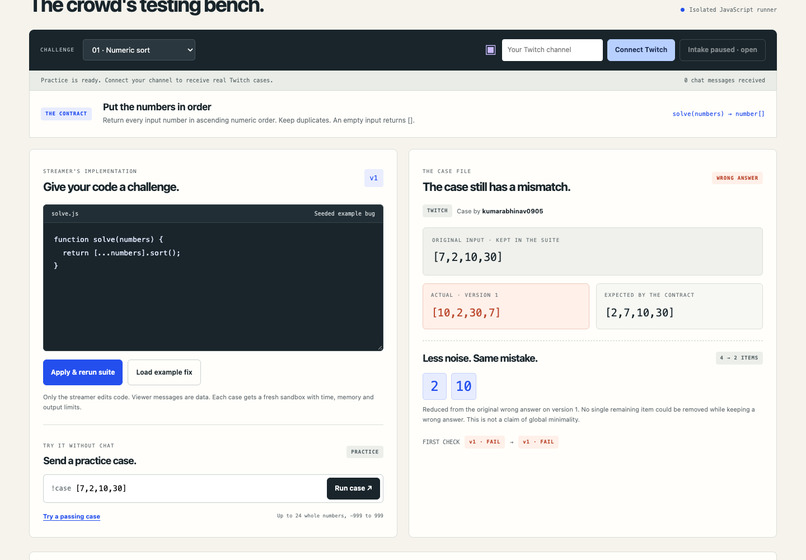
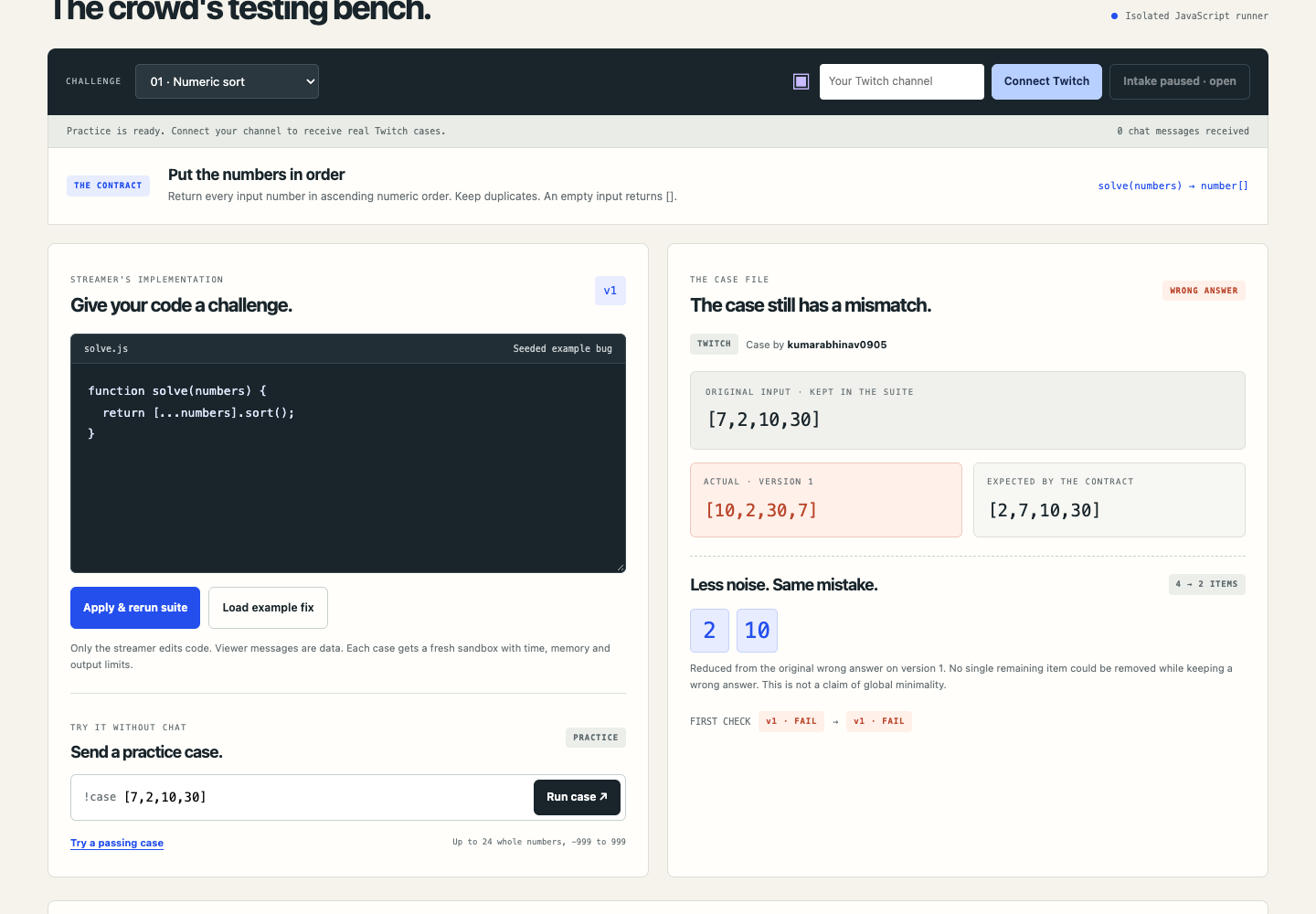
Replay of the verified Twitch case: [7,2,10,30] reduces to the failing input [2,10].
-
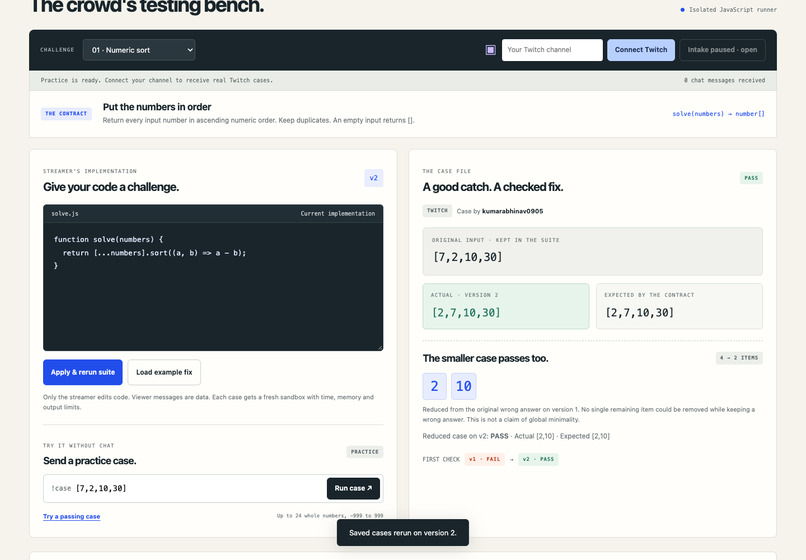
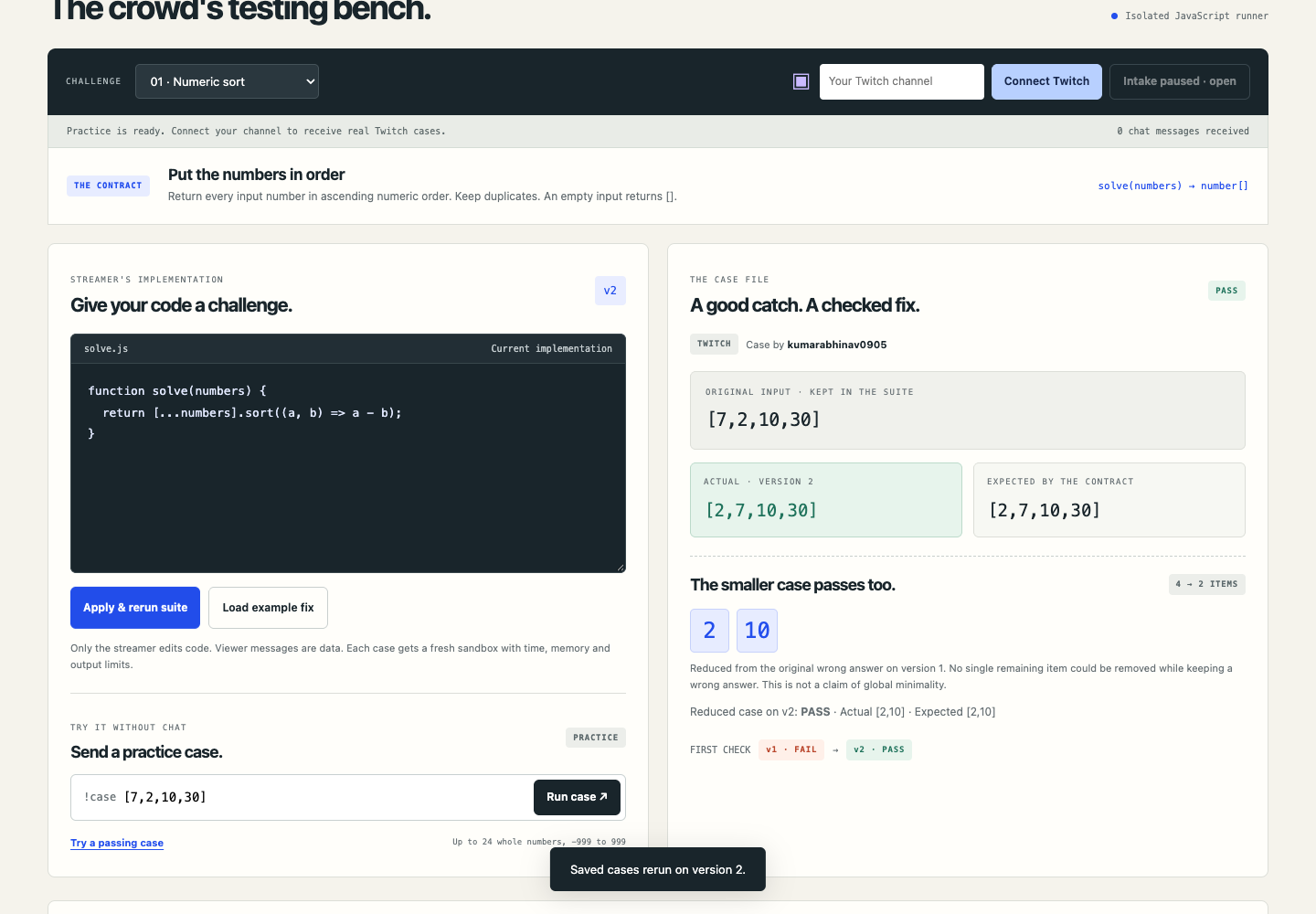
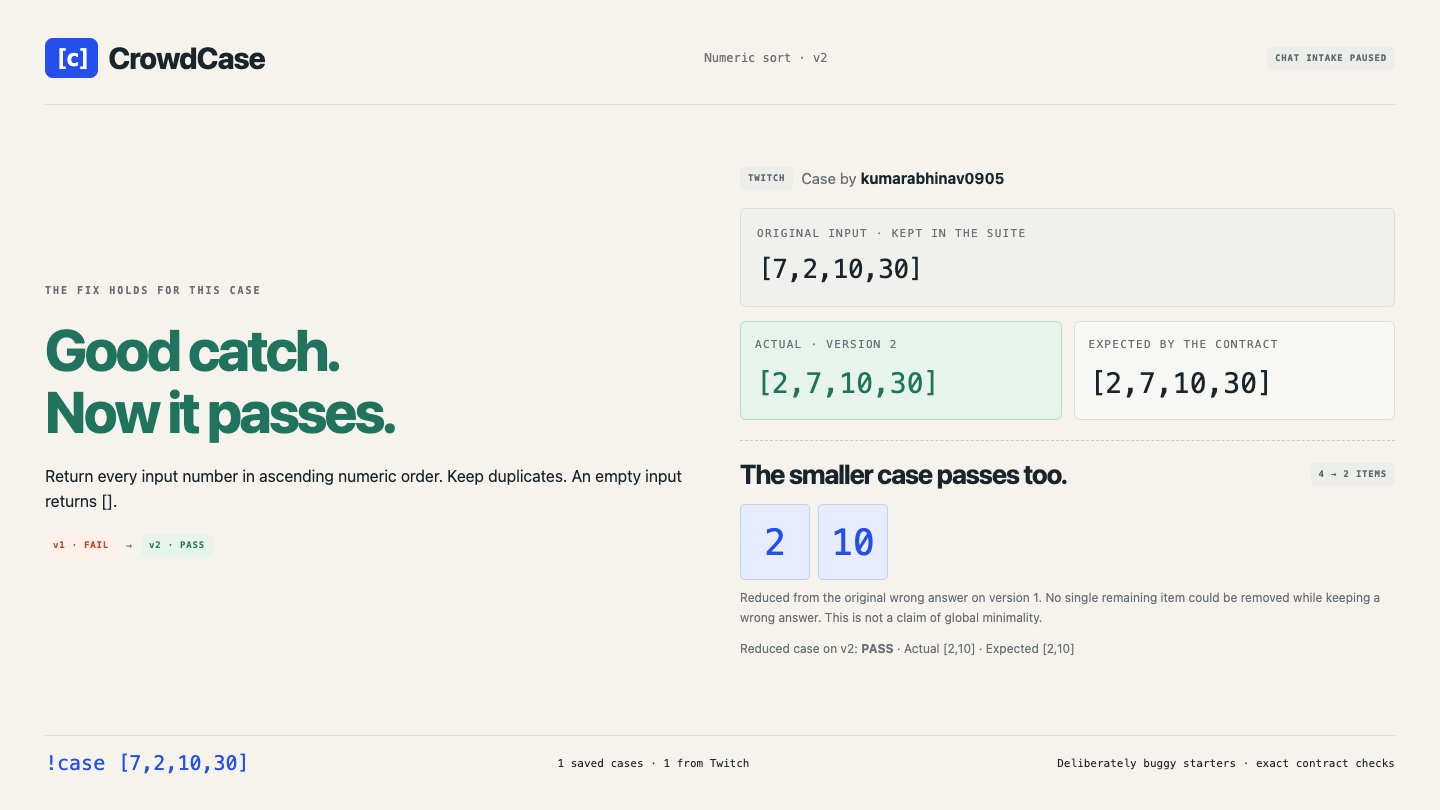
The fix passes both the original Twitch input and its smaller example. The viewer's contribution stays in the suite.
-
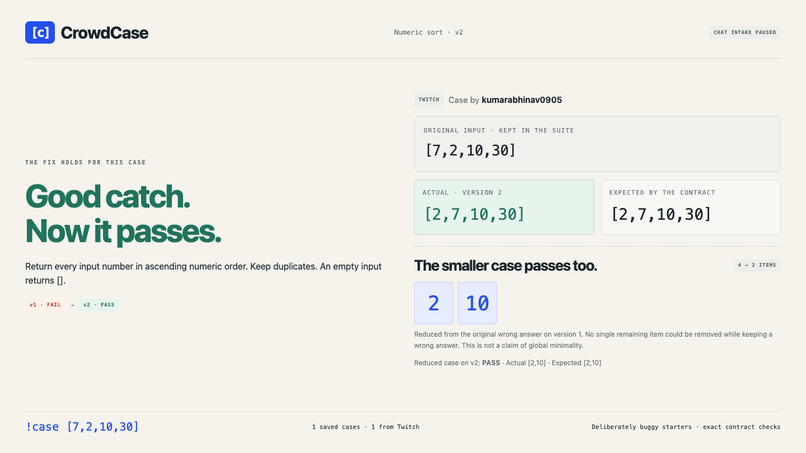
The separate stream display shows contributor credit and the checked fix. This is a saved real case, with intake paused.
-
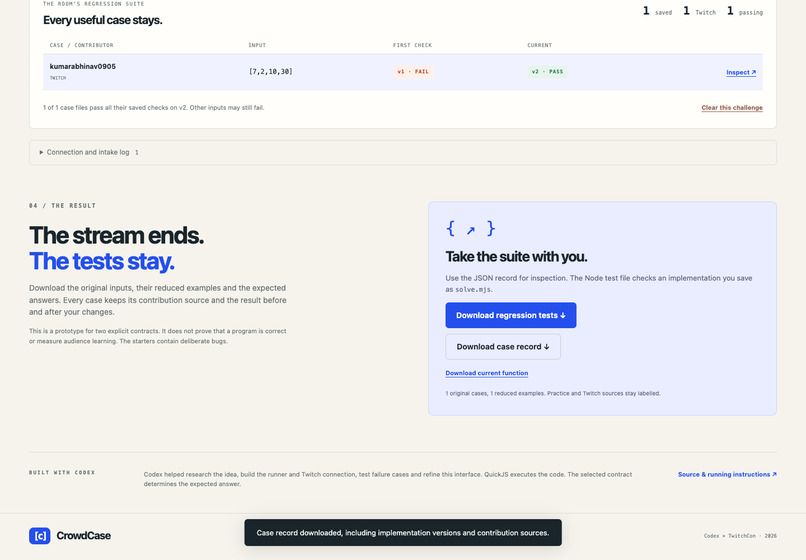
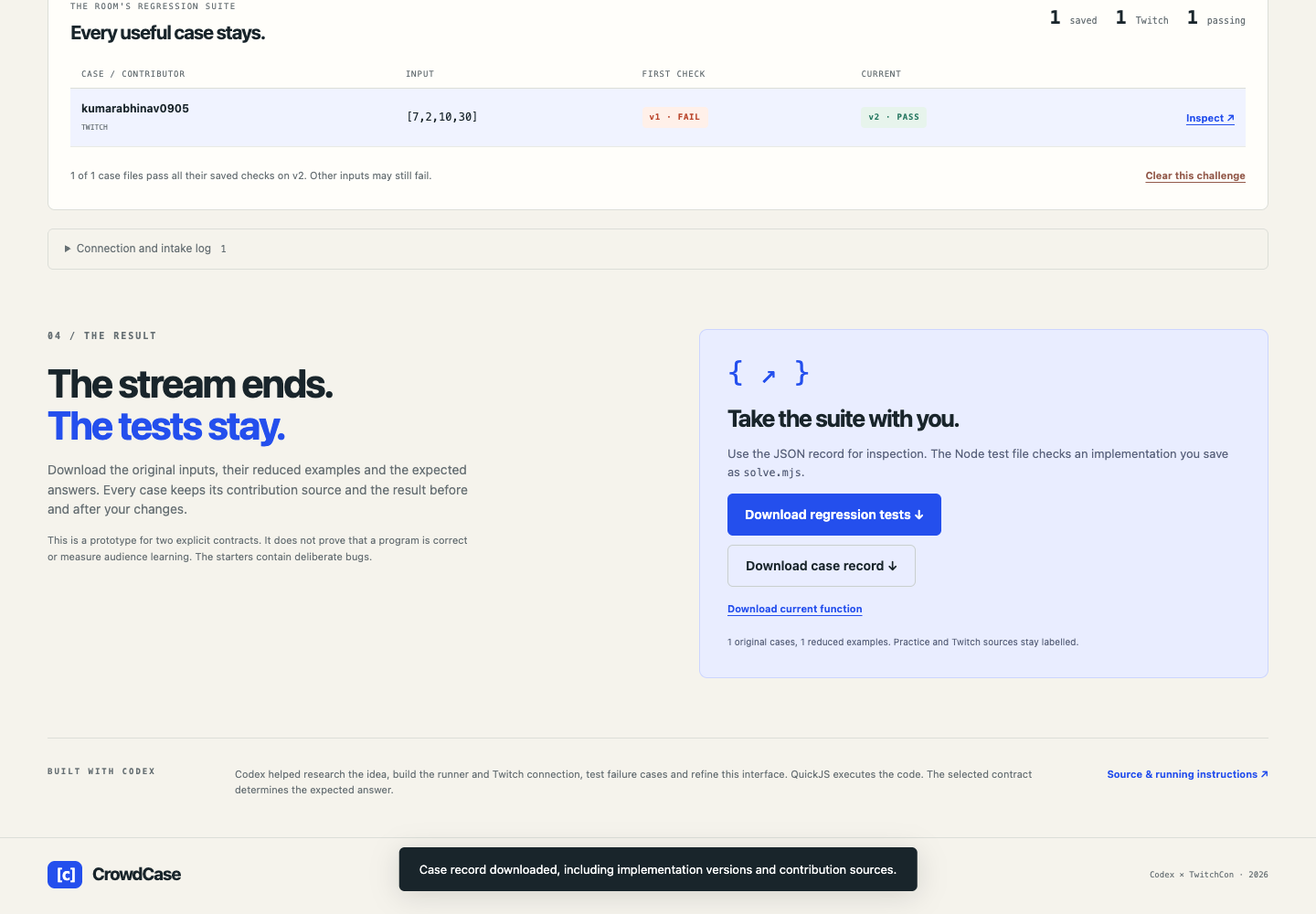
The result: download regression tests, the function and a JSON case record. The tests can run independently with Node.
The problem
"Try it with two-digit numbers."
A viewer spots an input the coding streamer missed. The suggestion disappears into chat before anyone checks it. Even when it exposes a bug, the stream can end without a test that reproduces it.
I wanted the room's good ideas to survive the stream.
How we solve it
CrowdCase gives viewers a small command with a useful outcome: !case [7,2,10,30].
The app runs the streamer's function against a stated contract. If the answer is wrong, it removes extra input values and looks for a smaller example that still fails. It keeps the original contribution, credits the viewer and adds the reduced example to the suite.
The streamer fixes the code and reruns both. Then the room's work can leave the stream as actual regression tests.
What we built
The first contract is numeric sorting. The deliberate starter bug uses JavaScript's default sort, which puts 10 before 2. A four-number viewer input becomes the smaller failure [2,10]. Adding a numeric comparator fixes both saved examples.
The second contract asks for the second-highest distinct score. Repeated scores share a place, so [9,9,3] exposes a different mistake. Each challenge has its own saved cases.
The prototype includes:
- A read-only Twitch IRC WebSocket connection with message IDs, timestamps, contribution credit and intake controls.
- A browser worker running QuickJS WebAssembly. Every execution gets a fresh runtime and context with time, memory, stack and output limits.
- A bounded reducer that preserves wrong answers. A timeout or exception cannot masquerade as a better counterexample.
- Code-version history and a case status that checks both the original input and its reduction.
- A separate stream display. The local Node host supports an OBS Browser Source; the static hosted version synchronizes tabs in the same browser.
- Downloadable Node regression tests, the current function and a JSON case record.
Viewers submit numbers, never executable code. Only the host edits the function.
How Codex helped
Codex helped compare project directions and test the reduction idea before building the interface. It then implemented the chat connection, runner, case model, reducer, exports and display. A separate review agent examined QuickJS packaging and execution hazards.
Testing changed the implementation. A patch could fix the original example while breaking the smaller one, so the app now refuses to call that case resolved. A previously passing input can also gain a reduction when a later edit introduces a regression. Both behaviors have tests.
Codex ran browser checks, tested exported files in a separate Node process and verified a real message sent by the participant through Twitch. There is no runtime language model: QuickJS runs the code and explicit contracts determine the expected answer.
Results
A real !case [7,2,10,30] message from kumarabhinav0905 reached CrowdCase at 17:14:34 UTC on November 2, 2026. The app credited the sender, detected the wrong answer, reduced the input to [2,10] in six checks and updated a separate browser display.
We reopened that saved case, applied the fix and exported the suite. Both exported Node tests passed. The project also passes 17 unit/integration tests and 6 browser scenarios covering execution limits, output validation, reruns, exports, Twitch parsing, mobile layout and display synchronization.
This is one verified participant contribution, not an audience study or a claim of public broadcasting. The demo labels the saved case as a replay.
What we learned and what comes next
The useful part is the retained test. A striking failure on screen is easier to explain when the app also keeps the original input, the smaller example and the code version that produced it.
Today, CrowdCase supports two contracts and bounded integer arrays. The starter bugs are deliberate fixtures. Passing these cases does not prove a program correct, and the reducer does not promise a globally smallest counterexample. The isolation has not received an independent security audit.
Next, I would add more carefully defined contracts, then test the workflow with coding streamers before expanding it to arbitrary projects.
Built With
- css
- esbuild
- html
- javascript
- node.js
- openai-codex
- playwright
- quickjs
- twitch-irc
- webassembly

