-
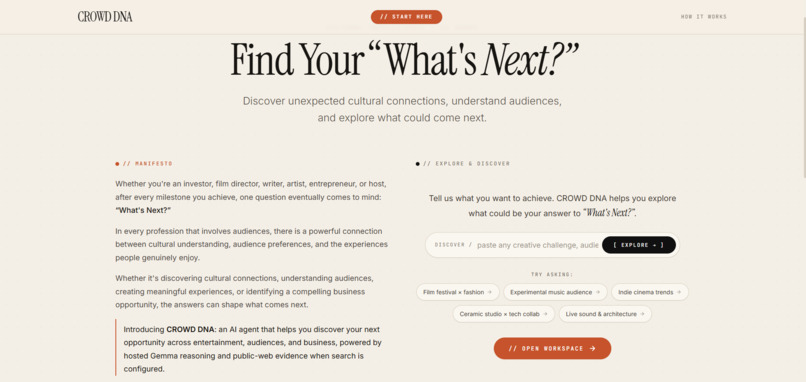
Home Page
-
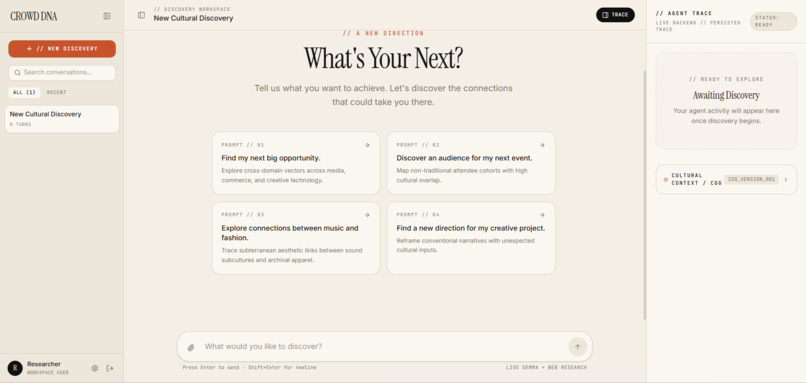
Workspace
-
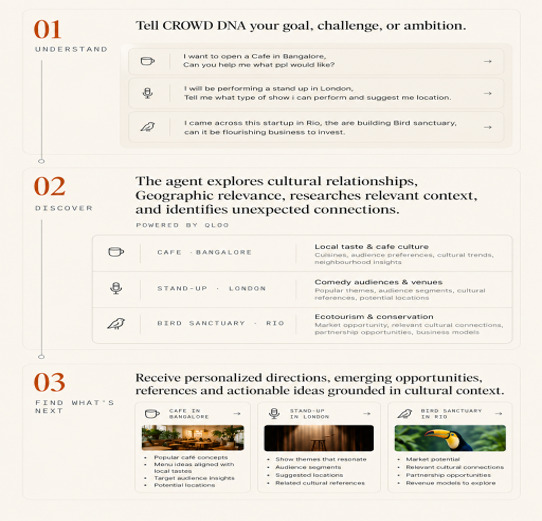
Flow Diagram
-
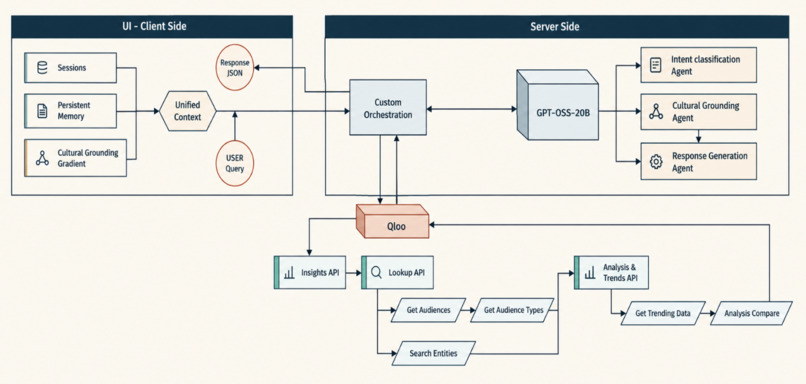
Technical Architecture
-
Testing and validation
-
Notable Feedbacks
CROWD DNA
An AI Agent That Discovers Your Next Opportunity Through Cultural Intelligence
Team: A.I.M. (Advanced Idea Mechanics)
1. Inspiration
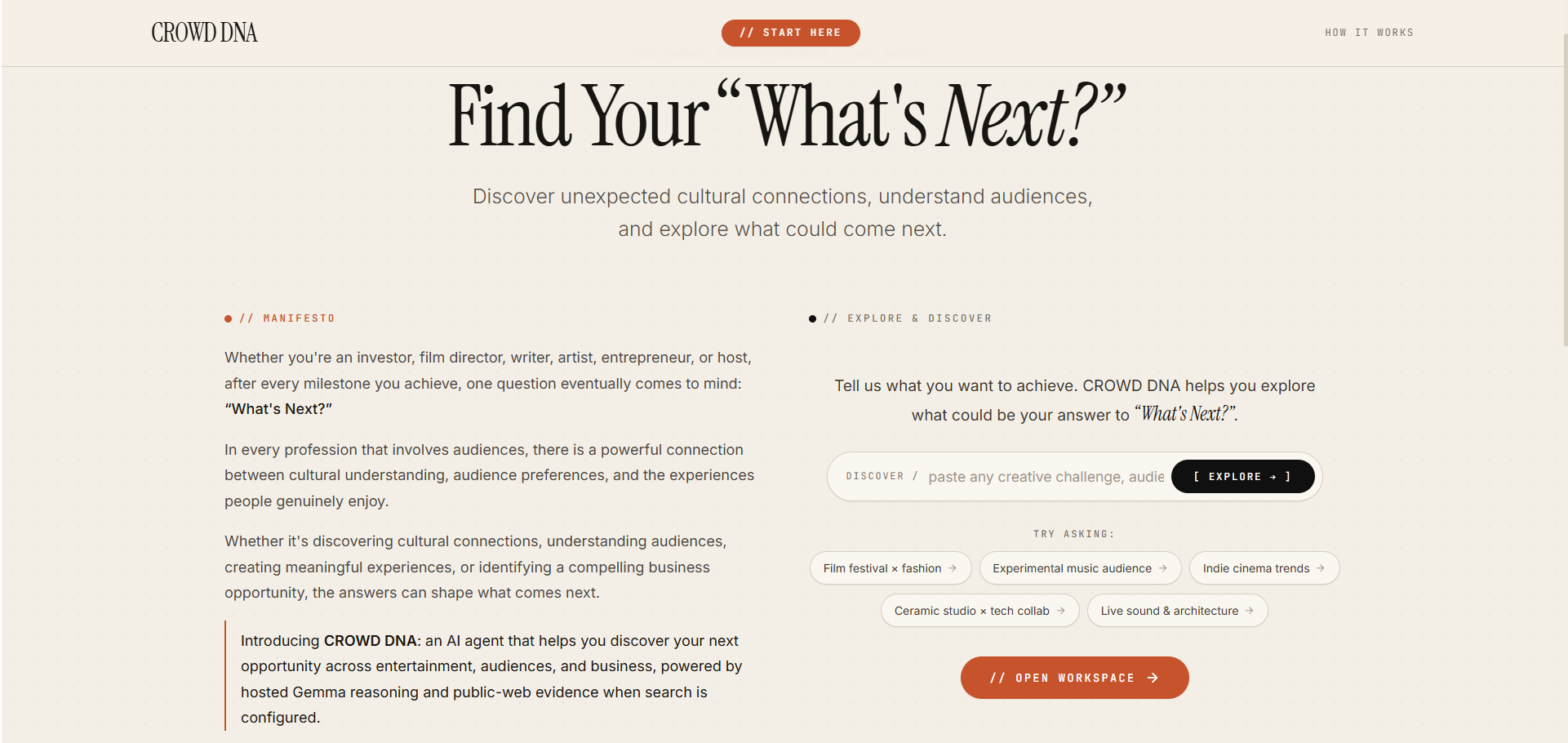
Every achievement eventually leads to a new question: "What's Next?"
Whether you're an entrepreneur planning your next venture, a filmmaker deciding what story to tell, an artist looking for a new audience, an investor evaluating an opportunity, or an event organizer trying to create an experience people will love, the next big decision often depends on understanding people.
But understanding people goes beyond demographics, statistics, and conventional market research. It involves understanding their culture: what they enjoy, what influences them, what they connect with, and what experiences resonate with them.
We noticed that traditional AI assistants are excellent at answering questions, generating content, and providing general recommendations. However, when it comes to discovering opportunities that depend on cultural context, audience preferences, and geographic relevance, their answers can sometimes remain generic. Users often need to provide multiple follow-up prompts to get recommendations that genuinely address their situation.
We wanted to explore a different approach.
What if an AI agent could understand not just what someone is asking, but also the cultural environment surrounding their goal? What if it could discover relationships between seemingly unrelated interests, understand local audiences, research relevant context, and use those connections to suggest possibilities that the user might not have considered?
This led us to CROWD DNA.
Our inspiration was to build more than another conversational AI assistant. We wanted to create an intelligent discovery agent that uses cultural intelligence to help people find their next opportunity.
Our central idea: Don't just tell people what they already know. Help them discover what they haven't thought to ask.
2. What it does
CROWD DNA is an agentic AI system that helps users discover opportunities across entertainment, audiences, and business through cultural intelligence powered by Qloo.
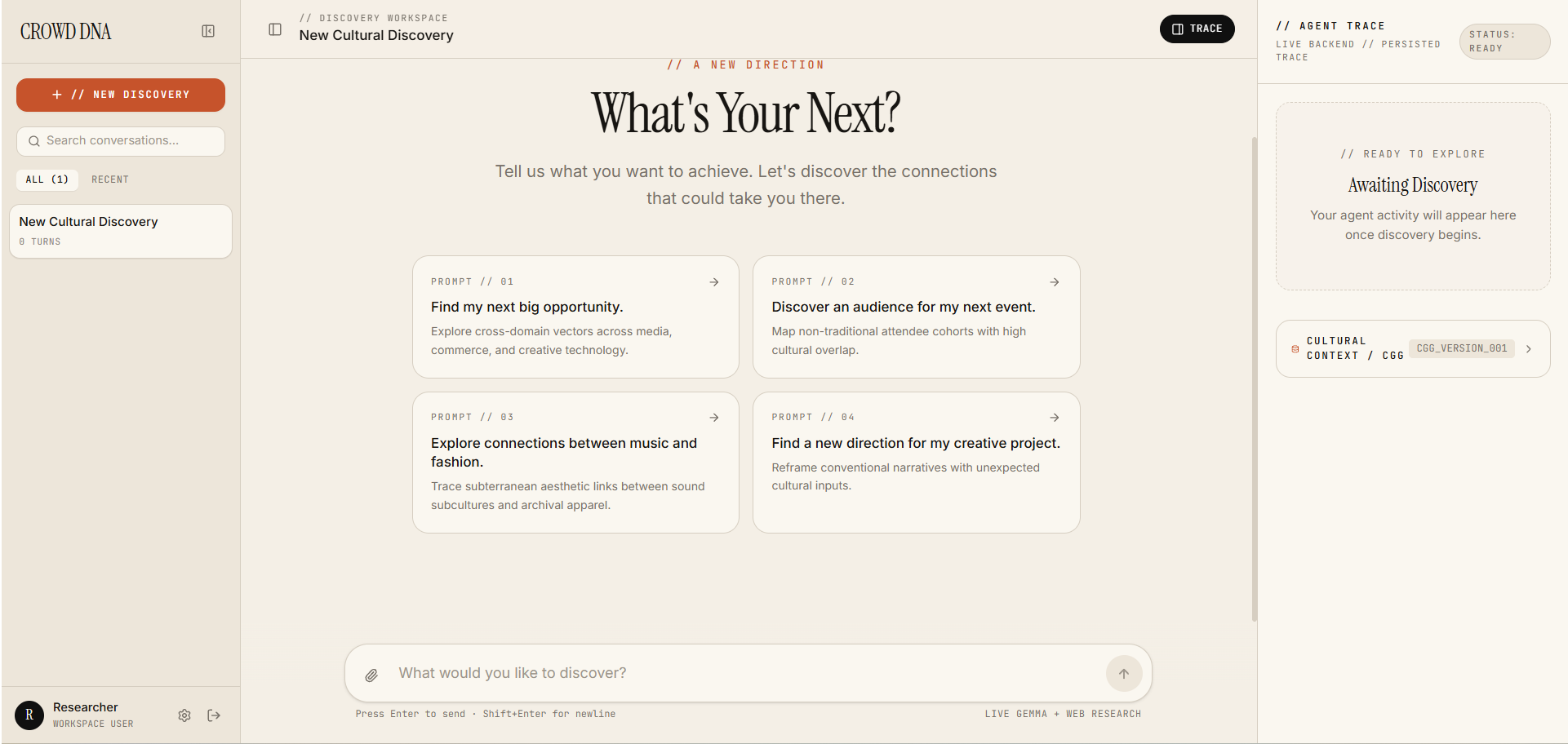
Instead of restricting users to predefined categories or recommendation templates, CROWD DNA allows them to describe any goal, challenge, ambition, or problem in natural language.
The system then explores the cultural and geographic context surrounding the request, identifies relevant relationships, researches additional information, and generates personalized directions and actionable possibilities.
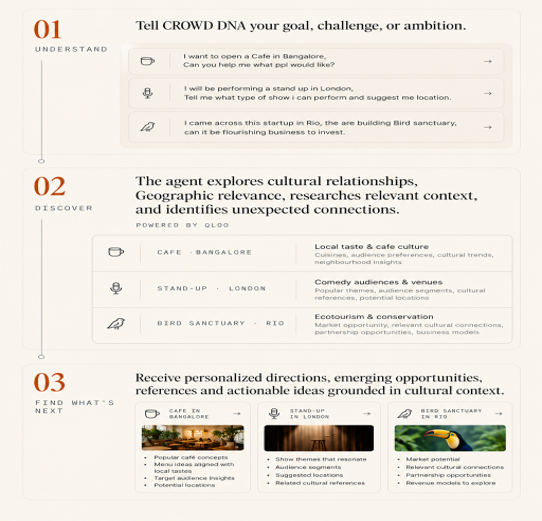
The product follows three fundamental stages:
01 — UNDERSTAND
The user tells CROWD DNA what they want to achieve.
They can ask open-ended questions, describe a business challenge, explain a creative ambition, or present an investment opportunity.
For example:
- Cafe in Bangalore: "I want to open a cafe in Bangalore. Can you help me understand what people would like?"
- Stand-up in London: "I will be performing stand-up in London. What type of show should I perform, and where should I perform it?"
- Bird sanctuary startup in Rio: "I came across a startup in Rio that is building a bird sanctuary. Could it be a flourishing business to invest in?"
CROWD DNA is not limited to a particular industry. The user defines the problem, and the agent determines what information and cultural context are relevant.
02 — DISCOVER
This is where CROWD DNA differentiates itself from a conventional conversational assistant.
The agent:
- Classifies the user's intent and understands the underlying objective.
- Identifies the cultural entities, audiences, and geographic context relevant to the request.
- Explores cultural relationships using Qloo's cultural intelligence.
- Retrieves relevant audience insights and cultural associations.
- Researches additional context and relevant information.
- Evaluates unexpected connections and potential directions.
For example:
| User's goal | What CROWD DNA explores |
|---|---|
| Cafe in Bangalore | Local tastes, cafe culture, audience preferences, and geographic relevance. |
| Stand-up in London | Comedy audiences, cultural references, audience segments, and potential venues. |
| Bird sanctuary in Rio | Ecotourism, conservation interests, cultural connections, and potential business models. |
Qloo provides the cultural intelligence layer, helping the agent explore relationships that may not be obvious from the original question.
03 — FIND WHAT'S NEXT
CROWD DNA converts its discoveries into personalized directions, emerging opportunities, references, and actionable ideas grounded in cultural context.
Examples of possible outcomes:
Cafe in Bangalore
- Explore popular cafe concepts.
- Develop menu ideas aligned with local tastes.
- Understand potential audience segments.
- Identify locations worth investigating.
Stand-up in London
- Explore comedy themes that may resonate with local audiences.
- Identify relevant audience segments.
- Discover cultural references that could connect with the audience.
- Suggest potential locations and venues to investigate.
Bird sanctuary in Rio
- Explore ecotourism and conservation opportunities.
- Identify relevant cultural connections.
- Investigate potential partnerships.
- Explore possible revenue models and business directions.
The objective is not simply to produce an answer, but to help users explore possibilities they may not have considered.
Beyond answers. Into possibilities.
CROWD DNA doesn't just respond to what you ask. It helps you explore what you haven't thought to ask yet.
3. How we built it
We approached CROWD DNA as an agentic system rather than a conventional chatbot with a collection of static prompts.
Our architecture combines an LLM, custom orchestration, Qloo's cultural intelligence APIs, persistent memory, a Cultural Grounding Gradient (CGG), and specialized agent roles.
A. Overall architecture
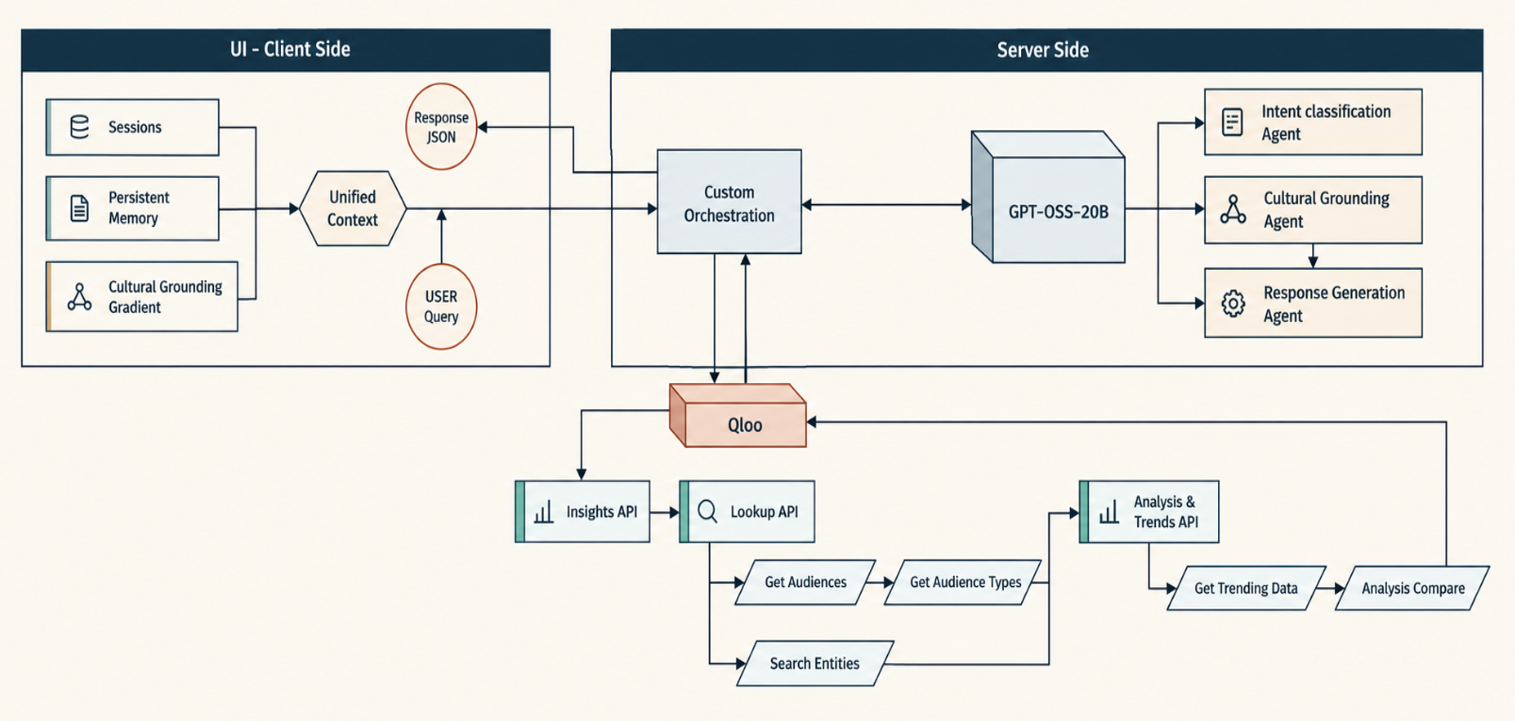
The architecture is divided into two major parts:
Client Side
- Sessions
- Persistent Memory
- Cultural Grounding Gradient (CGG)
- Unified Context
- User Query
- Response JSON
Server Side
- Custom Orchestration
- GPT-OSS-20B
- Intent Classification Agent
- Cultural Grounding Agent
- Response Generation Agent
- Qloo API integration
The client maintains the conversational context and relevant user information. The server handles orchestration, reasoning, cultural discovery, and response generation.
The system brings the relevant context together into a unified representation before processing the user's request.
B. GPT-OSS-20B as the reasoning engine
We use GPT-OSS-20B as the central language model powering the agentic workflow.
Rather than treating the model as a simple question-and-answer endpoint, we use it within a custom orchestration layer.
The orchestration layer coordinates the different stages of a task, determines which tools and information are needed, processes their outputs, and manages the overall execution.
We designed three specialized agent roles:
1. Intent Classification Agent
The first stage interprets the user's request.
It identifies:
- The user's underlying objective.
- The domain of the request.
- The relevant geographic location.
- The type of cultural information required.
- The questions that need further investigation.
For example, when someone asks about opening a cafe in Bangalore, the system needs to understand that the request is not simply asking for cafe recommendations. It is about exploring a potential business opportunity, local preferences, and audience interests.
2. Cultural Grounding Agent
This is the core discovery component.
It uses Qloo's cultural intelligence to investigate relevant entities, audiences, preferences, and relationships.
It also considers geographic relevance and additional contextual research.
The objective is to ground the model's recommendations in relevant cultural information rather than relying entirely on its pretrained knowledge or generic assumptions.
3. Response Generation Agent
Once the relevant information has been gathered and evaluated, the response generation stage organizes the findings into a useful answer.
It produces personalized recommendations, possible opportunities, relevant references, and actionable directions.
The output is returned to the client as structured response JSON.
C. Qloo integration — Cultural intelligence layer
Qloo is central to CROWD DNA's approach.
Its cultural intelligence allows us to explore relationships between entities and understand connections across different areas of culture.
We designed our integration around the following Qloo capabilities:
| Qloo capability | Purpose in CROWD DNA |
|---|---|
| Insights API | Retrieve relevant cultural insights and relationships. |
| Lookup API | Retrieve information about identified entities. |
| Search Entities | Discover relevant cultural entities. |
| Get Audiences | Explore relevant audience insights. |
| Get Audience Types | Investigate audience categories and characteristics. |
| Analysis & Trends API | Explore cultural trends and related information. |
| Get Trending Data | Retrieve relevant trending information. |
| Analysis Compare | Compare entities or cultural relationships. |
These capabilities allow the agent to investigate a request from multiple perspectives.
For example, a request about performing stand-up comedy in London can involve more than identifying comedy venues. The agent can investigate cultural references, relevant audience interests, and possible connections that could influence the type of performance.
Qloo supplies the cultural intelligence; CROWD DNA uses that intelligence to reason about the user's goal.
D. Cultural Grounding Gradient (CGG)
One of our important architectural ideas is the Cultural Grounding Gradient (CGG).
We wanted CROWD DNA to maintain an evolving representation of cultural context rather than depending exclusively on the immediate conversation.
The CGG is designed as an adaptive representation of cultural entities, relationships, and contextual signals that can evolve as the agent discovers new information.
Instead of assuming that every user or project can be represented by a fixed set of predefined cultural categories, the system is designed to accommodate new entities and relationships as they become relevant.
The CGG works alongside persistent memory and the current conversational context.
Its intended responsibilities include:
- Maintaining a structured representation of cultural entities.
- Recording relevant relationships and their context.
- Supporting updates as new evidence becomes available.
- Preserving the history of committed changes.
- Providing cultural context for future discovery tasks.
An important design decision is that not every statement made during a conversation should automatically become persistent memory.
The system distinguishes between proposed updates and committed context. Candidate changes can be evaluated before being accepted into persistent state.
This helps prevent temporary assumptions or incorrect interpretations from contaminating the user's longer-term cultural context.
E. Persistent memory and unified context
A major limitation of a conventional stateless LLM interaction is that information from previous conversations is not automatically available in future requests.
CROWD DNA is designed to address this through persistent memory and context management.
We distinguish between:
Session context: Information relevant to the current conversation, including the user's immediate request and ongoing task.
Persistent memory: Durable information that can help the agent maintain continuity across conversations.
Cultural Grounding Gradient: The evolving representation of relevant cultural entities and relationships.
These components contribute to a unified context that is provided to the orchestration system.
This means the agent can consider relevant previous information instead of treating every interaction as an entirely isolated question.
F. End-to-end agent workflow
The complete workflow can be summarized as follows:
- The user submits a natural-language request.
- The client combines the request with relevant session and persistent context.
- The custom orchestration layer receives the unified context.
- GPT-OSS-20B coordinates the reasoning workflow.
- The Intent Classification Agent identifies the objective and information requirements.
- The Cultural Grounding Agent explores relevant Qloo data, cultural relationships, geographic relevance, and additional research.
- The orchestration layer evaluates the gathered information and prepares the response.
- The Response Generation Agent produces a structured, personalized answer.
- Relevant memory or CGG updates can be proposed and validated separately.
- The final response is returned to the client as JSON.
The architecture is designed to make the LLM an orchestrator of a larger discovery process rather than the sole source of every recommendation.
4. Challenges we ran into
1. Translating open-ended requests into cultural queries
Users do not naturally express their problems in the format expected by an API.
Someone asking whether a bird sanctuary in Rio could be a good investment is not necessarily going to mention audience segments, cultural entities, ecotourism, or conservation interests.
The system must identify the underlying intent and determine which cultural and geographic information could help answer the question.
Designing this translation between natural-language requests and structured cultural discovery was a major challenge.
2. Connecting cultural intelligence with real-world context
Cultural relationships alone do not guarantee a successful business, event, or investment.
For example, identifying a relationship between an audience and a cultural entity does not automatically prove that an audience will purchase a product or attend an event.
We needed to consider geographic relevance, additional research, and the limitations of the available evidence when turning cultural insights into practical recommendations.
3. Building an evolving memory system
We wanted the agent to retain relevant context across interactions.
However, automatically storing everything the model says or assumes can introduce incorrect information into future conversations.
We therefore designed a distinction between temporary conversational context, proposed memory changes, and validated persistent updates.
4. Evaluating whether the system actually makes a difference
Perhaps our biggest challenge was determining whether CROWD DNA provided meaningful value over traditional LLMs.
A system can have a sophisticated architecture and multiple integrations, but that does not automatically mean users experience better results.
We needed to put the agent in front of real users and collect feedback based on practical tasks and problems.
That became an important part of our testing and validation process.
5. Accomplishments that we're proud of
A. Integrating Qloo into an agentic workflow
We designed a multi-stage architecture that uses GPT-OSS-20B, custom orchestration, specialized agent roles, and Qloo's cultural intelligence capabilities.
This allows the system to investigate requests through different stages instead of generating every answer directly from the initial prompt.
B. Developing the Cultural Grounding Gradient concept
We are particularly proud of exploring the CGG as an adaptive cultural representation that can evolve with new discoveries and validated context.
It represents our attempt to move beyond static preference profiles and build a system that can maintain a changing understanding of cultural relationships.
C. Initial user validation
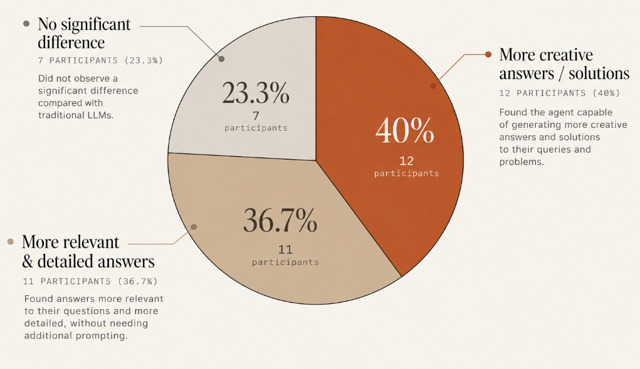
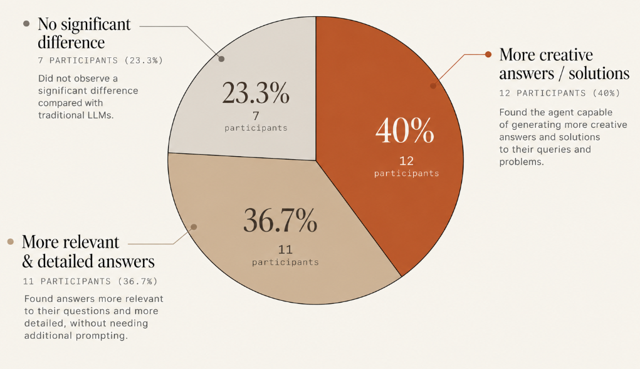
We asked 30 people from our friends and family network to use CROWD DNA and compare their experience with traditional LLMs.
The feedback was mixed, which was important for us because we wanted to understand where the agent was genuinely providing value.
Our results:
| User feedback | Participants | Percentage |
|---|---|---|
| More creative answers and solutions | 12 | 40% |
| More relevant and detailed answers | 11 | 36.7% |
| No significant difference | 7 | 23.3% |
| Total | 30 | 100% |
In total, 23 out of 30 participants (76.7%) reported a noticeable improvement in creativity, relevance, or response detail.
The feedback suggests that cultural grounding and agentic discovery can improve the experience for certain types of open-ended requests, although not every user experienced a significant difference.
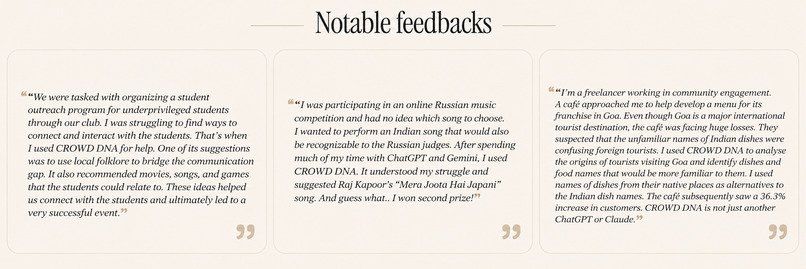
E. Notable user feedback
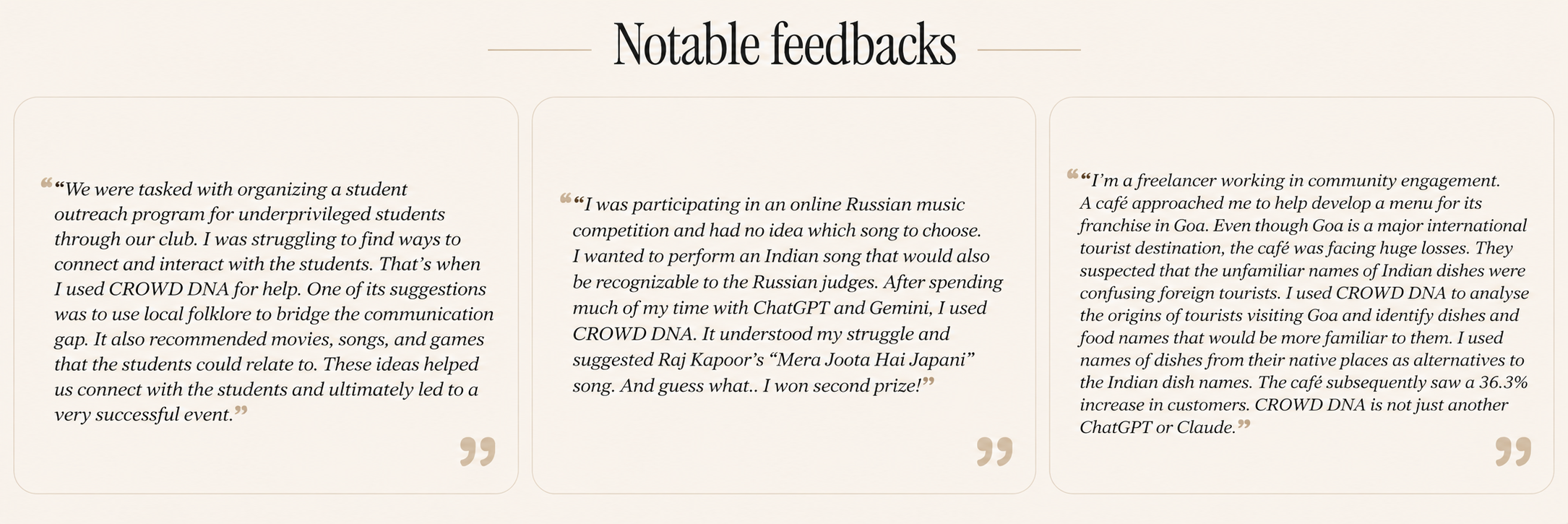
Beyond the numbers, some of the most meaningful validation came from the real-world experiences shared by participants.
- "We were tasked with organizing a student outreach program for underprivileged students through our club. I was struggling to find ways to connect and interact with the students. That's when I turned to CROWD DNA for help. One of its suggestions was to use local folklore to bridge the communication gap. It also recommended movies, songs, and games that the students could relate to. These ideas helped us connect with the students and ultimately led to a very successful event."
This feedback demonstrated how cultural understanding could be applied beyond conventional business recommendations, helping people create meaningful social and educational experiences.
- "I was participating in an online Russian music competition and had no idea which song to choose. I wanted to perform an Indian song that would also be recognizable to the Russian judges. After spending considerable time trying ChatGPT and Gemini, I decided to try CROWD DNA. It understood my dilemma and suggested Raj Kapoor's Mera Joota Hai Japani. And guess what? I won second prize!"
This was particularly interesting to us because the problem involved connecting two different cultural contexts.
The user wanted an Indian song that could also be recognized by a Russian audience. CROWD DNA suggested a culturally recognizable choice that the user ultimately performed in the competition.
The participant reported winning second prize.
- "I'm a freelancer working in community engagement. A café approached me to help develop a menu for its franchise in Goa. Despite Goa being a major international tourist destination, the café was facing significant losses. They suspected that the unfamiliar names of Indian dishes were confusing foreign tourists. I used CROWD DNA to analyze the origins of tourists visiting Goa and identify dishes and food names that would be more familiar to them. I used names of dishes from their respective cultures as alternatives to the Indian dish names. The café subsequently saw a 36.3% increase in customers. CROWD DNA is not just another ChatGPT or Claude."
This was one of the most interesting examples of CROWD DNA being applied to a business problem.
Instead of approaching the problem through conventional menu optimization alone, the user explored how cultural familiarity and tourist origins could influence how the menu was presented.
The participant reported a 36.3% increase in customers following the changes.
The reported business outcome was shared by the participant and was not independently audited by the team.
What these accomplishments mean to us
The most encouraging aspect of these experiences was the diversity of problems CROWD DNA was able to help users explore.
The examples ranged from student engagement and international music competitions to restaurant business strategy.
They reinforced the idea behind our product: cultural intelligence is relevant wherever people, preferences, and experiences intersect.
6. What we learned
Building and testing CROWD DNA taught us several important lessons.
1. Better models do not automatically mean better experiences
We learned that the value of an AI product cannot be measured by its model size, number of tools, or complexity of architecture.
What matters is whether the system helps users accomplish something they could not easily accomplish before.
Our testing reflected this. While 23 participants noticed improvements, 7 did not find a significant difference.
That feedback reminded us that technical sophistication must translate into practical user value.
2. Cultural context can change the direction of an answer
The student outreach and Russian music competition examples showed us that cultural context can fundamentally influence a recommendation.
A generic answer might suggest popular songs, common engagement activities, or conventional event ideas.
A culturally grounded answer can explore what resonates with a particular audience and why.
3. Geographic relevance matters
A recommendation that works in one city, country, or cultural environment may not work in another.
The Bangalore cafe, London stand-up, and Rio bird sanctuary examples helped us recognize the importance of combining cultural relationships with geographic context.
4. Users often need discovery, not just answers
Many users approach AI with an incomplete understanding of their actual problem.
They may know that they want to open a cafe, organize an event, or evaluate an investment, but they may not know which questions they should be asking.
We learned that an effective discovery agent should help users identify possibilities beyond their original framing.
5. Memory must be reliable
Persistent context can make an agent more useful across multiple interactions, but storing incorrect assumptions can make future recommendations worse.
We learned the importance of distinguishing between temporary observations, candidate memory updates, and validated persistent information.
7. What's next for CROWD DNA
We see CROWD DNA as the beginning of a larger vision: an agent that can help people navigate opportunities by understanding the cultural world around them.
Our next steps are focused on improving the quality, reliability, and practical usefulness of the system.
1. Improve the Cultural Grounding Gradient
We want to further develop CGG into a robust adaptive representation of cultural entities and relationships.
Our goals include:
- Improving how new cultural dimensions and entities are introduced.
- Better representing relationship strength, confidence, and recency.
- Developing stronger validation for proposed memory updates.
- Supporting historical versions and reliable context recovery.
- Improving how cultural context is retrieved for different tasks.
2. Improve agentic reasoning and orchestration
We plan to refine the specialized agent workflow and improve how the system decides which tools and research steps are necessary.
This includes:
- Better intent classification.
- More effective Qloo query construction.
- Improved tool selection and execution.
- Stronger evidence evaluation.
- Better handling of conflicting or incomplete information.
- More useful and transparent agent traces.
3. Expand cultural and geographic discovery
We want CROWD DNA to become more effective across different cities, countries, industries, and cultural environments.
This includes improving its ability to combine cultural intelligence with geographic relevance and additional real-world research.
4. More rigorous testing and evaluation
Our initial testing gave us encouraging feedback, but we want to move beyond informal user validation.
We plan to:
- Expand testing to a larger and more diverse group of users.
- Compare CROWD DNA against traditional LLMs using consistent prompts.
- Evaluate responses with and without Qloo integration.
- Measure relevance, creativity, factual grounding, and usefulness.
- Test consistency across multiple sessions.
- Investigate cases where users do not notice a significant improvement.
We also want to establish clearer benchmarks to identify which categories of problems benefit most from cultural intelligence.
5. Build toward real-world adoption
Our long-term goal is to make CROWD DNA useful to people who regularly make decisions involving audiences, culture, and experiences.
Potential areas include:
- Entrepreneurs exploring new business opportunities.
- Investors evaluating culturally relevant ventures.
- Event organizers understanding audiences.
- Artists and performers discovering new creative directions.
- Filmmakers and entertainment professionals exploring audience preferences.
- Brands and businesses developing culturally relevant experiences.
Ultimately, we want CROWD DNA to become an intelligent discovery partner that helps people find their next opportunity, even when they do not yet know exactly what they are looking for.
Team
A.I.M. — Advanced Idea Mechanics
We built CROWD DNA around one simple belief:
Your next opportunity might already exist in the connections you haven't discovered yet.
With CROWD DNA, we want to help people find those connections.
Find Your "What's Next?"
Built With
- cultural-grounding-agent
- cultural-grounding-gradient
- custom-agent-orchestration
- gpt-oss-20b
- intent-classification-agent
- json-based-client-server-architecture
- persistent-memory
- qloo-api
- response-generation-agent

