-
-
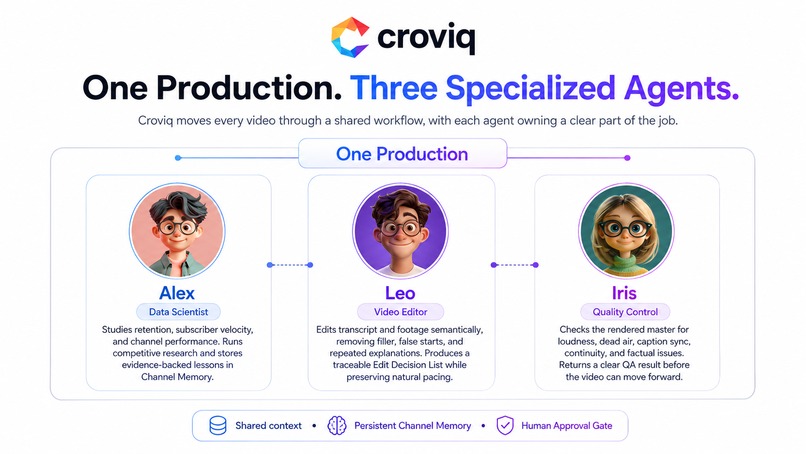
Meet your Production team
-
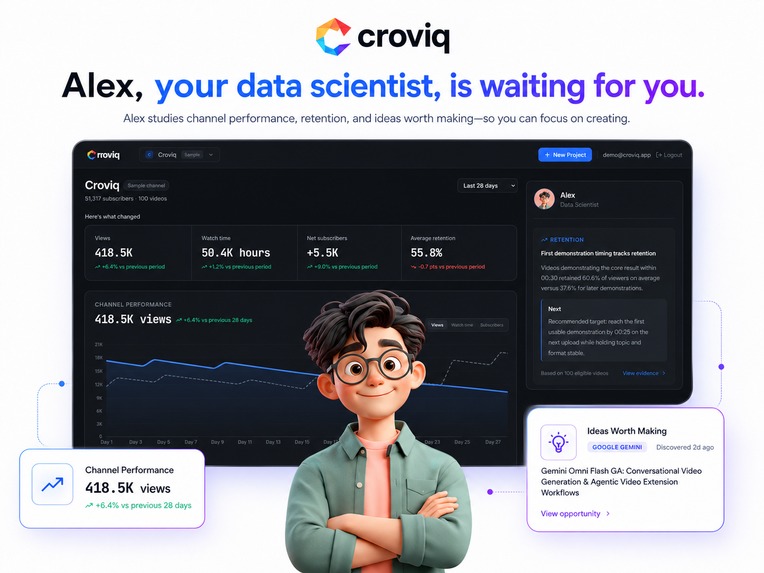
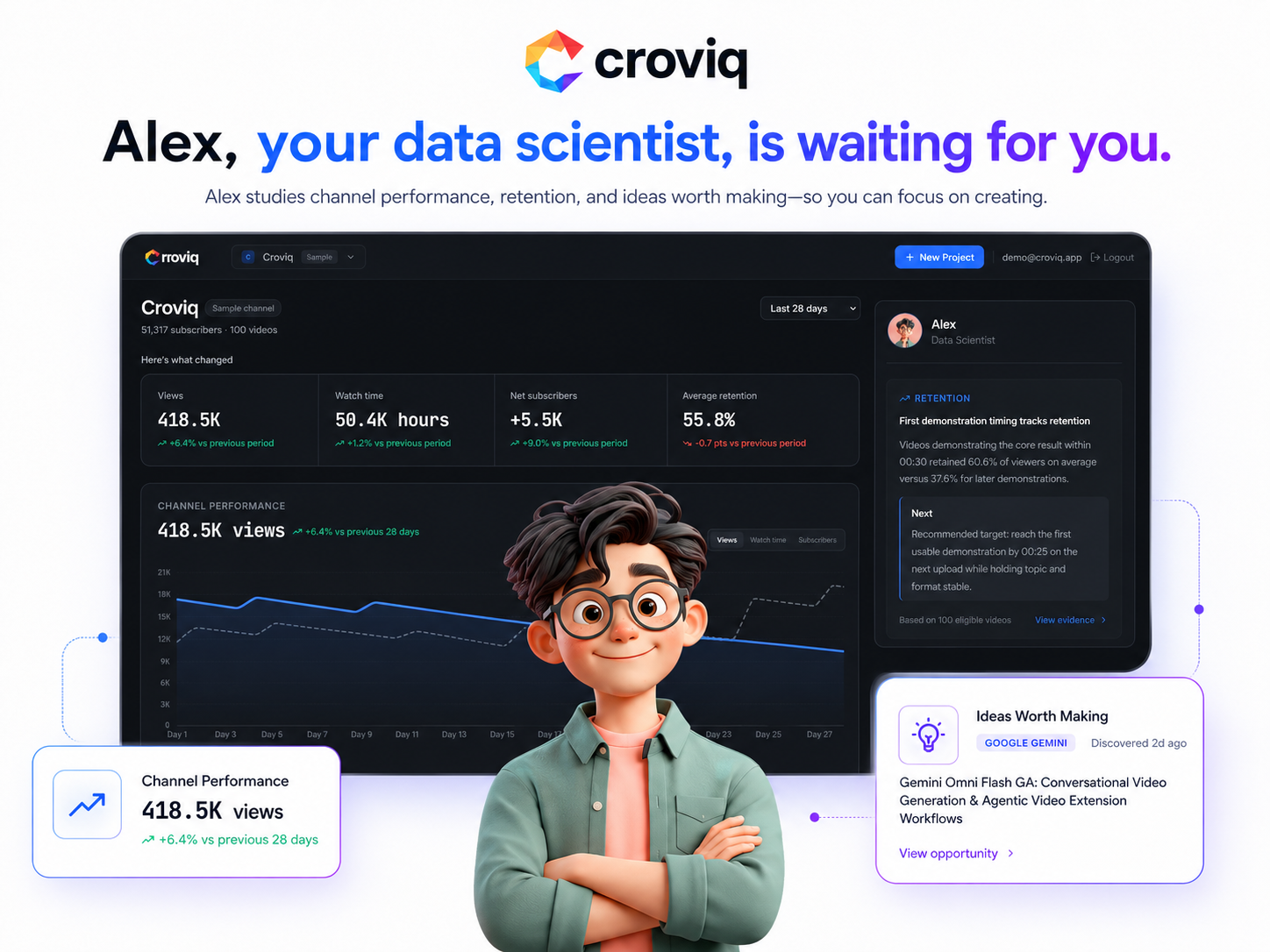
Alex the data scientist
-
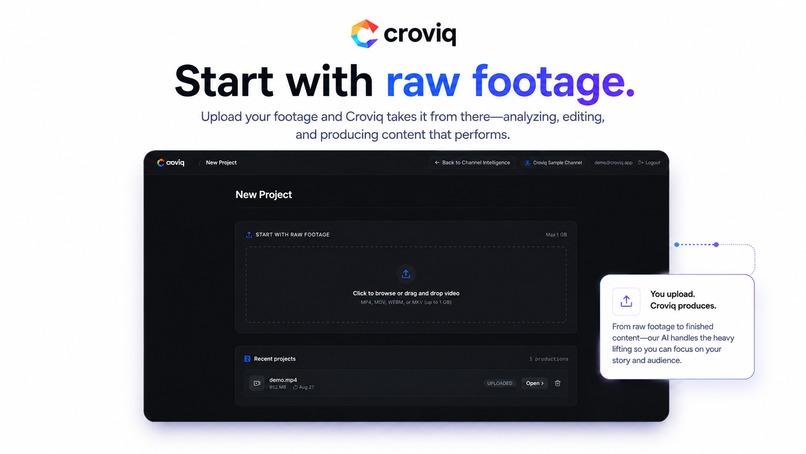
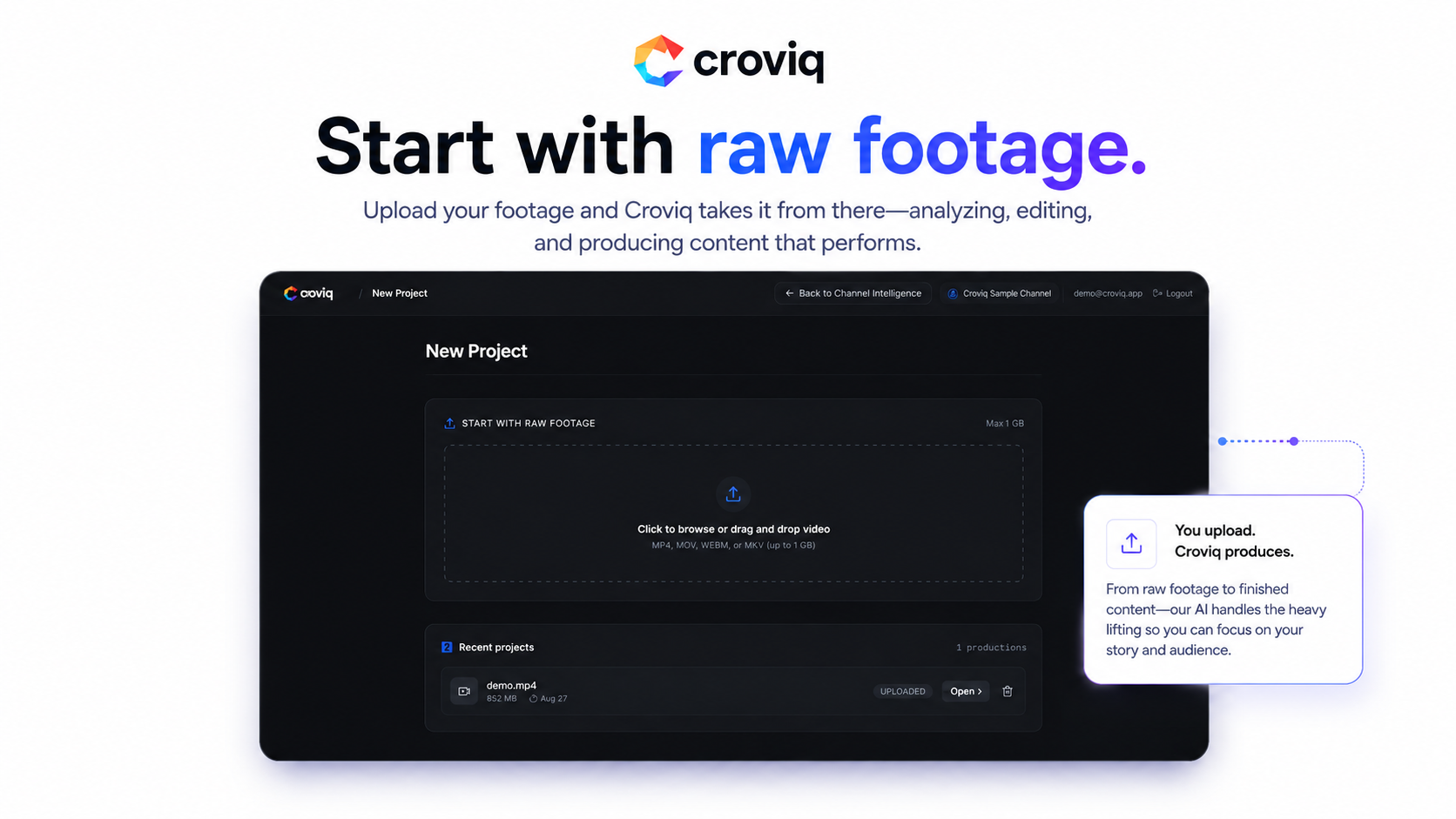
Start with raw footage
-
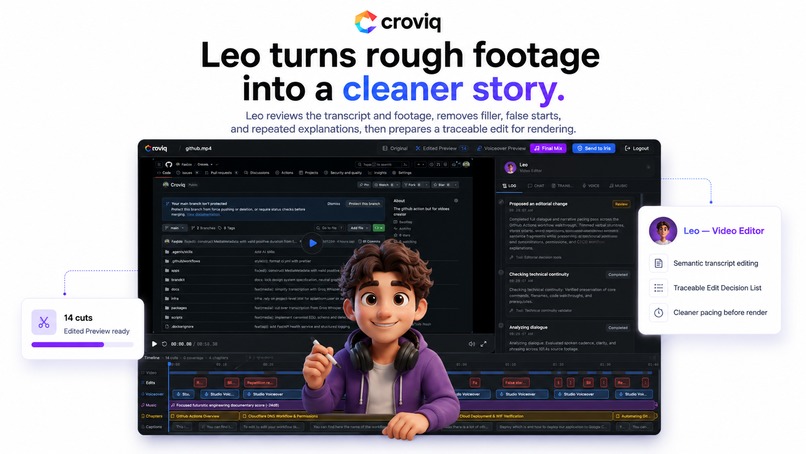
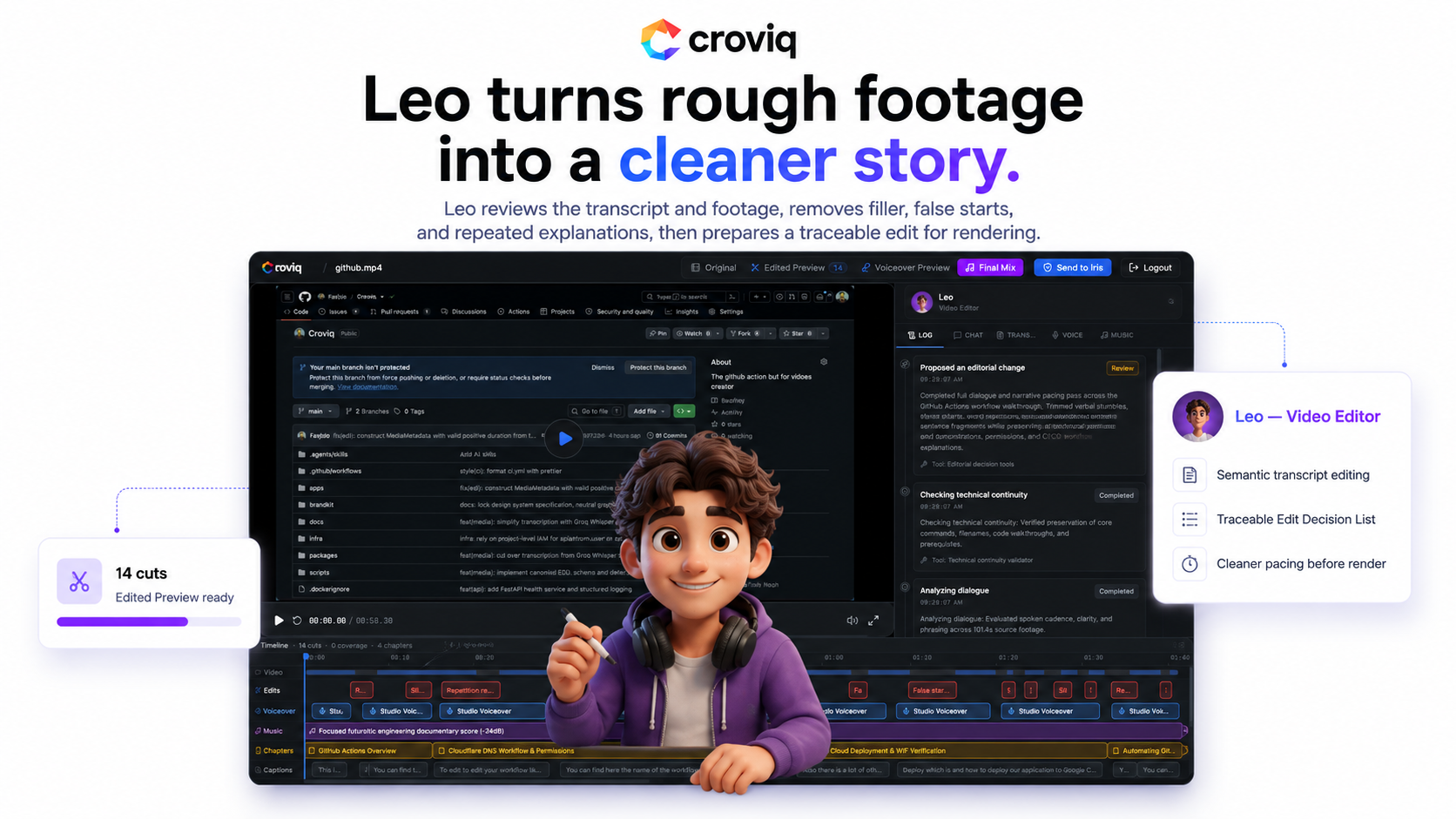
Leo
-
-
Inspiration
I have always wanted to start my own YouTube channel. I had ideas, knowledge, and personal experiences I wanted to share, but when I looked seriously at what it takes to run a good channel, I realized recording the video is only a small part of the job.
A solo creator is expected to research, write, record, edit, publish, understand analytics, figure out why one video worked and another did not, and somehow remember all of that when making the next one. Established creators solve this by having editors, researchers, producers and analysts. New creators usually do everything alone, often while working a normal job.
At the same time, creator-led media is getting bigger. Ofcom reports that YouTube is now the second most watched media service in the UK, and Deloitte found that 55% of Gen Z considers social media content more relevant than traditional media.
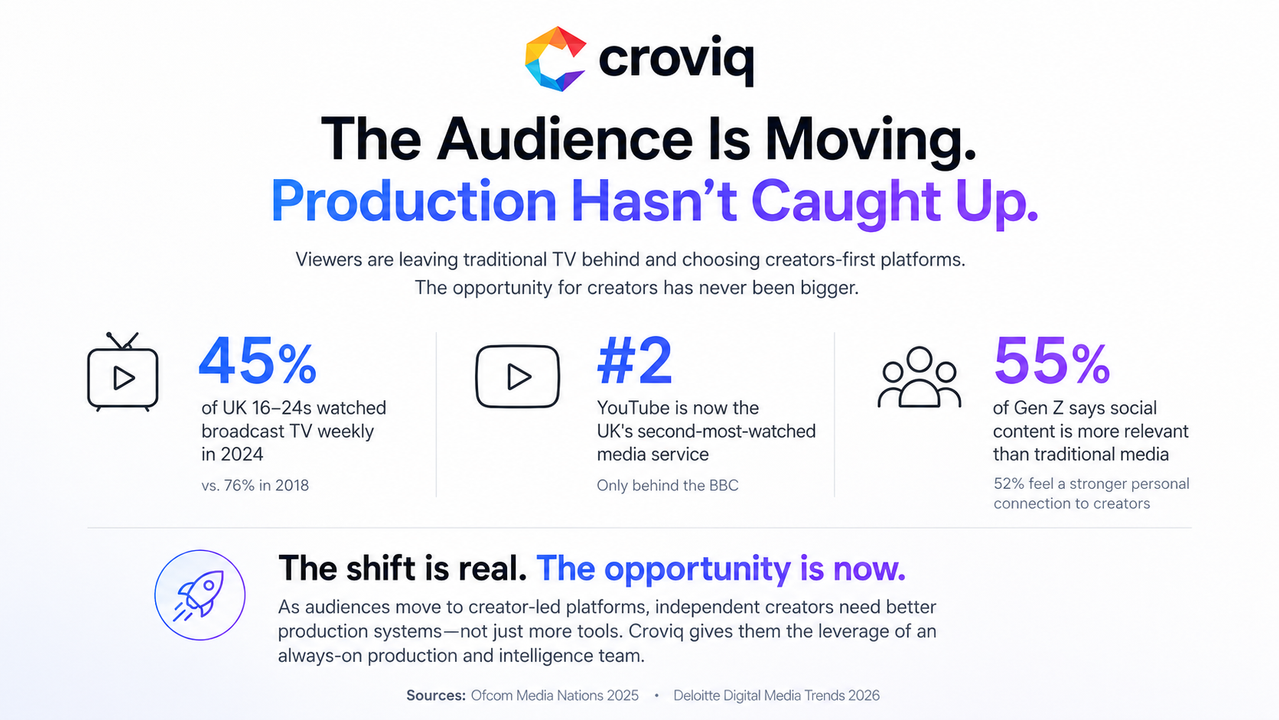
The market is there and The opportunity is huge, but so is the amount of work.
I am a DevOps engineer, so I started thinking about the problem from that perspective. When we ship software, we do not manually rebuild the entire release process every time. We have pipelines that build, test, validate, deploy, observe what happened, and use that information for the next release.
So I asked myself: why shouldn't a creator's channel work the same way?
That became Croviq, the idea is to give one creator the operational leverage of a small media team.
What Croviq does
Croviq is an app that give one creator the operational leverage of a small media team.
The point is not to give the creator another chatbot or another isolated editing tool. The point is to connect the whole production cycle.
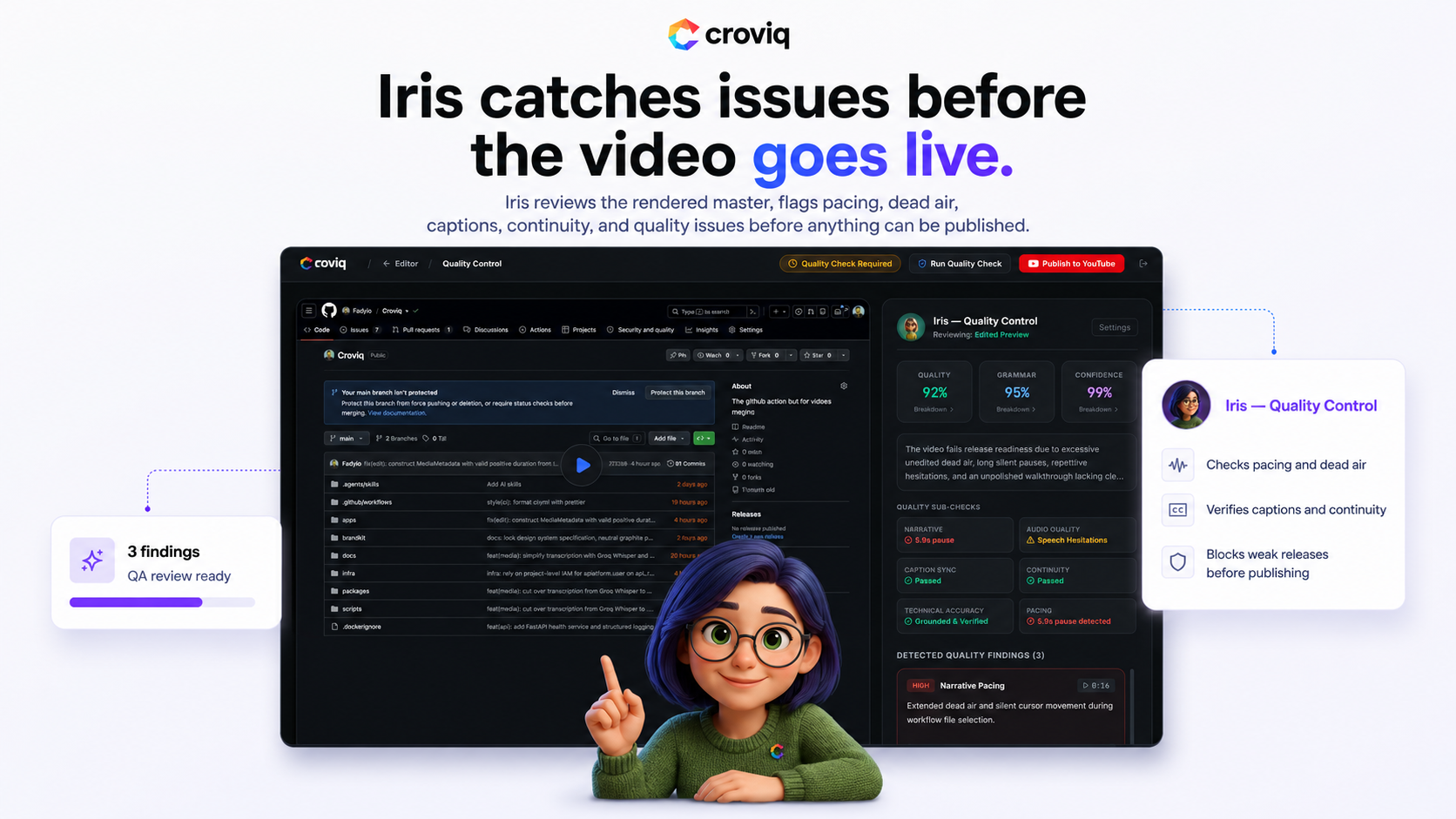
Raw footage goes in. Croviq understands it, edits it, renders it, checks the result, waits for approval, publishes it, studies what happened after release, and save those lessons into the next production.
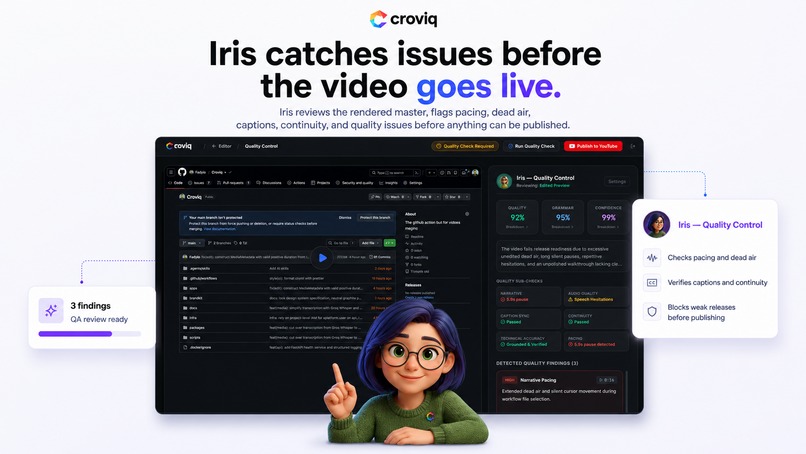
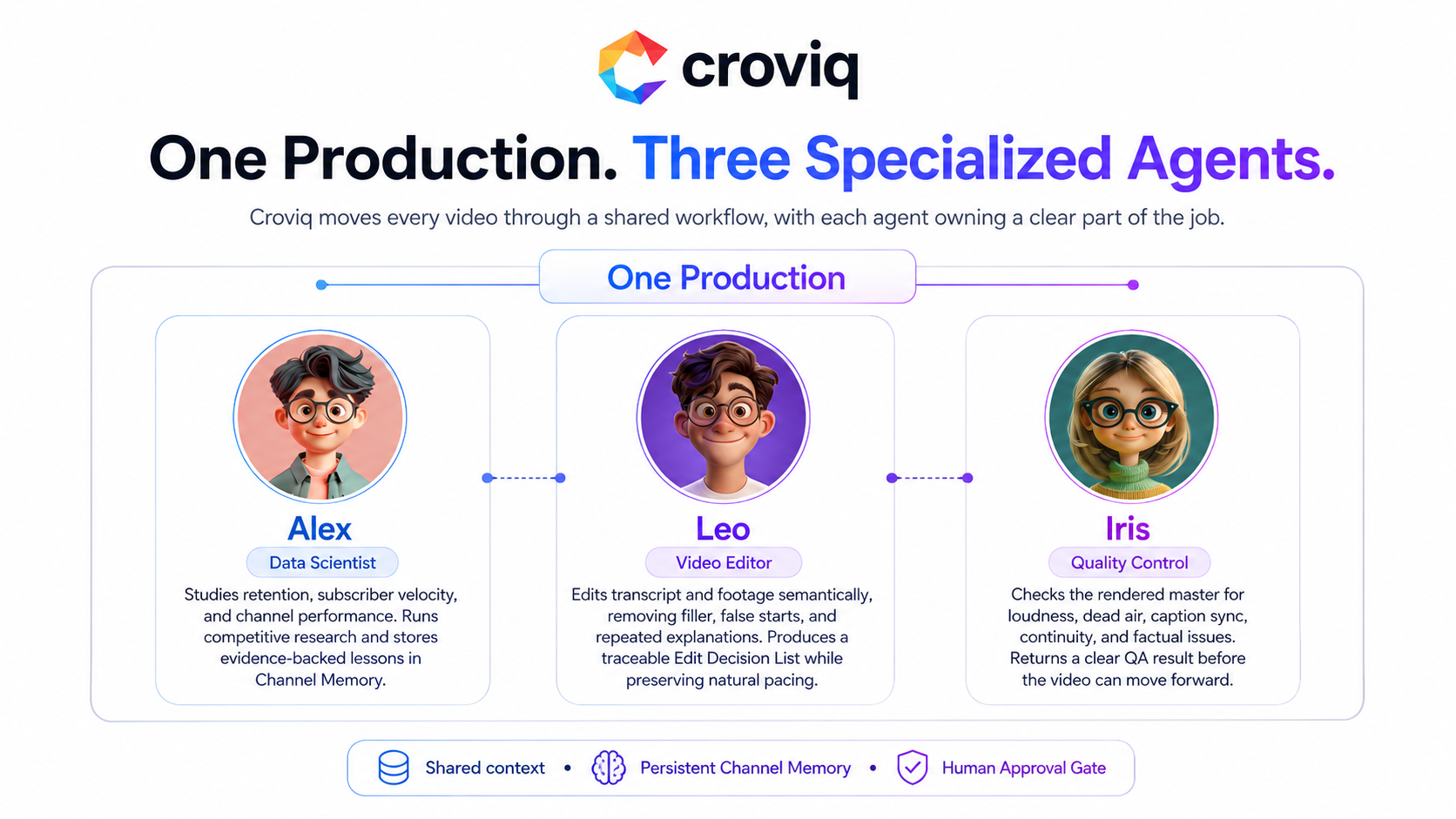
Three agents working on the same production.
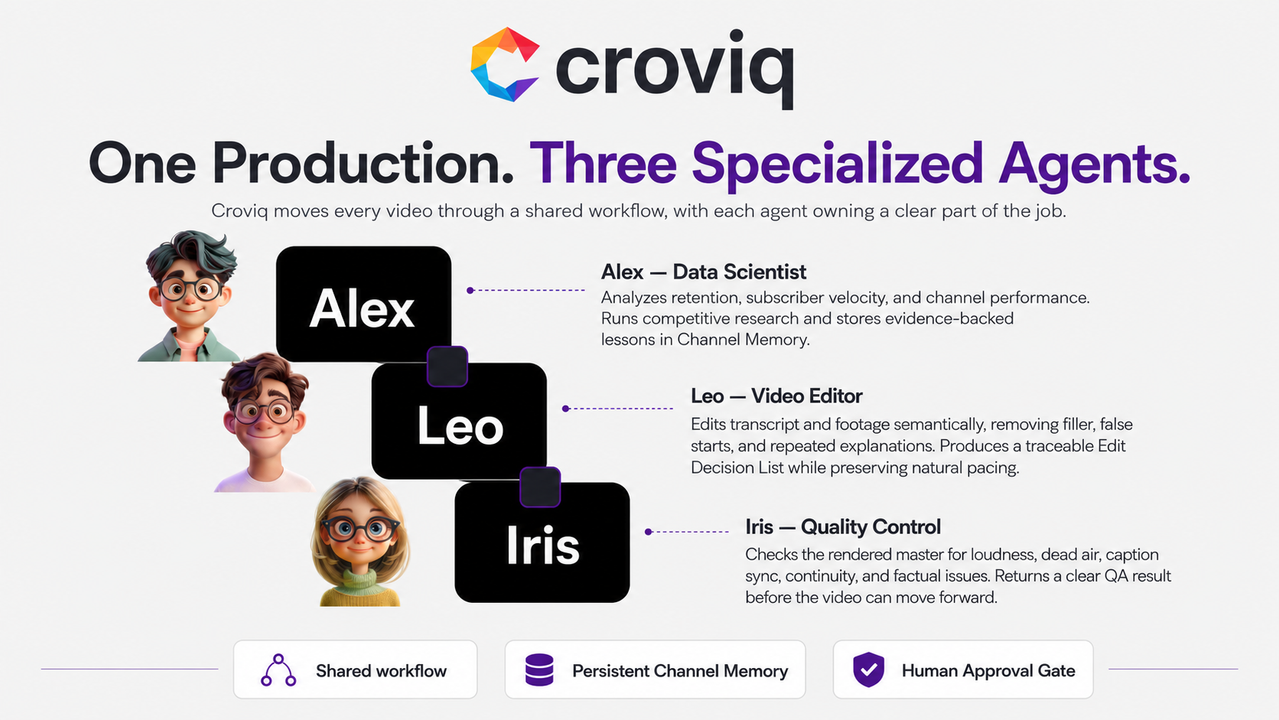
The creator is also always in control. Croviq can do a lot automatically, but it cannot publish past the human approval gate. After Iris finishes QA, the creator has to review and approve the release before anything is sent to YouTube.
How we built it
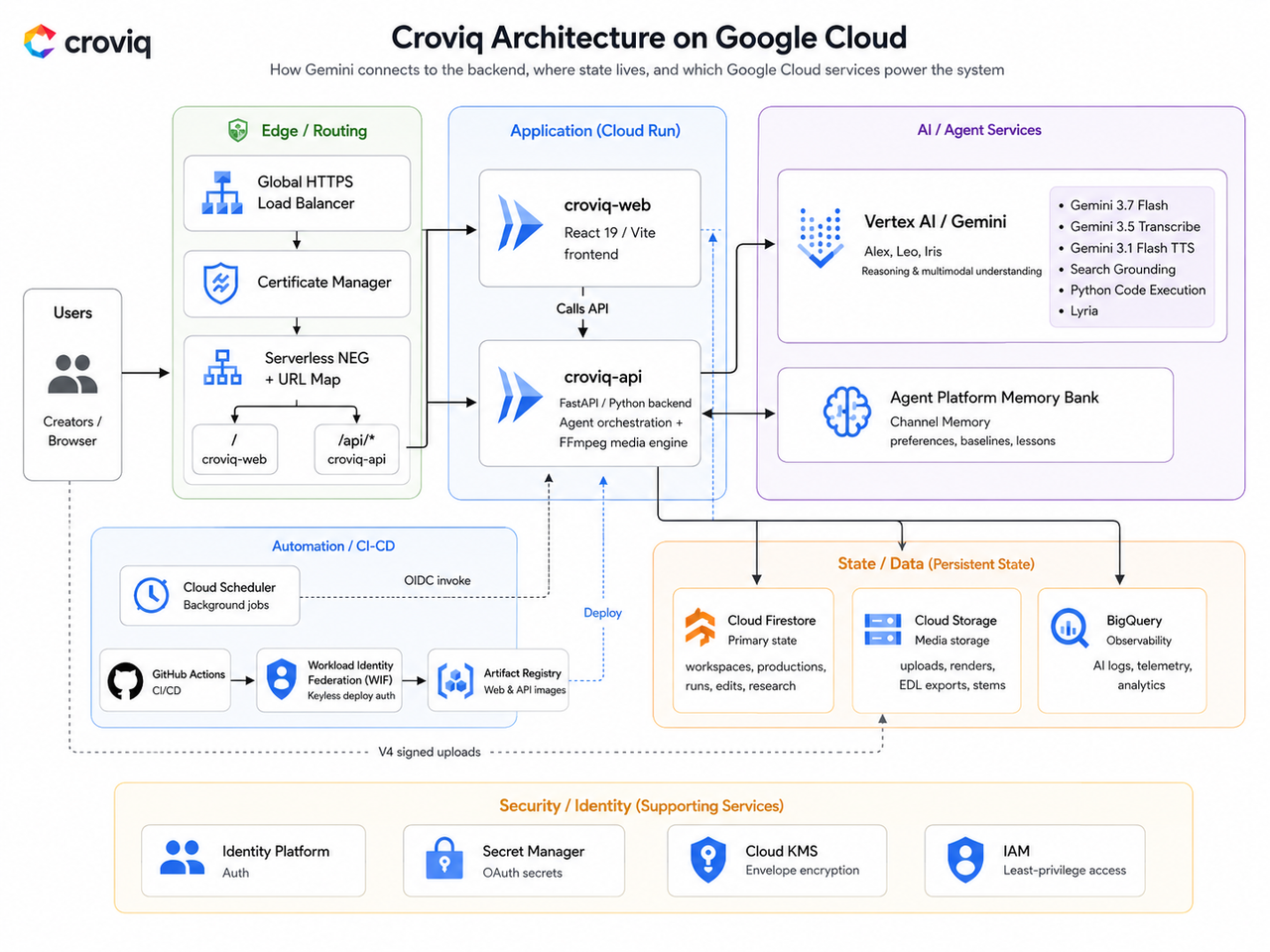
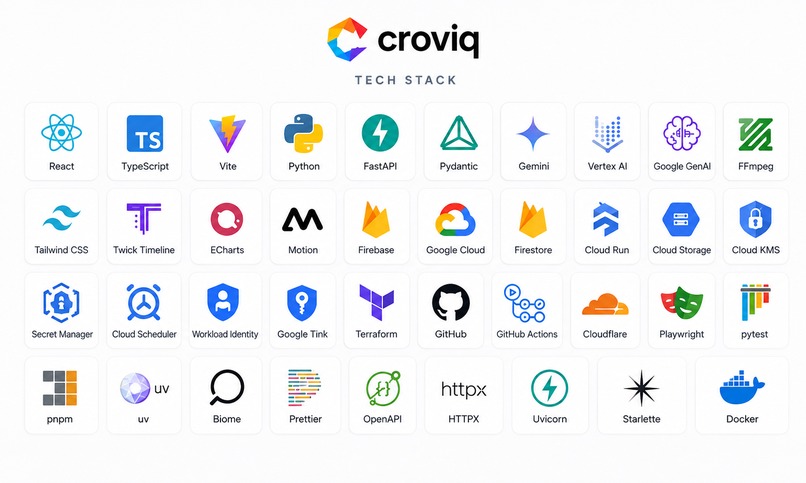
Croviq is a serverless multi agent app that is running on Google Cloud.
The architecture is built around a separation between three things: agent reasoning, production state, and deterministic media execution.
Gemini 3.7 Flash handles agent reasoning and multimodal understanding across video and audio. I use the Google GenAI SDK with Vertex AI for the agent layer. Gemini 3.5 Transcribe handles timestamped transcription, Gemini 3.1 Flash TTS is used for Voice over, Google Search Grounding is used for research for new topics to make videos about, and Gemini Python Code Execution is used by Alex for metric analysis.
Croviq itself is organized as a modular monorepo. The agent code, domain logic, media engine, observability, backend, frontend and infrastructure are separated so one part of the system does not have uncontrolled access to everything else.
Google AI stack
| Capability | Google AI |
|---|---|
| Agent reasoning & video understanding | Gemini 3.7 Flash |
| Timestamped transcription | Gemini 3.5 Transcribe |
| Studio Voice | Gemini 3.1 Flash TTS |
| Grounded research | Gemini Google Search Grounding |
| Metric analysis | Gemini Python Code Execution |
| Persistent creator knowledge | Agent Platform Memory Bank |
| Generated soundtrack | Google Lyria 3 |
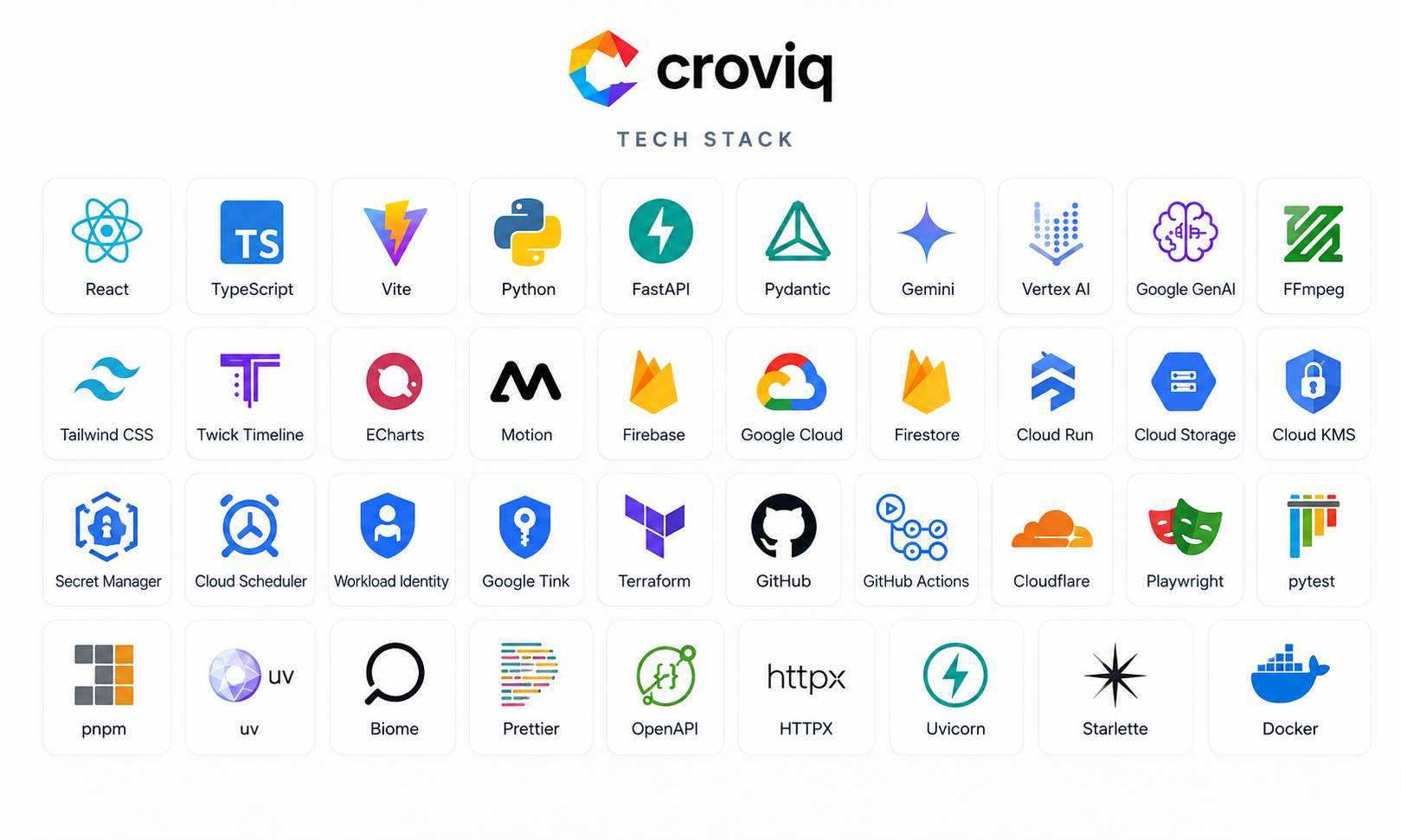
The frontend is built with React 19, TypeScript, Vite, Tailwind CSS, and Twick. The backend is built on FastAPI with Python 3.12.
On Google Cloud, Cloud Run hosts the frontend and API, Cloud Storage holds raw footage and rendered media, Firestore stores productions and state, Vertex AI runs the Gemini models, BigQuery stores AI observability data, Cloud Scheduler handles background jobs, Identity Platform handles authentication, and Secret Manager and Cloud KMS protect credentials and YouTube OAuth tokens.
Large video uploads go directly from the browser to private Cloud Storage using signed URLs instead of being proxied through the API.
The entire environment is managed with Terraform and GitHub Actions deploys using Workload Identity Federation, so there are no long-lived Google Cloud service-account keys sitting in CI.
You can find the full setup and deployment instructions in the GitHub README.
I wanted this to look and behave like a real system, not a hackathon frontend wrapped around one model call, also i wanted to test the gemini coding ability in my line of work.
ps: Gemini 3.7 is fantastic at DevOps tasks and has a deep understanding of Google Cloud Services. It rarely makes mistakes when you ask it to handle any Google Cloud related task.
Challenges I ran into
- Time was easily the biggest challenge when i started i had whole list of features that i want to do but i only had 7 days, I built Croviq completely solo while working full time. Most of the real work happened in the last five(I found out you can manage the agent right from your phone) . In that time I was building the agents, backend, frontend, infrastructure, security, media pipeline and testing.I am DevOps engineer and almost all of my professional cloud experience is in AWS. Before this project I had very limited hands-on experience with Google Cloud, and I am not primarily a frontend or backend engineer either.
- I was learning while building, Vertex AI, Cloud Run, Firestore, Identity Platform, KMS, the Google GenAI SDK, React, FastAPI and video processing all had to come together in one system. Google’s documentation and gemini honestly made the learning curve much easier than I expected.
- Context pollution and code rot: This was probably the hardest development problem when you doing agentic coding. An agent can introduce one weak implementation or bad pattern, then reuse it until it spreads across the codebase. If you do not catch those mistakes early, cleaning them up later becomes painful. Keeping the architecture clean required constant review.
- Gemini 3.7 itself was one of the best parts of the project. It is extremely fast, intelligent and especially good at frontend work, you can throw at it any screenshot and it will understand it like any human does, it has one of the best vision that i tried. I built Croviq using only Gemini 3.7 in oh my pi, which will take me to the next point, Most of my frustration was with the tooling around the model, I gave Antigravity CLI and desktop a real chance, but after running into limitations (I tried to make Antigravity to use chrome to debug something in the frontend but with no luck, it doesn't want to use chrome no matter what) around extensibility, tool use and the ecosystem, I went back to my normal setup(oh my pi and pi).
That was frustrating mainly because I think the underlying Gemini 3.7 model is already very good and so underrated. The model feels ahead of some of the tooling around it.
PS: If anyone from Google or DeepMind reading this, I have a lot of feedback during the build around Gemini agent behavior, Antigravity, CLI friction and the general developer experience also about jules and stitch. I would be happy to share it regardless of the result of the hackathon.
Accomplishments that I'm proud of
Most of the real work happened in last five days, outside my normal job. In that time, I designed and built the frontend, backend, agent workflow, cloud infrastructure, security, media pipeline, and testing.
What I am proud of is not just the amount of code. It is that all of those parts actually work together as one system.
This project also changed the way I think about AI assisted development. Two years ago, if you tell me you can build an app like this with only less than 7 days, I would not believe you. You still need to understand what you are building and catch bad architecture, bad assumptions, and bad code, but the amount of leverage is hard to ignore. Something at this scale would normally take a month to design and build properly, If this is what one developer working outside his normal stack can attempt today, I am very curious to see what software development looks like 5 years from now.
And lastly, I want to thank you, Google's team, especially Christina Lin, Willie Turney and Annie Wang(I watch a lot of your videos on youtube). One thing you said really stuck with me: the most important thing is to have fun. I definitely did. This hackathon gave me an excuse to experiment with Google models and tools I had never used before. I did not even know Google had a music generation model until I learned about Lyria from one of Christina Lin’s videos. I tried it, loved the results, and ended up integrating it into Croviq, That was one of the best parts of the whole experience. I did not just build an application. I discovered tools and ideas I probably would not have explored otherwise and had fun doing it.
What I learned
- Google Cloud Most of my professional cloud experience has been with AWS, so Croviq was the first project where I built the whole system on Google Cloud, I genuinely enjoyed learning how Google Cloud approaches things differently. I spent time reading about services, Cloud Run, Vertex AI, Firestore, KMS, and the rest of the stack, and the documentation made it much easier to get productive quickly, There are still areas I think could be improved in the Vertex AI documentation.
- Knowing when to code by hand: While AI tools helped design and scaffold the system quickly, I learned their limits. When it comes to complex backend logic and state management, relying purely on AI coding agents causes friction you still need solid engineering in python to make everything reliable.
- The collapse of traditional media: Reading through research papers on modern viewing habits was eye-opening. Younger generations are abandoning traditional media like newspapers and broadcast TV entirely, turning to TikTok, X, and YouTube not just for entertainment, but as their primary sources for daily news and information.
What's next for Croviq
- Translation, Dubbing Agent: Adding a dedicated localization agent to the mix, that translates and dubs a single video into multiple languages to help creators communicate clearly with audiences worldwide, removing the language barrier entirely.
- Integrated AI Video Generation: Integrating Google's generative video tools to create B-roll and visual scenes directly inside the app. This keeps everything in one unified workspace without juggling third-party tools.
- Autonomous Business & Sponsorship Agent: Building an AI employee dedicated purely to monetization. This agent will research new revenue streams, identify brand fit, and draft outreach emails to secure sponsorships so creators can turn their channels into viable businesses faster.
- Add Veo 3.1 and Omni 1.1 to make b-roll and upscale the video to take this to the next level, I tried to add them but i didn't have time.
And much much more, I want to create the best creator platform.
if you made this far thank you and have a nice day.
Built With
- cloud-run
- cloudflare
- fastapi
- firebase
- gemini-3.5-transcribe
- gemini-flash-3.7
- lyria
- python
- react
- tailwind
- twick
- typescript
- vertex
- vite

Log in or sign up for Devpost to join the conversation.