Inspiration
Every day, pedestrians and vehicles share urban spaces governed by traffic lights that often rely on fixed timing rather than real-time conditions. But traffic is dynamic, and not everyone crosses the road at the same speed.
We imagined a smarter pedestrian crossing: one that can see, understand, and react to what is happening around it.
That's how CrossSense was born — an intelligent, AI-powered crossing system designed to make urban mobility safer, more inclusive, and more efficient, without relying on cloud services or an Internet connection.
What it does
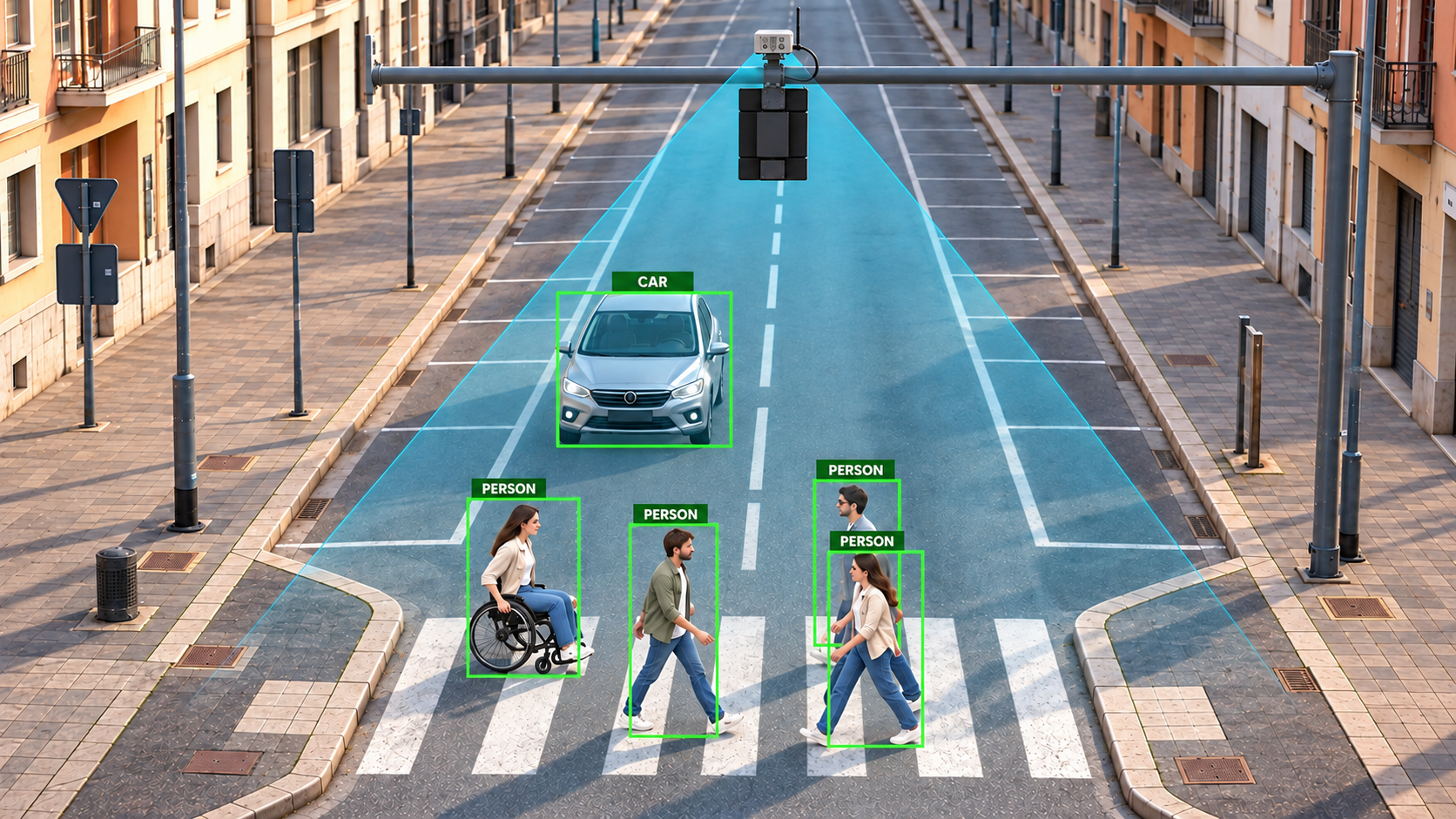
CrossSense transforms a traditional pedestrian crossing into an intelligent, adaptive system powered by offline AI.
Using a camera and local computer vision, the system monitors pedestrian waiting areas, crosswalks, and approaching traffic.
It provides three main capabilities:
- Adaptive Traffic Lights: Dynamically adjusts signal timing based on pedestrian demand, vehicle traffic, and accumulated waiting time, within predefined safety limits.
- Intelligent Pedestrian Protection: Detects when someone is still crossing after the pedestrian signal turns red and keeps conflicting vehicle traffic stopped until the crossing is clear.
- Traffic Analytics and Early Warning: Recognizes road-user categories, counts crossings, identifies movement directions, and supports early warnings when approaching vehicles could create dangerous situations.
CrossSense is designed to operate entirely offline, making it suitable for environments where connectivity is limited, unreliable, or unavailable.
How we built it
We developed CrossSense around the Arduino UNO Q, combining embedded computing, computer vision, and intelligent traffic management.
Our architecture consists of three main components:
- AI Perception: A camera monitors the intersection while an on-device AI model identifies pedestrians, bicycles, vehicles, and visible mobility aids.
- Decision-Making Engine: A traffic management algorithm processes detections, vehicle counts, pedestrian waiting times, and crosswalk occupancy to dynamically determine signal behavior.
- Traffic Control and Monitoring: The system translates decisions into traffic light commands and collects operational metrics to evaluate performance and safety.
The AI inference and decision-making processes run locally, removing the need for cloud infrastructure.
We also designed a demonstration featuring changing traffic conditions, pedestrians requiring additional crossing time, and approaching vehicles in potentially critical scenarios.
Challenges we ran into
Building an intelligent crossing system requires much more than detecting objects.
One of our biggest challenges was turning AI detections into reliable, real-time traffic decisions.
We had to consider several aspects:
- Running computer vision efficiently on embedded hardware with limited computational resources.
- Distinguishing pedestrians waiting to cross from those already moving across the road.
- Balancing traffic efficiency with pedestrian safety without introducing unpredictable signal behavior.
- Handling pedestrians who move slowly, stop unexpectedly, or remain in the crossing after the normal clearance interval.
- Preventing false detections from causing unnecessary or unsafe traffic light transitions.
The central engineering challenge was ensuring that AI supports traffic decisions without compromising deterministic safety rules.
Accomplishments that we're proud of
Our biggest achievement is bringing together Edge AI, embedded systems, and adaptive traffic management into a single intelligent crossing prototype.
We're particularly proud of:
- Designing an offline-first system that does not depend on Internet connectivity.
- Combining real-time object detection with traffic signal decision-making.
- Prioritizing pedestrian safety while also considering overall traffic efficiency.
- Introducing a crossing-clearance protection mechanism that responds to actual crosswalk occupancy rather than relying exclusively on fixed timers.
- Defining measurable performance indicators, including waiting times, traffic counts, response latency, false alarms, and protection continuity.
Most importantly, CrossSense demonstrates how accessible embedded AI technology can be applied to a real-world urban mobility problem.
What we learned
CrossSense taught us that building an AI-powered system is not just about making accurate predictions — it's about turning those predictions into meaningful, reliable actions.
We explored the interaction between computer vision, embedded processing, traffic control algorithms, and real-world safety constraints.
We also learned the importance of separating AI perception from deterministic control logic, designing for uncertain detections, and measuring system behavior rather than relying only on model accuracy.
The hackathon reinforced the value of multidisciplinary engineering and rapid prototyping to transform an idea into a tangible solution.
What's next for CrossSense
Our vision is to evolve CrossSense from an hackathon prototype into a scalable intelligent mobility platform.
Our next steps include:
- Improving AI robustness: Optimize inference performance and detection reliability across different lighting, weather, and traffic conditions.
- Expanding safety capabilities: Improve the detection of hazardous situations involving approaching vehicles and vulnerable road users.
- Advanced traffic optimization: Introduce predictive traffic management using historical and real-time traffic patterns.
- Real-world validation: Test the system in controlled environments and evaluate safety, latency, and reliability against defined requirements.
- Smart City integration: Develop monitoring interfaces and support future integration with broader urban mobility infrastructure.
Our long-term goal is simple: make pedestrian crossings safer, smarter, and more inclusive — one intersection at a time.
CrossSense — See the crossing. Sense the risk. Protect every step.

Log in or sign up for Devpost to join the conversation.