Inspiration
Big decisions are hard because one brain only has one perspective. Committees make better calls — when they argue well. But most of us make our biggest decisions alone, in our heads, with our biases unchecked. So I built the committee.
What it does
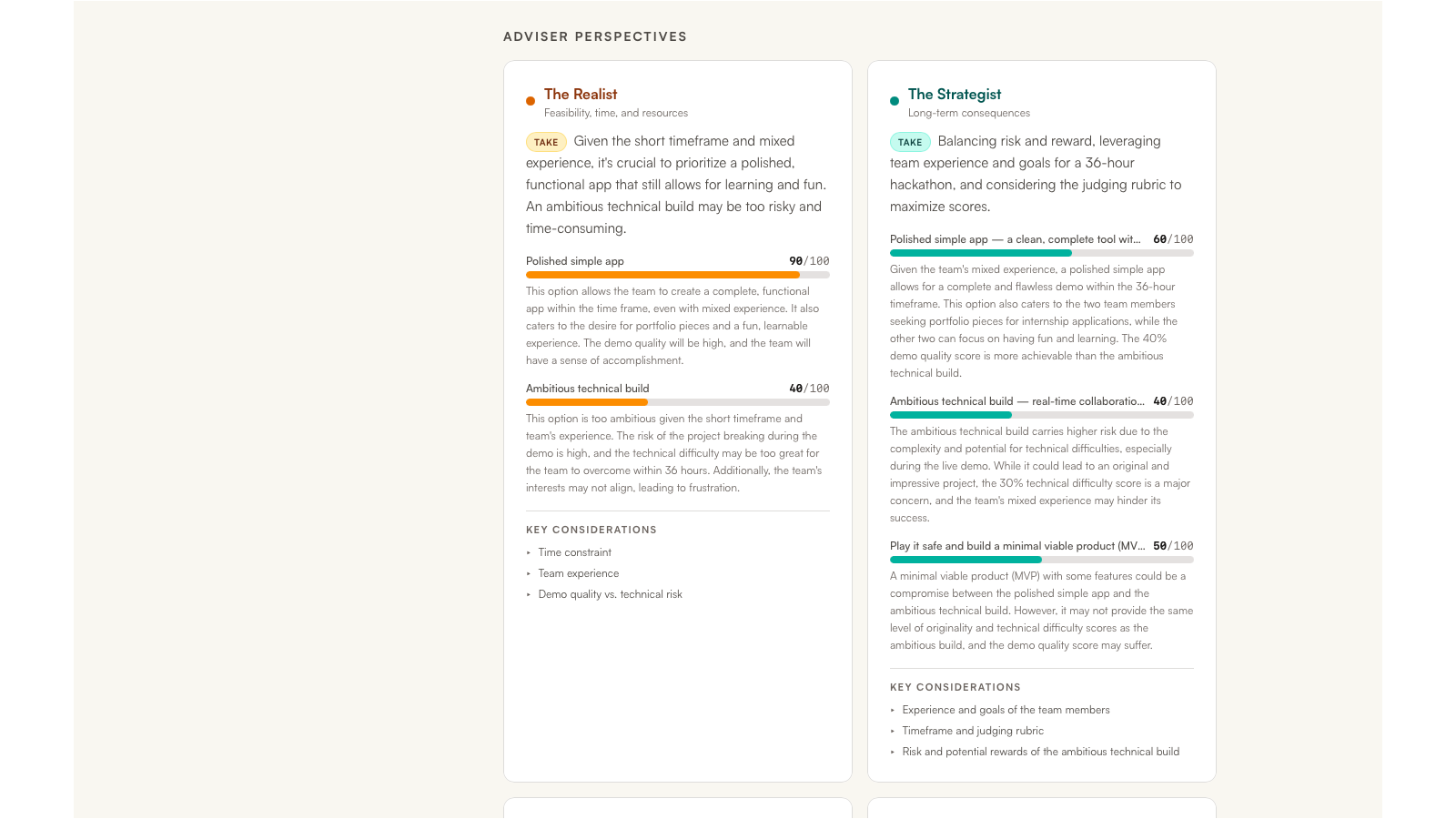
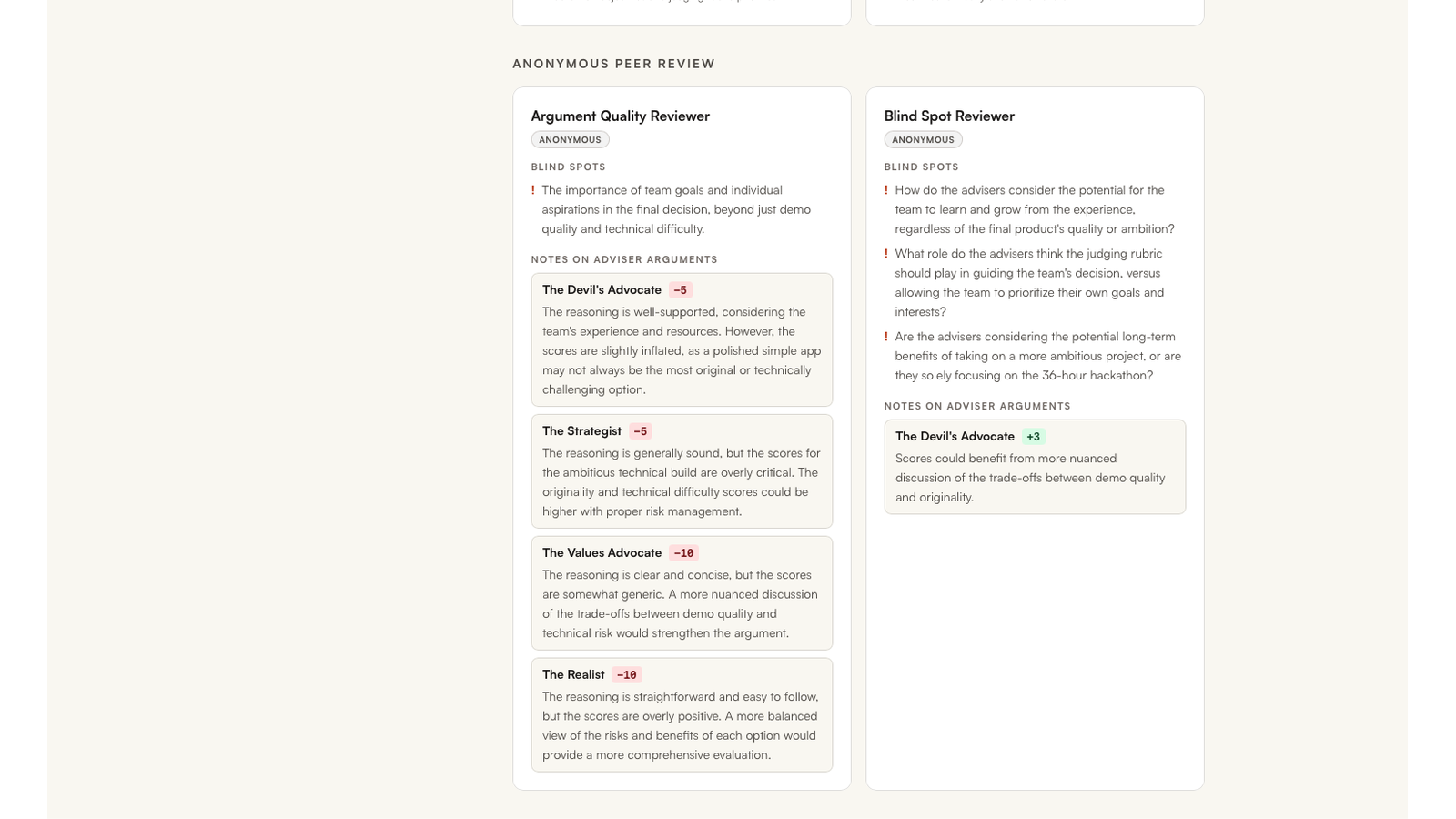
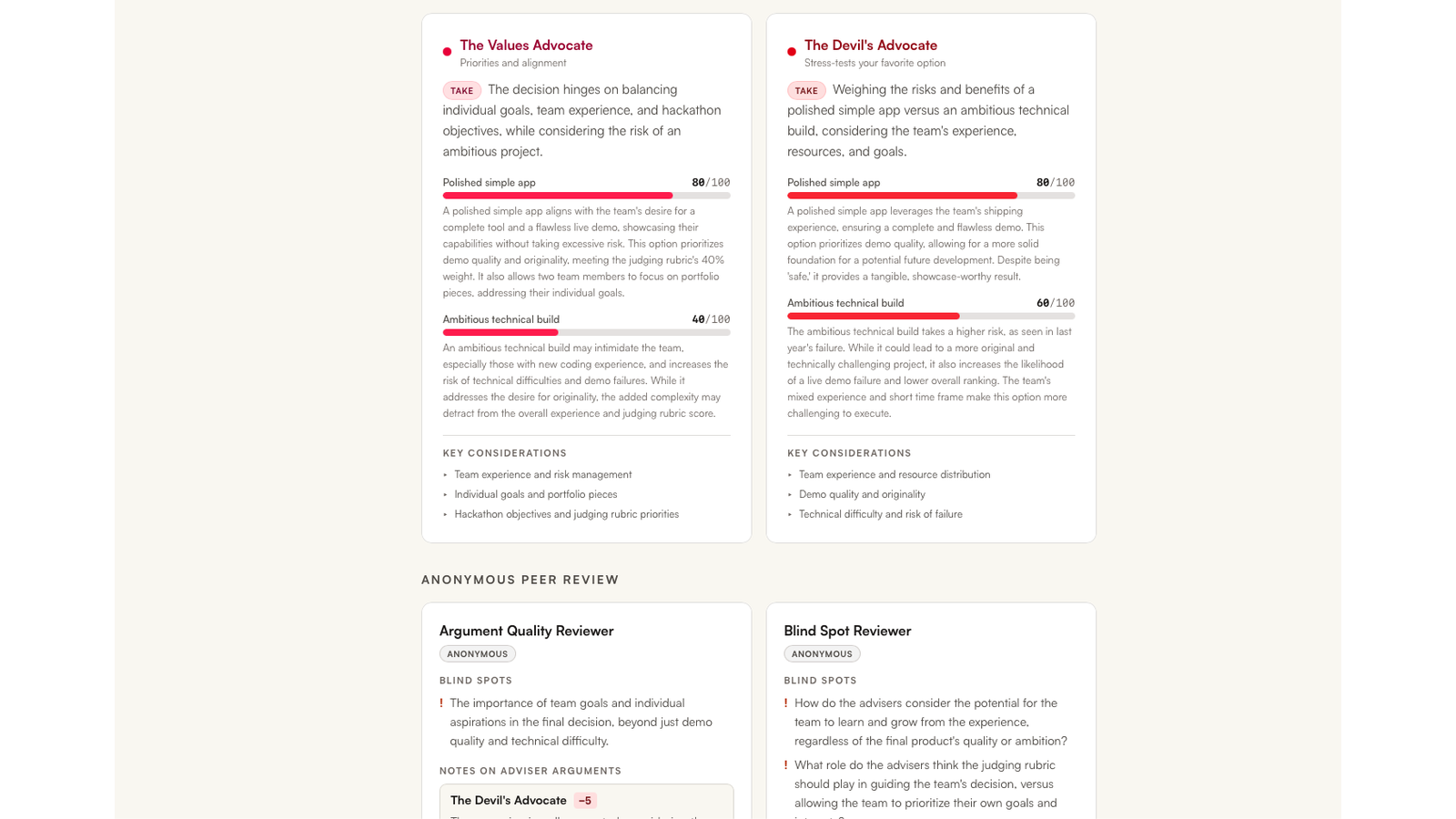
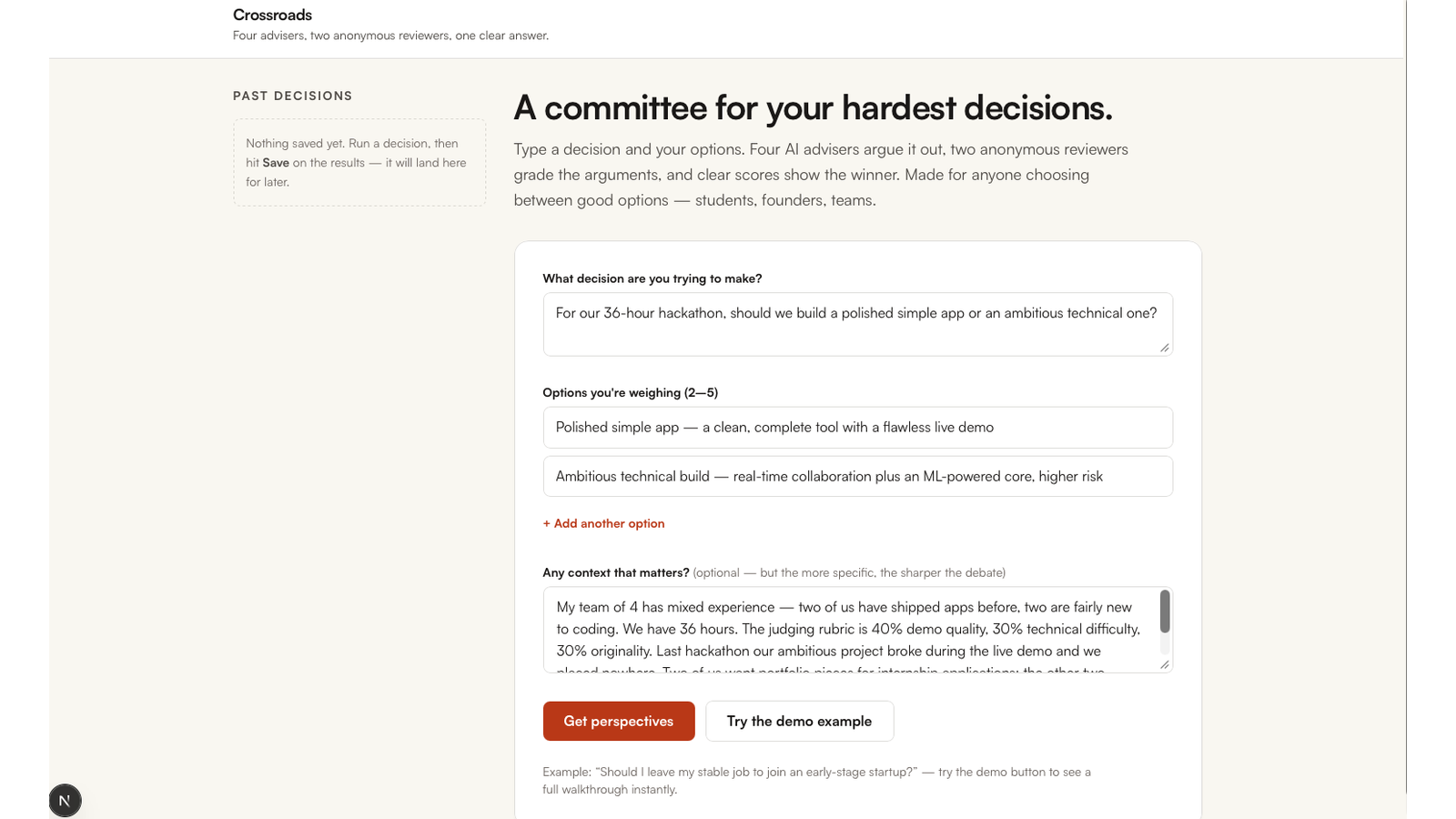
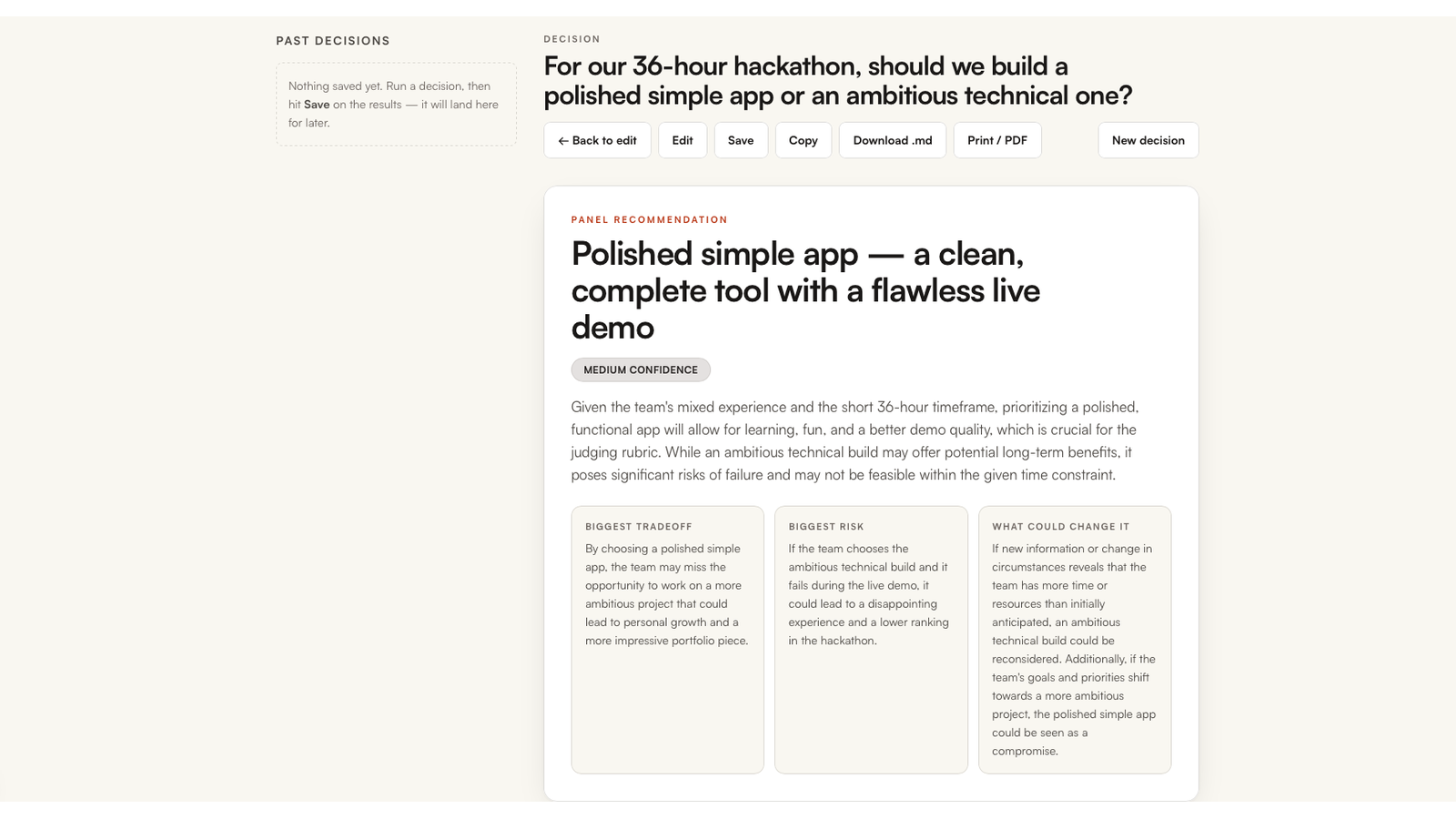
You enter a decision, 2–5 options, and what matters to you. Four independent AI advisers take it up — a Practical Realist, a Long-Term Strategist, a Values Advocate, and a Devil's Advocate that stress-tests your favorite option. Two anonymous reviewers grade every argument for quality and blind spots without knowing who wrote which. Deterministic code tallies the final scores — the model never grades itself. You get a recommendation with confidence, reasoning, biggest tradeoff, biggest risk, and what could change the answer. Edit inputs mid-flow through a floating panel, save past decisions to a sidebar, export as Markdown or PDF.
How we built it
Next.js + TypeScript + Tailwind on the frontend; a single API route orchestrates the pipeline. Seven model calls per decision — four advisers fired concurrently, two reviewers on the shuffled outputs, one synthesis call — all through a provider-neutral client that reads AI_BASE_URL / AI_MODEL / AI_API_KEY from env. It was built to run on local Ollama (llama3.2, 3B) with zero cloud dependency, and the same unchanged code later deployed to Vercel on Gemini — just env vars, no rewrite. A demo mode runs the full UI with zero model calls. Built with AI-assisted development: the code was generated with AI tools, then debugged, tested, and verified by hand — typecheck, lint, production build, end-to-end test on local hardware.
Challenges
At build time no cloud API key was available, so the architecture had to run entirely on local hardware — that constraint forced the provider-neutral design, and the privacy story came free with it. Getting reliable structured JSON out of a 3B local model took retry-and-validate logic. The advisers occasionally invented extra options nobody asked for, so display-side dedup went in. The whole UI got reskinned to look like a real product instead of an AI demo. Once keys came through, the same unchanged code deployed straight to Vercel — which proved the provider-neutral bet.
What's next
The app interrogates you before deliberating ("what's irreversible here?") instead of taking your first draft at face value, and grounds its arguments in retrieved facts instead of vibes.
Built With
- gemini
- llama3.2
- next.js
- ollama
- tailwindcss
- typescript
- vercel

Log in or sign up for Devpost to join the conversation.