-
-
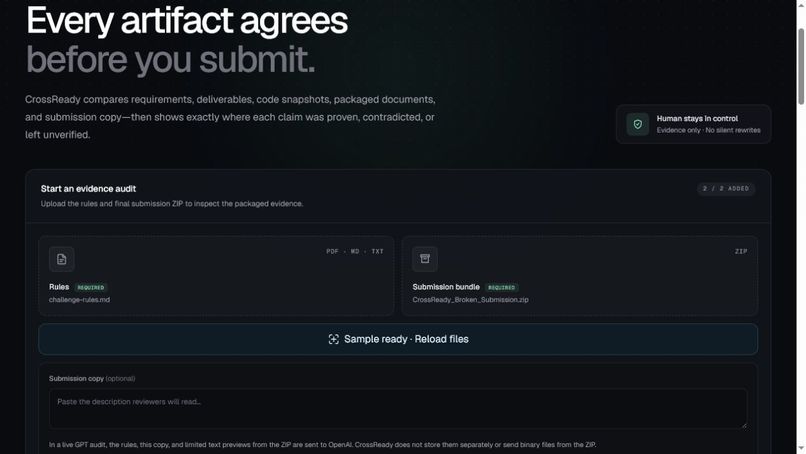
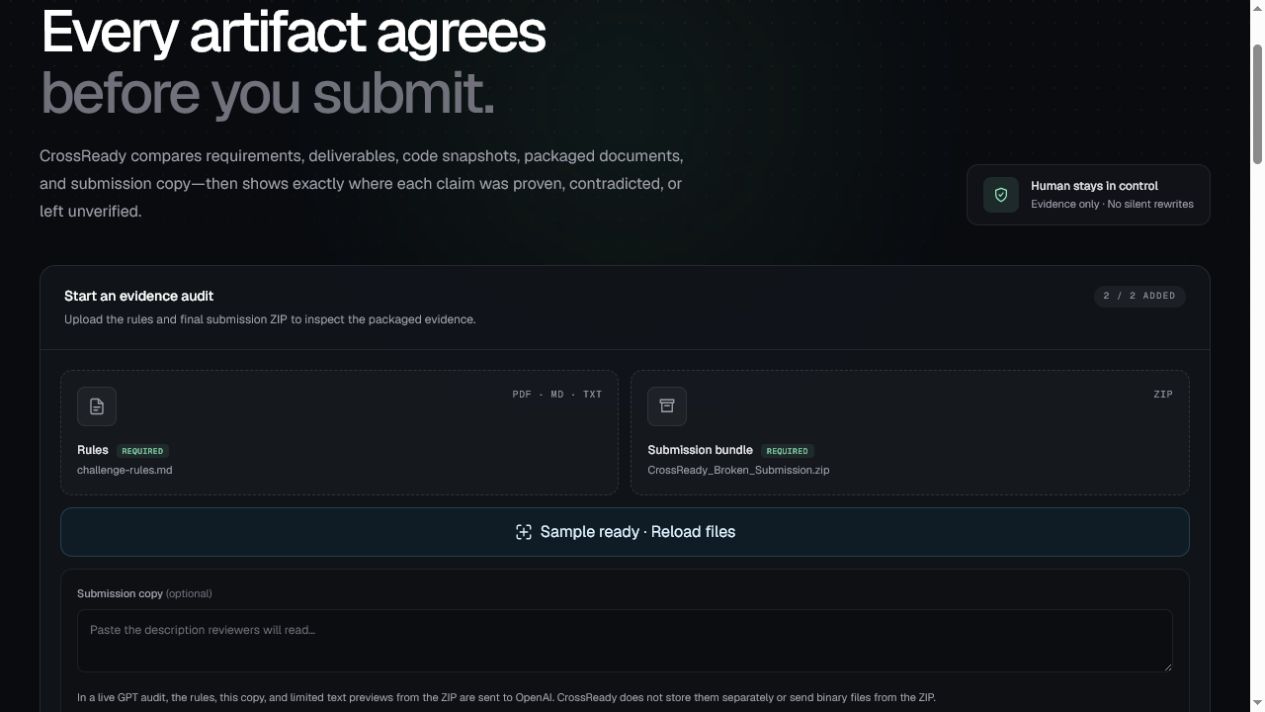
Submission package CI: rules, ZIP, optional reviewer copy, and a no-login sample path.
-
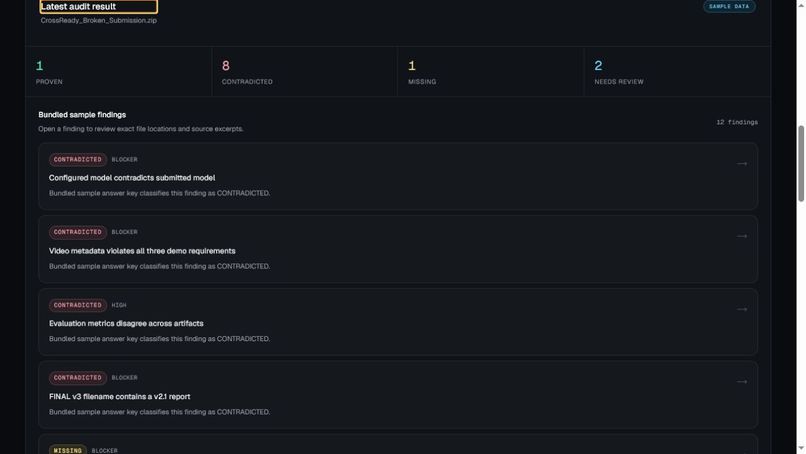
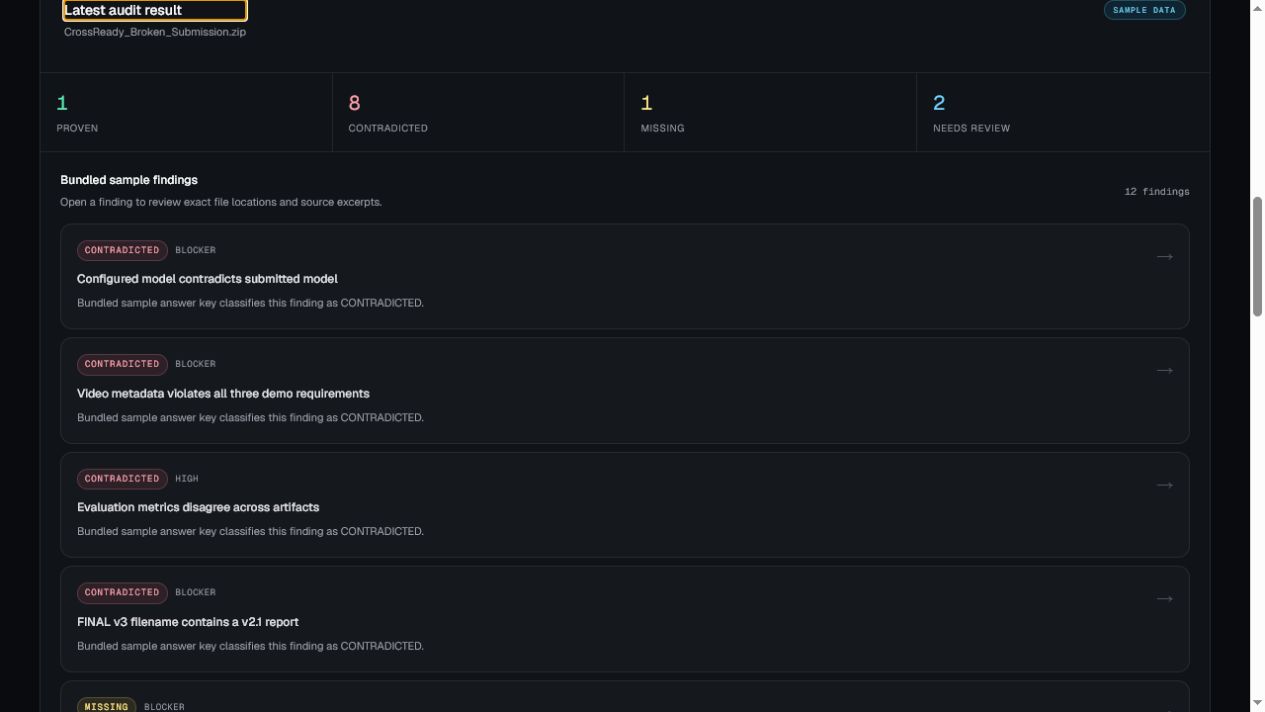
Public reviewer flow: 12 evidence-backed findings with exact status totals; no login or paid API key required.
-
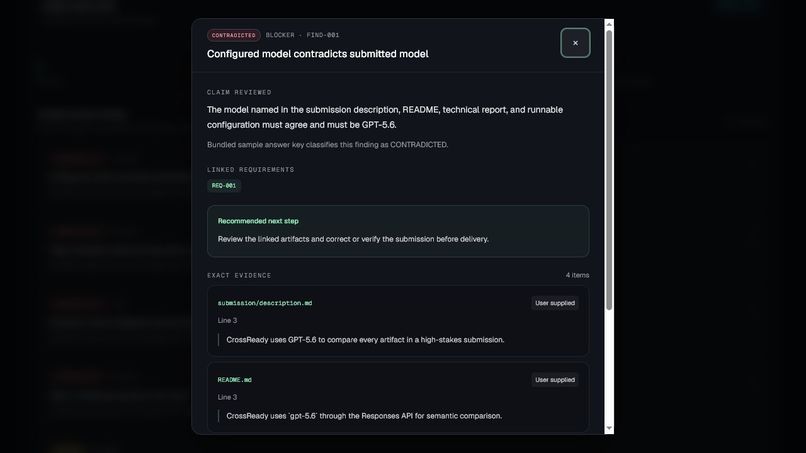
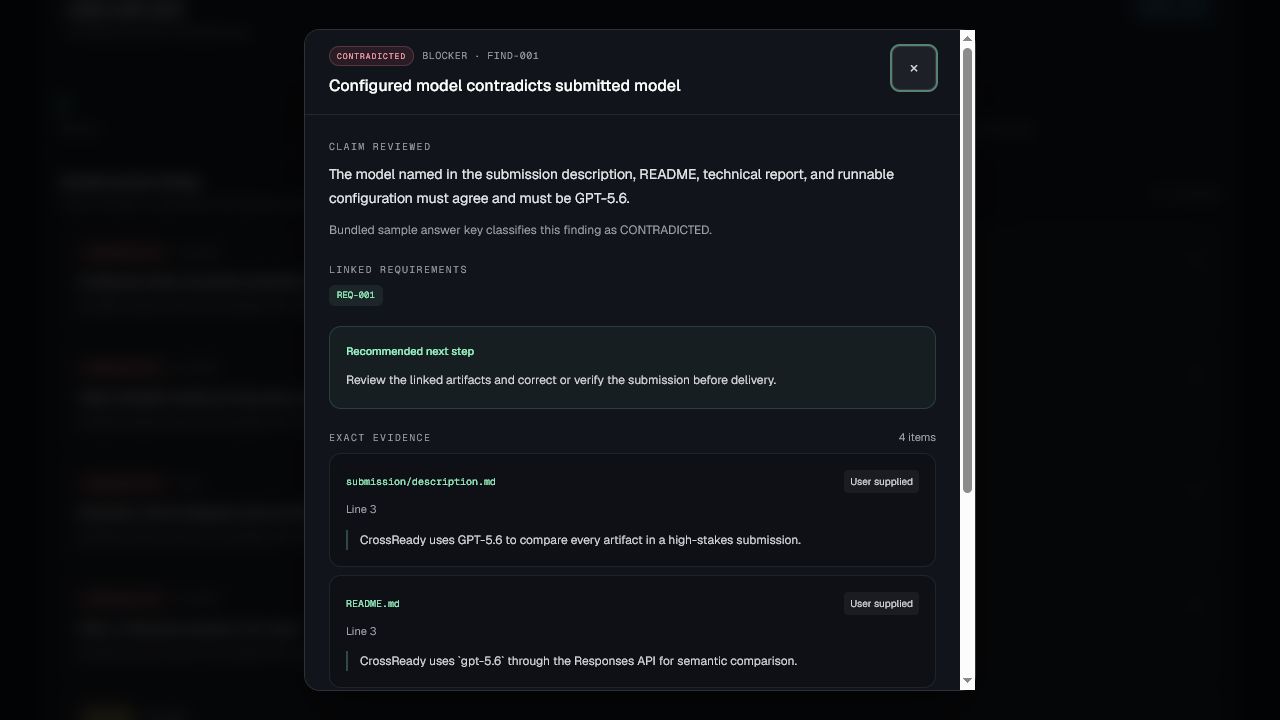
Evidence detail: verified file, exact line or page locator, quoted excerpt, and recommended next step.
Inspiration
CrossReady is CI for final submission packages. Unlike a document-only checker, it examines the entire handoff: rules, submission copy, ZIP contents, source configuration, manifests, and exact file hashes. GPT-5.6 finds semantic conflicts; deterministic code verifies whether the cited evidence exists.
A high-stakes submission can pass every individual checklist and still fail as a package.
The project description may claim one model while the code configures another.
A file named FINAL_v3 may contain a report labeled version 2.1. The README may
say every test passes while the attached machine results show failures. These
inconsistencies are easy to miss because the evidence is scattered across
rules, documents, source files, manifests, and submission copy.
Many checklist-style submission workflows stop at whether a file exists. We wanted to ask a more useful question:
Do all of the submitted artifacts tell the same, provable story?
That question became CrossReady.
Who it helps
CrossReady is designed for solo builders and small teams preparing work that must be correct at the moment it leaves their hands. The same preflight gate applies to RFP bids, grant applications, certification and audit packages, client deliverables, and research or competition submissions.
What it does
CrossReady audits a requirements document against a final submission package.
A user provides:
- a rules document in PDF, Markdown, or text format;
- a final ZIP submission bundle; and
- optionally, the description that reviewers will read.
CrossReady then:
- safely inventories the ZIP without executing its contents;
- computes SHA-256 hashes for the archive and individual files;
- checks
manifest.jsonclaims against the submitted bytes; - extracts atomic, testable requirements with GPT-5.6;
- compares those requirements with bounded textual evidence from the package;
- classifies each requirement as
PROVEN,CONTRADICTED,MISSING, orNEEDS_HUMAN; and - lets the user open every finding to inspect its file, locator, exact excerpt, provenance, and recommended next action.
The server does not accept a model-produced citation simply because it looks plausible. The artifact ID must be known, and the quoted excerpt must exist in the supplied text. A contradiction requires verified evidence from at least two distinct artifacts. Deterministic manifest and hash results override model output.
CrossReady never silently rewrites files and never submits anything on the user's behalf.
How we built it
We designed CrossReady as several trust layers instead of one large prompt.
1. Deterministic file layer
The ZIP scanner enforces archive, entry-count, expanded-size, duplicate-path, encrypted-entry, and path-traversal limits. It creates a file inventory, computes SHA-256 hashes, extracts bounded text previews, and compares manifest claims with the actual bytes.
2. GPT-5.6 reasoning layer
The first model call converts the rules document into a structured set of atomic requirements. The second call compares those requirements with the available submission evidence and proposes one finding per requirement.
Both calls use the OpenAI Responses API and Structured Outputs.
3. Server verification layer
Before a model finding reaches the interface, CrossReady:
- rejects unknown requirement and artifact IDs;
- verifies that cited text occurs in the referenced artifact preview;
- computes line locators on the server;
- requires evidence from two artifacts before accepting a contradiction;
- replaces manifest conclusions with deterministic byte-level results; and
- downgrades unverifiable evidence to
NEEDS_HUMAN.
4. Review interface
We built a responsive Next.js interface that puts the four status totals first. Each finding opens an accessible evidence dialog with keyboard focus trapping, Escape-to-close behavior, source restoration, exact excerpts, and a recommended next action.
5. Cost and failure protection
Live audits have bounded inputs, output-token ceilings, per-stage and whole-audit timeouts, browser cancellation propagation, disabled SDK retries, per-client rate limits, process-level daily limits, and per-instance concurrency limits.
Authentication, quota, rate-limit, timeout, refusal, invalid-output, and server failures are translated into plain-language messages. If only part of an audit completes, CrossReady shows the verified partial result instead of pretending the entire audit succeeded.
How GPT-5.6 is used
CrossReady uses GPT-5.6 for two distinct jobs:
- Requirement extraction: turn a long rules document into atomic, traceable requirements with source excerpts and locators.
- Cross-artifact analysis: compare each requirement with bounded evidence from submission copy and ZIP text previews.
The model output is constrained with Structured Outputs and Zod-compatible
schemas. Requests use store: false, low reasoning effort, low verbosity,
bounded output tokens, a hashed safety identifier, and no automatic SDK
retries.
GPT-5.6 proposes semantic findings, but deterministic code decides whether its evidence is acceptable. This separation was essential: the model is useful for finding relationships across differently worded documents, while the server provides the evidence boundary.
We completed an initial measured local run through the live gpt-5.6 path,
separate from the public saved-answer demo. The API returned model identifier
gpt-5.6-sol. That run produced:
- 14 extracted atomic requirements;
- exactly 14 final findings;
- 21 exact evidence excerpts with server-computed line references; and
- 8,478 total tokens across the two model stages.
For the final reviewer evidence, we made a later, distinct controlled live-model
run with the same fictional challenge rules file and intentionally broken ZIP.
It read 11 files and displayed 16 final findings, the GPT-5.6-SOL model badge,
9,038 tokens, and 71.9 seconds directly in the interface. Because these were two
different GPT-5.6 executions, their counts and token totals are reported
separately rather than treated as one benchmark. The later screen is preserved
as assets/screenshots/03-crossready-gpt56-live-result.png. It is a real paid
run, separate from the free 12-finding public sample.
How Codex was used
Codex was our primary implementation and verification workspace. It helped us:
- turn the product concept into canonical requirement and audit-report schemas;
- generate and validate an intentionally inconsistent sample submission;
- implement the safe ZIP scanner and deterministic manifest checks;
- connect GPT-5.6 through the Responses API and Structured Outputs;
- build the server-side evidence-verification boundary;
- add timeouts, cancellation, cost guards, and typed partial failures;
- implement the accessible evidence-review interface;
- create and run automated tests;
- diagnose a hosting preset mismatch; and
- conduct adversarial code, API, security, and usability reviews.
We did not delegate product authority to the model. The human participant chose the problem, track, four-state result model, evidence-first standard, no-silent-rewrite rule, and public-demo cost boundary. Codex accelerated implementation and verification within those decisions.
The demo was recorded with 64 passing automated tests. Three final hardening tests were added after recording, so the current baseline is 67 passing automated tests, together with clean lint, TypeScript, production-build, browser-flow, and deployed-runtime checks.
Challenges we ran into
Trusting evidence without trusting every model statement
The hardest problem was not generating findings. It was deciding which findings deserved to be shown as facts. We solved this by treating model output as a proposal and requiring server-verifiable citations before accepting it.
Distinguishing "missing" from "not inspectable"
A binary file, truncated preview, PDF page, external URL, or runtime claim may
contain the required evidence even when the current server cannot verify it.
Calling those cases "missing" would create false confidence. We introduced
NEEDS_HUMAN as a first-class result instead.
Inspecting untrusted archives safely
A submission ZIP is user-controlled input. We had to bound compressed and expanded sizes, reject unsafe paths and encrypted entries, prevent duplicate-path ambiguity, and avoid executing or writing submitted content to disk.
Protecting a small hackathon API budget
A two-stage model workflow can quietly become expensive if retries, large files, or parallel requests are left unbounded. We disabled hidden retries and added explicit input, output, time, rate, concurrency, and daily limits.
Demonstrating the product publicly without exposing paid credit
We intentionally deployed the reviewer build without an OpenAI API key. The public sample demonstrates the complete interaction and evidence-review experience through a fingerprint-locked bundled answer key, while the paid GPT-5.6 path was measured separately in a controlled local run.
Accomplishments that we are proud of
- Built a complete rules-to-evidence audit workflow rather than a static mockup.
- Verified a real two-stage GPT-5.6 run end to end.
- Made every finding inspectable through exact source evidence.
- Added deterministic byte-level manifest checks that can override model output.
- Prevented unverifiable claims from being presented as facts.
- Preserved useful partial results when a model stage fails.
- Created a no-login, no-cost reviewer path.
- Reached 67 passing automated tests plus clean build and browser verification.
- Kept the user in control: CrossReady reports discrepancies but does not rewrite or submit their work.
What we learned
The most important lesson was that an AI audit product should not merely sound confident. It should make confidence reviewable.
We learned that:
- structured output is only the beginning of reliability;
- model citations still need application-level verification;
- deterministic checks and semantic reasoning work better together than either does alone;
NEEDS_HUMANis not a failure—it is an honest product capability;- cancellation and retry behavior are part of cost design;
- a narrow, deep workflow creates more trust than a broad list of loosely verified features; and
- an honest demo is stronger than implying that a saved sample used a paid model call.
What's next
Our next priorities are:
- replace process-local rate limits with a durable shared limiter for multi-instance deployment;
- add richer independent PDF text and page verification;
- inspect live URLs and runtime evidence through a controlled browser or sandbox;
- connect repositories and CI results as explicit evidence sources;
- export a reviewer-ready evidence report;
- add audit history, collaboration, and finding resolution;
- measure precision and false-positive rates on a larger benchmark set; and
- add authenticated live GPT-5.6 audits with an explicit user-visible cost budget.
Reviewer test steps
No account or API key is required.
- Open https://crossready-build-week.vercel.app/.
- Select Try the broken sample.
- Confirm that both required files are selected and the interface shows
2 / 2 added. - Select Run sample audit.
- Review the 12 findings: 1 Proven, 8 Contradicted, 1 Missing, and 2 Needs review.
- Open Configured model contradicts submitted model.
- Inspect its four evidence records:
submission/description.mdREADME.mdrepository/src/config.tsdocs/technical-overview_FINAL_v3.pdf
- Notice that the submission-facing files claim GPT-5.6 while the sample
configuration and PDF identify
gpt-4.1-mini. - Close the dialog with the x button, by selecting the background, or by pressing Escape.
- Scroll through the ZIP inventory, manifest results, and bundled requirements.
The reviewer flow is intentionally deterministic and free. It does not consume OpenAI credit.
Technology list
- OpenAI Responses API
- GPT-5.6
- Structured Outputs
- OpenAI JavaScript SDK 6.48
- Next.js 16.2.10 App Router
- React 19.2.4
- TypeScript 5
- Tailwind CSS 4
- Zod 4.4
- zip.js 2.8
- Vitest 4.1
- ESLint 9
- SHA-256 and HMAC-based identifiers
- Vercel
Honesty and current limitations
The public deployment intentionally does not contain an OpenAI API key. Its bundled broken-sample path uses a curated, fingerprint-locked 12-finding answer key and does not call GPT-5.6. It demonstrates the actual file-loading, ZIP-scanning, result, and evidence-review interface without consuming paid credit.
The live GPT-5.6 path was tested separately in a controlled local environment. An initial measured run produced 14 requirements, 14 findings, 21 server-computed line references, and 8,478 total tokens. A later, distinct reviewer-capture run read 11 files and displayed 16 findings with 9,038 tokens in 71.9 seconds. The totals differ because they came from separate executions. We do not present either paid result as the free public sample.
Additional current limitations:
- The built-in daily and concurrency counters are process-local, not distributed.
- PDF excerpts and page locators are model-extracted and require human page confirmation.
- Images, binaries, live URLs, runtime behavior, and truncated previews are not treated as independently verified.
- Those uncertain cases are marked
NEEDS_HUMAN. - CrossReady reads bounded text previews and never executes submitted code.
- During a live audit, the rules document, optional submission copy, and bounded
text previews are sent to OpenAI with
store: false; ZIP binary files are not sent to the model. - CrossReady does not separately persist uploaded audit content.
- The prototype is an evidence-review tool, not a complete production compliance or security system.
- A durable shared limiter and retained OpenAI project spending cap are required before enabling paid audits on a multi-instance public deployment.
Built With
- api
- codex
- gpt-5.6
- next.js
- openai
- react
- responses
- tailwind
- typescript
- vercel
- vitest
- zip.js
- zod

Log in or sign up for Devpost to join the conversation.