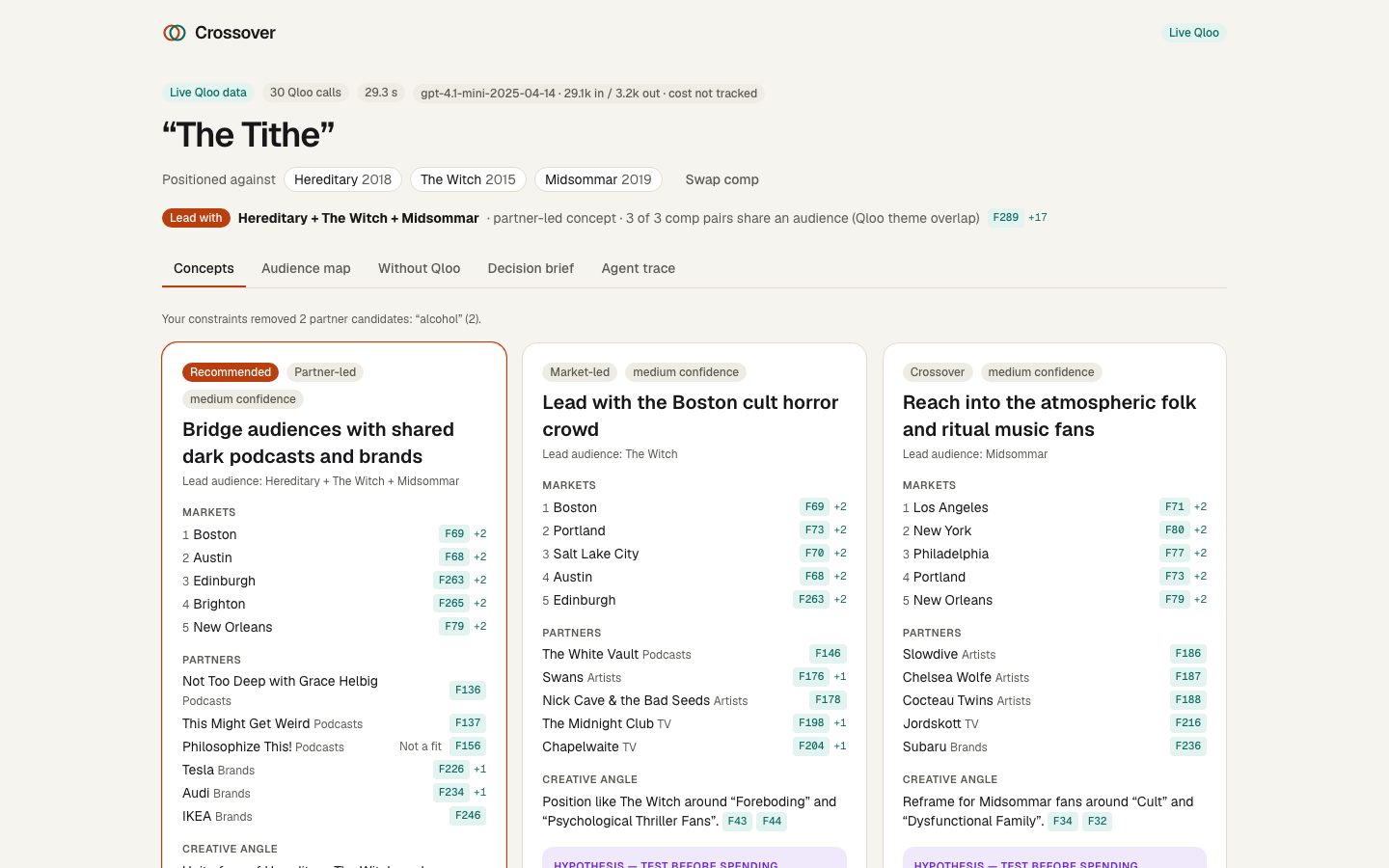
Crossover is a release-marketing agent for studio, streamer and record-label marketers. It answers the question every launch starts with, which comparable title ("comp") should we position against?, and turns the answer into a launch plan: which cities get the budget, which partners to approach, and which creative angle leads. Every partner and market in the plan traces back to the Qloo request that produced it.
What the agent can do
- Confirm comps before spending research. The marketer enters a release (title, format, logline, US/UK regions, budget band, exclusions) and 2–4 comps, or opens one of three presets. Each comp is resolved to a Qloo entity and shown for confirmation; a made-up title gets a "No close match" warning.
- Choose its own research. An LLM agent (
gpt-4.1-mini) runs a bounded tool-calling loop. It decides which Qloo calls to make: which partner domains, per-comp or combined signals, which comp pairs to compare. The steps, the agent's reasons and a live Qloo call counter stream to the screen. - Check its evidence and recover. After every turn, code checks for missing domains, thin results, unmapped markets and uncompared comp pairs, and makes the recovery calls.
- Score in code, not by the model. Partners are ranked by mean affinity across the comps and markets by fan concentration. Each comp pair gets a verdict, "one audience or two?", from the share of themes the two titles have in common. Confidence labels come from comp agreement and affinity strength.
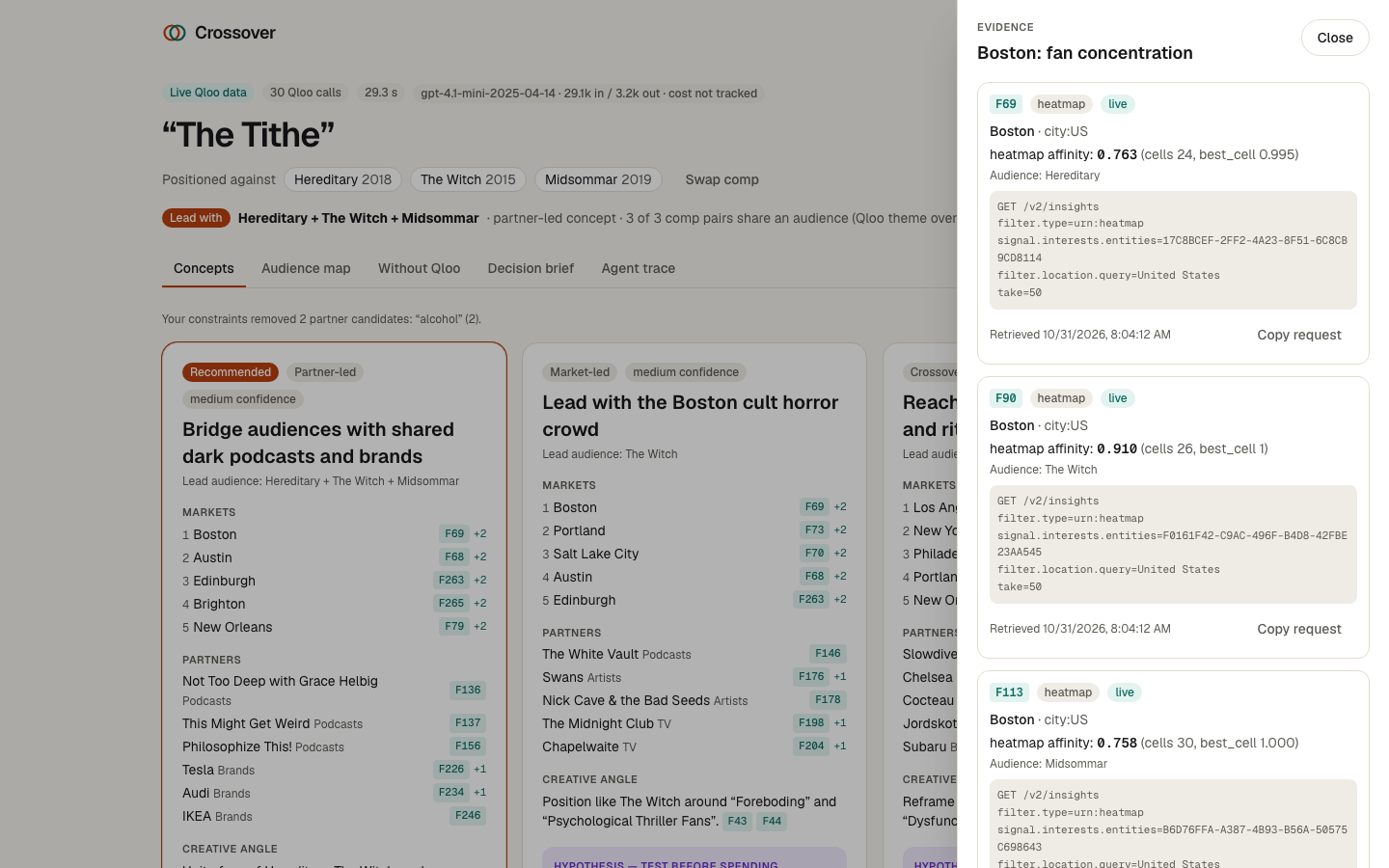
- Propose three concepts with different levers: market-led, partner-led (bridge both audiences) and crossover into an adjacent fandom. Each has ranked markets, a partner shortlist, a creative angle, a confidence label and the main risk. The model picks partners and markets only by candidate key, so every name on a concept comes from a Qloo fact. Exclusions, regions and pinned markets are enforced in code.
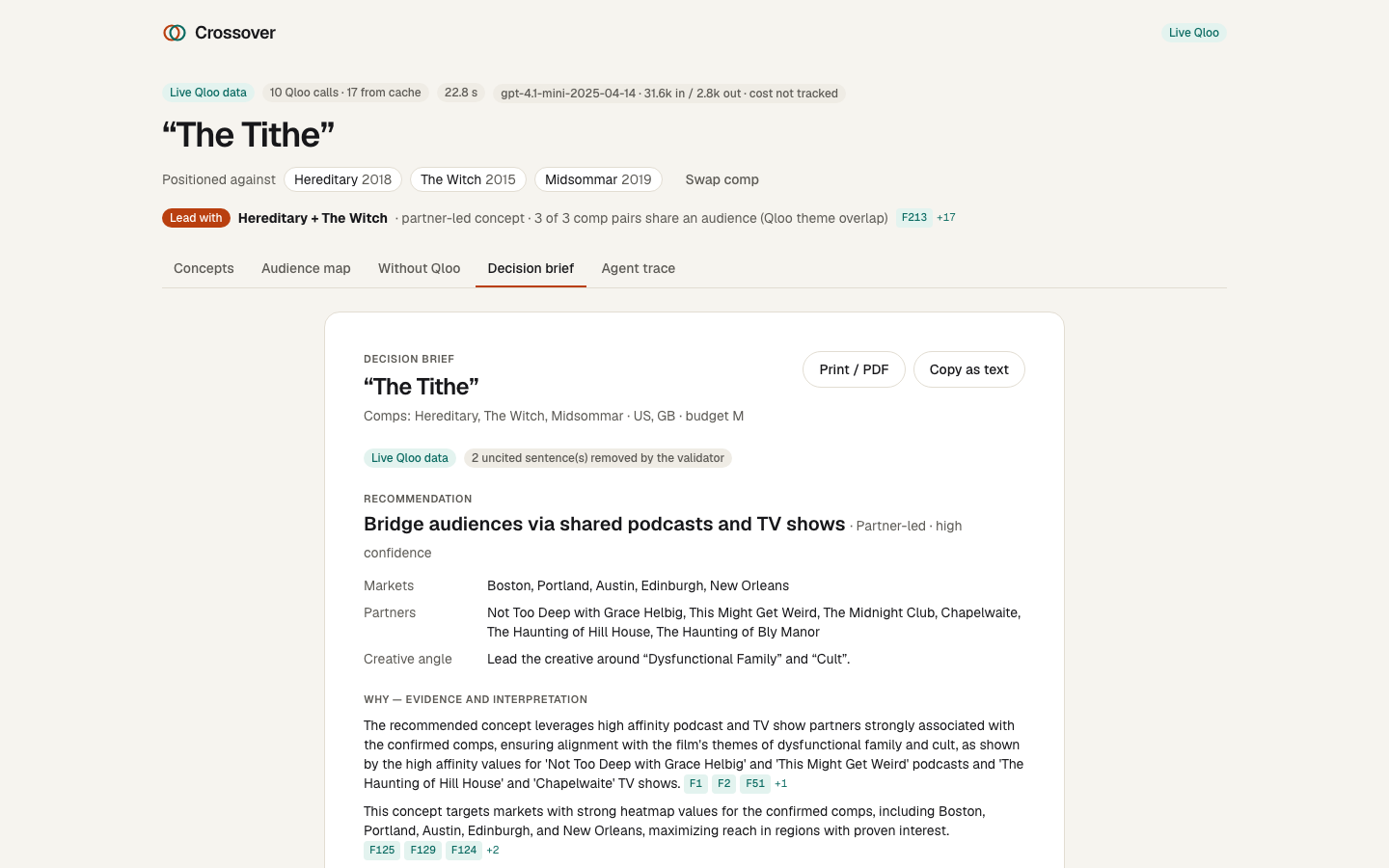
- Recommend and justify. Code picks the recommendation, shown as "Lead with …" in the results header. The model writes a cited rationale, trade-offs and a "test before you spend" checklist. A grounding validator deletes sentences with uncited claims, numbers not in the cited facts, unknown names, comparisons the scores contradict, or sensitive-trait language. The brief is printable.
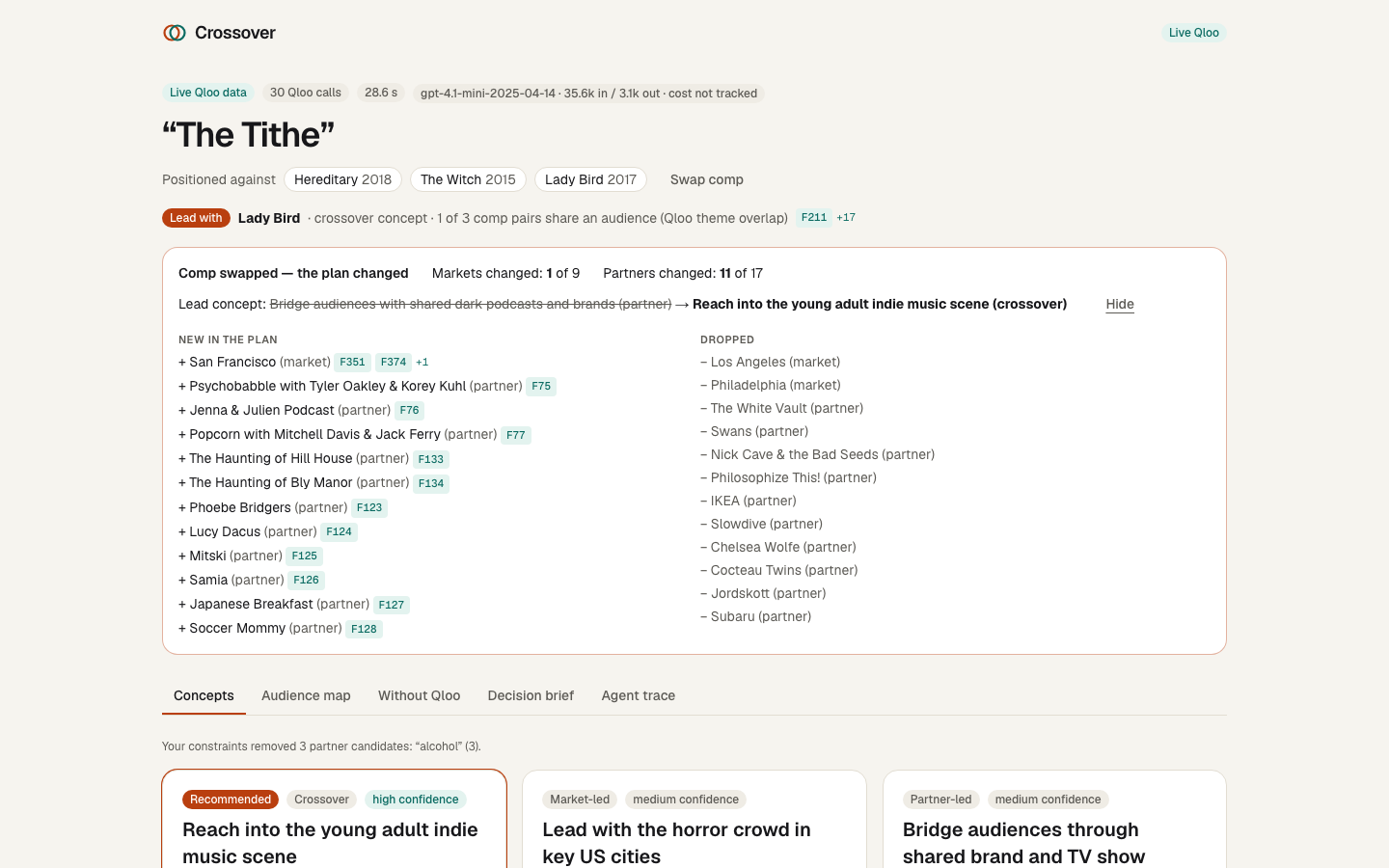
- Re-plan when the marketer changes their mind. Swap a comp (e.g. Midsommar → Lady Bird), mark a partner "not a fit" or pin a market, and the agent re-plans. A diff banner shows how many markets and partners changed and whether the lead concept changed; "What moved?" lists each new item with its evidence.
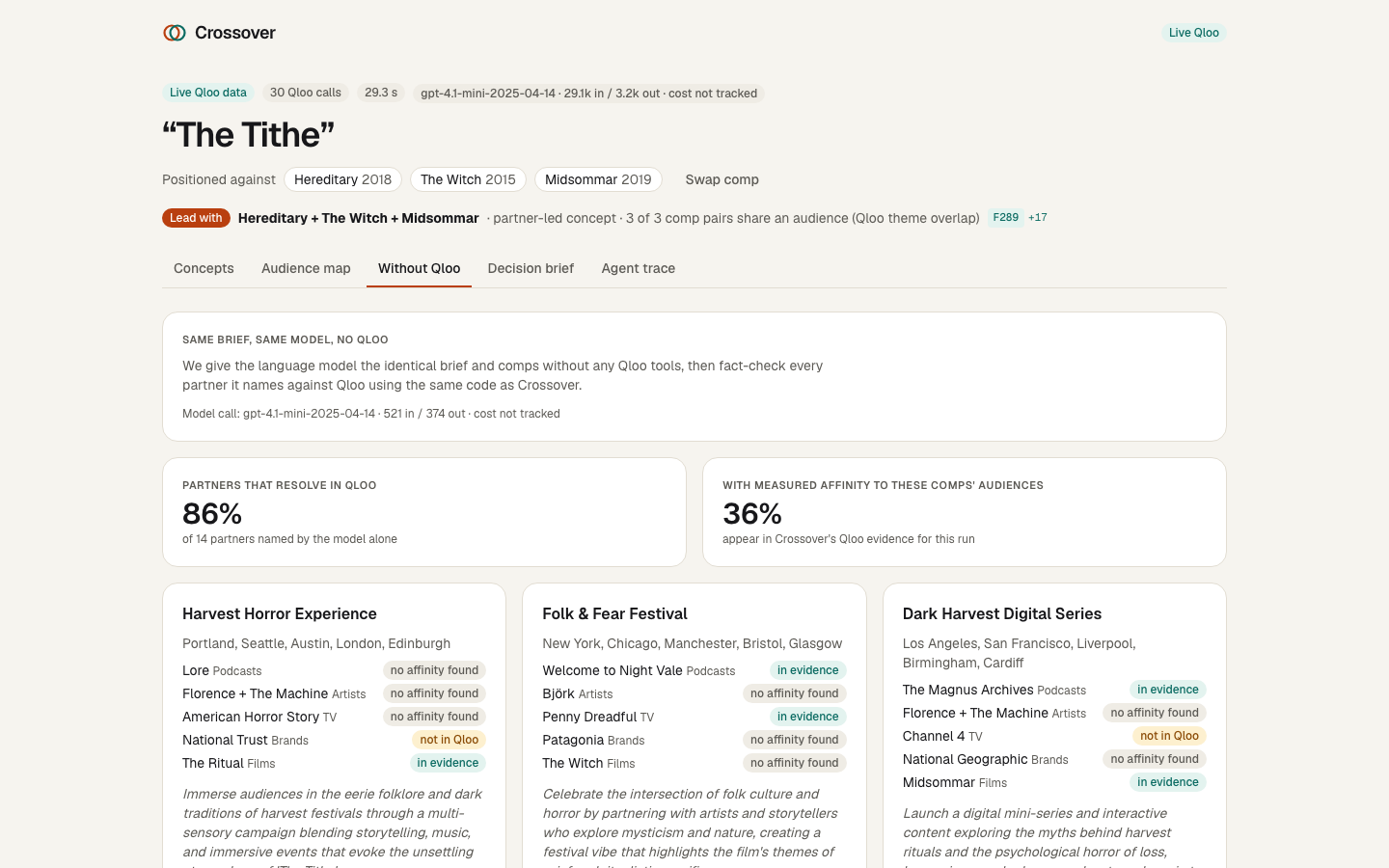
- Prove the value of Qloo. The Without Qloo tab gives the same model the same brief with no tools, then fact-checks every partner it names against Qloo: does it exist, and does it have measured affinity with these comps' audiences?
What makes it Qloo-powered
Qloo's taste graph provides the evidence; the model only plans the research and writes the text.
| Qloo capability | Endpoint | What it decides in Crossover |
|---|---|---|
| Entity search | GET /search |
Which real titles anchor the audience; fact-checks the model-only baseline |
| Cross-domain affinities | GET /v2/insights (podcasts, artists, TV or film, brands) |
Which partners to approach, attributed to the comp whose audience produced them |
| Taste tags | GET /v2/insights (urn:tag, story and media tags) |
Which creative angle the evidence supports |
| Demographics | GET /v2/insights (urn:demographics) |
Aggregate audience skew (group-level only) |
| Heatmap | GET /v2/insights (urn:heatmap) |
Which US and UK cities get the budget |
| Theme compare | GET /v2/analysis/compare |
One audience or two: bridge both comps, or pick a lead |
- Every value is traceable. Each Qloo value is stored with the request that produced it. Clicking any partner or market chip opens an evidence drawer with the exact endpoint and parameters, marked live, recorded or synthetic.
- Comp-anchored and attributed. Partners and markets are measured per comp, so the plan shows which comp's audience each one comes from. The swap diff shows how the plan changes when the anchor changes.
- Measured against the model alone. On our first six-brief evaluation (4 of 6 completed), 83% of the partners the model named without Qloo exist in Qloo, but only 31% have measured affinity with the comps' audiences. Crossover's partners are 100% on both by construction, because they come from Qloo results.
- Honest limits. Affinity describes aggregate taste overlap; it is not a forecast of box office, streams or ROI, and every brief says so. Coverage is US and UK for now, and household-name brands can still appear among brand partners.
Try it: https://crossover-murex.vercel.app (click Prestige horror film → Plan campaign, about 30 s)
Built With
- anthropic-sdk
- claude
- eslint
- github
- gpt-oss
- next.js
- node.js
- ollama
- openai-compatible-api
- playwright
- qloo
- qloo-insights-api
- react
- server-sent-events
- tailwind-css
- typescript
- vitest
- zod

Log in or sign up for Devpost to join the conversation.