-
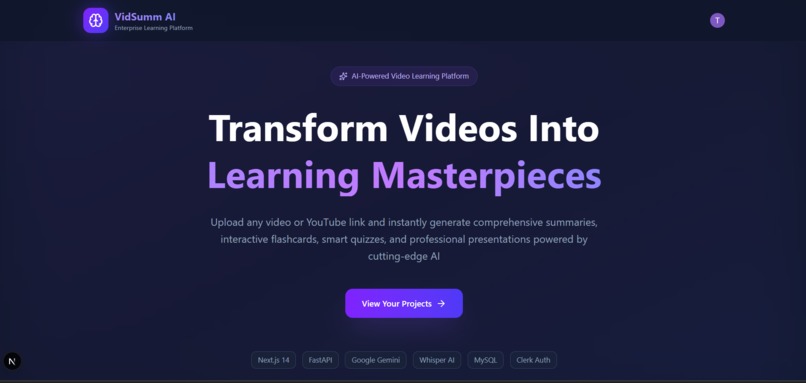
dashboard

Inspiration
Video has become the primary medium for learning from university lectures to corporate training and online tutorials. However, video-based learning is often slow, passive, and difficult to revise. Students spend hours watching lectures and then additional time creating notes, summaries, quizzes, and presentations manually. This repetitive workflow reduces productivity and learning efficiency. We were inspired by a simple question: Why should learners manually extract knowledge when AI can structure it instantly?
With advancements in speech recognition and large language models, we saw an opportunity to convert raw lecture videos into structured, interactive study material automatically.
What It Does
Cross Model AI transforms lecture videos into complete learning assets within minutes. The platform accepts local video files or YouTube links and processes them through an AI-driven pipeline to generate:
- Accurate transcripts
- Structured summaries
- Interactive flashcards
- Auto-generated quizzes
- Professional PowerPoint presentations
- An AI-powered chatbot for doubt resolution
The efficiency improvement can be expressed as: [ Efficiency\ Gain = \frac{Manual\ Effort - Automated\ Effort}{Manual\ Effort} \times 100\% ] Our testing showed nearly: [ 70\% - 80\% \text{ reduction in manual effort} ] --- ## How We Built It We designed a modular, scalable architecture: - Frontend: Next.js + TypeScript
- Backend: FastAPI (Python)
- Database: MySQL
- AI Models: Whisper (Speech-to-Text) + Gemini (Content Generation)
### Processing Flow
[
Video \rightarrow Transcription \rightarrow Analysis \rightarrow Structured\ Content
]
We implemented asynchronous processing, prompt engineering for structured outputs, and validation layers to ensure reliability and performance.
---
## Challenges We Ran Into
### 1)Structuring AI Output
LLMs often return inconsistent formats. We refined prompts and enforced JSON validation layers. ### 2)Large Video Processing
Handling long lectures required memory optimization and async execution. ### 3)API Latency
Total processing time depends on multiple stages: [ T_{total} = T_{transcription} + T_{analysis} + T_{generation} ] We optimized backend execution to reduce delays. ### 4)Maintaining Educational Quality
Generating meaningful quizzes and flashcards required multiple iterations and testing. --- ## Accomplishments We Are Proud Of - Built a complete end-to-end AI learning pipeline
- Successfully integrated multiple AI models into one workflow
- Achieved nearly: [ 70\% - 80\% \text{ efficiency improvement} ]
- Developed a scalable microservices-inspired architecture
- Delivered structured, reliable educational outputs [ Raw\ Video \rightarrow Structured\ Knowledge\ Assets ] --- ## What We Learned
- Designing scalable AI-driven systems
- Integrating multiple APIs efficiently
- Importance of prompt engineering
- Handling asynchronous backend processing
- Balancing performance, accuracy, and usability
We learned that building AI products is not just about models — it is about delivering meaningful user value. --- ## Future Scope ### Multi-Language Support
[ Global\ Reach \propto Language\ Support ] ### Real-Time Lecture Summarization
[ Live\ Input \rightarrow Instant\ Structured\ Output ] ### Personalized Learning Paths
[ Personalization = f(User\ Performance,\ Learning\ Patterns) ] ### LMS Integration & Advanced Analytics
Our long-term vision is to build a comprehensive AI-powered learning assistant that supports students before, during, and after every lecture.
Built With
- fastapi
- googlegemini
- mysql
- next.js
- openaiwhisper
- python
- react
- tailwind-css
- typescript

Log in or sign up for Devpost to join the conversation.