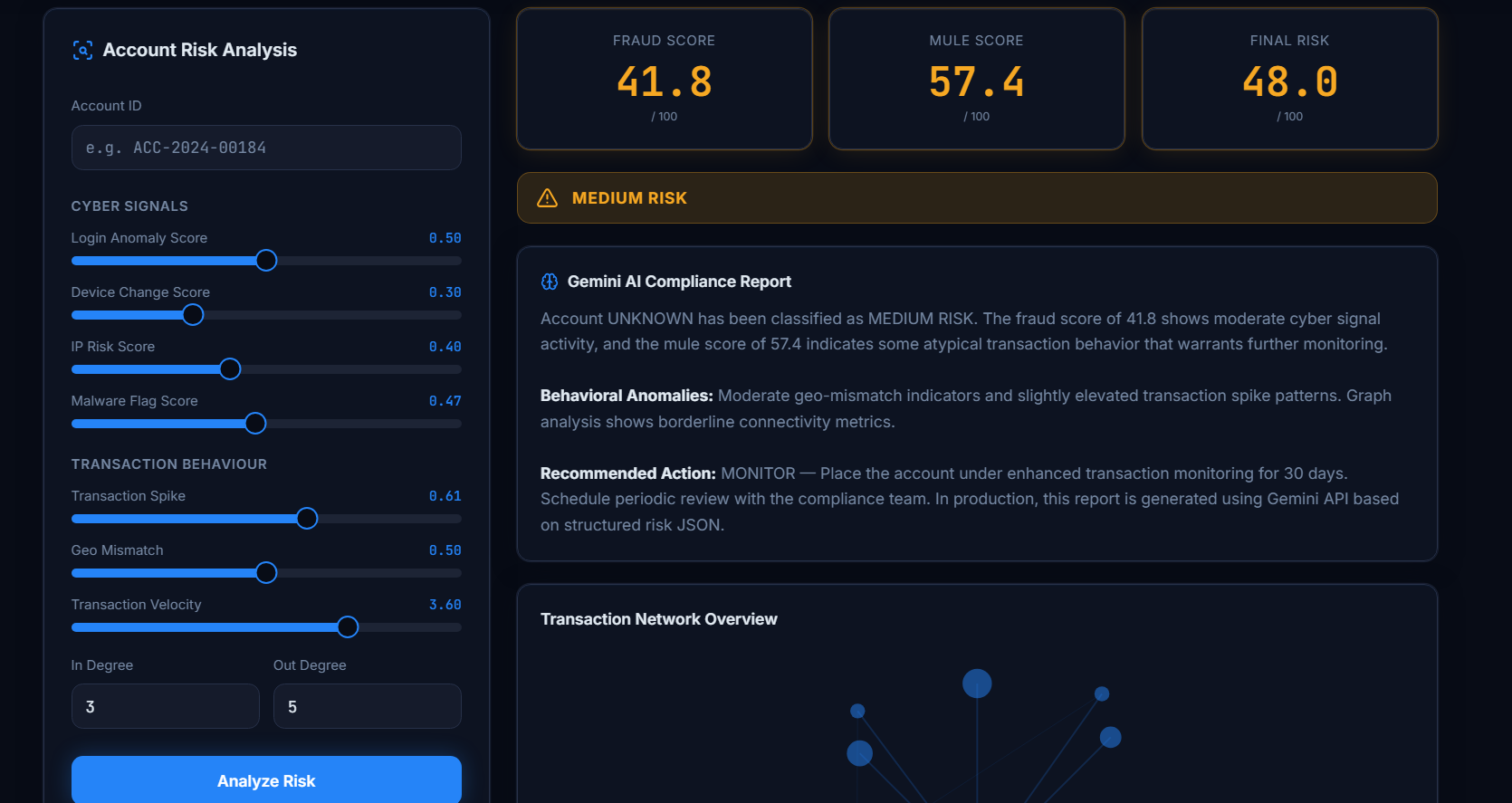
Inspiration Financial crime detection systems today operate in silos. Cybersecurity tools detect compromised logins. Transaction monitoring systems flag suspicious payments. Graph tools detect mule networks. But these systems rarely communicate. Criminals exploit this fragmentation to move funds quickly through coordinated networks before banks can respond. We were inspired to build a system that breaks these silos — combining cyber anomaly signals, transaction behavior, and graph intelligence into one unified AI platform. Our goal was simple: Detect, predict, and explain financial crime before funds disappear. 🔎 What It Does Our system is an AI-powered financial crime intelligence platform that: Detects compromised accounts using cyber anomaly signals Identifies mule accounts using graph-based transaction analysis Models laundering activity as a time-evolving network Predicts how quickly funds may exit the system Propagates risk across connected accounts Generates AI-powered compliance reports using Gemini Instead of treating fraud as isolated events, our system models financial crime as a coordinated, dynamic network problem. 🛠 How We Built It 🔹 1. Data Fusion Layer We combined: Cyber logs (login anomaly, device mismatch, IP risk, malware signals) Transaction data (sender, receiver, amount, timestamp) Graph relationships (account-to-account transfers) 🔹 2. Fraud Detection Model We trained an XGBoost classifier using cyber and transaction anomaly features to generate a Fraud Score (0–1). 🔹 3. Mule Detection Model We built a directed transaction graph and extracted: In-degree & Out-degree Holding time Transaction velocity In/Out ratio Chain velocity index Using these graph features, we trained a second XGBoost model to generate a Mule Score (0–1). 🔹 4. Temporal Graph Intelligence We modeled transaction timestamps to calculate: Multi-hop chain depth Money flow velocity Rapid burst transfers This enables early detection of fast-moving laundering chains. 🔹 5. Early Exit Prediction We trained a regression model to estimate: Predicted Time-to-Exit (minutes) If funds are predicted to exit the ecosystem quickly, the system raises a high-urgency alert. 🔹 6. Community Detection Using graph algorithms (Louvain method), we identified dense mule clusters and assigned cluster-level risk scores. 🔹 7. Risk Propagation Model Risk is propagated across neighbors: Risk(node) = Base Risk + Σ (Neighbor Risk × Edge Weight) This detects coordinated laundering rings. 🔹 8. Graph Database We used Neo4j to: Store accounts as nodes Store transfers as relationships Attach risk properties to nodes Visualize suspicious networks 🔹 9. Gemini AI Layer Gemini API generates structured AML compliance narratives by converting raw risk scores into professional reports suitable for banking regulators. ⚔️ Challenges We Ran Into Handling highly imbalanced fraud datasets Avoiding data leakage in regression modeling Integrating graph features with tabular ML models Managing model consistency between training and frontend Debugging frontend-backend communication under time pressure Designing a scalable graph schema for real-time updates 🏆 Accomplishments We’re Proud Of Built two working ML models (Fraud + Mule) Successfully integrated graph intelligence into detection pipeline Implemented time-aware laundering detection Built a working Neo4j graph database Generated explainable AI compliance reports Delivered an end-to-end working prototype Most importantly: We transformed fraud detection from a static classification task into a dynamic network intelligence system. 📚 What We Learned Financial crime is a graph problem, not just a classification problem Model performance is meaningless without explainability Data leakage can artificially inflate results Graph-based risk propagation reveals hidden coordination Real-world AML systems require cross-domain data fusion We also learned how to build scalable AI architecture under tight deadlines. 🔮 What’s Next for Cross-Domain Financial Crime Intelligence System Real-time streaming ingestion of transaction logs Deployment as a cloud-native microservices architecture Integration with banking core systems Advanced Graph Neural Networks (GNNs) Automated regulatory reporting workflows Continuous learning using feedback loops
Built With
- cnn
- forest
- opencv
- random
- xgboost

Log in or sign up for Devpost to join the conversation.