-
-
Automated_crop_insurance_agentic_fleet
-
Cropsentinel-Architecture
-
Cropsentinel_insurance_working_flow_diagram
Inspiration
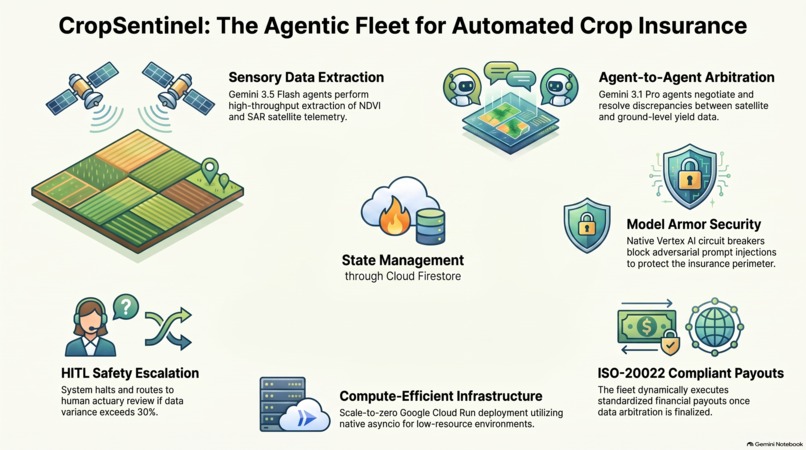
In agricultural hubs like Hosadurga, parametric insurance payouts take months because satellite telemetry data and human ground audits frequently disagree. This discrepancy traps crucial capital while manual actuaries review claims. The inspiration was to build a zero-trust, autonomous orchestration system capable of resolving these data conflicts instantly without violating enterprise compliance or data sovereignty.
What it does
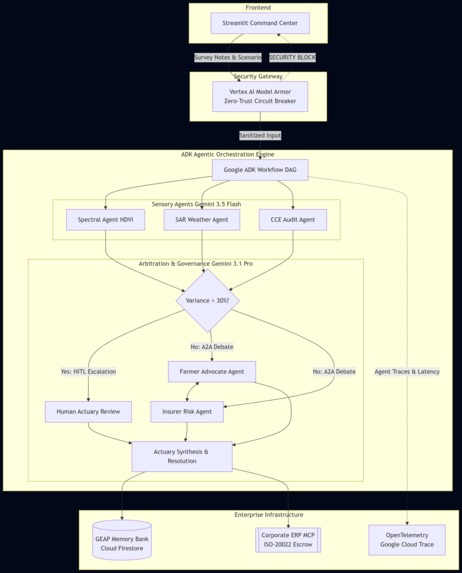
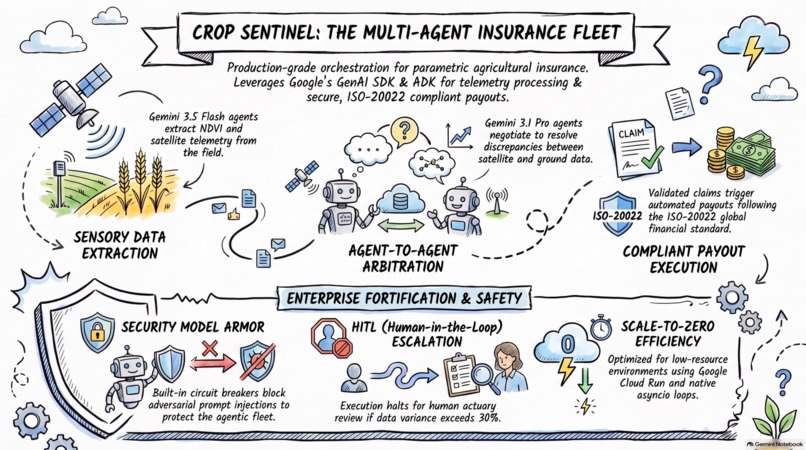
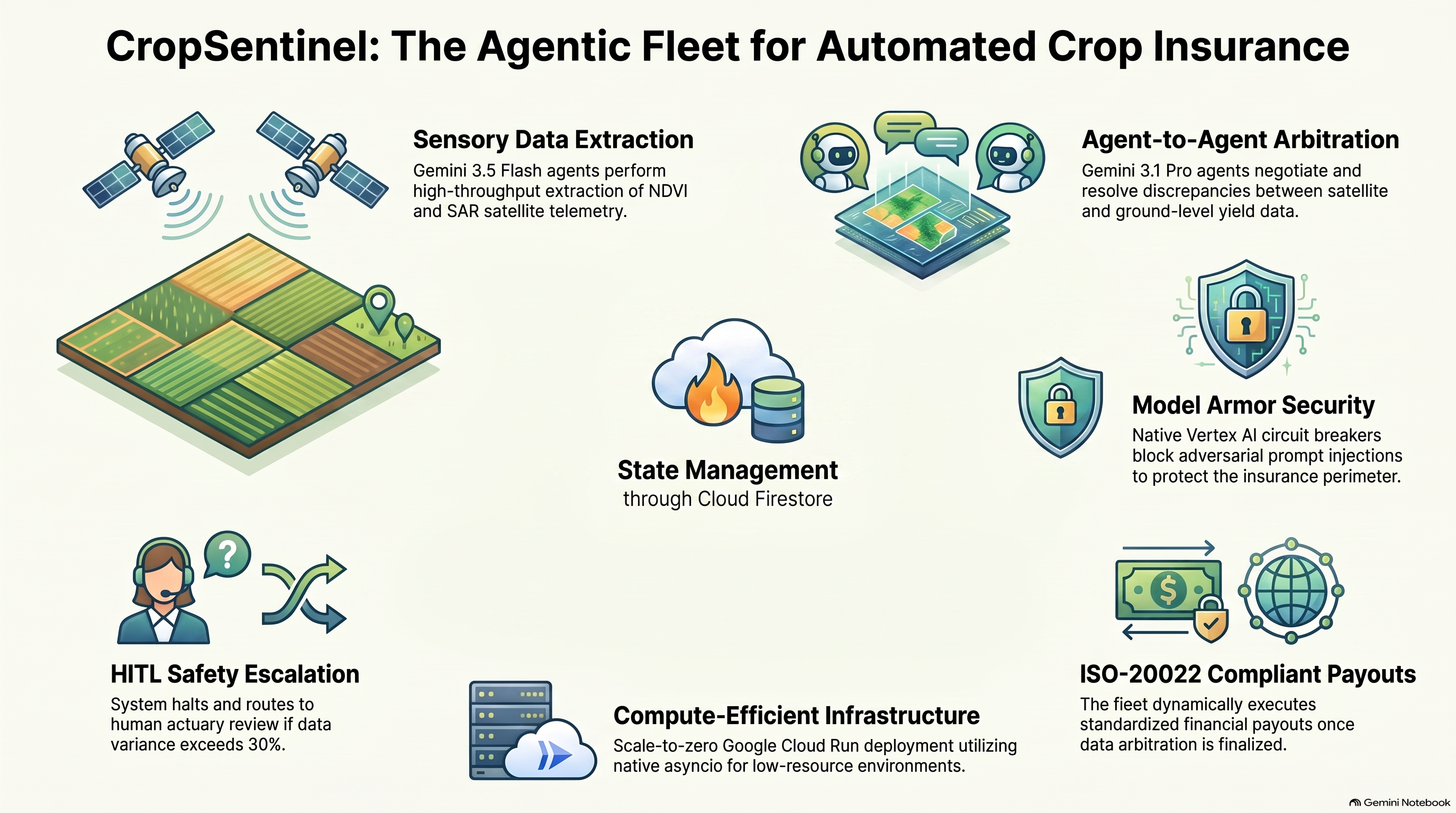
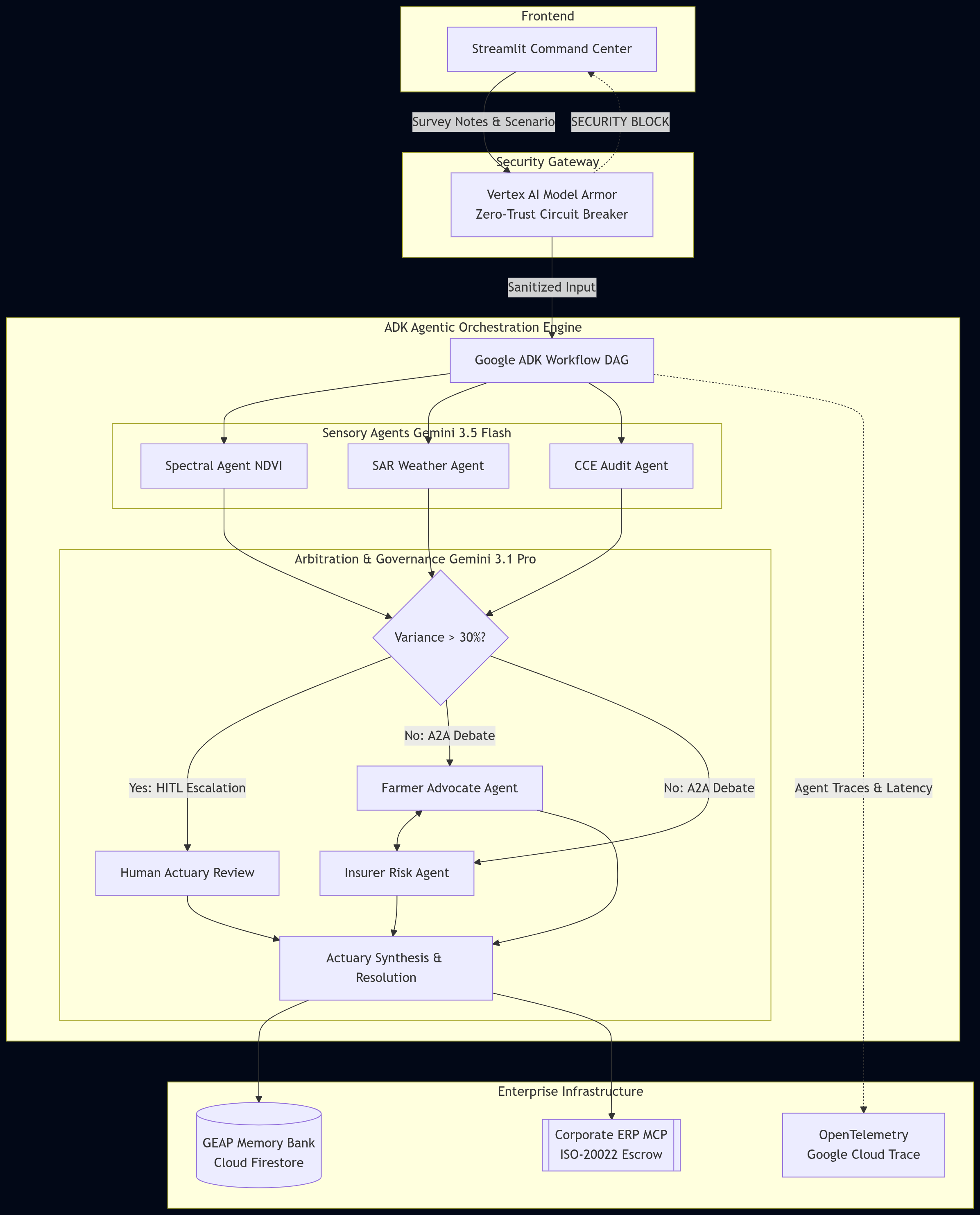
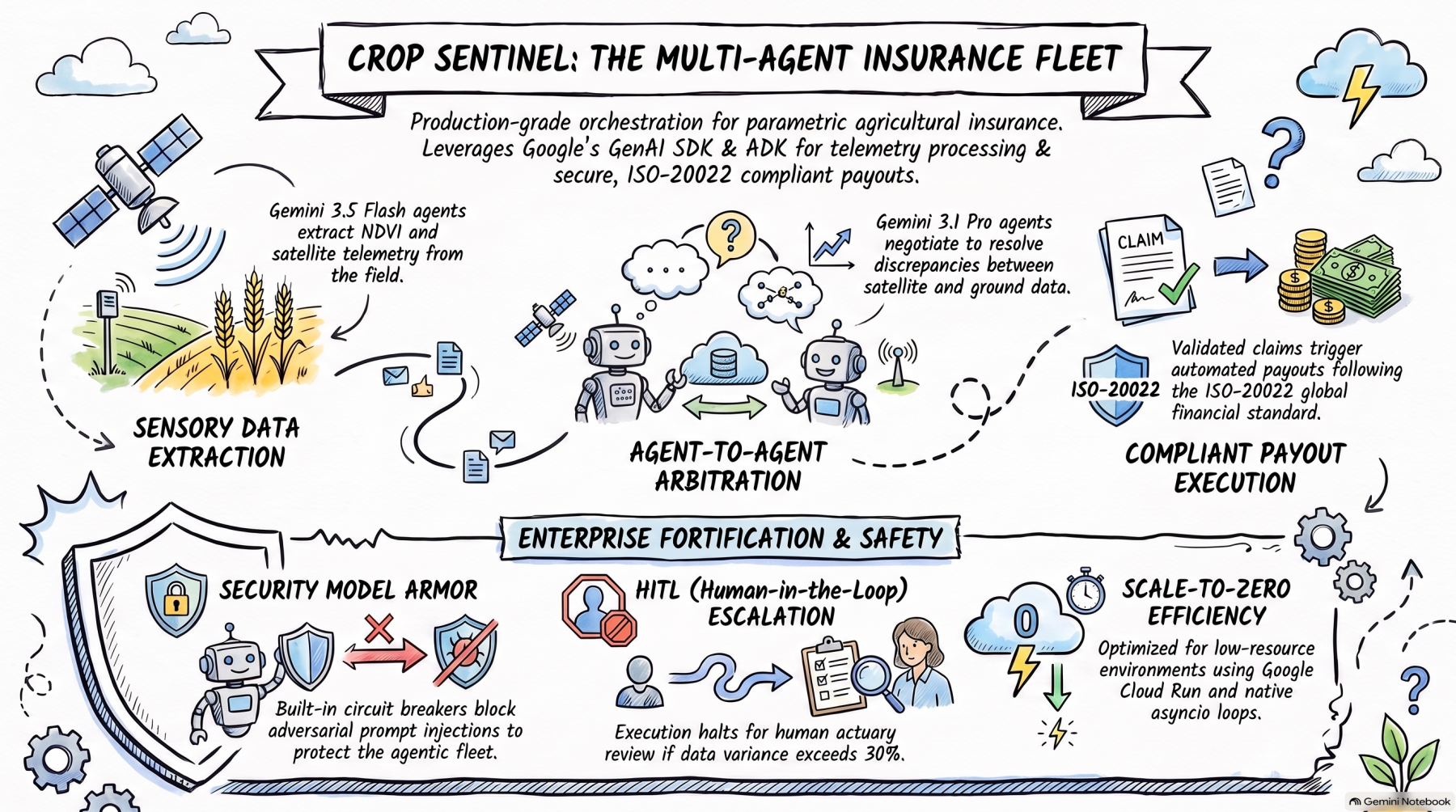
CropSentinel is a Fortified Enterprise Agentic Fleet that automates agricultural insurance claims. It ingests multispectral satellite data (NDVI), SAR radar backscatter, and ground-level Crop Cutting Experiment (CCE) notes. If the data aligns, it executes an ISO-20022 compliant escrow payout. If the data conflicts, Gemini-powered agents debate the discrepancy. Extreme variances trigger a deterministic Human-in-the-Loop (HITL) escalation, halting the payout for manual review.
How we built it
We bypassed bloated orchestration wrappers and built a custom, containerized Agent Runtime on Google Cloud Run using the Google Agent Development Kit (ADK) and native asyncio loops. This architecture was explicitly chosen to optimize for low-resource environments.Sensory Layer: Gemini 3.5 Flash powers parallel agents extracting metrics from raw survey text and satellite telemetry.Arbitration Layer: Gemini 3.1 Pro drives the Farmer Advocate and Insurer Risk agents to negotiate discrepancies.Security & Governance: Vertex AI Model Armor acts as an inline circuit breaker to block prompt injections, while OpenTelemetry streams the entire execution DAG to Google Cloud Trace.State Management: The GEAP Enterprise Memory Bank (Cloud Firestore) persists phenology facts across the 120-day crop lifecycle.For moderate variances, the system calculates a mathematically compromised payout using the formula: $$ResolvedLoss = (W_{telemetry} \times Loss_{spectral}) + (W_{cce} \times Loss_{ground})$$
Challenges we ran into
LLM non-determinism repeatedly broke our CI/CD pipelines. Because sensory agents rely on live inference to extract loss ratios, standard unit tests would fail when model variance altered the workflow trajectory. We solved this by building a rigorous Agentic Evaluation Harness using Pydantic V2 model_construct() mocking to strictly validate our DAG trajectories, latency bounds, and HITL routing.
Accomplishments that we're proud of
Successfully implementing a deterministic Human-in-the-Loop (HITL) circuit breaker. If the variance between the satellite and ground data exceeds 30% ($\Delta > 0.30$), or if Model Armor detects an adversarial attempt to force a 100% payout, the workflow safely halts before a single financial API token is burned.
What we learned
Enterprise agentic systems do not require heavy, memory-intensive frameworks to be effective. By relying on native asynchronous loops, strict type enforcement, and scale-to-zero containerization, you can deploy highly secure, multi-agent arbitration networks even in severely constrained hardware environments.
What's next for Cropsentinel
Expanding the GEAP Memory Bank to track multi-season soil degradation across entire farming cooperatives, and integrating on-device vision models to autonomously conduct real-time Crop Cutting Experiments (CCE) via drone telemetry.

Log in or sign up for Devpost to join the conversation.