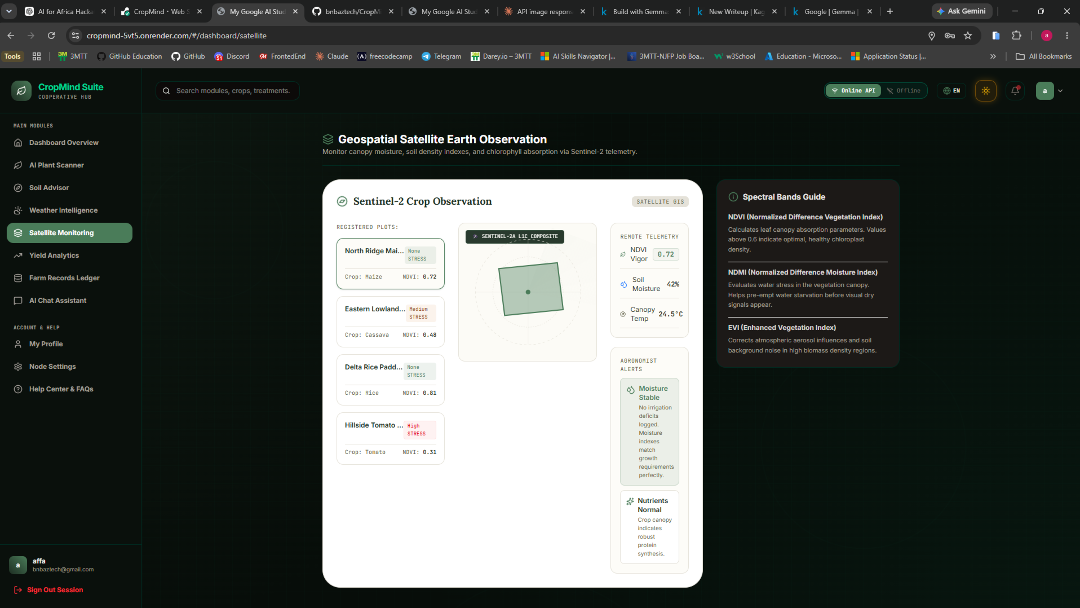
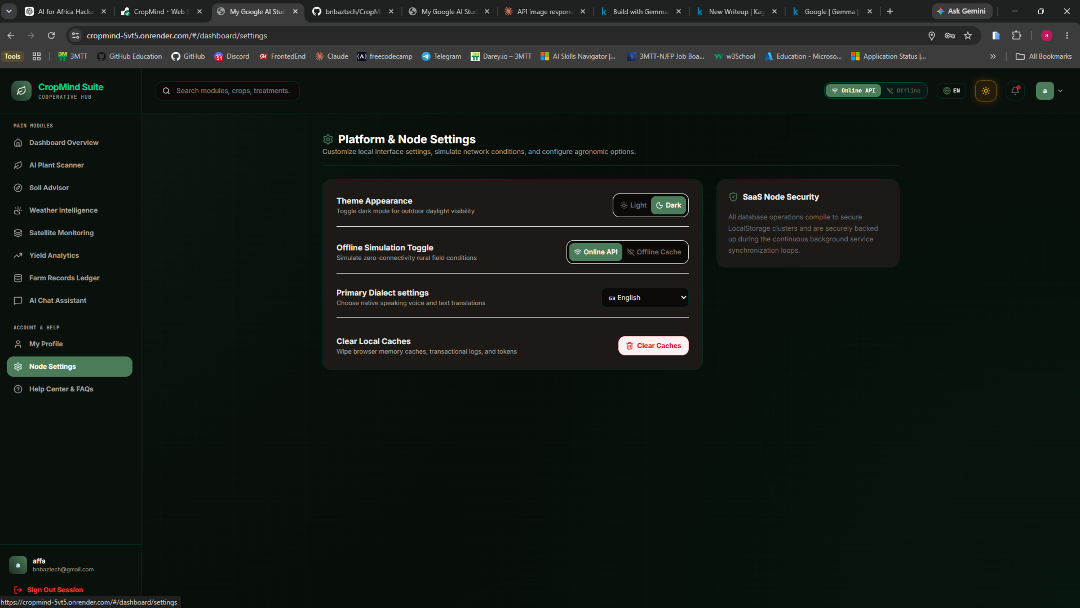
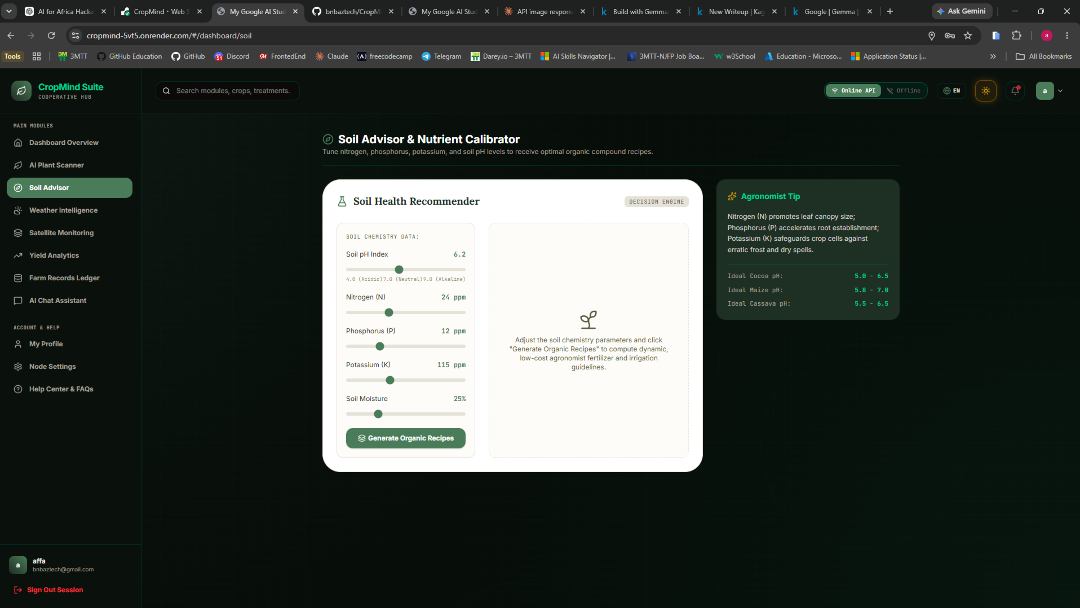
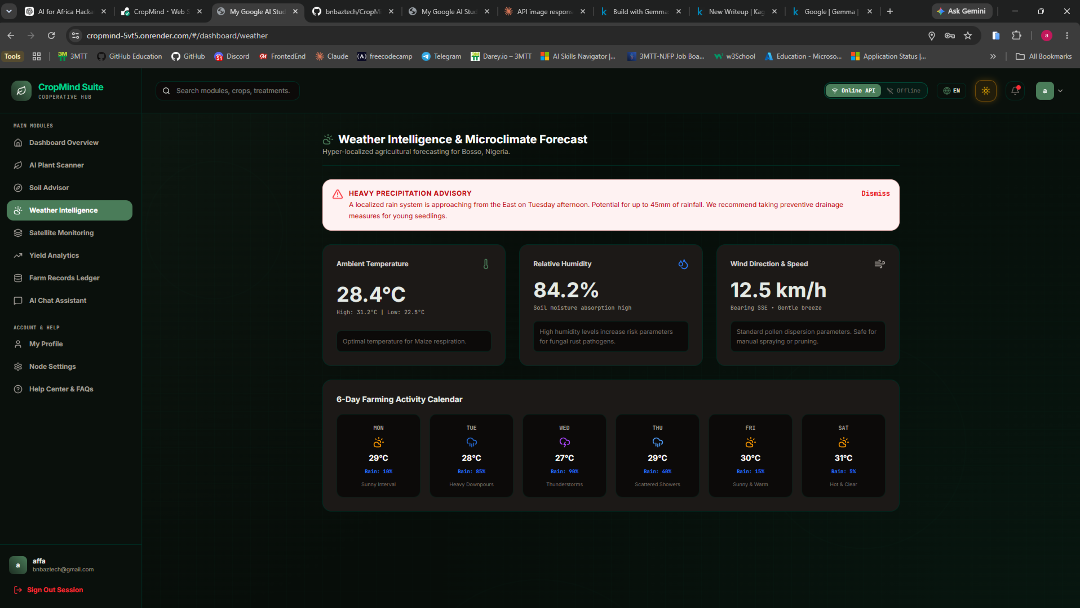
🌱 CropMind — AI-Powered Agricultural Intelligence for Smallholder Farmers
The Problem
For millions of smallholder farmers, a plant disease can become a serious economic problem before they know what is happening.
Many farmers do not have immediate access to agricultural experts, laboratories, or reliable crop-disease information. When symptoms appear on a leaf, farmers may have to rely on guesswork, traditional knowledge, or delayed access to extension services. A wrong diagnosis can lead to wasted money on unnecessary treatments, crop loss, and even further damage to the farm.
We wanted to explore a simple question:
What if a farmer could get useful agricultural guidance simply by showing an AI what is happening to their crop?
That question became the foundation of CropMind.
💡 Our Solution
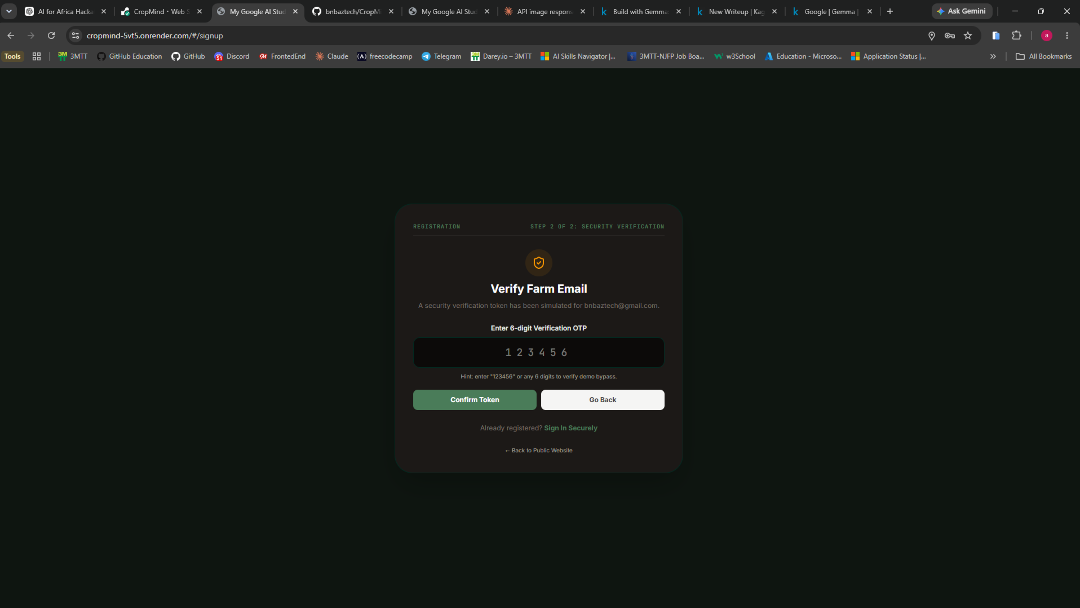
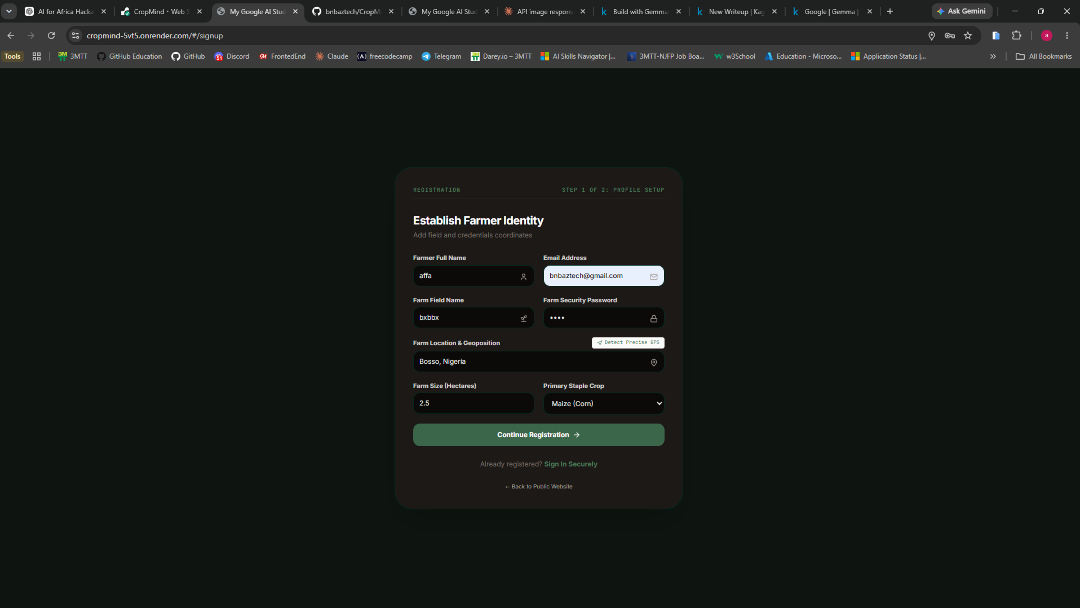
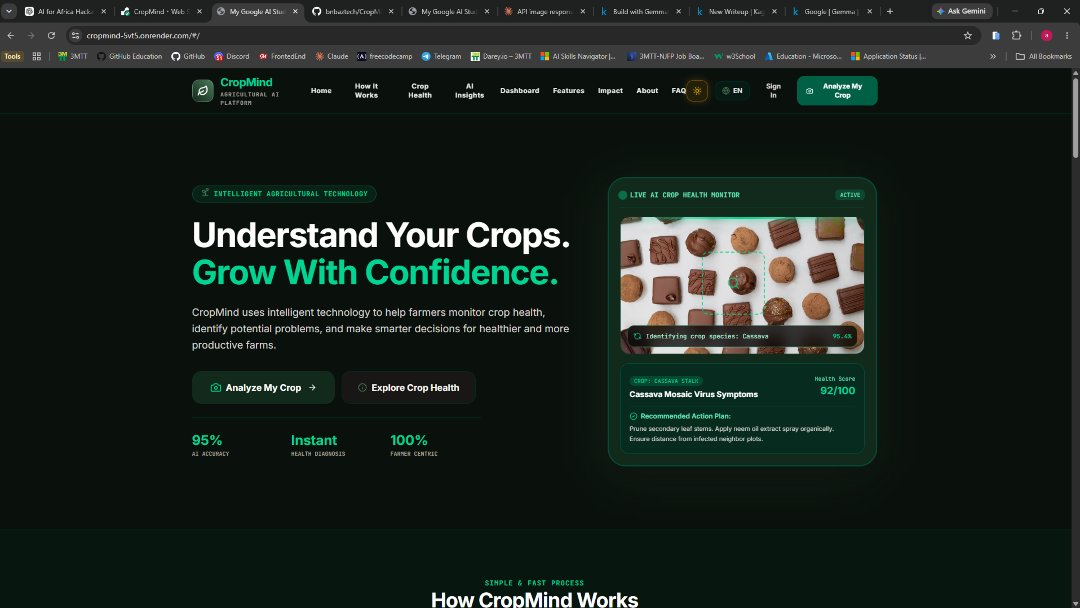
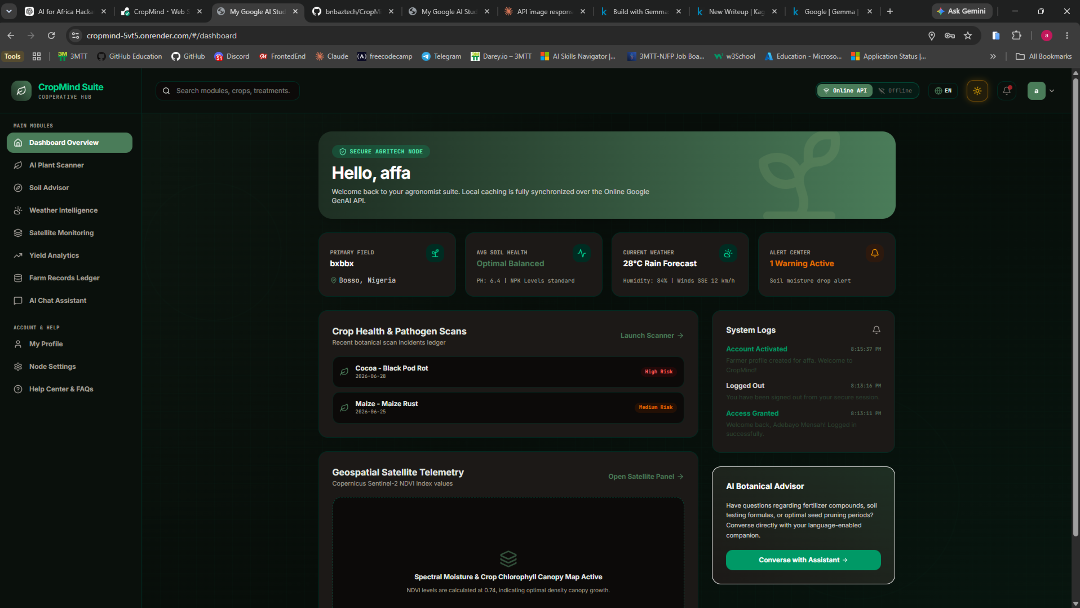
CropMind is an AI-powered agricultural assistant designed to help smallholder farmers understand crop problems and make better-informed farming decisions.
The platform combines AI-powered image analysis with an agricultural conversational assistant.
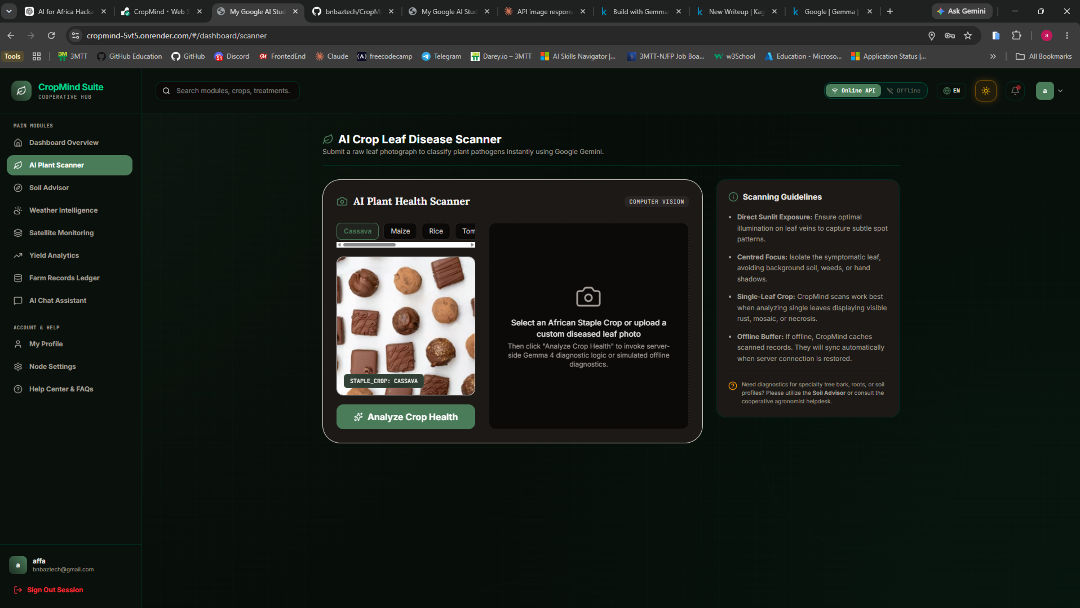
A farmer can provide an image of a crop or leaf, and CropMind analyzes the available visual evidence and produces a structured agricultural assessment.
Instead of simply returning a disease name, the system is designed around a more useful workflow:
Image → Evidence → Observations → Possible Diagnosis → Guidance
The farmer can also interact with the agricultural assistant through conversation, allowing them to ask follow-up questions and better understand the situation.
The goal is not to replace agricultural experts.
The goal is to make useful agricultural intelligence more accessible, understandable, and actionable.
🔬 How CropMind Works
CropMind is built around several interconnected components.
1. AI Crop Scanner
The farmer provides an image of a crop or plant.
Before the image reaches the AI provider, the system validates the request and image to reduce malicious or invalid inputs.
The system then sends the validated information through the diagnosis pipeline.
The response is structured into meaningful sections such as:
- Certainty / signal strength
- Evidence
- Observations
- Differential possibilities
- Agricultural guidance
This approach is intentionally different from simply displaying an AI-generated disease label.
2. Trust-Aware Diagnosis
One of the most important parts of CropMind's development has been making the AI response more trustworthy.
Early in development, the system could potentially return fabricated fallback information when the AI provider was unavailable.
For an agricultural application, this is dangerous.
A farmer should never receive a fake diagnosis presented as if it came from an actual analysis.
We therefore redesigned the diagnosis pipeline so that provider failures are treated as failures rather than being converted into fictional diagnoses or confidence scores.
The system now distinguishes between:
- Actual model output
- Evidence-based observations
- Uncertainty
- Withheld guidance
- Infrastructure/provider failures
This became one of the core principles of CropMind:
When the system does not know, it should say that it does not know.
💬 AI Agricultural Assistant
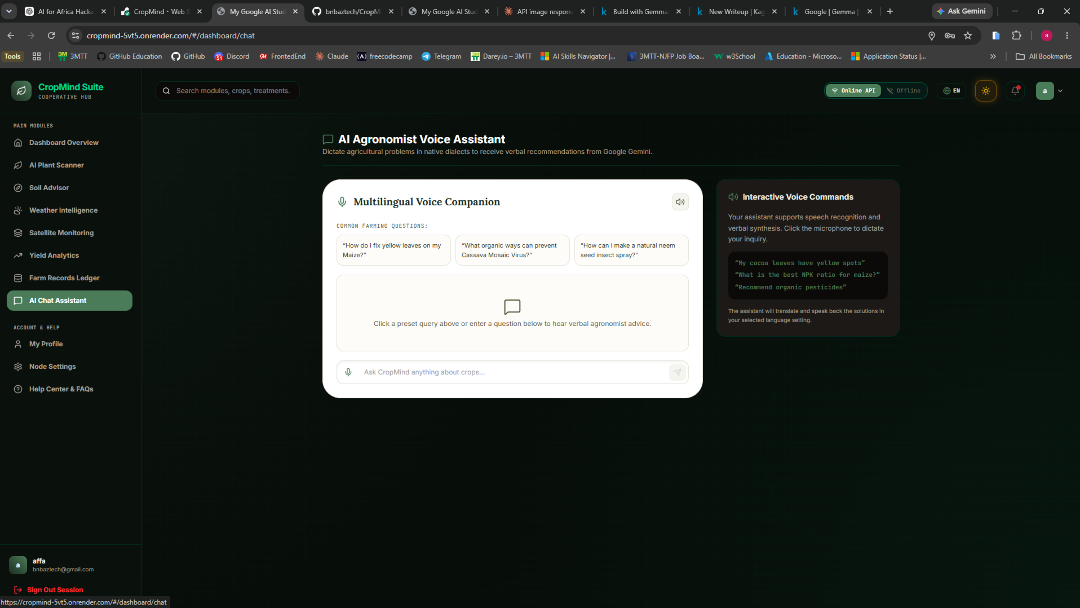
CropMind also includes a conversational assistant designed specifically around agricultural questions.
Instead of treating every question as an isolated request, the system is being developed around persistent consultation sessions.
A farmer can:
- Start a new consultation
- Continue an existing conversation
- Review previous conversations
- Ask follow-up questions
- Build context across multiple messages
- Return to previous consultations later
The conversation architecture stores messages as structured records rather than keeping only one temporary text response.
This allows future responses to use relevant previous conversation context instead of treating every question as completely new.
🧠 Conversation Memory
A major part of the system architecture is persistent conversation history.
Each consultation has its own identity and metadata, including:
- Consultation ID
- Farmer/owner ID
- Title
- Creation time
- Last update time
- Individual messages
- Message roles
- Message timestamps
- Message metadata
This makes the assistant behave more like a persistent agricultural consultation system rather than a disposable chatbot.
The architecture also protects conversations from being accessed or modified by another user.
🔐 Security
Because CropMind uses AI APIs that can consume paid resources, security became an important part of development.
Initially, AI endpoints could potentially be accessed without sufficient protection.
We introduced a security layer containing:
- Request validation
- Rate limiting
- Security headers
- CORS policy
- Structured error handling
- Request correlation IDs
- Image validation
- SVG rejection
- Payload size protection
- Timeout handling
- Principal-based request identification
- Protection against information leakage
The system also uses stable error codes instead of exposing raw provider errors to users.
🏗️ System Architecture
CropMind follows a modular architecture so that individual components can evolve without rewriting the entire application.
At a high level:
Frontend
→ Crop Scanner
→ AI Assistant
→ Consultation History
→ Diagnosis Report
Backend
→ API Routes
→ Validation Layer
→ Security Middleware
→ Diagnosis Pipeline
→ AI Provider Adapter
→ Consultation Store
→ Error Handling
AI Layer
→ Image Analysis
→ Agricultural Reasoning
→ Conversational Assistance
The architecture deliberately separates the application from the underlying AI provider.
This means the AI model can be changed without redesigning the entire application.
🛠️ Technology
CropMind was built using modern web and AI technologies, including:
- TypeScript
- React
- Node.js
- AI/LLM APIs
- REST APIs
- Zod validation
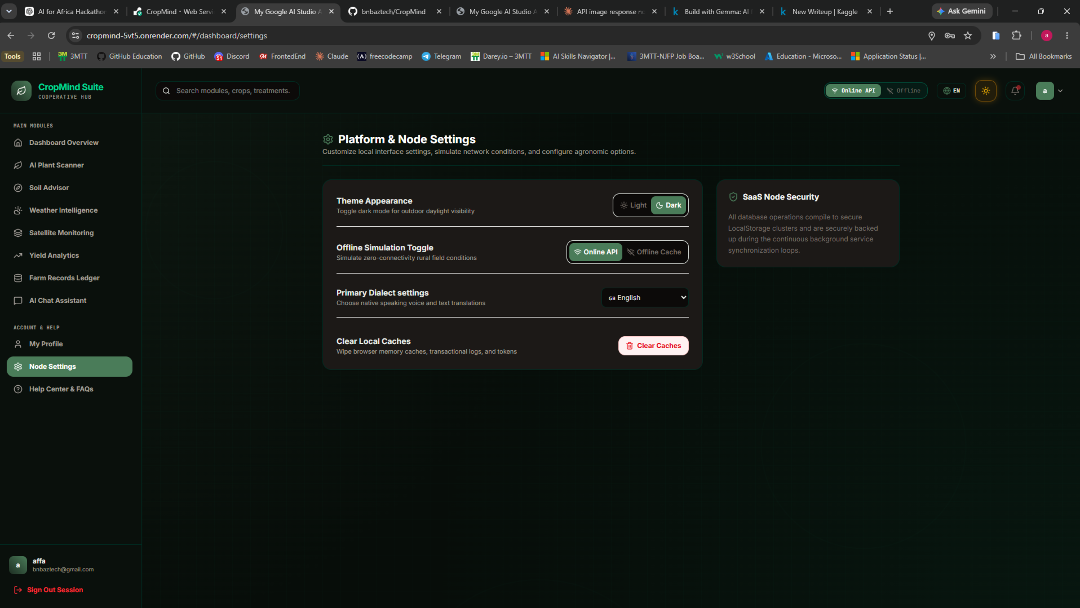
- Local persistent storage
- Structured logging
- Automated verification suites
- Git/GitHub
- Modern CSS/UI technologies
The project was developed with a strong focus on modularity, validation, testing, and maintainability rather than only creating a visual prototype.
🚧 Challenges We Faced
Building CropMind exposed several problems that would not be obvious in a simple AI demo.
AI Reliability
One of the biggest challenges was model reliability.
During testing, one model showed nondeterministic hangs. Some requests could remain unresolved until the application timeout was reached.
This initially produced a misleading message suggesting that the farmer's internet connection was responsible.
After controlled testing across multiple models, we determined that the problem was occurring in the model/provider path rather than the frontend rendering system.
We therefore changed the model configuration and added stronger production verification.
False AI Confidence
Another major challenge was the discovery of fabricated fallback diagnosis data.
The system could previously return preset agricultural information when the AI provider failed.
Although the information itself could be agriculturally accurate, presenting it as the result of an image analysis was misleading.
We removed this behavior from the diagnosis endpoint.
General agricultural information can still exist as reference material, but it is clearly separated from an actual AI diagnosis.
Persistent Conversations
The original assistant architecture stored essentially one temporary response.
This meant conversations could disappear when users navigated between sections.
We introduced a dedicated consultation data model and persistent client-side store so conversations can survive route changes and be organized into separate consultation sessions.
The next stage is connecting this data model to the AI backend so conversation history becomes part of the assistant's reasoning context.
Security and Abuse
An AI endpoint that anyone can repeatedly call can quickly consume API resources.
We therefore introduced rate limiting, request validation, image validation, timeouts, security headers, and structured error handling before expanding the AI functionality.
This changed CropMind from simply being an AI prototype into a system designed with real-world deployment concerns in mind.
📚 What We Learned
The biggest lesson from building CropMind was that building an AI application is not just about connecting an API to a user interface.
A real AI product needs:
Reliability + Security + Context + Trust + Good UX
We learned that an AI system should not pretend to know something when its underlying model failed.
We also learned that model selection matters just as much as application code, and that production testing must measure real behavior rather than assuming that a successful single request means the system is reliable.
Most importantly, we learned to design AI around the user's actual problem rather than around the capabilities of the model.
🌍 Why CropMind Matters
CropMind is designed around a real-world problem affecting farmers who may not have immediate access to agricultural expertise.
The long-term vision is to make agricultural intelligence available through a simple interface that farmers can use with the tools they already have.
The platform can evolve toward:
- Field-collected agricultural datasets
- More reliable crop and disease recognition
- Local agricultural knowledge
- Voice-based interaction
- Multilingual assistance
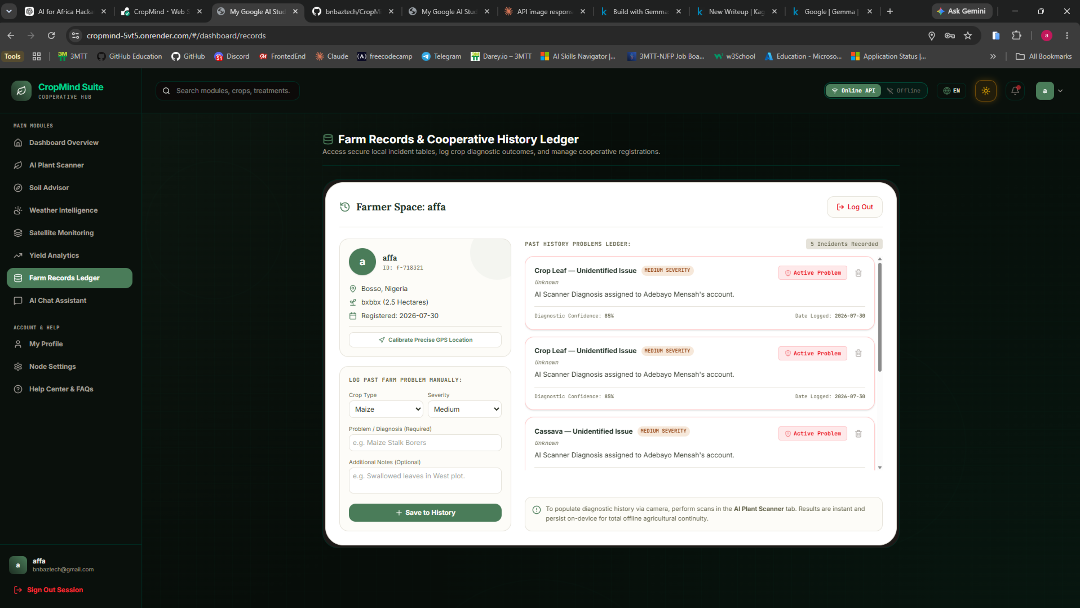
- Farmer consultation history
- Personalized agricultural guidance
- Offline/low-connectivity support
- Integration with agricultural experts
A major future direction is collecting and using field-collected African agricultural data.
Generic laboratory datasets can be useful for research, but real farms contain different lighting conditions, backgrounds, crop varieties, disease stages, and environmental conditions.
For CropMind to become truly useful in African agricultural environments, the system needs to learn from the reality of those environments.
🎯 Our Vision
CropMind is more than a crop-disease detector.
It is our attempt to build an agricultural intelligence layer for smallholder farmers.
The vision is simple:
Give farmers access to useful agricultural intelligence wherever they are, using the technology they already have.
We started with crop image analysis.
We are building toward a system where a farmer can communicate with an agricultural AI assistant, show it what is happening in the field, ask follow-up questions, maintain a history of consultations, and receive transparent guidance based on available evidence.
CropMind is still evolving, but every stage of development is moving toward one goal:
making agricultural technology more accessible, trustworthy, and useful for the people who need it most.
Built With
- css3
- git
- github
- google-gemini-api
- html5
- javascript
- node.js
- pino
- react
- rest-api
- typescript
- vite
- zod

Log in or sign up for Devpost to join the conversation.